Custom software development for startups should turn the riskiest business assumption into a dependable product without committing the company to an architecture it cannot operate. The implementation checklist therefore begins before coding: name the user, the decision or task the product improves, the evidence that would justify further investment, and the constraints that cannot be deferred. A startup needs speed, but useful speed comes from shortening feedback loops while preserving security, data integrity and a release path the team can repeat.
This guide is for founders, product leads and engineering partners preparing a first production release or replacing a fragile prototype. It complements the startup software scope and delivery plan and the custom software development FAQ. Use it as an acceptance checklist: every item should have an owner, observable proof and a decision if the proof is missing.
Define the startup outcome and the evidence threshold
Write one outcome statement that includes the user, present friction, expected behavior and measurable signal. “Build a marketplace” is not testable; “enable an approved supplier to publish an item and receive a verified order without staff re-entry” is. Select one primary adoption measure and guardrails for errors, support burden and unsafe behavior. A milestone is complete when the evidence supports a decision, not when a list of screens exists. Record assumptions separately so learning can change the plan without disguising scope changes.
Map the smallest end-to-end workflow, including unhappy paths. Show identity, permissions, validation, state transitions, notifications, payment or external integrations, support intervention and deletion. Prototypes often demonstrate only the center of this path; production failures appear at its boundaries. For each step, identify the authoritative record and who may correct it. This exposes whether the first release needs a workflow engine, a queue, an administrative interface or simply a well-designed transaction and audit trail.
| Decision | Evidence before build | Release acceptance |
|---|---|---|
| Problem is material | Observed workflow, interviews and baseline delay | Target users complete the task with less friction |
| Scope is coherent | End-to-end journey and explicit exclusions | Core path and recovery path both work |
| Risk is bounded | Data classification and abuse scenarios | Controls are tested with retained evidence |
| Investment should continue | Success and stop thresholds | Real usage supports the next funded slice |
Choose an architecture the current team can operate
Prefer a modular monolith or a small number of independently justified services unless scale, isolation or team boundaries demand more. Define modules around business capabilities, keep APIs explicit and make database ownership clear. Managed infrastructure can remove undifferentiated work, but every managed dependency still needs configuration ownership, limits, recovery behavior and cost monitoring. The Twelve-Factor guidance remains useful for configuration, disposability and environment parity, although it is a set of design principles rather than a complete architecture.
Document the request path and failure behavior before selecting products. State what happens when email, payment, identity, analytics or an AI service is slow or unavailable. Add timeouts, bounded retries, idempotency and a visible queue where repetition could cause duplicate effects. Define data retention, backups and restoration for the actual business records, not just the infrastructure. Architecture review should end with decisions and tests: a diagram alone cannot prove that a failed dependency preserves customer state.
Build security and privacy into the delivery backlog
Classify data and trust boundaries during discovery. Minimize collection, encrypt transport and stored sensitive data, use individual identities, apply least privilege and separate normal administration from emergency access. NIST SSDF organizes secure development around preparing the organization, protecting software, producing well-secured releases and responding to vulnerabilities. Translate those practices into backlog items such as repository protection, dependency review, secret handling, code review, security tests, artifact provenance and a vulnerability response owner.
Use the OWASP verification standard to select controls appropriate to the application rather than treating a penetration test as the whole program. Test authorization at the server on every protected action, validate untrusted input, avoid exposing secrets in clients or logs, and design account recovery as carefully as sign-in. Write abuse cases for invitation, password reset, billing, exports and administrative changes. If personal data is involved, record purpose, retention, deletion and processor responsibilities; jurisdiction-specific advice should be confirmed with qualified counsel.
Treat accessibility and operational UX as release requirements
A fast implementation is not successful if keyboard users cannot complete it, errors are unclear or a support operator cannot explain state. Adopt WCAG 2.2 as a reference target, test keyboard navigation and focus, provide labels and useful error messages, preserve contrast, and avoid interactions that depend only on dragging or color. Include loading, empty, permission-denied, partial-success and retry states in design review. These states also make automated testing and incident diagnosis more reliable.
Build the administrative and support surface alongside the customer path. Support staff need safe search, event history, status explanation and bounded correction actions. Avoid direct database edits as an operating procedure. Every consequential action should identify actor, time, target, previous state and outcome. Product copy should use the same domain language as the data model and support runbook; inconsistent names create preventable errors when a young team is moving quickly.
Create a repeatable path from commit to production
Protect the main branch, require review for consequential changes and automate build, test and deployment from versioned configuration. Keep environments sufficiently similar to expose configuration errors, while using synthetic or appropriately protected test data. A release artifact should be immutable and traceable to source. Separate deployment from feature exposure when a change is risky. Define rollback or forward-repair criteria before the release, including what happens to writes made after a new version starts serving traffic.
Test at several levels: unit tests for rules, contract tests for integrations, integration tests for state changes, and a small set of end-to-end tests for revenue or safety critical paths. Add accessibility and security checks to the normal pipeline, then perform focused human review where automation is weak. DORA’s measures are useful when interpreted as a balanced system: deployment frequency and lead time should be considered with failed-deployment recovery and change failure, not optimized independently.
| Production gate | Required evidence | Owner question |
|---|---|---|
| Identity and access | Role tests, recovery test and admin-access record | Can every privilege be explained? |
| Data integrity | Migration rehearsal, backup and restore result | Can authoritative state be recovered? |
| Release | Traceable artifact, smoke test and rollback rule | Can the team reverse safely? |
| Operations | Dashboard, actionable alerts and runbook | Who responds outside office hours? |
| Customer support | Event history and bounded correction actions | Can support resolve without database edits? |
Instrument the product around user outcomes
Collect logs, metrics and traces that connect technical behavior to the core workflow without recording sensitive content unnecessarily. Measure successful task completion, rejected actions, dependency failures, queue age, latency and correctness. Give every alert a condition, severity, owner and response. Page only for conditions requiring timely human action; route diagnostic or trend information to review queues. Include correlation identifiers so a support report can be followed across services and third parties.
Write a compact operating model before launch. Name the service owner, on-call or escalation contact, security contact, product decision maker and supplier contacts. Define incident severity, customer communication authority, backup verification, dependency review and patch cadence. Rehearse one failed dependency and one suspected account compromise. A startup does not need a large operations department, but it does need unambiguous decisions when revenue, data or trust is at risk.
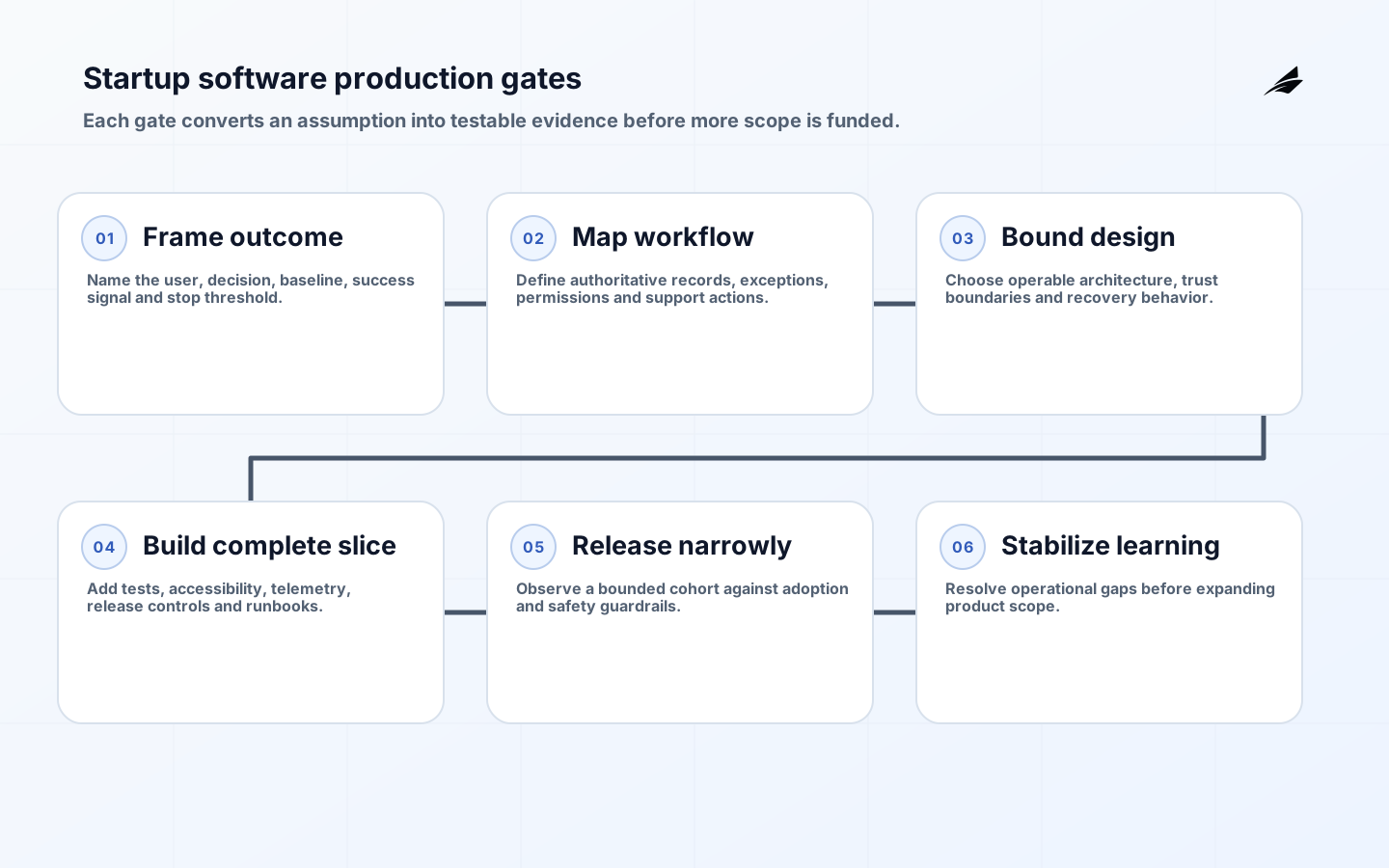
Use six implementation gates instead of one launch date
- Confirm the user outcome, baseline and stop threshold.
- Approve the workflow, authoritative records and explicit exclusions.
- Review architecture, trust boundaries, integrations and recovery behavior.
- Build a production slice with tests, telemetry and support controls.
- Release to a bounded cohort and compare evidence with guardrails.
- Stabilize operations before funding the next capability.

Key takeaways
- Define progress as evidence about a business outcome, not screen count.
- Select the simplest architecture the current team can secure and operate.
- Make recovery, support and accessibility part of the first production slice.
- Automate a traceable release path and test high-consequence failures.
- Scale scope only after production evidence justifies the next investment.
Frequently asked questions
How much should an MVP include?
Enough to test one coherent outcome with real operational constraints. It should include the core path, essential recovery, security, telemetry and support controls. Features that do not change the target decision belong in a later slice, but omitting data integrity or access control does not make a valid experiment.
Should a startup build on a no-code or managed platform?
It can, when the platform supports the required workflow, data ownership, security, accessibility, integration and exit needs. Evaluate limits and operating evidence, not only demo speed. Keep authoritative data exportable and understand how pricing changes with users, automation volume and storage.
What must a development partner hand over?
At minimum: source and history, infrastructure definitions, deployment access, architecture decisions, data model, test evidence, dependency inventory, runbooks, credentials under customer control, licenses and known risks. Verify the handover by having the receiving team deploy and operate a representative change.
Set a formal thirty-day review after launch. Compare the original outcome, support cases, reliability, security findings, cloud cost and delivery friction with the baseline. Decide which assumptions were confirmed, which controls need reinforcement and which proposed features no longer deserve investment. Record that decision beside the release evidence so the roadmap reflects observed product behavior rather than the loudest request after launch.
Conclusion
A startup implementation checklist is valuable when it protects learning and continuity at the same time. Begin with a testable outcome, build the smallest complete workflow, and require evidence for security, accessibility, release and recovery. The result should be a product the team can explain and operate, not a polished prototype whose risks become visible only after customers depend on it.