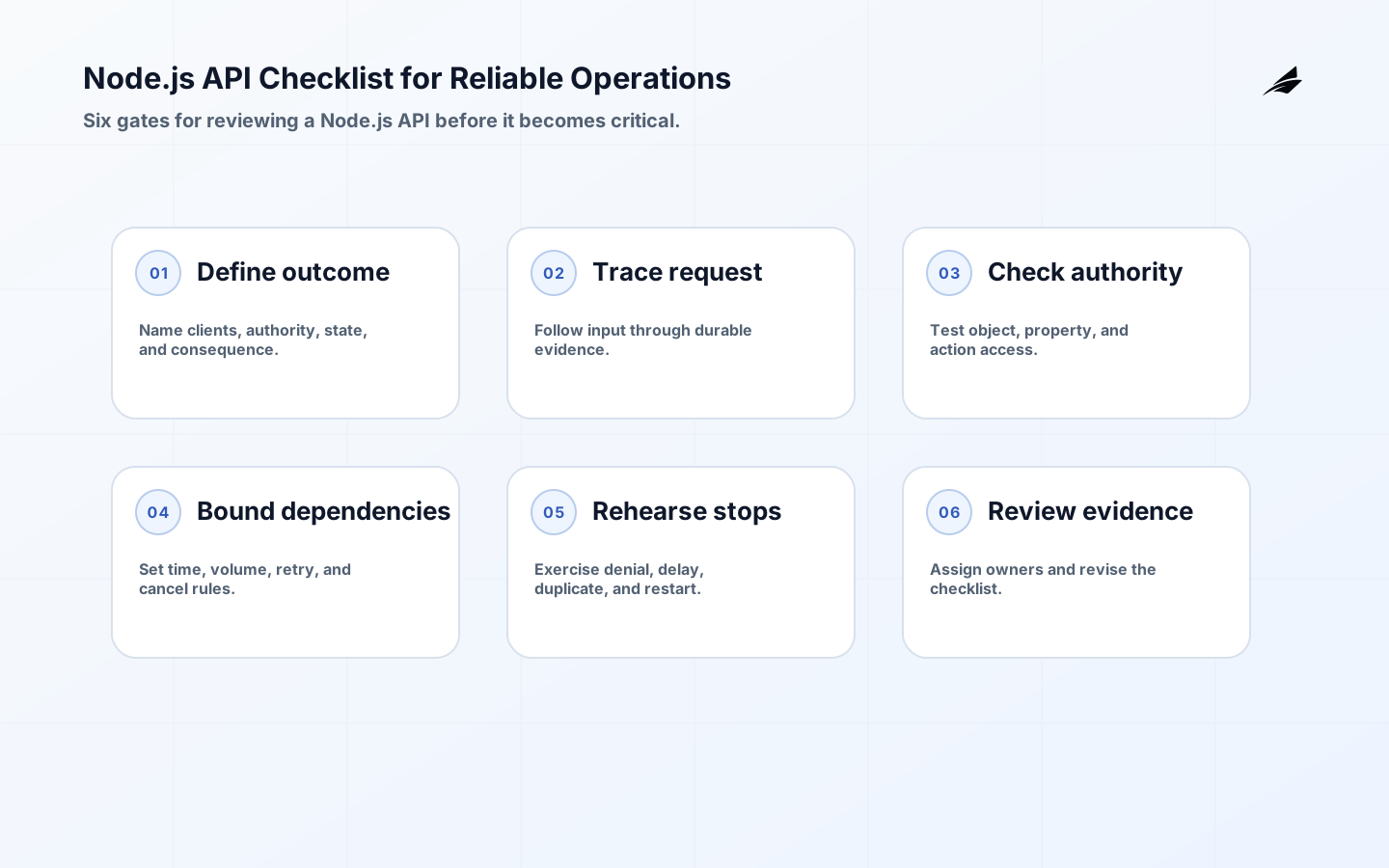
A reliable Node.js API is the result of many small decisions that remain visible under pressure. The route must describe its promise, validate untrusted input, enforce object and operation authorization, bound expensive work, handle cancellation, expose safe failure meaning, and produce evidence that an operator can use. This checklist is designed for a team reviewing a real service, not for a one-time framework setup. Work through it with the product owner, service owner, security reviewer, and the person who will respond when the API is slow or ambiguous.
Use the OpenAPI Specification to check request and response examples, the Node.js HTTP reference for connection and cancellation behavior, and HTTP semantics for method and status decisions. Review the OWASP API security risks for authorization, resource, and inventory risks, and use Node.js process lifecycle guidance when testing drain and restart behavior. Keep the checklist's local evidence and ownership explicit.
Define the node.js apis decision
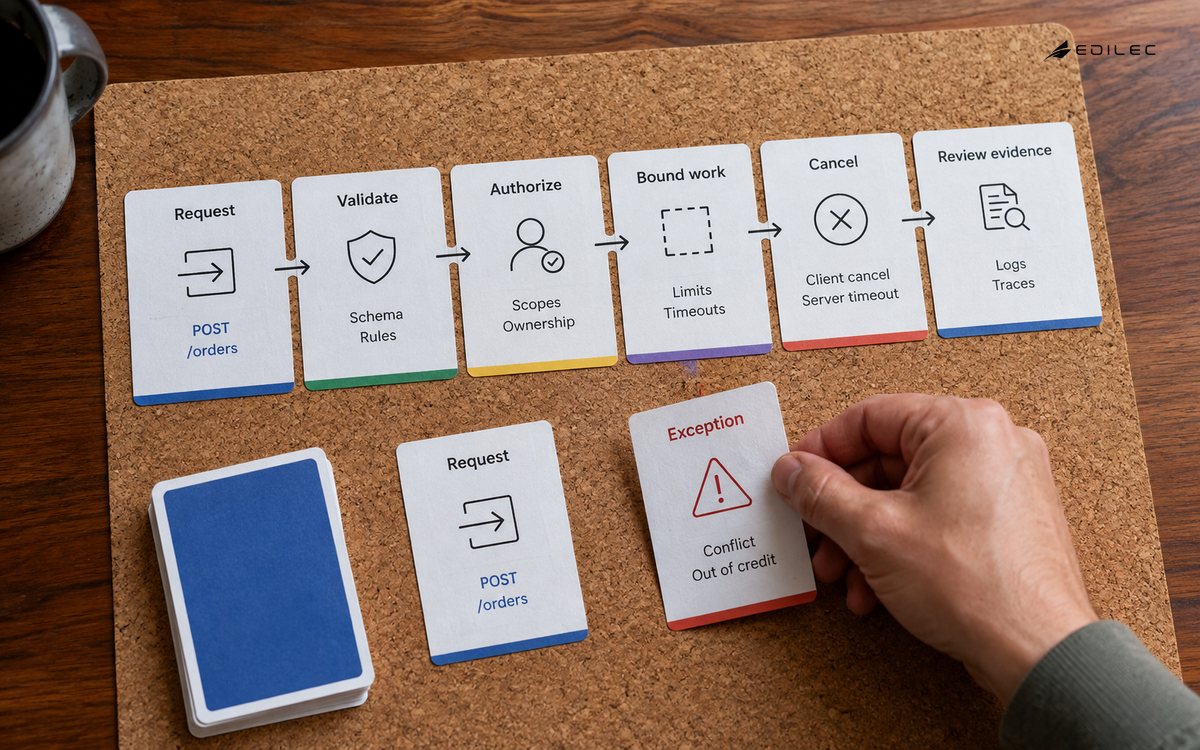
Write the outcome the API enables, the clients that depend on it, the authoritative state, and the risk if the request is delayed, duplicated, or misapplied. Record whether the operation is a read, command, or asynchronous job. Define the roles and tenant boundary before writing the route. OpenAPI can make the interface inspectable, but the important checklist item is semantic: can a client tell what the service promises and which system owns the result? Link the decision to a journey and a support route.
Plan a narrow first path
Choose one path that has a measurable outcome and manageable dependencies. List request fields, response examples, state transitions, permissions, limits, error meanings, and downstream calls. Include empty, invalid, denied, rate-limited, timed-out, and accepted-for-processing cases. Do not let a generated schema hide a missing product decision. A narrow first path is valuable because it gives the team a complete slice to test and operate, rather than a large surface with no evidence of ownership.
| Checklist area | Pass question | Evidence |
|---|---|---|
| Contract | Can a client act without parsing prose? | Schema and examples |
| Authorization | Is access checked for this object and operation? | Role and tenant tests |
| Limits | Can cost and waiting be bounded? | Timeout, size, and concurrency rules |
| Recovery | Can an ambiguous result be reconciled? | Operation ID and runbook |
Design the boundary and evidence
Check authority at object and action level
A route passes this check only when realistic roles and tenant contexts receive the intended result for the intended object. Test direct identifiers, hidden fields, bulk actions, and cross-tenant references; a valid session is not a substitute for an object-level decision. Keep the test data close to the policy examples so a future change can show exactly which access decision moved.
Keep parsing, authentication, authorization, validation, domain work, response mapping, and evidence recording easy to locate. Validate at runtime because network input does not carry TypeScript types. Check object-level access wherever a caller-supplied identifier reaches a data source; OWASP specifically calls this out as a major API risk. Add a correlation ID and deadline at ingress, propagate them to dependencies, and record a safe operation reference. Use a stable problem type or error code, and keep stacks, SQL, tokens, and provider internals out of the public response.
Decide what cancellation means. Node's HTTP APIs expose connection-related abort signals that can help stop downstream reads after a client disconnects. A mutation may already have committed, however, so the service needs idempotency and reconciliation rather than an assumption of rollback. Give asynchronous work a durable identifier, visible state, retry bound, and terminal owner. Document which response fields may be cached and which must remain private to a tenant or user.
Deliver with controlled change
Run contract, consumer, authorization, negative-path, load, and dependency failure tests before exposure. Deploy compatible application and database changes in an order that allows rollback or roll-forward. Use a canary or feature gate when a new path changes cost or permission, and record the release version that accepted each important command. A rollback checklist must include queues, emitted events, caches, and data correction, not just a previous container image. The related API versioning guide is useful when clients cannot move together.
Measure operating signals
Give every signal a decision
A latency, denial, or pending-age threshold matters only when it names an action. Decide whether the response is pause, narrow, reconcile, escalate, or accept; attach that decision to a current owner and a review date. The checklist is stronger when a dashboard can point to the exact runbook step rather than merely report that a number crossed a line.
Track latency, status, validation failures, authorization denials, cancellations, retries, dependency timeouts, event-loop delay, saturation, and pending age by route and release. OpenTelemetry's HTTP conventions provide common names for traces, metrics, and logs, but add domain evidence for whether the user's intended outcome occurred. Review percentiles and oldest work, not only averages. Each threshold needs an owner and action. Redact payloads, credentials, and personal data before telemetry enters a broad system, and restrict access to detailed traces.
Avoid familiar failure modes
Do not rely on gateway authentication as the only authorization check, accept unvalidated JSON because a typed client exists, use infinite retries, or return success before durable work is known. Avoid a single timeout for every dependency and a single generic error for every failure. Do not expose a large query surface without cost and field rules. Keep a current client inventory and deprecation owner. A reliable service is one where a new contributor can see both the happy path and the consequences of a bad input, slow provider, or deployment interruption.
- Document the capability, owner, clients, source of truth, and user outcome.
- Validate every network input at runtime and test unknown, missing, and malformed fields.
- Check object, property, and operation authorization for realistic roles and tenants.
- Bound body size, pagination, concurrency, dependency time, and retry attempts.
- Use idempotency and reconciliation for commands that can be repeated or become ambiguous.
- Propagate safe correlation, release, and outcome context into protected telemetry.
- Rehearse graceful shutdown, deployment drain, rollback, and terminal failure ownership.
Rehearse the stop conditions
Run the service through the moments that should stop or change its behavior: a body that exceeds the limit, a role that loses access, a provider that exceeds its deadline, a client that disconnects, a duplicate command, a deployment that drains connections, and a restore that replays old work. The expected result is not always an error response. It may be a rejected request, a pending operation, a requeued job, a reconciliation case, or a controlled shutdown. Record the state, evidence, and owner for each outcome.
Repeat the rehearsal with a realistic load shape and with one dependency returning a valid but unexpected response. Check that the service does not turn a malformed provider result into a successful business state, and that an alert includes enough context to find the affected operation. Test the customer-facing explanation separately from the operator diagnosis. A reliable API can be concise in public while still preserving the protected evidence needed to decide what happened.
- Request and operation identifiers remain consistent across boundaries.
- The response distinguishes correction, waiting, retry, and escalation.
- Durable state records the release, policy, and dependency outcome.
- A second operator can locate the query, queue, or repair tool.
Capture the failed path as a small decision record: condition, expected behavior, observed behavior, customer impact, containment, correction, and prevention. Do not turn the record into a long incident narrative that nobody can use. The short form is valuable when a later reviewer asks whether the same limit, dependency, or authorization rule is still safe. Link it to the contract example and the regression test so the operational lesson survives staff and runtime changes.
Keep the record close to the release or operation it describes, but protect customer data in the evidence. A reviewer should need the decision and identifiers, not a copied payload, to understand why the service stopped or continued.
| Stop condition | Expected state | Owner action |
|---|---|---|
| Input exceeds limit | Request rejected before side effect | Review client and capacity assumptions |
| Authority removed | Access denied and event recorded | Check policy and affected sessions |
| Dependency deadline | Pending, retryable, or terminal state | Reconcile or escalate by operation |
| Shutdown signal | No new work; in-flight work drains | Confirm requeue and readiness |
| Schema incompatibility | Deployment pauses or rolls forward safely | Repair migration or traffic exposure |
Ask a support lead to use the resulting evidence without reading the implementation. They should be able to find an operation identifier, determine whether the customer outcome is settled, and select the approved next action. This rehearsal often reveals that a metric exists without a query, a queue has no terminal owner, or a timeout message encourages a duplicate submission. Fix the path before adding another route. The related event-driven systems guide is useful when the API hands work to asynchronous consumers.
Review the decision over time
Review the checklist after a material client, dependency, data, or permission change. Ask whether the contract still matches the journey, whether the authority is still clear, whether the cost budget still holds, and whether the recovery route works for the oldest real case. Use the related TypeScript architecture checklist to connect compile-time structure to runtime boundaries. Retire controls that no longer protect a real risk, but record why they were removed.
Key takeaways
- A checklist is useful when every item names evidence and an owner.
- Contracts and runtime validation protect clients from accidental ambiguity.
- Authorization must reach the object and operation that can cause harm.
- Bounded work, idempotency, and reconciliation make failure recoverable.
- Operational signals should lead to a concrete decision, not only a score.
Node.js API checklist questions
The first checklist pass should cover one important route end to end. OpenAPI helps describe it, but it does not replace a decision about authority, permissions, or recovery. A Node.js API is ready for broader use when realistic callers can rely on the contract, the service can bound cost and waiting, and an operator can diagnose and reconcile the difficult case. Revisit the checklist after changes that affect clients, data, dependencies, or trust.
Conclusion: close the API reliability loop
Reliable digital operations come from a Node.js API whose promise, boundaries, controls, and evidence are all inspectable. Use the checklist around a real capability, test the negative paths, release with compatible change, and review signals with the people who operate the service. The result is a practical standard that can evolve with the team instead of a document that is forgotten after launch.