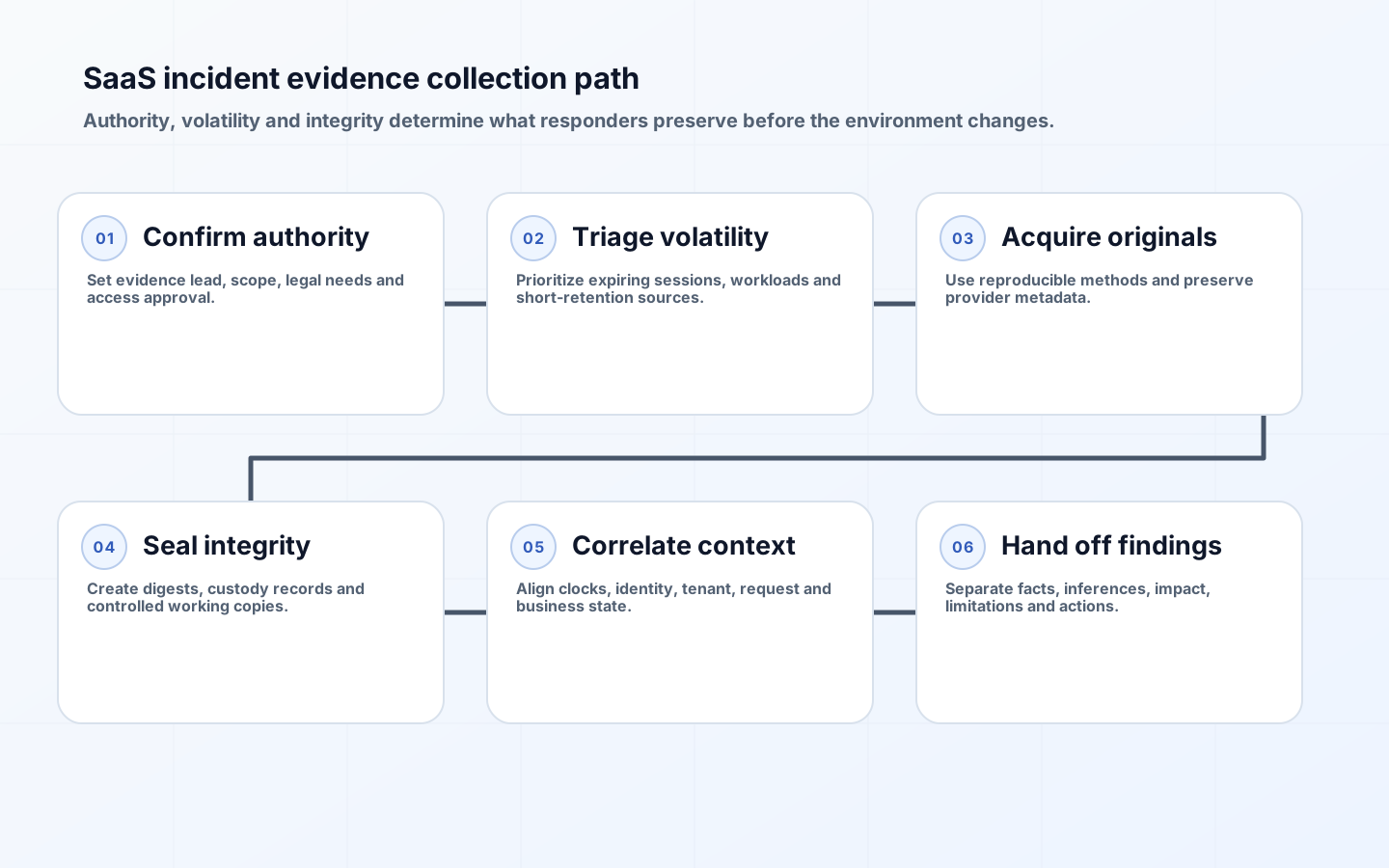
Incident evidence collection for SaaS applications begins before an alert. Once responders rotate credentials, isolate a workload, redeploy a container or disable an integration, valuable state may disappear. The objective is not to copy every available log. It is to preserve trustworthy, relevant material quickly enough to understand impact, support recovery, meet legal or contractual duties and learn what the attacker or failure actually changed.
This guide is for incident commanders, security engineers, platform teams and application owners. Pair it with controls for vendor access to cloud systems, browser security signals and reliable finance reporting evidence. Digital evidence can have legal consequences; qualified legal counsel and forensic specialists should direct collection when litigation, law enforcement, employee monitoring or regulated data is involved.
Prepare evidence sources before an incident
Maintain an evidence-source register by service and trust boundary. Include identity provider, cloud control plane, source repository, CI/CD, workload runtime, application audit events, API gateway, database, object store, queue, endpoint, email, support console and critical SaaS vendors. For each source record owner, fields, clock, retention, export method, access needed, integrity features and known gaps. CISA recommends centralizing and protecting logs, setting policies and assigning response roles in its logging guidance.
Write high-value application events at the business layer. Infrastructure can show a request reached an endpoint; it may not reveal which tenant, permission, invoice, export or administrative operation was affected. OWASP’s logging guidance recommends recording authentication and authorization failures, administrative actions, data access, exports and configuration changes while excluding secrets, tokens and sensitive data that the log does not need.
| Source | Question it answers | Preservation concern | SaaS context needed |
|---|---|---|---|
| Identity provider | Who authenticated, from where and with what assurance? | Short retention and mutable account state | User, tenant, factor, session and admin action |
| Cloud control plane | Who changed infrastructure, policy or keys? | Cross-account and regional exports | Principal, role chain, resource and request ID |
| Application audit events | What business operation occurred? | Missing failure and denied events | Tenant, actor, object, action and outcome |
| Database or object versions | What authoritative state changed? | Collection can alter metadata or load production | Record version, transaction and storage generation |
| CI/CD and repository | Was code or configuration changed? | Ephemeral job logs and revoked identities | Commit, artifact digest, approver and environment |
| Third-party SaaS | Did an integration act or leak data? | Vendor retention and export delay | Customer account, connector identity and correlation ID |
Establish authority, scope and collection priorities
At declaration, appoint an incident commander and evidence lead. Confirm who may access affected tenant data, place legal holds, request vendor records and approve disruptive acquisition. Record the working hypothesis, affected time window, systems, tenants and data classes, but label assumptions. NIST SP 800-61 Rev. 3 integrates response across governance, identification, protection, detection, response and recovery; evidence work therefore needs coordination with containment and service restoration, not a separate forensic queue.
Prioritize by volatility, decision value and collection cost. Capture expiring sessions, process or container state, autoscaling instances, volatile network information and short-retention provider logs before durable archives when they matter to the hypothesis. Do not delay containment merely to obtain perfect evidence when customers remain at risk. Record what the team chose not to collect and why, then preserve substitute evidence such as snapshots, provider audit records or deployment manifests.
Collect evidence without contaminating the source
Use documented, minimally invasive collection methods. Prefer provider snapshots, immutable object versions, audit exports and forensic images over browsing and copying individual files. If a live command is necessary, capture who ran it, exact command, start and end time, target, output location and errors. NIST SP 800-86 organizes forensic work around collection, examination, analysis and reporting and stresses that organizations should involve management and legal counsel for applicable law.
Generate a cryptographic digest for each exported object or package using an organization-approved algorithm, store the digest separately, and verify it after every transfer. Preserve original provider metadata, export parameters and time zone. Work from a controlled copy; restrict and log access to originals. Hashes can demonstrate that bytes did not change after collection, but they do not prove the source was truthful, the query was complete or the collector had the right scope.
| Evidence record field | Why it matters | Example |
|---|---|---|
| evidence_id | Stable reference across notes and reports | IR-2026-014-E037 |
| source and locator | Identifies account, region, service and object | prod-audit / eu-west / export job 884 |
| collection authority | Shows approved person or automation | Evidence lead under incident ticket |
| method and parameters | Makes scope reproducible | Provider export, UTC range, event filters |
| source and observed time | Supports clock-offset analysis | Event at 10:02; collector saw 10:04 |
| digest and algorithm | Detects post-collection byte changes | SHA-256 value in evidence register |
| custody history | Records every access, transfer and copy | Acquired, sealed, examined, archived |
| limitations | Prevents overclaiming | Provider retains only 30 days; one region absent |
Preserve tenant, identity and request context
SaaS evidence must distinguish actor identity from account and tenant scope. Record the authenticated subject, assumed role or workload identity, session assurance, authorization result, tenant resolved by the server, target object and business operation. Client-supplied tenant IDs are claims, not proof. Preserve policy or role versions where possible so an investigator can evaluate authorization as it existed at event time rather than using today’s permissions.
Carry correlation identifiers through edge, application, queue, worker, database and third-party calls. The OpenTelemetry log model provides fields for event and observed timestamps, resource context, trace IDs and span IDs. Adopt equivalent semantics even if the estate uses another telemetry stack. Normalize copies for search, but retain original events and document every transformation.
Build a timeline that separates facts from inference
Normalize all times to UTC while preserving original values and offsets. Measure known clock drift and distinguish event occurrence, provider ingestion, export and analyst observation. Sort by causal and correlation relationships, not timestamp alone; queues, offline clients and cross-region replication can make a later action appear first. Link every timeline entry to evidence IDs and include confidence.
Use three labels: observed fact, supported inference and open question. For example, a control-plane event may prove a role changed a policy; it does not by itself prove the human behind a federated session intended the change. Correlate identity assurance, source network, device, preceding actions and business context. Seek disconfirming evidence, especially for insider attribution and customer impact.
Limit exposure while preserving necessary material
Incident collections can become concentrated archives of personal data, secrets and customer content. Define a case-specific collection purpose and minimize fields where full payloads are unnecessary. Redact only on working copies and retain a documented relationship to the sealed original. Use case-based access, strong encryption, short-lived credentials and access logging. Separate legal hold from indefinite retention; counsel should determine when normal disposal pauses and resumes.
Do not paste raw evidence into chat, general tickets or collaborative documents. Provide investigators a controlled workspace with malware-safe viewing, export restrictions and enough compute to avoid local downloads. Rotate exposed secrets, but first preserve metadata needed to understand their scope and use. A token value itself is rarely needed in a report and can create a second incident if copied casually.
Package findings for containment, recovery and review
Issue short evidence briefs while the incident is active: verified facts, affected assets and tenants, confidence, collection gaps and the decision the evidence informs. Keep customer impact separate from attacker activity. A malicious query may have executed without returning records; a failed exfiltration alert may still reveal compromised access. Reconcile database state, provider transfer records and application behavior before asserting exposure volume.
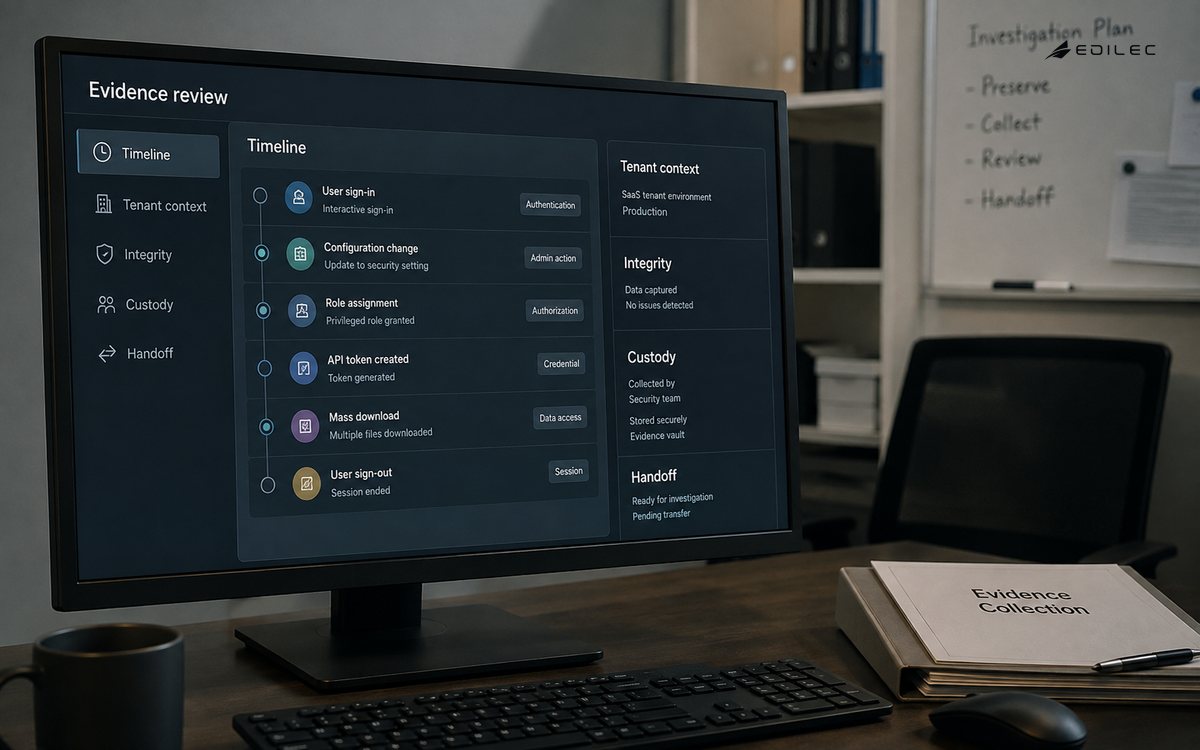
The final package should contain scope, authority, source register, evidence inventory, custody log, methods, timeline, findings, limitations and retained queries or scripts. Link remediation to evidence gaps as well as root contributors. If missing tenant context prevented impact analysis, the action is an application audit-event change with an owner and test, not merely “improve logging.”
- Declare authority, evidence lead, hypothesis, time window and protected data classes.
- Freeze avoidable lifecycle actions and identify volatile or short-retention sources.
- Acquire originals with reproducible methods, metadata, digests and custody records.
- Normalize controlled copies and correlate identity, tenant, request and business state.
- Separate observed facts, supported inferences, impact conclusions and unresolved gaps.
- Transfer the evidence package to recovery, legal review and funded control improvement.
Key takeaways
- Inventory evidence sources, retention and access before an incident.
- Prioritize volatile, decision-relevant material without delaying necessary containment.
- Preserve original metadata, collection parameters, integrity digests and custody history.
- Correlate SaaS activity through trusted tenant, identity and business-operation context.
- State limitations plainly and turn evidence gaps into owned engineering work.
Frequently asked questions
Does hashing establish chain of custody?
No. A digest helps show that collected bytes remained unchanged. Chain of custody also requires source identification, authority, method, time, handler, storage, access and transfer records. Neither proves that the source system originally recorded a complete or accurate event.
How long should SaaS evidence be retained?
Use the applicable legal, regulatory, contractual and incident-response requirements, balanced with privacy and security risk. Normal telemetry retention and case-evidence retention may differ. Document the rule, hold authority, review date and defensible disposal process rather than choosing an arbitrary permanent period.
What if a cloud provider owns the underlying logs?
Use documented export APIs and support escalation, preserve request and job metadata, and record provider limitations. Contracts should define audit availability, retention, incident cooperation and time to obtain records. Supplement provider data with application events and independent identity or network evidence.
Conclusion
Dependable incident evidence collection is a prepared operating capability, not improvised copying during a crisis. Know the sources, preserve volatile state, protect originals, reconstruct activity with tenant and identity context, and communicate uncertainty. That discipline lets a SaaS team contain harm quickly without sacrificing the evidence needed to explain and prevent it.