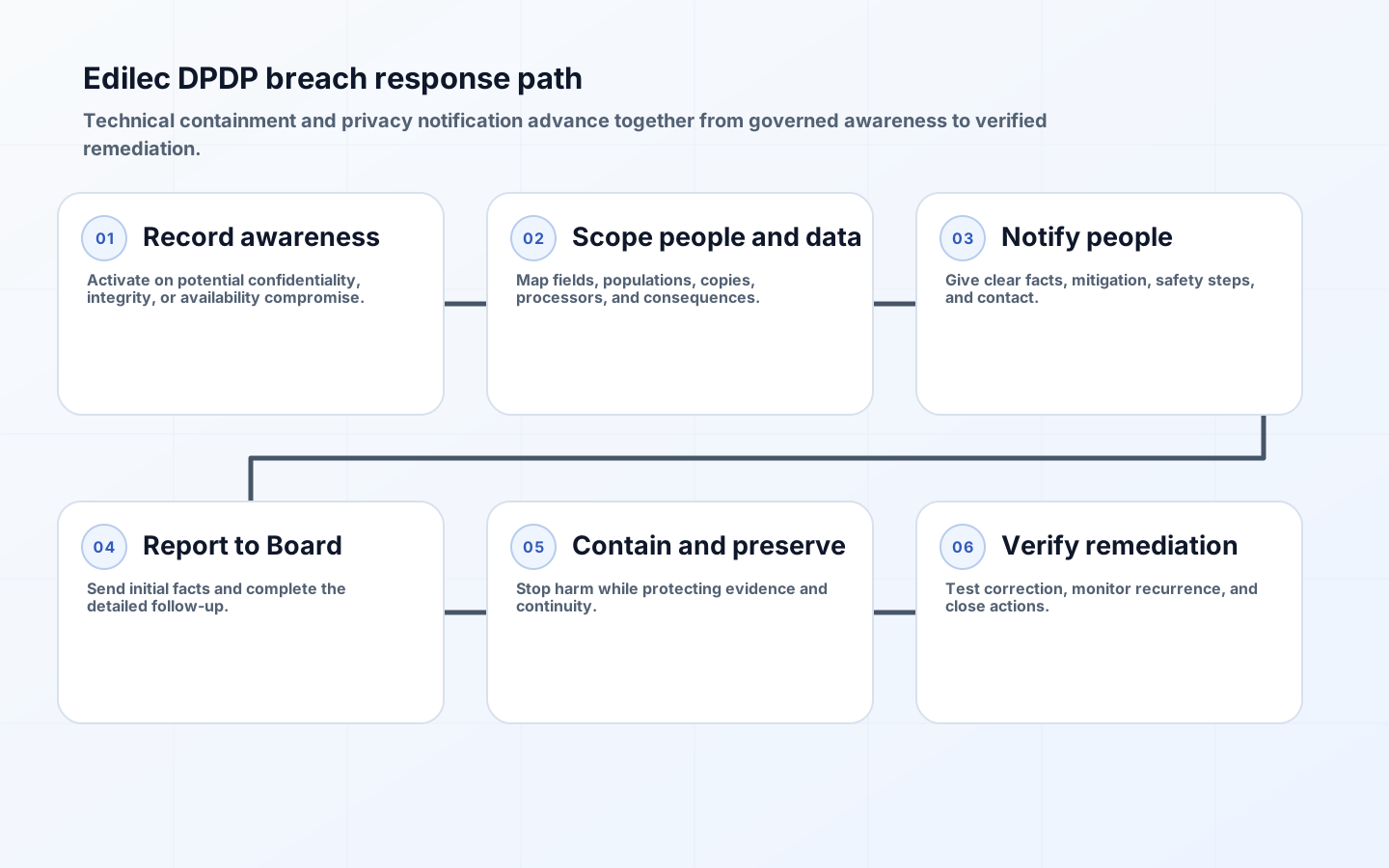
A DPDP data breach notification process must run beside technical incident response, not after it. Responders need to contain compromise while privacy teams determine whose digital personal data was affected, what consequences may follow, how to reach those people, and what the Data Protection Board needs. Waiting for perfect forensics can delay required initial communication; notifying from an ungoverned draft can misstate scope or expose more data. The solution is a staged workflow with explicit awareness criteria, parallel workstreams, approved facts, and updates as knowledge improves.
Under the final DPDP Rules, 2025, Rule 7 requires notice to affected Data Principals without delay and an initial intimation to the Board without delay, followed by specified details within seventy-two hours unless the Board permits longer. These provisions and the related core Act duties are in the eighteen-month commencement phase under the official timeline. As of 13 July 2026, organizations should prepare, test, and monitor for later changes rather than claim the phased duties are already operative.
Define breach awareness and activation
The DPDP Act defines personal data breach broadly around unauthorized processing or accidental disclosure, acquisition, sharing, use, alteration, destruction, or loss of access that compromises confidentiality, integrity, or availability. Build intake from security alerts, support, processors, researchers, employees, fraud, failed deletion, misdirected messages, lost devices, and availability events. A designated incident authority should record the earliest awareness candidate, decide whether the privacy workflow activates, and preserve the reasoning. Do not limit privacy incidents to malicious exfiltration.
Build parallel response workstreams
Run containment, forensic scoping, personal-data mapping, legal assessment, Data Principal communications, Board reporting, processor coordination, business continuity, and remediation in parallel under one incident identifier. Maintain an approved-facts ledger with source, confidence, owner, and timestamp. Separate confirmed facts, reasonable working assumptions, and unknowns. The incident commander owns pace; privacy counsel interprets duties; security leads containment and evidence; data owners map affected people; communications makes notices understandable; product and support create safe user actions. Deputies and out-of-hours contacts must be named before an incident.

| Workstream | First question | Output | Owner |
|---|---|---|---|
| Containment | How do we stop continuing harm safely? | Controlled containment plan | Incident commander |
| Forensics | What happened and when? | Evidence-backed timeline | Security response |
| Data scope | Whose data and which fields? | Affected-person population | Data owner |
| Notification | What must each audience know now? | Principal and Board notices | Privacy and communications |
| Processors | Which supplier holds facts or must act? | Preservation and action receipts | Vendor owner |
| Remediation | What prevents recurrence and repairs harm? | Owned corrective plan | Control owner |
Notify affected Data Principals usefully
Rule 7 calls for concise, clear, plain notice through the user's account or registered communication mode, describing the nature, extent, and timing of the breach; likely consequences; mitigation measures; safety steps the person can take; and contact information for a responsible person. Translate that into practical action without speculation. Explain which account or relationship is affected, distinguish passwords from hashed or encrypted values accurately, warn about tailored fraud where relevant, and avoid links that resemble phishing. Make support accessible, script it from the approved-facts ledger, and update people when facts materially change.
Report to the Board in stages
Design an initial Board packet for the nature, extent, timing, location, and likely impact known at that point. The follow-up packet should cover updated facts, broad events and circumstances, mitigation, responsible person if known, remedial measures to prevent recurrence, and Data Principal notifications. Preserve submission receipts and any request for additional time. A seventy-two-hour field in a ticket is not enough: automate deadline calculation from the governed awareness time, escalation, approvals, secure submission, and update tracking. Unknown information should be identified as unknown with a collection owner.
| Stage | Minimum evidence | Communication | Control |
|---|---|---|---|
| Triage | Alert, reporter, systems, awareness candidate | Internal activation | Preserve volatile data |
| Initial scope | Data types, populations, access path | Without-delay notices as applicable | Approved-facts ledger |
| Containment | Actions, side effects, residual exposure | User safety guidance | Change approvals |
| Detailed report | Cause, mitigation, remediation, notices | Board follow-up within required period | Submission receipt |
| Recovery | Restored controls and monitored risk | Material updates | Independent validation |
| Closure | Root cause, lessons, residual obligations | Final case records | Retention and access controls |
Coordinate CERT-In and processors
A single event may trigger other regimes. The CERT-In Directions page links the directions requiring specified entities to report listed cyber incidents within six hours of noticing or being informed. Build a separate applicability decision, clock, content set, and receipt; do not assume a DPDP notice satisfies CERT-In. Processor contracts should require rapid detection notice, preservation, scoped facts, containment support, contact availability, subprocessor flow-down, and evidence delivery. The Data Fiduciary needs enough control to meet its own timeline even when the technical event occurs at a supplier.
Preserve evidence and verify remediation
Protect logs, images, access records, communications, decisions, notice versions, population queries, submission receipts, and remediation tests with access control, integrity, retention, and legal-hold rules. Rule 6 of the final Rules specifies baseline security safeguards including visibility, investigation, remediation, continuity, processor contracts, and retention of relevant logs and personal data for one year unless another law requires otherwise. The MeitY final Rules collection should be monitored for corrigenda. Close actions only after testing shows that the cause and parallel paths are controlled.
Exercise the breach workflow under pressure
Start with an ambiguous processor alert outside business hours. Require the on-call lead to record awareness, preserve evidence, activate privacy roles, and challenge incomplete facts. Inject a changing population count, mixed jurisdictions, encrypted fields with uncertain key exposure, unavailable data owner, and a supplier unable to export logs. Teams must separate the breach definition, phased DPDP duties, CERT-In applicability, sector rules, contracts, foreign notifications, insurance, and law-enforcement considerations. Draft affected-person communication from confirmed facts with useful safety action and a non-phishing delivery plan, then revise it when scope changes.
Prepare initial and detailed Board packets, calculate the deadline, list unknowns with owners, preserve approvals, and respond to a further-information request. Have support authenticate safely, use approved facts, protect people from follow-on fraud, and contribute new evidence. Engineers should contain while preserving forensic value and document emergency changes. Force processor and subprocessor coordination through evidence holds, action receipts, and timeline reconciliation. Close with cause analysis covering control design, detection, escalation, minimization, retention, access, and supplier governance, followed by independent verification and a replay. The plan is ready only when people, tooling, templates, secure channels, deadline alerts, and records work together under uncertainty.
- Precompute data-to-person joins and secure notification channels for critical systems; building the affected population during an incident can consume the reporting window and produce dangerous errors.
- Keep notice population logic versioned and reviewable so additions, exclusions, duplicates, deceased users, shared accounts, and failed delivery can be explained.
- Use secure collaboration for evidence and drafts. Ordinary chat rooms and email distribution lists can spread breached personal data and privileged analysis beyond the response team.
- Separate restoration from remediation: service availability can return while compromised credentials, exposed exports, malicious persistence, or unsafe processor access still require containment.
- Coordinate fraud, identity, customer care, and accessibility teams so recommended safety steps are feasible and do not transfer unreasonable cost or complexity to affected people.
- Preserve why a notification fact changed. A transparent update history helps the Board, affected people, auditors, and responders understand evolving knowledge without mistaking correction for concealment.
- Test monitoring after closure for recurrence, attempted use of exposed data, delayed supplier evidence, notice delivery failures, and corrective controls that drift under production load.
Maintain pre-approved notice components but never let templates decide the facts. Components can cover explanation structure, safety guidance, accessible formats, language workflow, contact routes, Board packet fields, and secure delivery. Incident-specific reviewers must validate affected data, timing, extent, consequence, mitigation, audience, and recommended action. Test templates against ransomware, misdirected disclosure, processor compromise, integrity manipulation, loss of access, insider misuse, and exposed credentials. Different events produce different user needs even when the reporting workflow is shared.
DPDP breach workflow takeaways
- Activate on confidentiality, integrity, or availability compromise, including accidental and processor events.
- Record a governed awareness time and run technical, privacy, notification, supplier, and remediation work in parallel.
- Use an approved-facts ledger to communicate promptly without presenting assumptions as facts.
- Prepare distinct affected-person, Board, CERT-In, contractual, and sector workflows and clocks.
- Contract processors for rapid facts, preservation, action, and subprocessor coordination.
- Retain attributable evidence and independently test remediation before closure.
DPDP data breach notification FAQ
Must every affected person be told under the phased rule? The final rule is framed around each affected Data Principal, without a risk threshold in its text. Confirm commencement and current guidance for the event date.
Does encryption mean no breach occurred? Not automatically. Assess unauthorized processing and compromise, key exposure, algorithm and implementation, metadata, integrity, and availability.
Can the team wait for a completed forensic report? The staged model is designed for communication without delay followed by more detail. State unknowns and update them rather than delaying all action.
Conclusion
A reliable DPDP breach workflow turns uncertain technical signals into controlled facts, useful notices, regulator evidence, and verified correction. Build the clocks, roles, templates, processor duties, and evidence channels during the commencement runway, then exercise them with scenarios that force incomplete information and competing reporting duties.