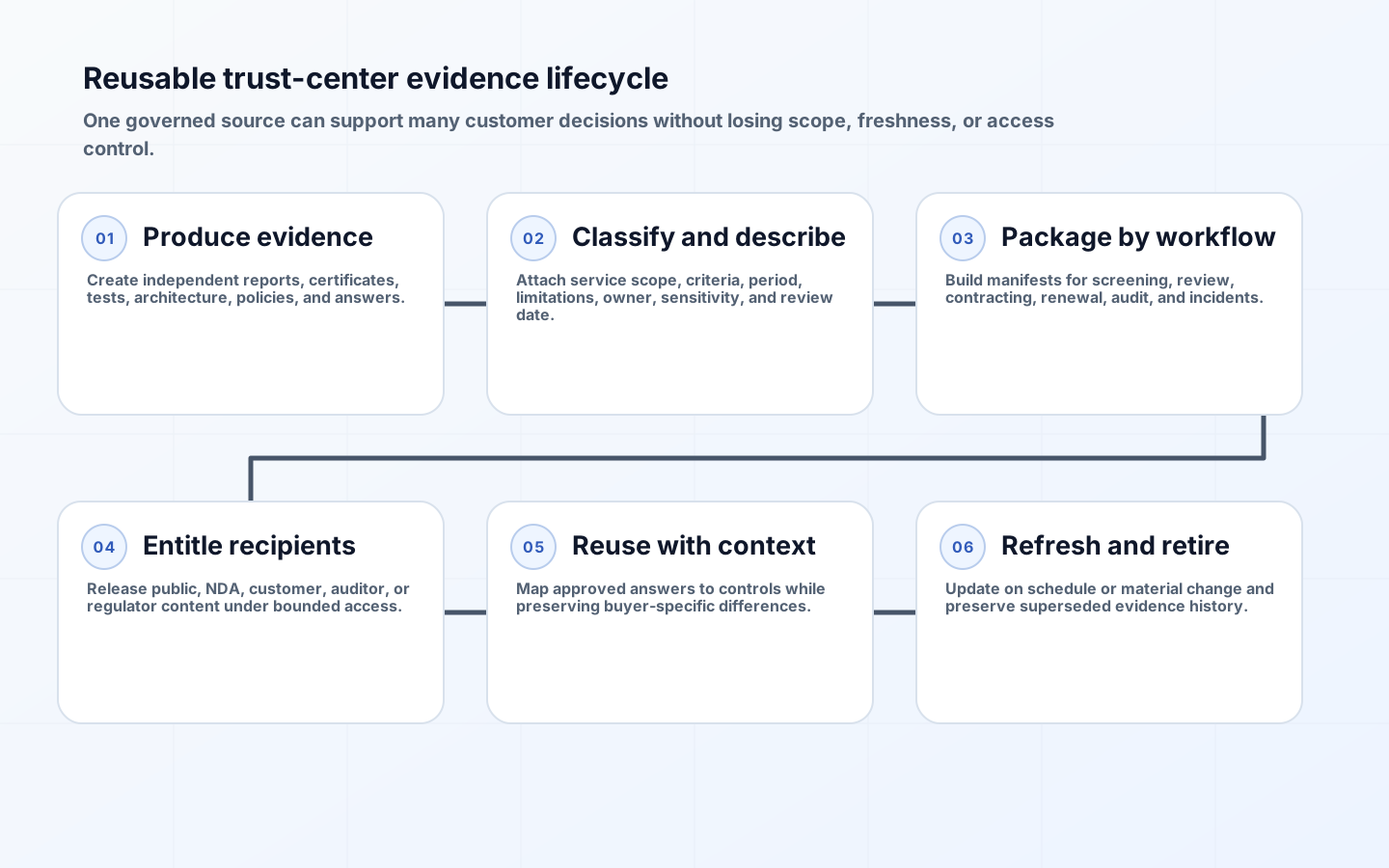
A SaaS security trust center should help a customer answer a risk question with evidence it can cite, store, review, and reuse. A page of badges and optimistic statements does not meet that need. Buyers must determine which service and regions were assessed, what period evidence covers, what controls customers must operate, which exceptions matter, and whether a document may be shared with auditors or affiliates. Design the center as an assurance distribution system with governed content, not as a decorated document folder.
Reusable evidence reduces duplicate work only when it is precise. One maintained answer mapped to a control library can support questionnaires, due diligence, renewals, and audits; one vague answer can create inconsistent commitments across hundreds of deals. Security, legal, privacy, compliance, product, sales engineering, and support therefore need shared ownership. The trust center publishes approved facts while routing novel or sensitive questions to accountable experts.
Define customer and governance outcomes
List the decisions the center should support: initial vendor screening, technical security review, regulatory mapping, contract diligence, annual reassessment, incident follow-up, and customer audit preparation. For each, identify audience, evidence, sensitivity, freshness, and response target. Public visitors may need architecture summaries and policy positions; authenticated prospects may need detailed questionnaires; contracted customers under confidentiality may need reports and test summaries; regulators or auditors may require a controlled bespoke package.
Set boundaries for what the portal will not decide. It cannot determine a buyer's risk appetite, certify that the service satisfies every law, or replace review of shared responsibilities and intended configuration. It should expose enough scope and context for those decisions. Measure reduced repeated handling, improved answer consistency, evidence freshness, and customer completion, not merely page views or downloads.
Create an evidence model before a page layout
Represent each item with title, evidence type, owner, issuer, service scope, legal entities, regions, assessment criteria, period, issue date, expiry or review date, confidentiality, permitted recipients, related controls, superseded version, and known limitations. Separate source evidence from customer-facing summaries. A summary may improve usability, but the center must not imply that it has the same assurance level as an independent report.

The AICPA SOC suite distinguishes reports and subject matter within the System and Organization Controls family. Label the exact report type, service organization, system, period, and auditor; do not shorten every artifact to SOC certified. Similarly, certification scope statements, penetration-test executive summaries, privacy assessments, and business-continuity exercises have different criteria and limitations. Preserve those distinctions in metadata and display.
| Evidence class | Customer question | Required context | Typical access |
|---|---|---|---|
| Independent assurance report | Were described controls suitably designed or operating under stated criteria? | System, criteria, period, opinion, exceptions and complementary controls | NDA and approved recipients |
| Certificate | Was a scoped management system certified? | Standard, scope, sites, issuer, validity and exclusions | Public or authenticated |
| Questionnaire or CAIQ | How does the provider describe control implementation? | Version, service, answer owner, evidence links and review date | Authenticated or public |
| Penetration-test summary | Was defined attack testing performed and remediated? | Scope, date, methodology, assessor, exclusions and residual findings | Customer-only |
| Architecture document | Where are boundaries and shared duties? | Service version, data flows, regions and customer controls | Tiered by detail |
| Policy statement | What practice does management require? | Owner, approval, scope and review date | Usually summary only |
Make scope and shared responsibility unmistakable
SaaS companies often sell multiple products, hosting options, regions, acquired services, agents, APIs, and marketplace integrations under one brand. Every artifact should identify which are included. Use a service-scope matrix and let customers filter evidence for their purchased offering. If a report covers the core platform but excludes a recently acquired analytics service, state that beside the download rather than inside a distant footnote.
Publish shared-responsibility guidance that connects customer actions to actual controls: identity federation, administrator MFA, role design, tenant configuration, logging export, data retention, endpoint protection, keys, integrations, backups, and incident contacts. Distinguish mandatory prerequisites from recommendations. The buyer should be able to identify which assurance conclusions depend on complementary user-entity controls and assign them internally.
Package evidence for repeated customer workflows
Create curated packages such as baseline enterprise review, privacy and data handling, resilience, regulated-sector addendum, and AI feature review. Each package should be a manifest of current artifacts, not duplicated files that drift. Give the package an identifier, generated date, service scope, and manifest checksum. When a report changes, the next package resolves the new version while historical package records preserve what a customer received.
Map approved answers and evidence to a control library. The CSA STAR program provides a registry and cloud assurance structures such as the Cloud Controls Matrix and CAIQ; a provider may use those to publish structured transparency and reduce questionnaire repetition. Maintain mappings rather than claiming frameworks are interchangeable. A mapped answer should include applicability, implementation narrative, evidence, owner, and freshness so automation does not flatten meaningful differences.
| Workflow | Reusable package | Dynamic inputs | Escalation trigger |
|---|---|---|---|
| Initial screening | Public posture, certifications, service overview | Purchased product and data class | Unsupported geography or use |
| Security review | Questionnaire, architecture, report and test summary | Integrations, identities and customer configuration | Novel privileged access or unresolved exception |
| Contracting | Approved commitments and subprocessor information | Negotiated terms and regulatory duties | Request exceeds standard control or disclosure |
| Annual renewal | Change log and refreshed evidence manifest | Customer incidents and service changes | Expired report or material architecture change |
| Customer audit | Scoped report and control-to-evidence index | Auditor purpose and sample | Raw evidence or personnel access request |
| Incident follow-up | Incident-specific assurance package | Affected tenant, timeline and contractual rights | Regulator, litigation hold or forensic request |
Apply entitlement without creating needless friction
Classify content as public, registered, prospect under NDA, customer, named auditor or regulator, and tightly restricted. Authenticate higher tiers through business identity, verify account relationships, and require purpose and recipient terms where appropriate. Entitlements should expire with the relationship and be reviewed after role changes. Watermarks and download logs can deter casual redistribution, but they do not replace contractual controls or careful content minimization.
Avoid collecting excessive personal data merely to deliver a public certificate. For restricted evidence, log requester, organization, approver, artifact version, time, purpose, and action. Define incident procedures for misdelivery or unauthorized redistribution. Support accessible previews and machine-readable answers where safe, while ensuring links do not bypass authorization through predictable object URLs or long-lived public tokens.
Engineer freshness, change disclosure, and retirement
Every artifact needs an owner and review trigger. Calendar review is only the baseline; material product changes, new regions, acquisitions, control failures, incidents, report exceptions, subprocessor changes, or legal changes may require immediate revision. Show issue and next-review dates and mark superseded documents clearly. Never silently replace a downloadable file at the same opaque link when customers may need to prove which version they assessed.
Publish a meaningful change log with dates, affected services, customer relevance, and linked updated evidence. Separate corrections from new assurance periods. Where a current independent report is not yet available, explain the gap, expected timing, bridge evidence, and limits. This is more credible than leaving an expired badge in place. Preserve historical artifacts under retention and confidentiality rules but remove them from ordinary discovery.
Govern answers and measure reuse
Establish a review workflow: content owner drafts, security validates technical facts, legal reviews commitments and disclosure, privacy reviews personal-data claims, and an accountable publisher approves release. High-risk claims should cite source evidence. Sales teams should link to approved answers rather than editing them in local documents. Novel questions enter an intake queue, and useful answers graduate into the library after review.
NIST SP 1326 frames supplier due diligence around structured, pertinent information, while NIST SP 800-161 Rev. 1 integrates supply-chain risk across organizational levels. Use those principles to measure whether the center supports decisions: evidence age, coverage by service, request completion time, percentage answered from approved content, escalations, stale-item exposure, access errors, contradictory commitments, and customer questions that reveal missing controls.
Key takeaways
- Model scope, period, criteria, limitations and ownership for every evidence item.
- Build packages as manifests of governed source artifacts, not copied folders.
- Map reusable answers to controls while preserving framework and assurance distinctions.
- Tier access by sensitivity and relationship, with expiry and accountable release.
- Trigger updates on material change and measure decision reuse, freshness and consistency.
Frequently asked questions
Should a SOC 2 report be public?
Usually it is distributed to appropriate restricted recipients under the report's and provider's terms. A public summary and controlled report access can balance transparency with sensitive system information. Follow auditor, legal, and contractual requirements.
Can a trust center replace security questionnaires?
It can answer much of the repeated baseline through structured reusable content. Buyer-specific architecture, regulatory, risk, or contract questions will still require contextual review. The goal is to reserve expert time for those differences.
How often should evidence be refreshed?
Use the artifact's assurance period and a risk-based review cadence, plus event triggers for material changes, incidents, exceptions, and scope changes. Display dates and gaps. One annual calendar rule is insufficient for fast-changing SaaS services.
Conclusion
A useful SaaS security trust center makes assurance evidence easier to interpret without overstating it. It connects exact service scope, independent and internal artifacts, shared responsibilities, controlled recipients, current versions, and approved answers into customer workflows. Governed packaging can reduce repeated questionnaires and sales friction, but the deeper value is consistency: customers and the provider make decisions from the same current facts, limitations, and commitments.