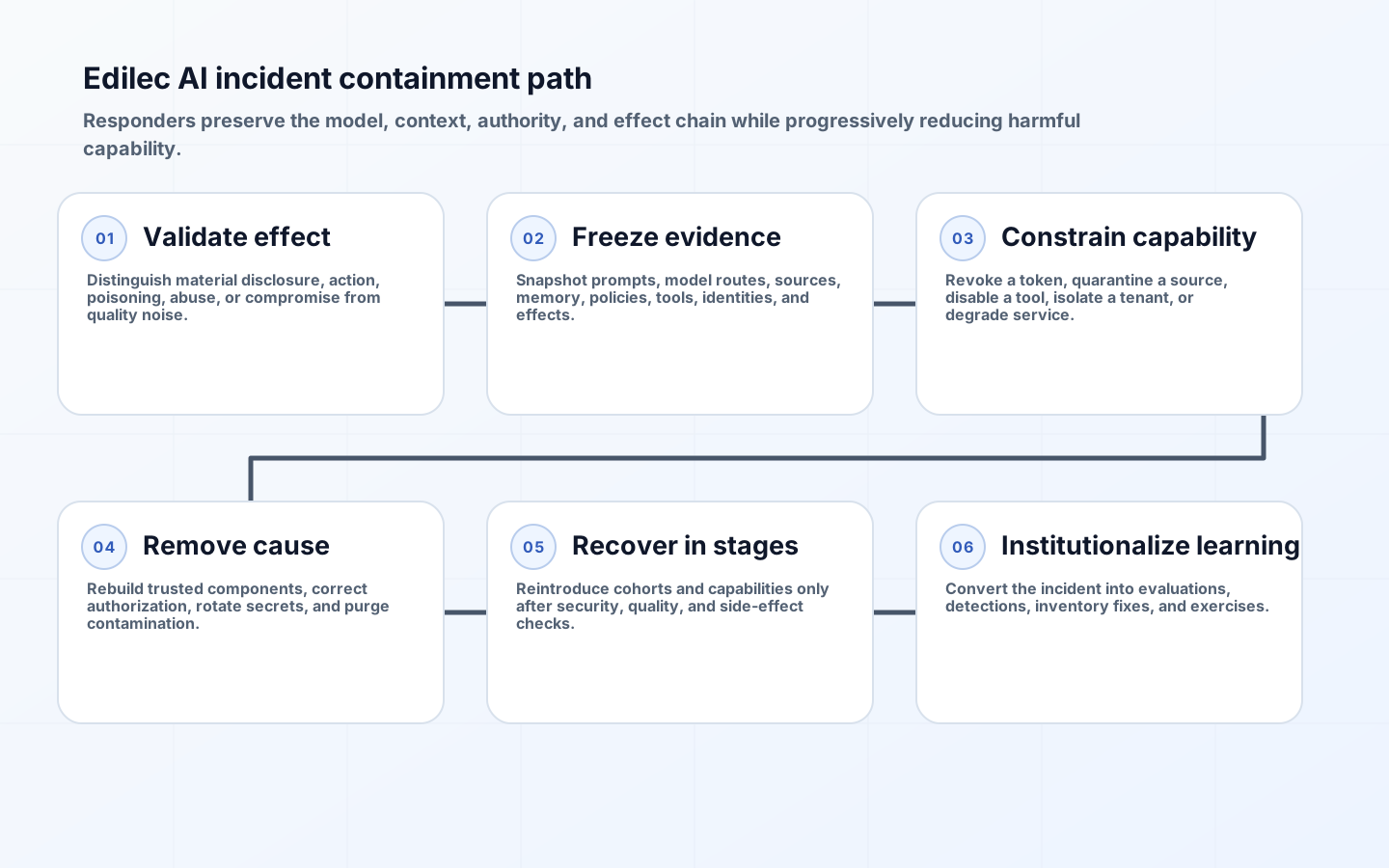
AI incident response begins when a model-enabled workflow causes, enables, or credibly threatens harm that requires coordinated action. The incident may be a conventional compromise expressed through an AI interface, a poisoned knowledge source, a model or prompt regression, cross-tenant disclosure, unsafe tool execution, persistent memory manipulation, provider failure, or deliberate abuse. Responders must contain the effect without erasing the prompt, context, version, policy, and action chain needed to understand it.
The durable principles remain familiar: prepare, detect, analyze, contain, eradicate, recover, and learn. What changes is the evidence graph and the number of independently changing components. Edilec's web incident response guide covers the conventional foundation; this playbook adds model endpoints, system instructions, retrieval indexes, memory, guardrails, tool brokers, evaluation sets, and AI providers to the response boundary.
Classify AI incidents by effect and control failure
Do not create an incident category for every surprising output. Triage on effect, exposure, persistence, reachability and control failure. A factual error with no material consequence may enter quality operations; disclosure of protected data, unauthorized external action, systematic harmful guidance, compromised model artifacts, or a poisoned corpus requires security coordination. The NIST Generative AI Profile highlights information integrity, privacy, security, harmful content, value-chain risk and incident disclosure as connected concerns, which supports cross-functional classification.
| Incident pattern | First question | Likely owners | Immediate evidence |
|---|---|---|---|
| Sensitive output | Was protected data disclosed, inferred or merely fabricated? | IR, privacy, data owner | Full request context, source references, user and tenant identity |
| Unsafe agent action | What authority and approval path produced the effect? | IR, platform, business process owner | Tool arguments, token claims, policy decision and downstream record |
| Retrieval poisoning | Which source, transformation or index admitted the content? | Knowledge owner, platform, security | Source version, ingestion job, embedding/index lineage and retrieval trace |
| Model or adapter compromise | Which artifact is deployed and where did it originate? | ML platform, supply-chain security | Artifact digest, registry event, build provenance and deployment manifest |
| Abuse or extraction | Is one actor probing at scale or using legitimate access harmfully? | Fraud, security operations, product | Account graph, request sequence, rate and response characteristics |
| Provider regression | Did an external model or policy change without a controlled release? | Vendor owner, platform, risk | Provider version metadata, route history, evaluations and contract notices |
Prepare ownership, inventory, and fallback paths
Maintain a service inventory that connects each AI use case to its product owner, model and provider, deployment version, prompts, retrieval collections, data classes, memory store, tools, guardrails, identity policies, observability, evaluation suite, and external dependencies. Name who can disable each component and who can authorize business fallback. A generic application inventory that says only 'uses an LLM' will not tell an incident commander which index to quarantine or which agent credential to revoke.
Predefine degraded modes: read-only assistance, retrieval without tools, deterministic search, previous approved model, human queue, or full suspension. Test capacity and user messaging before an event. A kill switch that routes every case to an unstaffed mailbox is not a recovery control. Align trigger thresholds with the monitoring design in Edilec's production model monitoring guide, and ensure an on-call responder can distinguish quality drift from active abuse.
Contain the AI path without losing evidence
Contain the narrowest harmful capability first. Revoke a tool credential, switch a tool to read-only, isolate one tenant, disable memory writes, quarantine a source, remove an index alias, pin a known model, reduce rate, block an abusive account, or route a use case to human review. Broader shutdown is justified when blast radius is unknown or the control plane is untrusted. Record every change, actor, reason and timestamp; containment itself alters the system that investigators need to reconstruct.
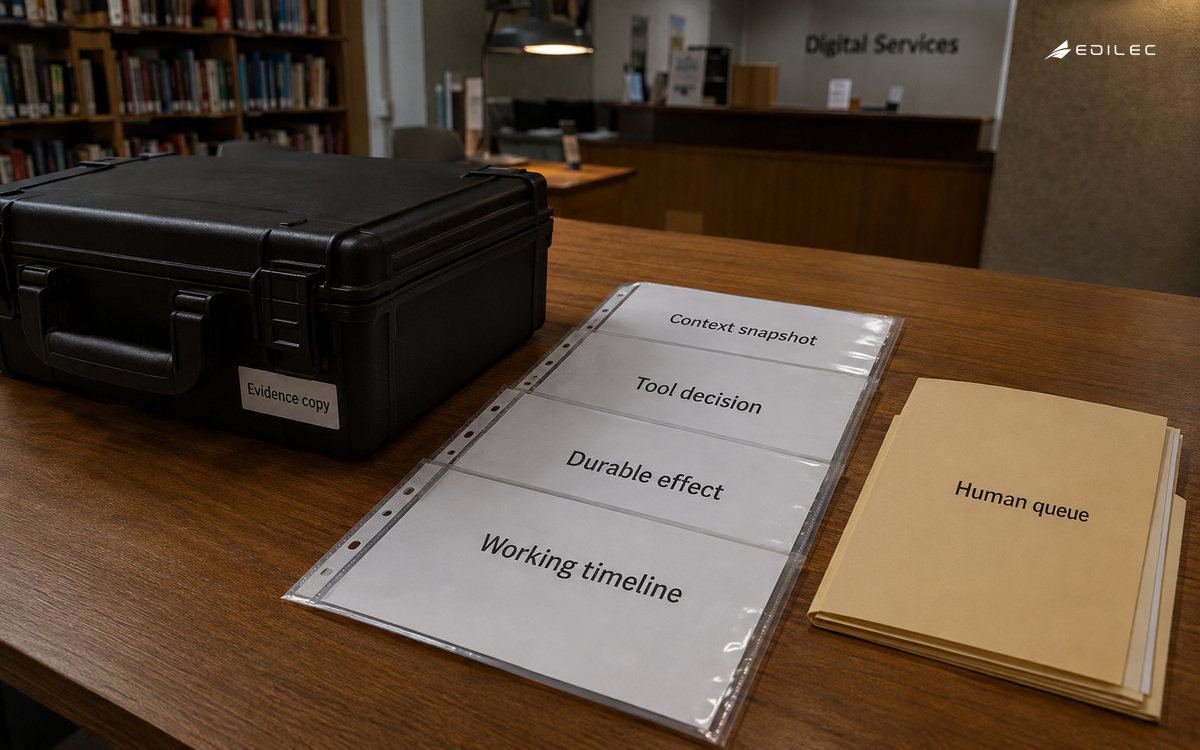
Preserve before mutating when seconds permit: trace identifiers, prompts and system instructions, retrieved chunks and source versions, model and parameter identifiers, guardrail results, policy decisions, tool calls, approvals, memory reads and writes, output handling, provider request IDs, application logs, account state, and external effects. Snapshot mutable prompts, indexes and configuration. Hash exported evidence, restrict access, and keep raw sensitive content separate from the working timeline. Never replay a dangerous tool call merely to improve a screenshot.
Build an AI forensic timeline that explains causality
A useful timeline follows the data and authority chain rather than only host events. Begin with the user's identity, tenant and request; add orchestration decisions, input filtering, retrieved material, memory, model response, output checks, tool authorization, approval, execution, and durable effect. Correlate model-provider and internal timestamps carefully. The observability fields described in Edilec's LLM observability checklist become forensic evidence only when identities, versions and records can be joined reliably.
Use MITRE ATLAS to test hypotheses about adversary behavior, including reconnaissance, model access, data manipulation and impact, while retaining conventional threat frameworks for underlying infrastructure. Use the OWASP GenAI Security Project to identify application and agentic failure paths. Taxonomies guide questions; they do not prove attribution. Label confirmed facts, supported inferences and open hypotheses separately so the response team does not harden an early guess into the incident record.
Eradicate the cause across model and application layers
Eradication depends on the cause. Remove malicious source material and rebuild affected indexes from a trusted snapshot; rotate exposed credentials and invalidate sessions; replace compromised artifacts by digest; correct authorization outside the model; patch unsafe output handling; constrain tools; purge poisoned memory; block abusive automation; or change provider routes. A system-prompt edit may reduce one reproduction but should not be treated as eradication when the failure crossed a deterministic security boundary.
| Change | Evidence before change | Recovery test | Rollback trigger |
|---|---|---|---|
| Model rollback | Current and prior model identifiers, route and evaluation results | Critical regression suite plus affected scenario | Material quality loss or repeated harmful behavior |
| Index rebuild | Source snapshot, transform code, index version and alias | Provenance, permission and poisoned-document tests | Missing trusted records or unauthorized retrieval |
| Memory purge | Affected keys, writers, readers and retention policy | Isolation, correction and expected-context tests | Continued contamination or unacceptable workflow loss |
| Credential rotation | Issued scopes, use history and dependent services | Denied old token and successful least-privilege path | Unexpected dependency failure requiring controlled exception |
| Guardrail update | Previous rule, bypass evidence and false-positive baseline | Variant attacks and representative legitimate cases | Operational blockage without compensating control |
| Tool suspension | Pending requests, approvals and external state | Read-only or restored path with idempotency checks | Ambiguous side effects or policy bypass |
Recover through staged validation
Recover by cohort and capability. Begin with internal users or a small tenant set, keep high-impact tools disabled, watch affected signals, and expand only after explicit gates. Validate the original scenario, nearby variants, core business quality, tenant isolation, authorization, cost and latency. Confirm that quarantined content is absent from every derivative store and cache, not only the source system. Reconcile pending tool actions so retries do not duplicate payments, messages or record changes.
NIST SP 800-61 Revision 3 integrates incident response into cybersecurity risk management and CSF 2.0 outcomes rather than treating it as an isolated response-team lifecycle. Apply that principle by requiring service owners, legal, privacy, communications, vendor management and business continuity to approve relevant recovery gates. The incident commander coordinates; the accountable owner decides when residual risk is acceptable.
Coordinate provider, customer, and legal communications
Prepare contact routes for model providers, vector or observability vendors, data owners and downstream tool operators. Contracts should preserve useful request metadata, define incident support and notification, permit evidence export, and explain model or policy change communication. Ask precise questions: which model snapshot served a request, whether other customers were affected, which logs remain available, and which mitigations were deployed. Record provider statements as evidence with source and time.
Legal and privacy teams determine regulatory, contractual and individual notification duties. Responders should supply verified scope, data categories, affected people or tenants, likely consequences, containment and uncertainty. Avoid attributing an output to a training-data breach until investigation distinguishes retrieved disclosure, prompt echo, inference, fabrication and model memorization. Communicate what is known, what is being tested, and when the next update will occur.
Convert the incident into durable control evidence
After recovery, add confirmed cases and safe variants to evaluation suites, update threat models, tighten inventories, fix telemetry joins, revise fallback capacity, and test playbook actions. Measure whether detection led to a decision, whether responders had the authority and evidence they needed, and whether containment preserved service safely. Do not reward a low incident count if reporting channels are unclear or traces cannot reveal harm.
Assign every lesson an owner, due date, verification method and risk sponsor. Separate one-time cleanup from systemic changes. A poisoned document may be removed today while source attestation, dual review and index lineage take longer. Track both. Exercise the revised playbook with a scenario that includes uncertainty, a provider dependency and an ambiguous tool outcome; a discussion that skips those frictions will overstate readiness.
Key takeaways
- Classify incidents by material effect, persistence, exposure and control failure, not by unusual text alone.
- Inventory model, prompts, retrieval, memory, tools, identity, guardrails and providers as response assets.
- Contain the narrowest harmful capability while preserving the versioned data and authority chain.
- Recover in stages with regression, isolation, authorization and side-effect reconciliation tests.
- Turn confirmed incident paths into evaluations, detections, playbook exercises and owned remediation.
Frequently asked questions
Does every hallucination require incident response?
No. Most isolated low-impact errors belong in product quality operations. Escalate when the behavior causes or threatens material harm, indicates compromise or abuse, crosses a protected boundary, persists systematically, or triggers legal and contractual duties.
What is an AI kill switch?
It is a governed ability to disable or degrade a harmful AI capability, such as tool execution, memory writes, one model route or an entire workflow. It needs tested authority, observability, user communication and a viable fallback; a hidden configuration flag alone is insufficient.
Should prompts be retained for investigations?
Retain only what a documented security, reliability and legal purpose requires. Apply minimization, access control, redaction and retention limits. Preserve an incident hold when authorized, while separating highly sensitive raw content from broadly accessible operational summaries.
Conclusion
Effective AI incident response protects two things at once: the business from continuing harm and the evidence needed to explain what happened. That requires component-level containment, a causal timeline across context and authority, trusted rebuild paths, and staged recovery. Generic response mechanics remain essential, but they must be extended to the mutable AI system around the model.
Choose one important AI workflow and rehearse a poisoned source, a cross-tenant disclosure, and an unauthorized tool action. For each, prove who can contain it, what evidence survives, which fallback works, and who approves recovery. The unanswered steps are the practical backlog for readiness.