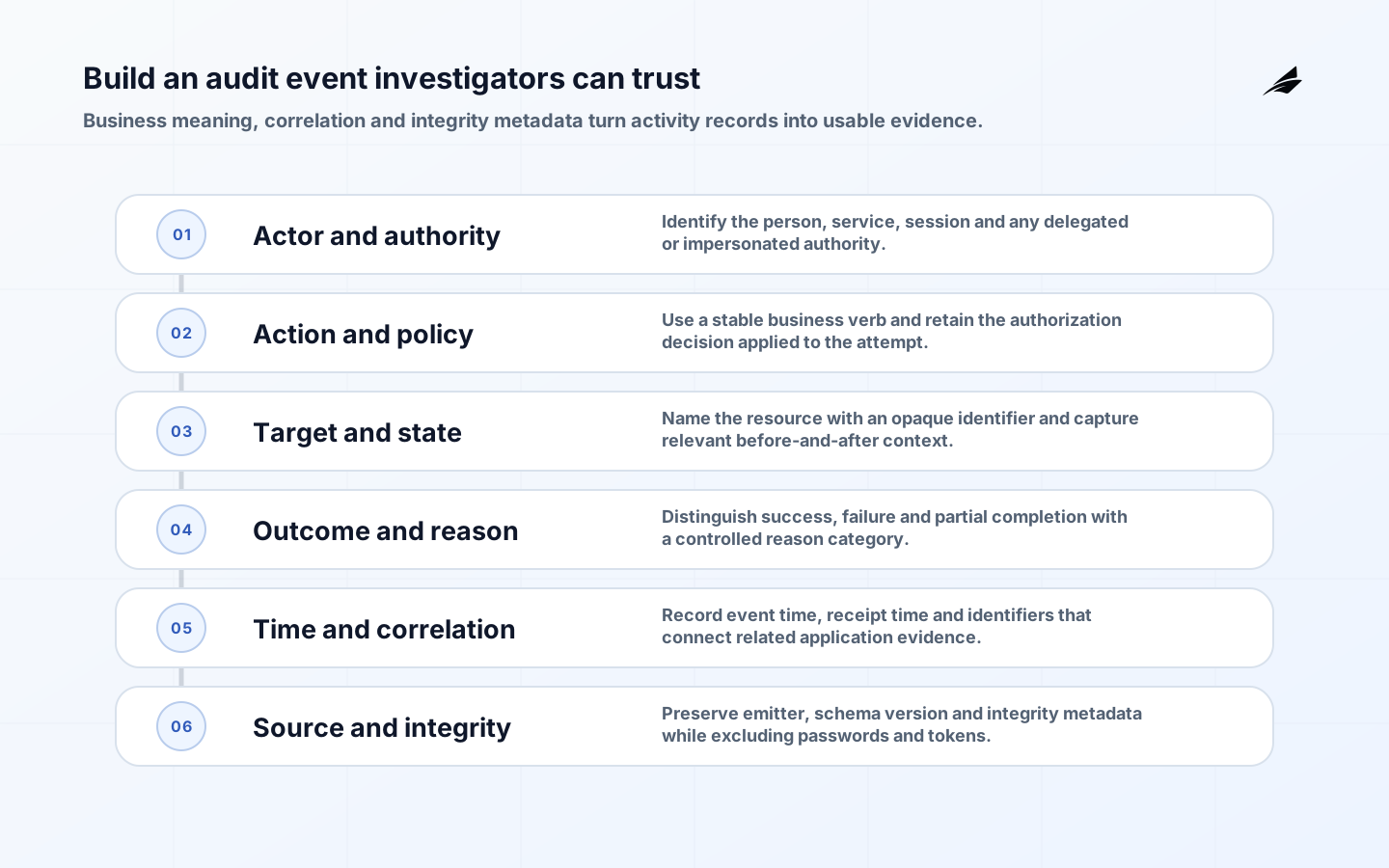
An audit trail is useful when an investigator can reconstruct a material action without guessing across disconnected timestamps. That requires application meaning: actor, authority, target, action, outcome, time, request or transaction identity and relevant before-and-after context. Infrastructure logs remain valuable, but a successful HTTP request does not explain who approved a refund, changed a beneficiary or exported a record.
The first design artifact should state the operating outcome: Produce trustworthy, searchable evidence for defined investigation questions while limiting sensitive data and operating cost. Translate that promise into named records, decisions, controls and measures. Tool selection becomes easier when vendors and implementation teams must demonstrate the difficult exception, the unavailable dependency and the recovery path rather than only the happy path.
Define scope in business and risk terms
Ask investigators, application owners, fraud teams, privacy staff and support leads which questions they have failed to answer from existing evidence. Walk through real incident and dispute timelines, noting missing actor, authority, target and outcome context. Bound the first logging improvement around a few high-impact actions and specify data that must be excluded before selecting a collector or retention tier.
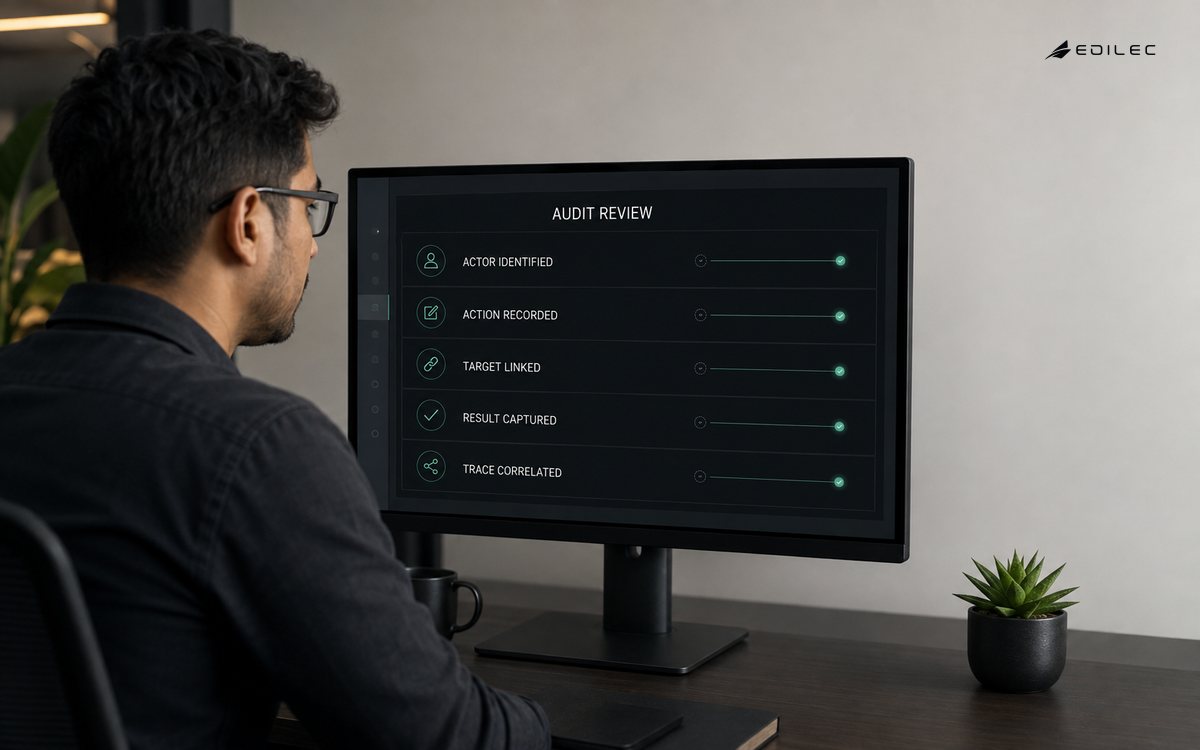
- Write investigation questions before choosing fields or retention periods.
- Define a canonical event envelope and controlled action vocabulary.
- Distinguish human actor, service identity, impersonation and delegated authority.
- Correlate application, identity, gateway and data events with stable identifiers.
- Protect collection paths and stored logs against unauthorized change or deletion.
- Test queries, clocks, access, export and legal hold through investigation exercises.
Design the lifecycle, decisions and boundaries
Define an audit event contract with stable business action names, actor and delegated authority, target identity, outcome, event and receipt times, and correlation fields. Emission should occur where the application knows the decision, not only at a proxy. Collection must authenticate sources and handle buffering without silent loss. Duplicate delivery is acceptable when event IDs support deduplication; gaps and malformed events require owned queues.
| Area | Question | Practical design |
|---|---|---|
| Actor | Who initiated and under what authenticated or delegated authority? | Subject ID, session, service ID and impersonation chain |
| Action | What business operation was attempted? | Stable verb and policy decision |
| Target | Which record or resource was affected? | Type, opaque ID and tenant or domain |
| Result | Did it succeed, fail or partially complete? | Outcome, reason category and resulting state |
| Context | How can related evidence be found? | Event ID, trace ID, request ID, source and time |
Resolve implementation details early
Assign ownership for event semantics to the application domain, collection reliability to the platform, and access and retention to security and privacy owners. Production logs should not be copied into development. Use synthetic events to test parsers and searches, with governed samples for edge cases. Document clock sources, schema versions, storage tiers, legal holds, export formats, regional restrictions and collection failure behavior.
Consider an administrator changing a supplier bank account. Record the authenticated administrator, privileged role, supplier identifier, changed field names, approval request, policy result, final outcome and correlation ID. Do not write the full bank details into the log. A later investigation can link the change to authentication, approval and notification events while access to the sensitive business record remains separately controlled.
Build security, privacy and accessibility into acceptance
Threat-model log injection, forged sources, collector compromise, unauthorized search, deletion and denial through excessive volume. Applications should allowlist fields and encode untrusted text. Exclude passwords, tokens and unnecessary personal or financial values. Separate collection administration from investigation access, audit all searches and exports, and protect case evidence with approval, integrity checks and documented custody.
Roll out with observable gates
- Baseline the current outcome, delay, failure demand and risk before changing the process.
- Build a thin end-to-end path and test contracts, permissions, telemetry and recovery.
- Run in simulation, shadow or limited-production mode where the control permits it.
- Release to a named cohort with an owner, support coverage, stop conditions and rollback steps.
- Review technical signals and business outcomes together; investigate segment differences.
- Expand only when exceptions are handled reliably and operating documentation matches reality.
- Retire the previous path, credentials, jobs and access after evidence and retention needs are satisfied.
An audit-logging release gate should demonstrate that a reviewer can reconstruct the chosen scenario across application, identity and downstream events. Deliberately introduce a denied action, delayed event, duplicate, clock skew and collector interruption. Confirm alerts and failure queues work, prohibited fields are absent and access is recorded. Rollback must not silently restore an application version that omits a required event.
Risks and measures
| Risk | Response | Evidence to watch |
|---|---|---|
| Missing context | Question-led event contracts and review | Exercises answered without guesswork |
| Sensitive leakage | Allowlisted fields, masking and payload tests | Detected prohibited fields |
| Tampering | Restricted append path and integrity monitoring | Unauthorized changes or gaps |
| Clock disorder | Synchronized time plus receipt time and sequence | Out-of-order events |
| Unbounded volume | Risk-based events, tiered retention and sampling only outside audit trails | Cost and query latency |
Measure source coverage, accepted and rejected events, delivery delay, clock drift, schema failures, missing correlation, query latency and access to sensitive indexes. Most importantly, run timed investigation exercises and record which questions remain unresolved. Lower storage cost is not success if essential context is discarded; more events are not success if analysts cannot distinguish a material action from noise.
Operate the capability after launch
Create joint governance for application event contracts and the evidence platform. Review new high-impact actions, schema changes, retention rules, privileged searches and sources that have gone quiet. Exercise compromised administrator activity, a partial collector outage, disputed record change and urgent legal hold. Feed failures into event libraries, detection content, access policy and responder playbooks.
Operational details that determine reliability
Event names should describe completed or attempted business actions, not implementation methods. “invoice.paymentdestinationchanged” remains understandable after a controller or database changes; “PUT /v2/object” does not. Publish event schemas with required fields, types and semantic definitions. Consumers should tolerate additive change, while incompatible meaning receives a new version or event name.
Capture both event time and collection time. For asynchronous work, include causation and correlation identifiers so investigators can distinguish the initiating request from later processing. Synchronize clocks and monitor drift, but do not assume perfect order across distributed systems. Sequence numbers or domain versions can establish order for one record when wall-clock timestamps are close or delayed.
Logging failure needs an explicit policy. A high-risk administrative action may need to fail closed if its audit event cannot be durably accepted; a low-risk read may continue while raising an operational alert. Buffering must be bounded and protected from local users. Monitor dropped, malformed, duplicated and late events, plus sudden silence from a normally active source.
Access to logs can expose behavior, identifiers and security design. Separate collection administration from investigation access, require case-linked approval for sensitive searches where appropriate, and audit every search and export. Retention should follow investigation, legal and regulatory needs rather than indefinite convenience. Disposal must include replicas, indexes, exports and temporary case files.
Procurement and architecture review should use scenario-based evidence for audit logging, incident investigation, security monitoring. Ask each proposed solution to perform the representative case, reject an unauthorized action, survive an unavailable dependency, expose an understandable status, produce investigation evidence and export the owned data. Record configuration and integration work needed to achieve the demonstration. A feature visible in a product list is not proof that the complete control or journey will operate in the organization’s environment.
Acceptance should connect design claims to repeatable evidence. For actor, retain tests or records that show subject id, session, service id and impersonation chain. For the risk of missing context, assign the response before launch and review exercises answered without guesswork. Add load, recovery, permission and accessibility evidence in proportion to impact. The release decision should identify residual risks, their owners and the conditions that would pause further rollout.
Key takeaways
- Start from a complete business outcome and the evidence needed to trust it.
- Make identity, authority, state, exception handling and ownership explicit.
- Design failure, recovery and reconciliation before expanding volume.
- Roll out to controlled cohorts with measurable gates and practiced rollback.
- Treat configuration, policy, access and retirement as continuing product work.
FAQ
Should we buy a product or build?
Compare logging platforms on authenticated ingestion, schema governance, integrity controls, searchable retention, case export, access auditing and cost across hot and archive tiers. Application-specific event design still belongs with the product team. Include migration of saved investigations, detections and retention holds, plus open export formats and deletion verification, when assessing long-term fit.
What belongs in the first release?
Start with one investigation question involving a consequential application action, such as changing payment details or exporting client data. Implement the canonical event, correlate authentication and policy evidence, route it through production-like collection and have an independent analyst answer the question. Test tampering, loss and sensitive-field controls rather than treating dashboard visibility as completion.
How should success be measured?
Use measures that reflect evidence quality: percentage of priority actions covered, required-field completeness, event arrival delay, clock variance, query success, exercise completion time and unresolved questions. Track unauthorized search attempts and export review as well. Volume and retention days are capacity facts, not proof that the trail supports attribution or reconstruction.
When can the old process be retired?
Retire a legacy log source only after its material events are emitted by the replacement, historical retention and holds remain searchable, detections and saved queries are migrated, and responders can locate the new evidence. Remove stale collectors and credentials, then monitor for source silence or old-format arrivals. Preserve documentation mapping old event names to new semantics.
Conclusion
Investigation-ready audit logs are designed from questions, emitted with application meaning and protected as sensitive evidence. Stable contracts, trustworthy collection, controlled access and practiced searches let responders reconstruct actions without exposing entire business records. The work remains a product discipline: every new privileged or high-impact capability should bring reviewed events, tests, retention decisions and usable investigation context.