Security headers and browser controls tell a user agent how to handle content, transport, embedding, capabilities and cross-origin relationships. They can reduce exploitability and data exposure when an application already validates input, encodes output, enforces authorization and manages sessions correctly. They are defense in depth, not a substitute for fixing cross-site scripting, broken access control, insecure uploads or weak TLS.
This production guide explains what each major control does, where it belongs and how to release it without breaking legitimate functionality. Use it alongside threat modeling for custom software, secrets rotation for engineering teams and tenant isolation reviews. Header policy should follow the application's origins, content types, embedding needs and data sensitivity rather than a copied scanner score.
Map browser threats before choosing directives
Inventory every response family: public HTML, authenticated HTML, JSON APIs, static assets, user uploads, downloads, redirects, errors and third-party callbacks. Record which origins supply scripts, styles, fonts, images, frames and network connections. Identify whether pages may be embedded, whether the application embeds others, which browser capabilities it uses and whether any response contains sensitive data. Policies differ by response purpose; a JSON API does not benefit from every document control.
Start with threats the browser can mediate. CSP constrains content sources and can limit script execution. Framing policy reduces clickjacking exposure. HSTS instructs a supporting browser to use HTTPS for future requests. nosniff discourages MIME interpretation that conflicts with the declared type. Referrer policy limits information sent in navigation. Permissions Policy controls access to selected browser features. Cross-origin isolation headers alter how documents share browsing contexts and resources. None of them grants API authorization.
| Control | Primary purpose | Typical starting point | Main deployment risk |
|---|---|---|---|
| Content-Security-Policy | Constrain executable and fetched content | Report-only inventory, then nonce or hash policy | Blocked scripts, styles or third parties |
| Strict-Transport-Security | Require HTTPS after a secure visit | Short max-age on HTTPS-only host | Long lockout after certificate or subdomain failure |
| X-Content-Type-Options | Prevent MIME sniffing | nosniff with correct Content-Type | Mislabelled assets stop working |
| Referrer-Policy | Limit referrer disclosure | strict-origin-when-cross-origin | Analytics or partner assumptions change |
| Permissions-Policy | Restrict browser capabilities | Disable unused features | Embedded workflows lose needed capability |
| frame-ancestors / X-Frame-Options | Control embedding | Deny or allow named parent origins | Legitimate portals can no longer frame pages |
Build Content Security Policy from actual dependencies
CSP is most effective when scripts are authorized narrowly with nonces or hashes and dangerous broad sources are absent. Begin by listing first-party bundles, inline code, dynamically created scripts, workers, frames and network destinations. Remove inline handlers and string-to-code patterns that force weaker directives. Prefer a response header because it supports the complete feature set; a meta-delivered policy cannot provide framing protection, sandboxing or violation reporting in the same way.
Run a stricter policy in Content-Security-Policy-Report-Only while a compatible policy remains enforced. Sample and aggregate violations because extensions, injected software and stale pages create noise. A report is evidence of a blocked or reportable load, not proof of an attack. Do not automatically allow every reported origin. Tie each addition to an owned dependency and test the exact journey. Preserve policy tests in CI so a template or CDN change cannot silently broaden sources.
Harden transport, type and sensitive responses
Enable HSTS only after the host works exclusively over HTTPS and certificate renewal, redirect behavior and recovery are dependable. Start with a limited max-age, observe, then extend it. Add includeSubDomains only when every current and future subdomain can meet the requirement. Preloading has ecosystem-wide consequences and should be a deliberate later decision. HSTS is sent over HTTPS; a browser must receive a trusted secure response before ordinary policy takes effect unless the domain is preloaded.
Set an accurate Content-Type on every response and add X-Content-Type-Options: nosniff. Treat user uploads according to declared and verified content, store them away from executable origins when possible, and use Content-Disposition: attachment for content that must download rather than render. For authenticated or sensitive responses, choose cache directives from the actual storage risk. no-cache permits storage with revalidation; use no-store where retaining the response in a cache is unacceptable.
Control framing, referrers and browser capabilities
Use CSP frame-ancestors to define which parent origins may embed a page. X-Frame-Options: DENY or SAMEORIGIN can remain as a compatibility layer, but it is less expressive. Test authentication, payment, support widgets and partner portals before enforcement. The frame policy on the framed response is decisive. A JavaScript frame-busting snippet is not equivalent because it executes after navigation and can be bypassed or blocked.
Choose Referrer Policy according to whether paths or query strings may reveal customer, search or document information. The common strict-origin-when-cross-origin posture retains useful same-origin detail and sends only the origin across secure origins, but more sensitive products may choose less disclosure. Permissions Policy should deny camera, microphone, geolocation and other features the application does not use, then allow required capabilities to explicit origins or frames. Browser support and feature names evolve, so test target clients.
Use cross-origin isolation only for a defined need
Cross-Origin-Opener-Policy can separate a top-level document's browsing context group from cross-origin documents. Cross-Origin-Embedder-Policy can require embedded cross-origin resources to opt in through CORS or Cross-Origin-Resource-Policy. CORP lets a resource state which origins may include it. Together these controls can create a cross-origin-isolated context required by selected powerful browser features and reduce some cross-origin data exposure, but they can also break popups, sign-in flows, analytics and CDN assets.
Do not confuse response isolation with CORS. CORS controls whether browser JavaScript may read a cross-origin response; it is not authentication, CSRF protection or a firewall. Specify allowed origins carefully for credentialed requests and vary caches correctly. Test redirects and errors because an upstream may omit CORS or isolation headers on non-success paths. If an API is public, a wildcard may be intentional; if it carries user data, authorization must still protect every object.
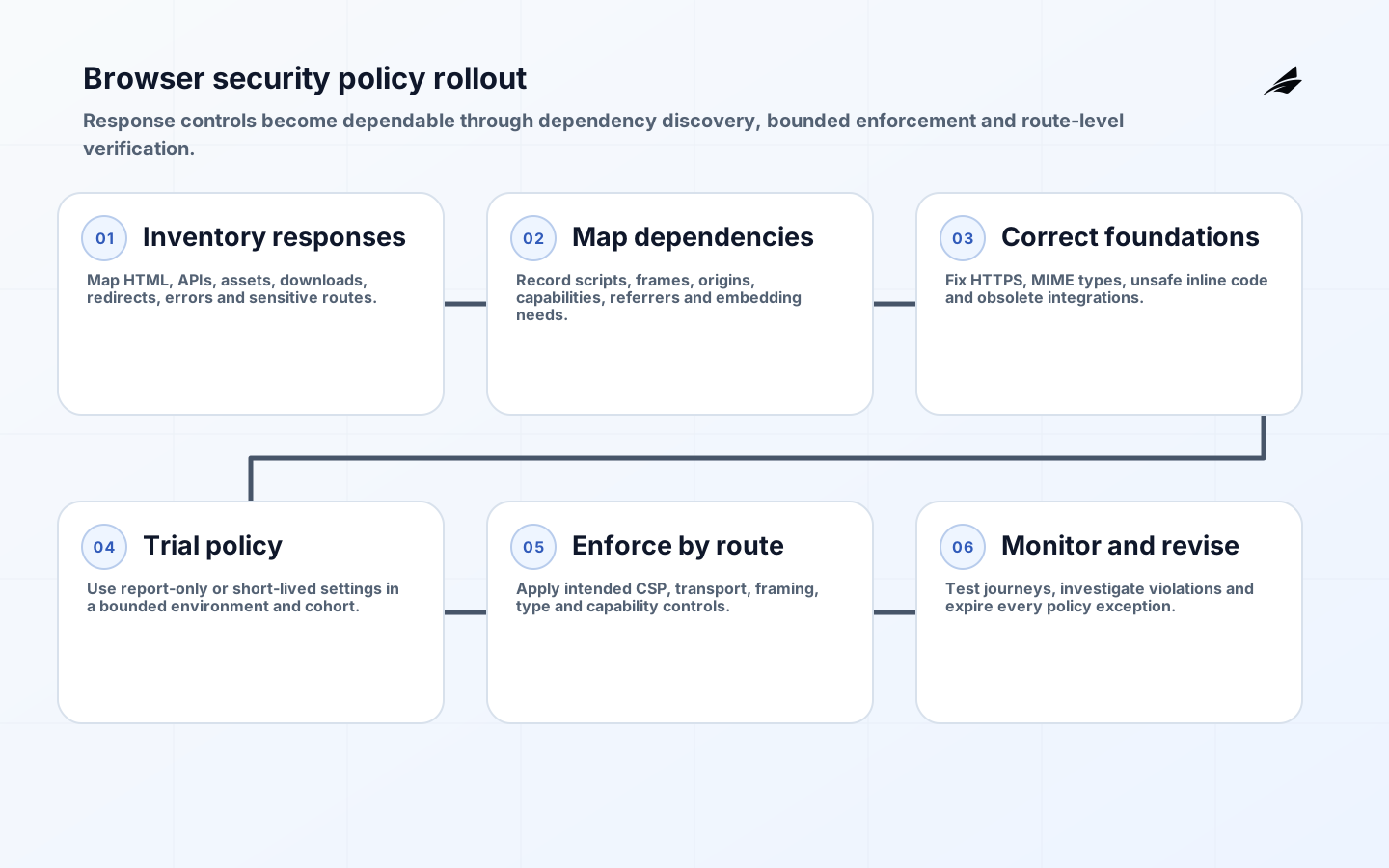
Roll out browser policy in six controlled stages
- Inventory response types, origins, frames, capabilities and sensitive data flows.
- Declare an owner and policy baseline for each route or response family.
- Correct MIME types, HTTPS behavior and obsolete dependencies before enforcement.
- Deploy report-only or short-lived settings to a bounded environment and cohort.
- Validate critical journeys, accessibility, integrations, errors and older supported clients.
- Enforce progressively, monitor violations and review every policy exception.

Implement headers at the layer that reliably owns the final response, which may be application, reverse proxy, CDN or edge function. Avoid contradictory values emitted by multiple layers. Define tests against representative URLs, including redirects, 404 and 500 responses, downloads and authenticated pages. A scanner that checks only the home page cannot prove route coverage. Capture headers after every hop and test in a real browser because browser behavior depends on navigation context.
Test behavior, not just header presence
Combine static configuration checks with browser journey tests. Verify that expected content loads, prohibited sources fail, pages cannot be framed unexpectedly, sensitive referrers are absent and disabled capabilities stay disabled. Test session recovery, downloads, OAuth popups, payment redirects, embedded support and accessibility tools. Security tests should include an intentionally disallowed resource so a missing enforcement layer is visible, not merely assert that a header string exists.
Monitor policy violations by directive, route, release, browser and source, with sampling and privacy controls. Alert on material regressions such as a new first-party script blocked after deployment, not every extension-generated event. Track coverage across response families and policy exceptions with owners and expiry. Review browser compatibility and authoritative guidance periodically. Remove obsolete headers such as HPKP and avoid X-XSS-Protection as an assumed modern defense; OWASP recommends CSP and explicitly disabling the legacy filter where relevant.
| Verification layer | Question | Evidence |
|---|---|---|
| Configuration | Is one intended policy emitted on every target response? | Route matrix and automated header test |
| Browser | Do supported journeys work under enforcement? | End-to-end test and console review |
| Negative security | Does a prohibited load or frame fail? | Controlled adversarial test |
| Operations | Can the team explain and reverse a breakage? | Dashboard, owner and rollback rehearsal |
| Governance | Are exceptions necessary and current? | Named dependency, review date and removal plan |
Key takeaways
- Choose controls from response purpose and a browser-focused threat model.
- Build CSP from owned dependencies and move from reporting to enforcement gradually.
- Adopt HSTS only after HTTPS and certificate operations are dependable.
- Treat CORS, framing and cross-origin isolation as different policy mechanisms.
- Test critical browser behavior across all response paths, not just header presence on a homepage.
Frequently asked questions
Should a JSON API return every security header?
No. Use controls relevant to the response. Correct content type, nosniff, transport, cache and CORS policy may matter, while document-specific CSP directives or framing controls often do not affect non-rendered JSON. Protect the API with authentication and object-level authorization.
Is an A grade from a header scanner enough?
No. A scanner provides useful configuration evidence but usually cannot cover authenticated routes, business journeys, third-party dependencies or application vulnerabilities. Combine it with route coverage, browser tests, threat modeling and normal application security verification.
Can CSP stop all cross-site scripting?
No. A strong policy can reduce exploitability, especially with nonce- or hash-based scripts, but policy weaknesses and browser differences exist. Continue contextual output encoding, safe DOM APIs, input handling, dependency management and security testing.
Conclusion
Browser controls work best as an engineered policy layer: inventory the application, select controls for actual threats, correct dependencies, release gradually and verify real journeys. The result is not the longest header list. It is a coherent set of enforceable boundaries that strengthens secure application behavior without surprising users or operators.