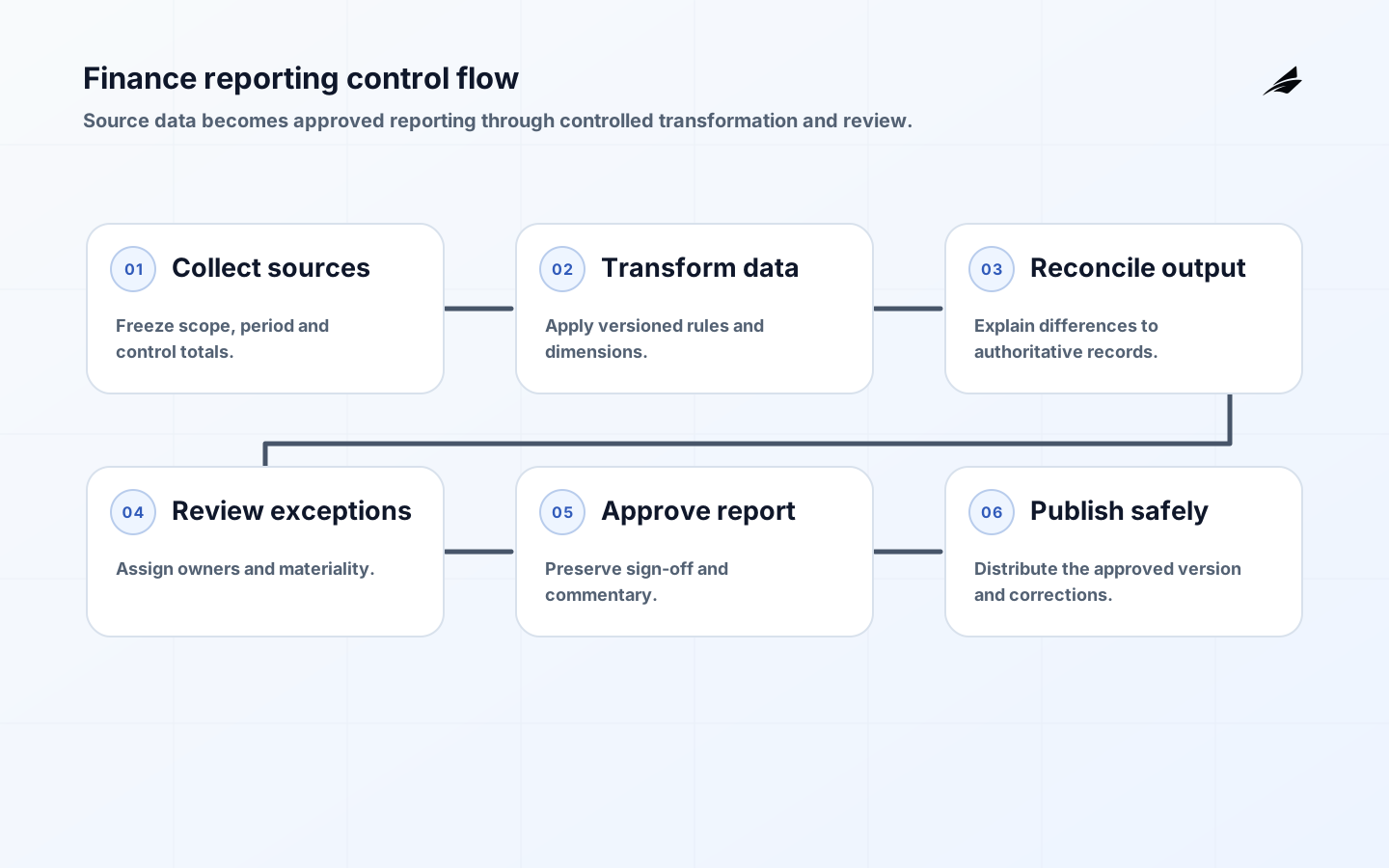
Finance reporting automation replaces repeated collection, transformation and formatting with a controlled data product. It should not remove finance judgment or turn an unexplained spreadsheet into unexplained code. A dependable system preserves the reporting period, entity scope, currency treatment, metric definition, source lineage, reconciliation difference, reviewer decision and published version. The central design question is therefore not how quickly a dashboard refreshes, but whether finance can explain and reproduce every material number.
This guide describes a practical path from workbook inventory to automated collection, governed transformations, reconciliation, review and publication. SEC Inline XBRL and the IFRS Accounting Taxonomy illustrate why financial concepts need stable definitions and context. dbt data tests provide one implementation approach for checking model assertions. OpenLineage and W3C PROV provide useful models for recording how data and processing relate. The exact accounting framework and regulatory obligations must be confirmed by qualified finance and legal owners.
Start with the reporting decision and publication boundary
Inventory reports by audience, decision, cadence, materiality and owner. Distinguish statutory statements, management packs, board reporting, operational forecasts and ad hoc analysis. They may share data but have different approval, timing and correction requirements. Choose one bounded report whose manual effort or error risk is measurable. Record preparation time, late adjustments, unexplained differences, review cycles and downstream copies.
Define when a report becomes official. Draft, reviewed, approved, distributed and corrected are distinct states. A dashboard that always shows the newest source values may be unsuitable for a board pack that must preserve the approved period. Decide whether automation produces a live analytical view, a controlled snapshot or both. Assign the finance owner who approves meaning and the technical owner who operates the pipeline.
| Report element | Definition to preserve | Control evidence |
|---|---|---|
| Period | Calendar, cutoff and close state | Approved period and snapshot time |
| Entity | Included legal entities and eliminations | Scope list and consolidation result |
| Measure | Grain, sign, currency, filters and rounding | Versioned definition and examples |
| Publication | Audience, approval and correction policy | Reviewer, release and superseded version |
Create an authoritative source and lineage map
List every ledger, subledger, planning system, master-data source and manual input. Record owner, identifier, extraction method, latency, retention and control total. Preserve entity, account, period, currency and transaction identifiers through transformation. Do not join records by display labels when governed keys exist. Manual adjustments need a controlled template, reason, owner and approval rather than an untracked cell edit.
Represent lineage at a level useful for investigation. A user should be able to move from a reported value to the model, source dataset and relevant control totals. OpenLineage can describe jobs, runs and datasets; W3C PROV offers a broader vocabulary for entities, activities and agents. The chosen technology matters less than consistent identifiers and retention. Lineage that cannot answer why a number changed is decorative.
Move spreadsheet logic into versioned transformations
Extract formulas, mappings and exclusions from workbooks with finance owners. Express each metric in clear language before implementing it. Separate raw ingestion, standardized records, business rules and presentation. This layered design helps teams identify whether a difference comes from source, mapping, calculation or report layout. Keep effective-dated dimensions for reorganizations and account changes so historical reporting does not silently adopt today's structure.

Use code review and controlled deployment for financial logic. Tests should cover uniqueness, required relationships, accepted values and business fixtures; dbt data tests are one practical mechanism, not the only choice. Include boundary examples such as reversals, late postings, zero denominators, foreign currency, reopened periods and eliminated intercompany activity. Compare new results with the approved workbook over representative periods and classify every material difference.
Make reconciliation a first-class workflow
Reconcile imported record count and value to source control totals before applying reporting logic. Reconcile transformed results to authoritative balances at the natural grain. Differences should enter a queue with category, materiality, owner, age, explanation and resolution. Avoid a generic balancing adjustment that hides whether the cause is timing, scope, mapping, duplication or source correction.
Set tolerances only where the accounting meaning supports them. A small difference can still reveal a broken key or missing entity. Preserve both original and corrected values and identify which publication is affected. Recurring reconciliation breaks are product signals; fix their source or contract instead of institutionalizing manual repair. The close should not depend on one analyst remembering an undocumented sequence.
| Difference category | Example | Resolution owner |
|---|---|---|
| Timing | Late source posting after extraction | Finance close owner |
| Scope | Entity omitted from consolidation set | Reporting policy owner |
| Mapping | New account lacks governed category | Master-data owner |
| Pipeline | Duplicate ingestion or failed transformation | Data engineering owner |
| Adjustment | Approved management reclassification | Authorized finance reviewer |
Design review and sign-off into the system
A reviewer needs the current result, comparison, material changes, unresolved exceptions, source freshness and definition version. Show what changed since the previous review. Route approval according to report, entity and materiality. Prevent self-approval where policy requires separation. Comments should attach to a specific value or section and remain with the publication history.
Freeze or snapshot the reviewed dataset so a later source refresh does not rewrite approved evidence. If a correction is needed, issue a new version with reason, approver and affected audience. Record delivery outcome for scheduled reports. Automating email before controlling version state merely distributes mistakes faster.
Operate pipelines around the finance calendar
Set service objectives for source arrival, transformation completion, reconciliation and publication. Alert on missed business deadlines and incomplete control totals, not every transient task retry. Provide runbooks for unavailable sources, partial loads, incorrect mapping and failed publication. Recovery includes financial reconciliation after rerun, not only a green scheduler.
Protect credentials, report access and sensitive dimensions. Use least privilege and monitor bulk export. Test restoration of code, configuration, lineage and approved snapshots. Coordinate change windows with close and board calendars. A technically small schema change can have a large reporting consequence when it arrives during sign-off.
Measure improvement without weakening control
Track preparation time, review iterations, aged differences, manual adjustments, failed controls, late publication and time to explain a variance. Also track adoption and retired workbooks so automation does not become another parallel path. Faster reporting is valuable only if finance trusts the result and can retrieve evidence.
Review unit cost and platform use, but do not optimize by deleting required history or quality checks. Establish a backlog for recurring reconciliation, slow models and confusing definitions. Retire reports that no longer support a decision. A smaller governed catalog is more useful than hundreds of automated outputs without accountable readers.
Migrate workbooks without losing business knowledge
Treat each workbook as a combination of data source, transformation, decision aid and personal working method. Interview preparers and reviewers while walking through a completed period. Identify hidden mappings, copied values, macros, manual checks, external links and judgement notes. Classify each element as a production rule to implement, a controlled input to preserve, an analytical convenience or obsolete work to retire. Keep annotated examples of difficult periods so the automated design retains lessons that are not obvious from formulas alone. Migration is complete only when finance owners can perform the report without depending on an undocumented local file.
Run the automated and existing processes in parallel for representative periods, but give each difference an owner and resolution date. Compare at source total, transformation stage and published output so investigation can isolate the cause. Freeze changes to the old workbook during final validation or record them through the same review path. Plan cutover, fallback and archive: identify the authoritative publication date, revoke uncontrolled distribution, retain required historical workbooks and communicate where users should obtain the approved result. After cutover, monitor attempts to use retired files because they reveal missing capability, access or confidence.
Document operational knowledge in runbooks that follow the reporting calendar. Include source arrival expectations, manual input deadlines, reconciliation owners, approval substitutes, publication channels and correction procedures. Cross-train at least one alternate preparer and reviewer. Conduct a rehearsal in which the primary analyst is unavailable and a source feed fails. The goal is not to eliminate finance expertise; it is to make expertise available through explicit definitions, controlled decisions and recoverable procedures rather than through one person's memory.
Key takeaways
Finance reporting automation is a controlled publication system. It connects authoritative sources, versioned definitions, tested transformation, reconciliation, review and immutable release history. Preserve finance authority while removing repeated mechanical work. Make the approved report easy to identify, and keep drafts, corrections and superseded versions visibly distinct so downstream users do not act on the wrong state. Record who received each controlled publication and when any corrected version replaced it.
- Define period, entity, metric and publication state before building.
- Version calculations and test approved boundary examples.
- Route every material difference through reconciliation.
- Snapshot reviewed results and issue controlled corrections.
- Operate the pipeline against finance deadlines and evidence needs.
Frequently asked questions
Must spreadsheets disappear?
No. Spreadsheets remain useful for analysis and controlled input. The goal is to remove hidden production logic and uncontrolled copying, not to prohibit every workbook.
Should finance dashboards always be live?
Not necessarily. Operational analysis may be live, while approved management or statutory reporting often needs a stable period snapshot and correction history.
Can automation shorten the close?
Yes when it removes collection, matching and formatting delays. It cannot replace policy decisions or resolve poor source ownership by itself.
Conclusion
Finance reporting automation without spreadsheet chaos succeeds when a reader can trace a published number to source, definition, transformation, reconciliation and approval. Build one report end to end, compare it with trusted periods and preserve every material difference. Expand only after finance can operate the system during close, explain corrections and recover evidence without returning to an undocumented workbook chain.