Secrets rotation for growing engineering teams is the capability to replace a credential without losing service, missing a consumer or leaving the old value usable indefinitely. The hard part is coordinated state change: the issuer, secret store, deployment system and every consumer must move through a safe overlap period. Rotation should reduce exposure after leakage and prove that emergency replacement is possible. A calendar job that creates a new value but never verifies adoption or revokes the old one is not a completed control.
This playbook covers machine credentials, API keys, database passwords, signing material and certificates; human passwords follow different guidance and should not be forced through arbitrary periodic changes without a risk basis. Pair it with OAuth and OpenID Connect design to reduce long-lived application secrets, the secure admin panel guide for privileged operations, and the data pipeline reliability guide where credentials cross scheduled jobs.
Inventory secrets, consumers and authority
Create an inventory from secret managers, cloud identity systems, CI/CD variables, certificate stores, repositories, runtime configuration and external providers. For each item, record type, issuer, owner, environment, consuming workloads, privilege, storage location, creation time, expiry, current rotation method and revocation path. Do not store secret values in the inventory. Unknown consumers are the primary operational risk: a credential may be referenced by a forgotten cron job, disaster-recovery environment, vendor integration or desktop client that cannot receive updates safely.
Classify by consequence and replaceability. A read-only test credential has a different urgency from a production signing key or shared database administrator password. Record whether multiple active versions are supported, whether consumers reload at runtime, and whether the issuer exposes an API. Assign a service owner and a security owner; platform teams can provide automation, but the workload owner must verify behavior. Secret scanning and push protection help discover credentials in code, yet discovery is not revocation and commit-history cleanup is not a substitute for replacing an exposed value.
| Inventory field | Why it matters | Minimum evidence |
|---|---|---|
| Issuer and target | Rotation must change both stored value and validating system | Provider resource and account |
| Consumers | Every workload must adopt before revocation | Service, environment and version binding |
| Privilege and data | Consequence determines priority and controls | Role, scope and protected asset |
| Overlap support | Zero-downtime sequence depends on simultaneous validity | Tested dual-value behavior |
| Owner and runbook | Failures need accountable action | Primary, backup and escalation |
Choose the right replacement strategy
Prefer removing the static secret. Workload identity, federation and provider roles can issue short-lived credentials tied to a runtime identity. Dynamic secrets, such as leased database users, reduce sharing and make revocation attributable. HashiCorp Vault leases illustrate the model: a dynamic secret has a time to live and can be renewed or revoked. Where static credentials remain, use a central manager, distinct values per service and environment, least privilege, explicit expiry and automated distribution. Never rotate by posting a new value in chat or a ticket.
Match the pattern to consumer capability
Use create-before-revoke when the target permits two valid credentials. Create and validate the new value, deploy consumers gradually, prove old-value usage has ended, then revoke. Alternating-user database rotation can preserve availability while one account changes. Immediate replacement is appropriate after confirmed exposure when overlap would prolong attacker access, but it requires incident command and accepts controlled disruption. Certificates and signing keys need trust-chain, verification and archival decisions beyond updating a password field. NIST SP 800-57 provides broader key-management guidance for cryptographic material.
Automate a reentrant rotation workflow
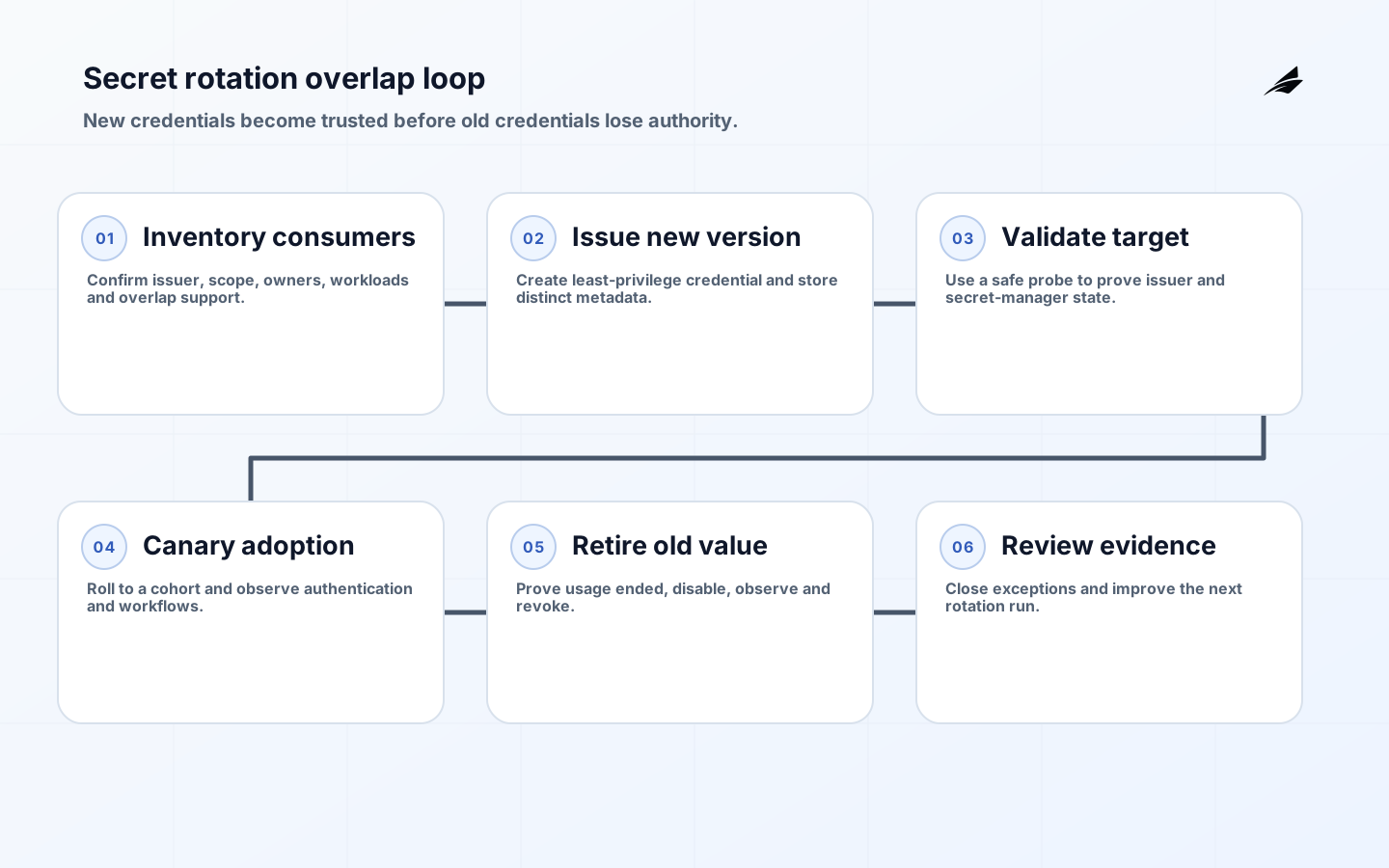
- Preflight ownership, issuer health, consumer inventory, overlap support and rollback access.
- Create a new credential with the required scope and store it as a distinct version.
- Validate the new value against the target using a non-destructive operation.
- Roll the version to a small consumer cohort and watch authentication and workflow signals.
- Complete rollout, then prove that no expected consumer still uses the previous version.
- Disable the old value, observe through a defined safety window, revoke it and retain evidence.

Make every step idempotent and resumable. Google’s rotation recommendations emphasize gradual rollout and warn that binding production consumers directly to a moving latest alias can spread a bad value immediately. Persist workflow state without persisting plaintext. Prevent concurrent rotation of the same target with locks or version checks. Use bounded retries, because repeated credential creation can exhaust provider limits. A scheduler only initiates work; the workflow still needs success criteria, timeout, alerting and a person who can intervene.
| Gate | Pass condition | Failure response |
|---|---|---|
| Preflight | Owners, consumers and recovery access confirmed | Stop and repair inventory |
| Issue | New version exists with correct scope | Revoke orphan and inspect issuer |
| Validate | Target accepts safe probe | Keep current version active |
| Rollout | Canary workflows pass within thresholds | Roll back version binding |
| Retire | Old-version usage is absent or explained | Find lagging consumer |
| Close | Old value revoked and evidence retained | Escalate incomplete rotation |
Observe adoption without exposing values
Measure rotation outcome by secret identifier and version, never by plaintext. Record requester, workflow run, issuer response, deployment cohort, validation result, old-version use, revocation and exceptions. Alert on overdue rotations, failed runs, use of disabled versions, unexpected principals and secrets without owners. Protect audit logs from modification and restrict access. Test the telemetry itself: a rotation that succeeds while the evidence pipeline is unavailable should remain incomplete or generate a reconciliation task.
Monitor customer workflows in addition to authentication errors. A database credential may authenticate while connecting to the wrong schema or lacking a newly required permission. Compare error rate, latency, queue age and business completion before and after the canary. AWS Secrets Manager supports managed and function-based rotation; whichever mechanism is chosen, the runbook must cover target updates, secret versions and consumers. Provider automation does not know every application-specific success condition.
Prepare for emergency rotation
An exposed secret is an incident, not merely an overdue maintenance task. Identify scope, disable or restrict the credential, preserve evidence, rotate related credentials where trust is shared and investigate use. Assume a value committed to a repository or written to public logs was copied. Do not delay revocation while attempting to erase every historical copy. If emergency replacement risks outage, the incident commander weighs containment against service impact and records the decision. Notify affected parties according to legal and contractual obligations.
Scale policy by risk and capability
Define policy by credential class rather than one interval for everything. Consider privilege, exposure, issuer capability, detection quality and business impact. Short-lived credentials may renew continuously; some offline keys require controlled ceremonies. Track inventory coverage, automated rotation coverage, successful completion, mean age, emergency replacement time and exceptions. Review exceptions with expiry and compensating controls. A team should first automate high-consequence, high-change credentials where manual coordination is most likely to fail.
Test rotation as a resilience exercise
Run scheduled exercises in a non-production environment that has the same binding and deployment pattern as production. Introduce a bad new value, an unavailable issuer, a lagging consumer, duplicate scheduler delivery and a failed audit sink. Confirm that the workflow pauses or rolls back without revoking the only working credential. Then rehearse emergency replacement in production for a low-consequence credential under change control. Measure discovery-to-revocation time, manual steps, missing permissions and communication delays.
Include backup and disaster-recovery consumers. A dormant environment may use a credential version that production retired months ago, causing recovery to fail when it is most needed. Restore configuration into an isolated exercise, rotate the required credentials and prove that the recovered service can authenticate without reintroducing revoked values. Update recovery images, runbooks and inventories from the result. Rotation and recovery are one dependency lifecycle, not independent platform features.
Key takeaways
- Inventory issuers, consumers, privilege, overlap and revocation before scheduling rotation.
- Replace static secrets with workload identity or leased credentials where practical.
- Use create, validate, canary, adopt, disable and revoke as explicit gates.
- Make workflows reentrant and prove business behavior, not only authentication.
- Treat exposed credentials as incidents requiring investigation beyond replacement.
Frequently asked questions
How often should secrets rotate?
Use a risk-based cryptoperiod informed by credential type, privilege, exposure and issuer guidance. Short-lived automatically issued credentials can last minutes or hours; static third-party keys may have longer periods because replacement is disruptive. Document the decision and always support immediate revocation after suspected compromise. A universal 90-day rule can create outages without addressing the most dangerous shared credentials.
Should applications restart when a secret changes?
Either restart through a gradual deployment with an explicitly bound version, or implement tested runtime reload. Restarting is often simpler and more predictable. Continuous polling of latest can spread a bad value across all instances. Whichever approach is used, prove that long-lived connections, background workers and scaled-to-zero workloads eventually adopt the new version.
What should we do with shared credentials?
Eliminate sharing by issuing a distinct identity per workload or person. Until then, inventory every consumer, reduce privilege, centralize storage and plan coordinated replacement. Shared credentials weaken attribution and make revocation expensive. Their presence should be a tracked exception with an owner and migration date, not a permanent category in the secret manager.
Conclusion
Reliable rotation is a controlled migration from one trusted version to another. Growing teams should reduce static credentials, maintain a consumer inventory, automate a staged and observable workflow, and rehearse emergency revocation. When every run ends with verified adoption, old-value revocation and retained evidence, rotation becomes an ordinary engineering operation instead of a risky event postponed until compromise forces it.