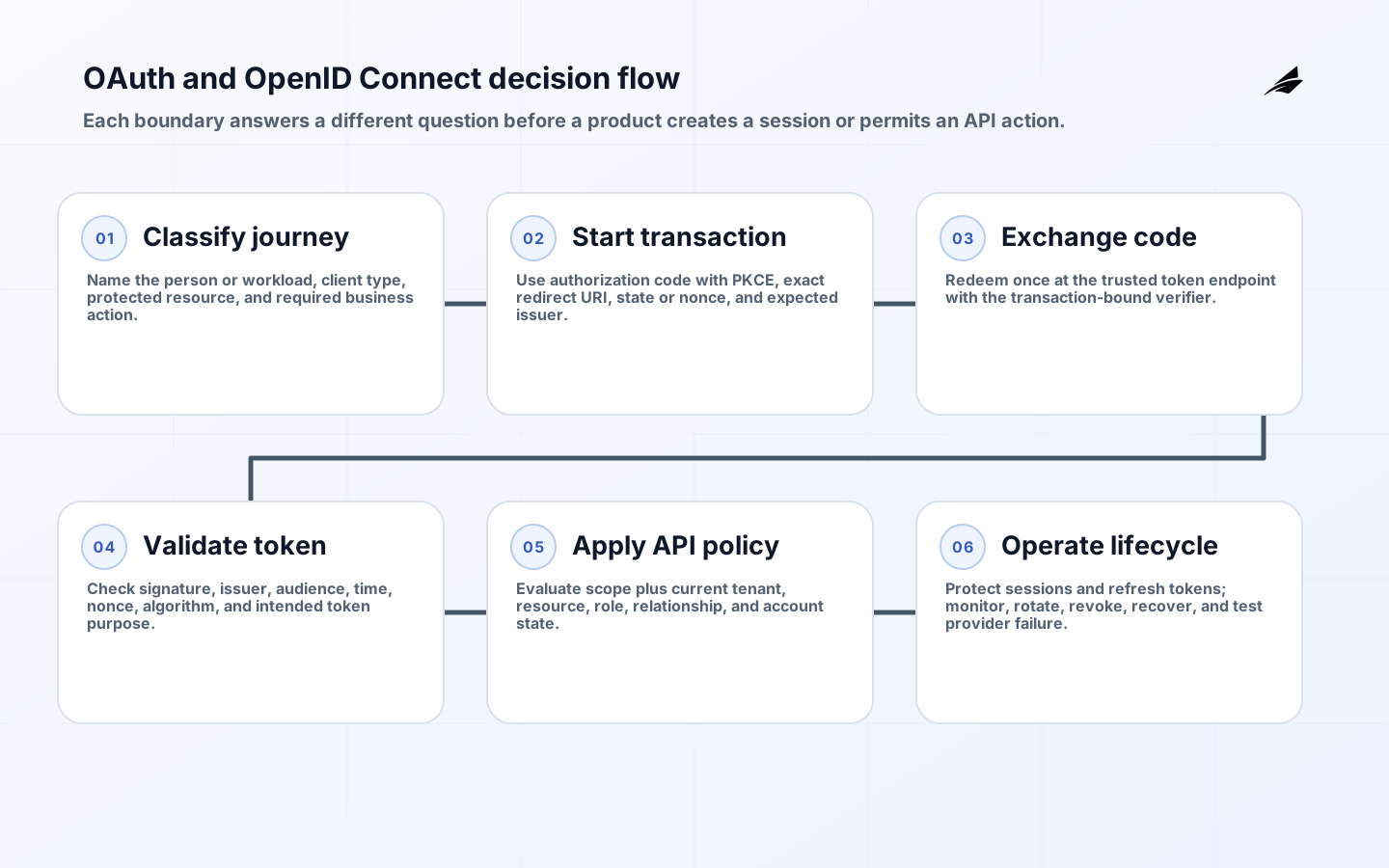
OAuth and OpenID Connect for product teams begins with a boundary that prevents many design errors: OAuth delegates limited access to a protected resource, while OpenID Connect adds an identity layer for authenticating a person. An access token is for an API; an ID token tells a registered client about an authentication event. Treating either token as a universal session credential creates audience confusion, excess data exposure, and authorization decisions that are difficult to audit.
This guide turns the standards into product decisions for browser, mobile, machine-to-machine, and partner integrations. Pair it with the API security checklist for SaaS products when designing resource servers, the investigation-ready audit log guide when defining evidence, and the data retention policy guide when deciding how long identity and consent records should remain available.
Model the actor, client, resource, and decision
Draw each journey with four explicit parties: the resource owner, client, authorization server, and resource server. For sign-in, add the OpenID Provider and relying-party terms used by OpenID Connect. Name whether the client can keep credentials confidential, where browser redirects occur, which API receives the access token, and which business action the user is authorizing. A vague requirement such as “add SSO” is not enough to select a protocol flow or define safe failure behavior.
Separate authentication from application entitlement. A valid ID token can establish that the configured issuer authenticated a subject for this client; it does not prove that the subject may approve an invoice, view another tenant, or retain access after employment ends. Map the stable issuer and subject pair to a local account, then evaluate current tenant membership, role, relationship, account state, and step-up requirements in the product’s authorization layer.
| Product need | Protocol artifact | Product responsibility |
|---|---|---|
| Sign a person in | OpenID Connect ID token | Validate the token and map the subject to a current local account |
| Call an API for a user | OAuth access token | Enforce audience, scope and resource-level authorization |
| Continue delegated access | Refresh token | Protect, rotate or sender-constrain, revoke, and limit lifetime |
| Run a backend integration | Client credentials grant | Use workload identity and narrow service permissions, not a user session |
| Display profile data | ID token claims or UserInfo | Request only data required for the declared user experience |
Choose a flow from the client’s security properties
Use the authorization code flow with PKCE for browser-based and native interactive clients. RFC 9700 applies PKCE beyond its original native-app use: public clients must use it, confidential clients are recommended to use it, and S256 is the challenge method that does not reveal the verifier. Register redirect URIs exactly and reject open redirect behavior. Do not select the implicit grant merely because an older sample or identity provider still exposes it; current best practice favors responses that return tokens from the token endpoint rather than in browser URLs.
A server-rendered web application can keep tokens in a backend session and issue only a hardened session cookie to the browser. A single-page application needs a deliberate browser security model; a backend-for-frontend can reduce token exposure but becomes a security boundary that needs CSRF defenses and session controls. Native apps should use an external user-agent and an app-claimed HTTPS redirect or platform-appropriate redirect mechanism. Service workloads should authenticate themselves and must not borrow a long-lived human refresh token.
Validate every response at the correct boundary
An OpenID Connect client must validate the ID token’s signature with keys obtained from trusted issuer metadata, restrict accepted algorithms, and check issuer, audience, expiration, and nonce where applicable. If multiple authorization servers are supported, bind each transaction to the expected issuer and token endpoint to resist mix-up. Key rotation should refresh metadata safely without accepting arbitrary key locations supplied by untrusted token content. Clock tolerance should be small, explicit, and monitored rather than used to hide synchronization failures.
A resource server validates access tokens according to their format and deployment profile. For JWT access tokens, verify signature, issuer, audience, time bounds, and authorization claims; for opaque tokens, use the trusted introspection arrangement and cache only within revocation and risk tolerances. Never send an ID token to an API as a substitute. Never let the client’s UI be the enforcement point. The API must decide whether this token, subject or workload, tenant, resource, and operation are allowed now.
| Check | Failure it prevents | Acceptance evidence |
|---|---|---|
| Exact redirect URI | Code leakage to an attacker-controlled destination | Negative tests reject wildcard and near-match routes |
| PKCE verifier binding | Stolen or injected authorization-code redemption | A code cannot be exchanged without its transaction verifier |
| Issuer and audience | Token substitution across providers or APIs | Tokens minted for another issuer or resource are rejected |
| Nonce or bound state | Login CSRF and response replay | A callback is accepted once and only for its initiating session |
| Scope plus object policy | Over-broad API action | Tests deny cross-tenant and unauthorized object access |
| Refresh-token controls | Persistent replay after theft | Rotation or sender constraint detects reuse and revokes the chain |
Design scopes, claims, consent, and account linking
Scopes should describe a coherent delegated capability that a user and API owner can understand. Avoid one scope per endpoint and avoid a single scope that unlocks the whole product. Apply least privilege through the combination of audience, scope, tenant context, and server-side object policy. Ask for incremental access when the user reaches a feature that needs it. Administrative consent must be distinguished from an end user approving a specific action, because those decisions have different authorities and evidence.
Use the stable sub value within its iss namespace as the external identity key. Email addresses can change, be recycled, or be unverified; they are profile data, not durable subject identifiers. Automatic account linking based only on a matching email can join an attacker-controlled identity to an existing account. Require a verified, authenticated linking ceremony, notify the account owner, preserve unlink and recovery paths, and record which identity asserted each consequential change.
Operate tokens, keys, sessions, and federation changes
Keep access tokens short-lived enough to limit theft impact while allowing reliable calls. Issue refresh tokens only when offline access is genuinely needed, bind them to client and user context, and use rotation with reuse detection or sender-constrained mechanisms where the ecosystem supports them. RFC 9700 recommends sender-constraining access tokens using mechanisms such as mutual TLS or DPoP where appropriate. Token storage should match the client threat model; browser local storage is not a general answer to session design.
Create operating procedures for signing-key rotation, compromised client credentials, provider outage, tenant-domain takeover, consent withdrawal, and emergency revocation. Monitor authorization failures by reason without logging raw tokens or unnecessary claims. Contract tests should run against discovery metadata, redirect handling, token validation, logout behavior, and provider key rollover. Federation changes are production changes: stage them, preserve a recovery identity for administrators, and use bounded rollout cohorts.
Implement the identity journey in controlled stages
- Write the user journey, protected action, client type, trust boundaries, and recovery path.
- Register exact redirect URIs and choose authorization code with PKCE for interactive clients.
- Define issuer, audience, scope, claim, token lifetime, consent, and local-account rules.
- Implement metadata retrieval, strict token validation, server-side authorization, and secure session handling.
- Test replay, mix-up, wrong audience, expired token, key rotation, cross-tenant access, and provider outage.
- Release to a bounded group, inspect failures and support cases, then expand with a documented rollback path.

Key takeaways
- Use OAuth for delegated API access and OpenID Connect for authentication; do not interchange their tokens.
- Select flows from client security properties and use authorization code with PKCE for interactive clients.
- Validate issuer, audience, time, transaction binding, and signature before trusting token content.
- Keep business authorization in the resource server and local product policy.
- Treat consent, account linking, key rotation, revocation, and provider failure as product workflows.
Frequently asked questions
Does using JWTs mean the application has implemented OAuth?
No. JWT is a token format, while OAuth defines authorization roles, grants, endpoints, and security behavior. A home-grown signed JWT does not acquire the protections of OAuth. Conversely, OAuth can use opaque access tokens. Choose the protocol first, then use the token profile and validation rules required by the issuer and resource server.
Is OpenID Connect the same as enterprise SSO?
OpenID Connect is one common protocol for implementing sign-in and federation. A complete SSO product also needs tenant discovery, account lifecycle, administrator recovery, session policy, audit evidence, support processes, and often other protocols. The protocol solves interoperability; the product team still owns the surrounding account experience and authorization.
Does deleting the local cookie log the user out everywhere?
Usually not. It ends the application’s local session, but the identity provider or other relying parties may retain sessions. Define whether the product needs local logout, provider-initiated or relying-party-initiated logout, token revocation, or a high-risk global response. Make the user-facing promise match what the implementation can actually terminate.
Before launch, give support and incident responders a safe way to identify the issuer, client, transaction, local account, consent, and denial reason without revealing credentials. A useful support trace shows correlation identifiers, policy version, provider response class, and local authorization outcome while redacting codes, tokens, secrets, and unnecessary claims. This closes the gap between protocol correctness and a login problem the organization can actually resolve.
Conclusion
A dependable OAuth and OpenID Connect implementation is a chain of narrow, verified decisions. Start with the actor and protected resource, choose a modern flow, bind each callback to its transaction, validate tokens for their intended consumer, and re-evaluate business permission at the API. Product quality then depends on the less visible work: understandable consent, safe linking and recovery, observable denial paths, rotation, revocation, and rehearsed provider failure.