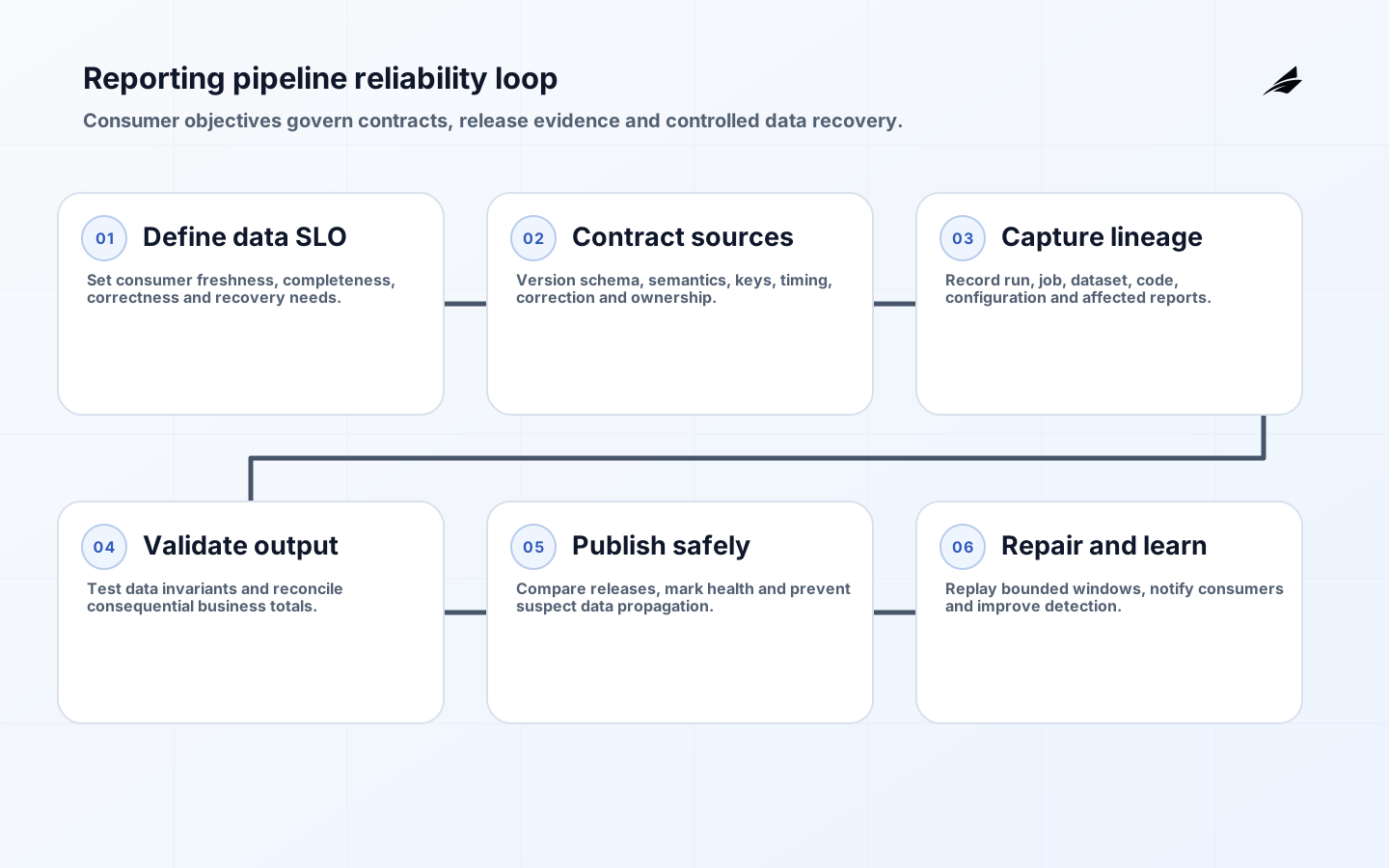
Data pipeline reliability for business reporting means delivering data that is timely, complete, correct, explainable and recoverable enough for a defined decision. A job marked successful does not prove that a finance total reconciles or that a dashboard is fresh. Reliability must be measured at the data product and business boundary, where delayed or corrupted output can change planning, payment, inventory or customer action.
This guide treats a reporting pipeline as a service with consumers, objectives, releases and incidents. It covers batch and streaming systems, although exact designs vary. The operating model should reveal stale or suspect data before users act, preserve lineage and versions for diagnosis, and support controlled repair. The objective is not zero incidents; it is bounded impact, rapid detection and trustworthy recovery.
Define consumers, decisions and data SLOs
List each material report or downstream product, its owner, decision cadence, cutoff and tolerance for delay or correction. A morning operations queue and monthly statutory report require different freshness and acceptance. Define when stale data is safer than partial data. Acceptance evidence should identify the responsible owner, the source record, the expected result and the decision required when the result is missing.
Create service-level indicators for freshness, completeness and correctness. Google SRE gives examples such as the percentage processed within a duration or the oldest data age. Add reconciliation and availability only where they reflect consumer need. Test the normal path, boundary conditions and a realistic failure path; a successful demonstration alone does not prove the reporting data service is ready.
| Objective | Indicator | Example response |
|---|---|---|
| Freshness | Age of newest complete partition | Display stale state and halt dependent refresh |
| Completeness | Expected versus delivered records or control total | Wait, isolate source or publish qualified partial state |
| Correctness | Assertions and authoritative reconciliation | Quarantine output and restore known-good version |
| Recoverability | Time to rebuild an affected window | Invoke selective replay and verify downstream state |
Establish source and transformation contracts
For every source, define schema, keys, semantics, cadence, late-data behavior, deletion, ownership and change notification. Validate required fields and distributions at ingestion. A syntactically valid value can still be semantically wrong when units or status meaning changes. Keep the definition and its effective date with the implementation so later teams can explain why historical and current behavior differ.
Version transformations and metric definitions with effective dates. Keep event time, source update time and processing time. Define idempotency, merge and correction behavior. Contracts should make breaking changes visible without pretending producers and consumers never evolve. Make exceptions visible in the same operating workflow instead of routing them to private spreadsheets or undocumented support messages.
Capture lineage and ownership as execution evidence
Record which job run read which dataset versions and produced which outputs. OpenLineage models runs, jobs and datasets with facets for schema, ownership, quality and lifecycle. Stable namespaces and names are essential if lineage is to support incident investigation. Use progressive exposure and explicit stop conditions so the team can learn from production without placing the entire estate at risk.
Link report metrics to transformations and source fields where practical. Capture code version, configuration and scheduler run. Lineage does not prove correctness, but it narrows impact analysis and identifies the owner who can explain a change. Measure the business completion time and error consequence, not only component uptime or the number of tasks closed.
Layer data tests around failure consequences
Use schema, uniqueness, non-null, accepted-value, referential-integrity and distribution checks. Add business invariants and reconciliations for consequential outputs. Test late, duplicate, out-of-order and corrected records, not only clean fixtures. Preserve identifiers, timestamps and version information across handoffs so reconciliation can distinguish delay, duplication and correction.
Run unit tests on transformations, integration tests on representative partitions and a small production-like dry run before scale. dbt tests and other tools automate assertions, but ownership and response determine whether a failed assertion protects users. Document the recovery sequence and exercise it with representative state before relying on it during a live incident.
Release pipeline changes with data-aware controls
Version code and configuration, use representative input and compare old and new outputs before promotion. Canary by dataset, tenant or period when possible. Define material-difference thresholds and inspect changed distributions rather than relying only on job completion. Apply least privilege to people and services, and record material administrative actions with enough context for later review.

Keep a known-good output or reproducible rebuild path. A code rollback may not undo corrupted tables already consumed downstream. Tag suspect data, pause dependent publication and decide whether to restore, replay or correct. Review this control when scope, integrations, users or obligations change; a launch-time decision should not become a permanent assumption.
| Change gate | Evidence | Rollback limitation |
|---|---|---|
| Schema | Producer-consumer compatibility | Old code may not read new source shape |
| Transformation | Diff on representative periods | Reverting code does not restore overwritten output |
| Performance | Peak volume and dependency headroom | Backlog can outlive deployment rollback |
| Publication | Freshness, completeness and reconciliation | Users may already have exported bad data |
| Recovery | Selective replay and downstream validation | Full rebuild may exceed decision deadline |
Monitor data symptoms and dependency health
Alert on consumer-facing SLO risk: stale partitions, missing cohorts, unexplained reconciliation variance and blocked publication. Also monitor queue age, failed records, resource saturation and dependency limits for diagnosis. Avoid alerting on every transient task retry. Separate a commercial promise from the operational mechanism and evidence that will make the promise dependable.
Provide a data health state beside reports so users know whether values are current, provisional or quarantined. Link alerts to runbooks, lineage, owners and recent changes. Test alert routing and escalation, especially around reporting cutoffs. Give users a clear degraded state and next action instead of allowing partial data or failed automation to appear complete.
Respond to data incidents without spreading corruption
First stop propagation: pause publication, isolate a partition or serve a known-good snapshot with a visible timestamp. Identify affected reports, periods and decisions through lineage and consumer inventory. Communicate impact and uncertainty, not only component status. Automate repeatable verification where it shortens feedback, while retaining accountable human judgment for consequential ambiguity.
Repair the smallest safe window and reconcile outputs before reopening. Preserve the bad version for analysis where policy permits. Notify downstream owners about exports or decisions that may need correction. Write a blameless review focused on detection, containment and prevention. Version configuration with code and deployment records so a defect can be reproduced, contained and corrected without guesswork.
Operate ownership, capacity and continuous improvement
Assign dataset, pipeline and metric owners and define who can approve corrections. Maintain runbooks for late source, schema change, corrupt output, failed replay and missing credentials. Exercise recovery and dependency failure rather than assuming orchestration retries are enough. Define a small set of leading and lagging measures, then remove metrics that have no owner or operating response.
Track SLO attainment, detection time, restoration time, repeated incidents, test effectiveness, replay cost and user-discovered defects. Retire unused reports and pipelines to reduce hidden risk. Review growth, hotspots, retention and rebuild duration before capacity becomes an incident. Record dependency guarantees and throttling behavior in SLO design so upstream and downstream limits are visible before failure.
Assess reporting-pipeline production readiness
Before a pipeline becomes authoritative, prove that the team can identify its consumers, interpret health, contain bad output and rebuild a bounded window. Use a readiness review that follows one report from source contract through transformation, lineage, publication and decision. Include a late-source incident and a corrupt-transformation incident. The exercise should reveal who can pause publication, communicate impact and approve corrected data.
- Publish freshness, completeness and correctness objectives for named consumers.
- Verify contracts, ownership and lineage for every material input and output.
- Demonstrate representative data tests and authoritative reconciliation.
- Exercise quarantine, known-good serving, selective replay and downstream notification.
- Confirm retention and capacity support the required rebuild window.
Repeat readiness after a new critical source, major transformation rewrite or reporting cutoff change. Review actual incidents to refine the scenarios. A pipeline may remain technically stable while the business raises its freshness expectation or adds a regulated use. Production readiness is therefore a maintained agreement between data owners, operators and consumers, not a one-time deployment gate.
Key takeaways
- Define reliability from consumer decisions and cutoffs.
- Use contracts, effective dates and lineage for explainability.
- Test business invariants, late data and correction paths.
- Release with output comparison and data-aware rollback plans.
- Contain suspect data, reconcile repairs and communicate affected decisions.
Frequently asked questions
What is the difference between data observability and data quality?
Observability supplies signals and context about pipeline and dataset behavior. Quality evaluates whether data meets defined requirements. Observability can reveal freshness or distribution change, but owners still need contracts, assertions, reconciliation and response decisions to determine whether output is fit for use.
Should a pipeline publish partial data?
Only under an explicit consumer policy. Some monitoring decisions prefer timely partial data with clear coverage; financial or regulatory reports may require complete reconciled input. Define the threshold, label the state and prevent downstream users from mistaking a partial refresh for final output.
Is exactly-once processing required?
Not universally. Many reliable designs use at-least-once delivery with idempotent processing and deduplication. Select semantics based on business consequence, technology and recovery needs. Whatever the choice, test retries and reconcile effects rather than relying on a marketing label.
Conclusion
Reliable reporting pipelines are operated as services, not scheduled scripts. Their SLOs describe consumer-visible data, their contracts and lineage explain change, and their recovery plans account for state already written and consumed. Trust grows when the system identifies uncertainty before users do.
Start with one consequential report. Define its cutoff, freshness, completeness and reconciliation, then trace every producing job and dataset. Exercise a corrupt transformation and selective replay. The lessons will reveal which controls the wider reporting estate needs most.