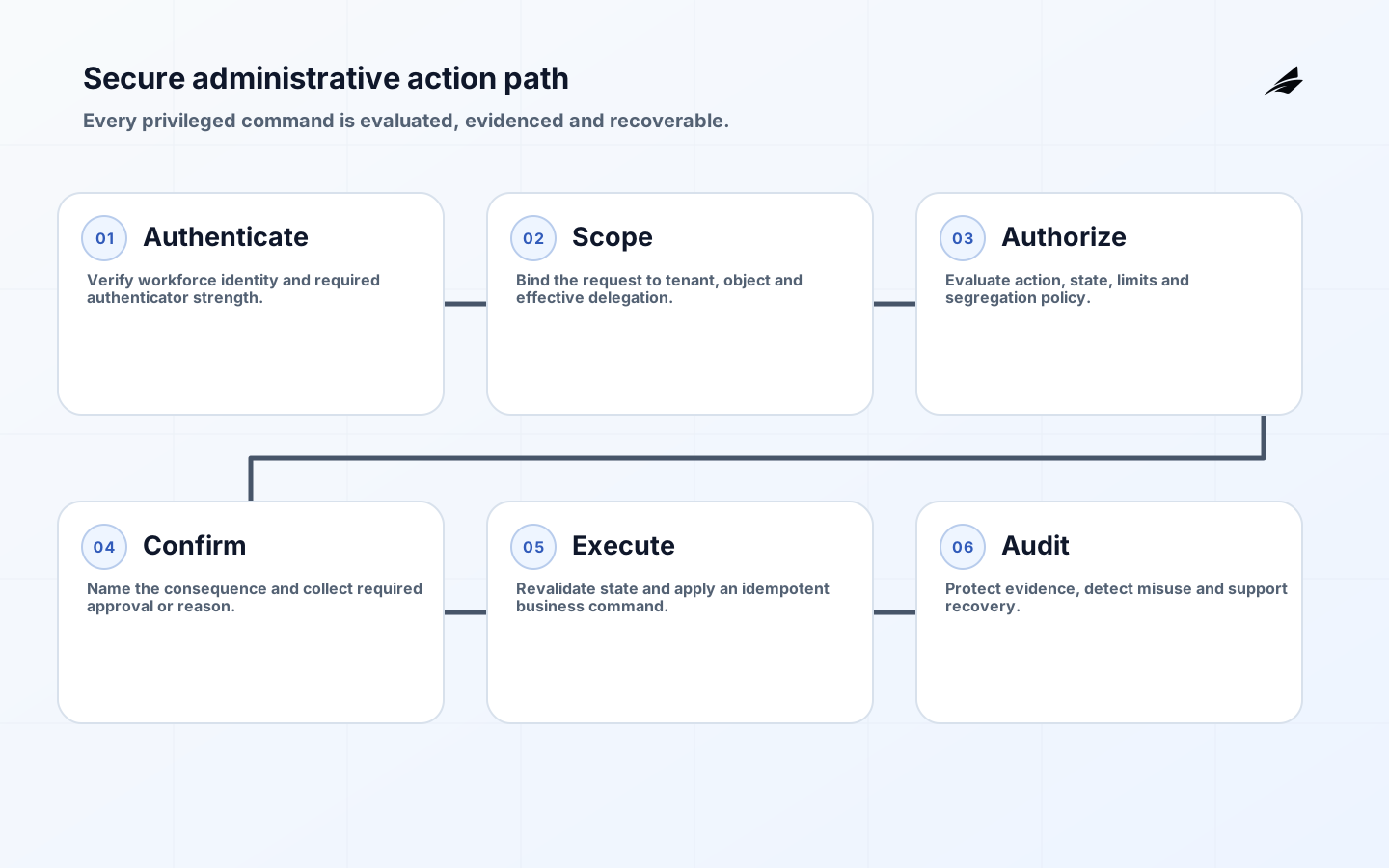
Secure admin panels for service businesses protect the screens that can change customer records, prices, schedules, access, payments and service outcomes. These panels concentrate authority and often expose many tenants through one operator account. Security therefore depends on the full action path: authenticated identity, current employment, tenant context, object authorization, business constraints, confirmation, execution, audit and recovery. Hiding a URL or limiting it to an office network is not an adequate control.
Design begins by inventorying consequential actions and the harm from misuse or error. The audit log investigation guide and OAuth and OpenID Connect guide provide adjacent detail. This article focuses on the admin surface as an operational control system.
Inventory privileged actions and affected objects
List create, read, update, delete, export, impersonate, refund, reschedule, grant, revoke, configure and bulk actions. For each one record object type, tenant, impact, required role, separation requirement, step-up need, reversibility and notification. Include background effects such as emails, integrations and billing. A harmless-looking field change can trigger a consequential downstream action; authorization must protect the command, not only the page.
Use stable internal identifiers and explicit tenant scope in every service call. Never infer authorization from a record identifier supplied by the browser. The server should load the object, establish its tenant and evaluate the subject's permission for that exact action and state. Apply the same policy to APIs, exports and bulk endpoints. A disabled button is usability, not enforcement.
| Action | Minimum control | Additional protection |
|---|---|---|
| View customer record | Tenant and object authorization | Field masking and access reason |
| Export data | Scoped permission and limits | Recent authentication, approval and notification |
| Refund or credit | Amount and account policy | Segregation above threshold |
| Grant administrator | Privileged role authorization | Step-up and independent approval |
| Impersonate user | Dedicated permission and purpose | Visible banner, short duration and immutable audit |
Use strong workforce identity and bounded sessions
Prefer managed workforce federation with prompt offboarding, phishing-resistant authentication for privileged users and controlled emergency accounts. Bind sessions to an authenticated subject and current role state. Rotate session identifiers after sign-in and privilege changes, enforce inactivity and overall limits, and terminate sessions when access is revoked. Require recent stronger authentication for exports, credential changes, impersonation and other high-impact actions.
Network and device signals can add context, but NIST zero-trust principles caution against treating location as sufficient trust. Verify each access request according to identity, resource, action and policy. Protect cookies, redirect flows and tokens according to current OAuth and browser guidance. Do not embed long-lived administrative tokens in client code or share generic administrator accounts.
Make authorization explicit and testable
Define permissions around business capabilities rather than page names. Roles may group permissions, while attributes such as tenant, region, assignment, amount and record state refine decisions. Keep policies understandable enough for service owners to review. Deny unknown combinations. If an operator temporarily covers another region, represent delegation with approver, scope and expiry instead of permanently expanding a role.
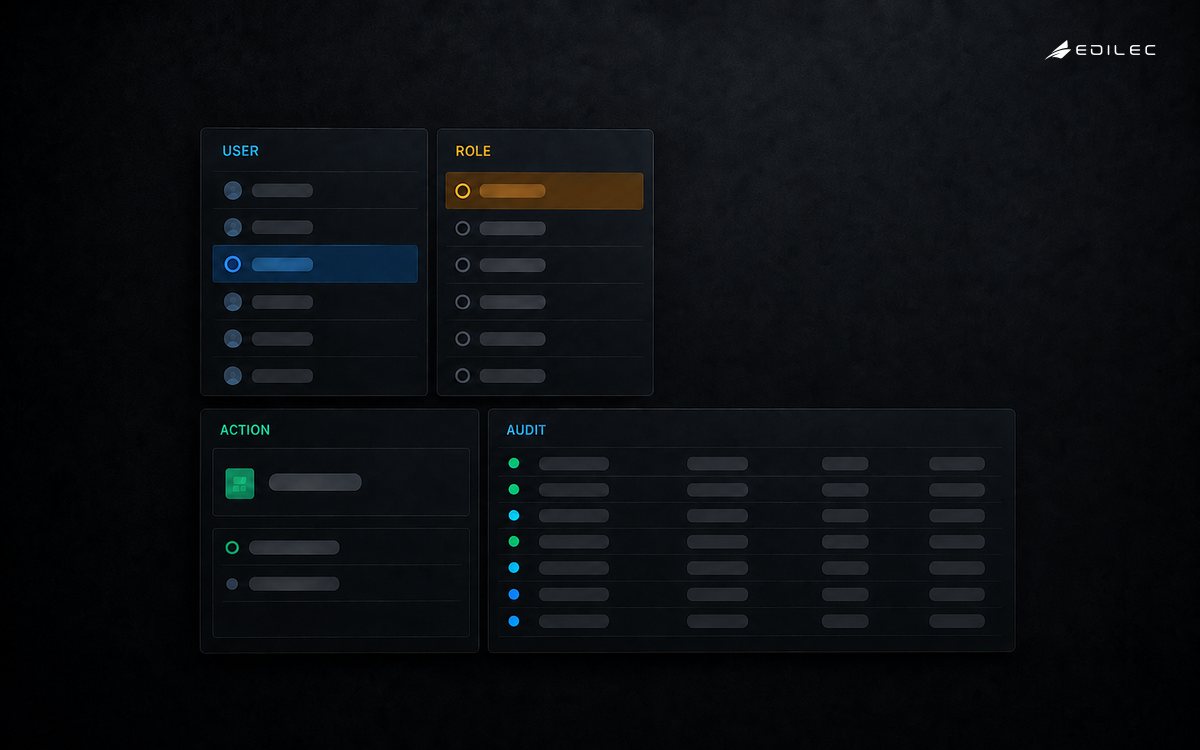
Centralize policy logic where it reduces drift, but enforce close to the protected data and command. Cache carefully and invalidate on role changes. Test horizontal access across tenants and objects, vertical access between ordinary and privileged roles, and state-specific restrictions. Include batch endpoints and indirect references. OWASP ASVS provides a practical verification vocabulary for authentication, session, access control and audit requirements.
| Control test | Expected result | Evidence |
|---|---|---|
| Change object ID to another tenant | Request denied without information leakage | Authorization decision and correlation ID |
| Replay privileged request after role removal | Request denied | Current policy evaluated |
| Bulk action includes unauthorized row | Atomic reject or documented partial result | Per-object decision summary |
| Concurrent refund requests | Limit and idempotency enforced | Single business effect |
| Expired delegation | No residual permission | Expiry and reconciliation record |
Design high-impact actions for prevention and recovery
Use clear confirmation that names the customer, scope and consequence, especially for bulk or irreversible operations. Require a reason where it supports review, but do not rely on free text as authorization. Validate current state immediately before execution and use idempotency for repeated requests. Prefer reversible status changes or staged deletion when business and legal requirements allow. Show partial failures honestly instead of reporting the whole batch as successful.
Impersonation needs a separate, highly visible mode with purpose, short expiry and restricted actions. Never disclose the customer's credential or create an indistinguishable session. Record both operator and represented subject. Notify or obtain consent where policy requires it. Emergency override should be rare, monitored and reviewed afterward; it must not become the normal route around a difficult workflow.
Create audit evidence that supports investigations
Record who acted, their session and effective role, tenant, object, action, decision, relevant before-and-after values, approval, reason, time, result and correlation. Avoid passwords, tokens and excessive personal content. Protect logs from alteration and restrict access. Synchronize time and document retention. The OWASP logging guidance distinguishes security-relevant application events from general diagnostic logs; both may be correlated but have different audiences and controls.
Alert on patterns with operational meaning: mass export, repeated denied cross-tenant access, new admin grants, emergency overrides, unusual impersonation, disabled controls and destructive bulk actions. Tune by role and service context. Review privileged membership and delegations regularly. An alert is not a control unless someone owns triage, escalation and containment. Exercise the process with representative misuse and error scenarios.
Release and operate admin changes carefully
Threat-model new actions and test policy at API boundaries. Use peer review, dependency checks and protected deployment. Roll out high-impact changes to a small operator cohort and monitor decisions and business effects. Keep an emergency disable control that blocks the action server-side. Train operators on the new state and recovery path, not only the button sequence.
Measure authorization denials, stale privileges, audit completeness, override use, failed bulk actions and time to revoke access. Investigate unexpected changes rather than optimizing every denial downward. Admin friction can reveal a missing delegation model or workflow defect. Balance efficiency with the consequence of error, and improve the underlying policy instead of issuing broader roles.
Exercise realistic misuse and operator-error scenarios
Test a compromised ordinary agent attempting another tenant's record, a privileged operator exporting outside assignment, a supervisor granting access to themselves, a stale browser replaying after offboarding and a support user abusing impersonation. Include accidental scenarios: wrong customer selected, duplicate refund click, broad bulk filter and incomplete integration response. For each case, verify prevention, visible feedback, audit evidence and containment. Tabletop the incidents with service and security owners so escalation authority is understood.
Use production-like authorization policy and representative tenant data structures without copying unnecessary customer content. Security testing should cover direct API calls, alternate HTTP methods, parameter manipulation and batch boundaries. Rate limits protect availability but do not replace permission checks. Review server-side logs to confirm denials do not leak object existence. Add regression tests for every discovered authorization defect at the narrowest reliable service boundary.
Require evidence before enabling a new privileged action
Acceptance should include an approved action and role definition, threat model, object-level policy tests, high-impact confirmation, idempotency, failure behavior, audit schema, alert routing, recovery runbook and accessibility review. Confirm that role removal and session revocation take effect within the intended time. Verify that the action can be disabled independently and that existing records remain understandable after rollback.
After release, sample completed actions and denied attempts, reconcile audit records to business effects and review unexpected override. Revisit permissions when services, teams or contracts change. Do not wait for an annual access review to remove obviously stale roles. A short regular review between operations, product and security keeps policy aligned with real work and identifies where the interface is encouraging risky workarounds.
Keep an inventory of administrative endpoints and jobs alongside the visible interface. Retired screens sometimes leave callable APIs, scheduled tasks or old mobile routes behind. Verify removal at the authorization and deployment layers, rotate obsolete credentials and preserve only the audit history required. Surface reduction is a practical control: every unused privileged route removed is one less policy and dependency to secure. Review the inventory after every major workflow retirement or platform migration.
Key takeaways
- Inventory privileged actions and downstream effects.
- Use strong workforce identity, short high-assurance sessions and rapid revocation.
- Enforce object and tenant authorization on the server.
- Make consequential actions confirmable, idempotent and recoverable.
- Create protected audit evidence and an owned detection process.
Frequently asked questions
Is a VPN enough to secure an admin panel?
No. A VPN reduces exposure but does not establish business authorization or protect against compromised insiders and sessions. Keep strong authentication, object-level policy, safe actions and audit controls inside the application.
Is role-based access control sufficient?
Roles are a useful starting point. Service businesses often also need tenant, assignment, region, amount, record state and delegation constraints. Keep the model understandable and test combinations; avoid either one super-admin role or an unmanageable permission explosion.
Should audit logs store every field value?
Store enough to reconstruct material decisions without creating a second sensitive database. Mask secrets and unnecessary personal data, use structured change summaries and link to protected source records where appropriate. Retention and access should follow defined investigation needs.
Conclusion
A secure admin panel is a controlled path for consequential work. Strong identity, current object authorization, clear action design, durable audit and practiced recovery reduce both malicious misuse and ordinary operational mistakes. These controls belong in the product architecture, not around it as an afterthought.
Start with the five actions that could cause the most customer or financial harm. Trace each from operator authentication through business effect and audit. Fix gaps there before expanding the administrative surface.