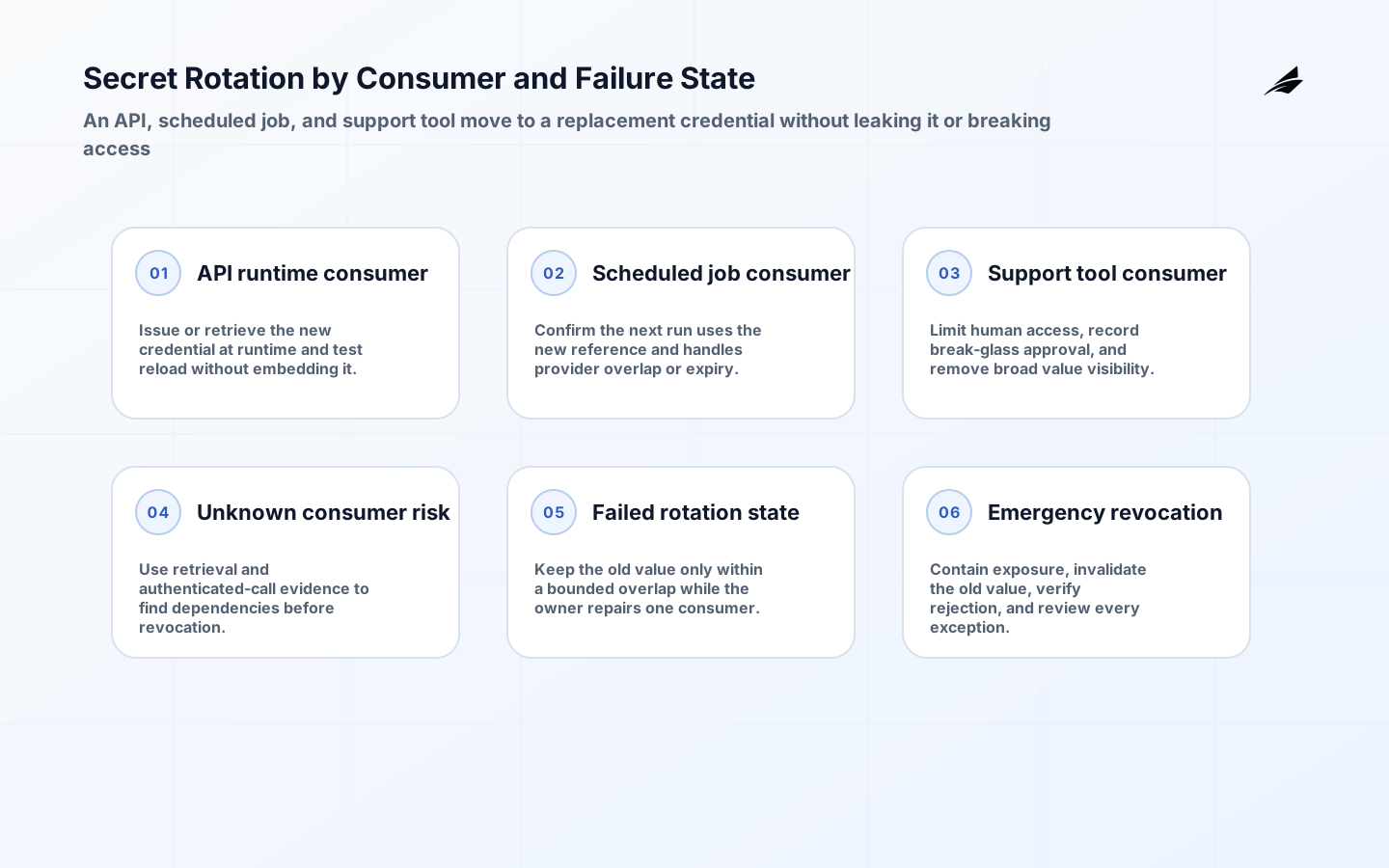
Secrets management is the discipline of controlling values that grant access or prove identity: API tokens, database passwords, private keys, signing material, and credentials issued by an external system. The difficult part is rarely choosing a vault product. It is deciding which applications need which capability, who owns the credential lifecycle, how a workload proves its identity, and what happens when a value is exposed or a service account changes. A secret copied into a repository, CI variable, container image, or chat transcript creates a different recovery problem in every location. Begin with a lifecycle rather than a storage location. A secret should have a purpose, owner, consumer, scope, rotation mechanism, expiry behavior, and revocation path. Without those fields, rotation becomes a risky outage exercise and inventory becomes a list nobody can trust.
Design the lifecycle first
Build an inventory around access relationships, not just string values. For each secret, record the provider or system it unlocks, the human or team accountable for it, the workloads that consume it, the environment, the permitted operations, the last rotation, and the next review. Classify high-consequence secrets separately: a production database credential, customer encryption key, or deployment signing key needs a more deliberate recovery process than a low-risk test token. Avoid placing raw secret values in the inventory. The record should point to a protected secret reference and include enough context for a responder to assess impact. This makes it possible to answer a breach question quickly: which access paths may be affected, which workloads must be restarted, and which external systems must be notified.

Prefer identity and runtime delivery
The strongest design often reduces the number of long-lived secrets a workload needs. Where the platform supports it, give the workload a verifiable identity and issue short-lived credentials or scoped tokens at runtime. Where a static secret is necessary, retrieve it through a controlled integration, keep it out of build artifacts, and expose it only to the process that needs it. Base64 encoding is not encryption, and a Kubernetes Secret is not automatically a complete protection model; access control, encryption at rest, and careful workload mounting still matter. The secrets management implementation checklist can help teams examine deployment details, but the architectural question comes first: could this access be granted through identity rather than a reusable shared value?
| Decision | Preferred direction | Why it matters |
|---|---|---|
| Consumer identity | Use a distinct workload or service identity. | Limits blast radius and makes access attributable. |
| Delivery time | Retrieve or issue credentials at runtime. | Keeps secrets out of source and image layers. |
| Scope | Grant the smallest useful operation and resource set. | Reduces the effect of compromise. |
| Rotation | Automate replacement where the dependency supports overlap. | Makes expiry a routine operation rather than an emergency. |
| Audit | Log retrieval metadata, not secret values. | Supports investigation without creating another leak. |
Make rotation and revocation operational
Rotation is successful only when consumers move to the new credential and the old one can be revoked without breaking legitimate work. Start by documenting whether the target system permits overlapping credentials. If it does, create the new value, update consumers, confirm successful authentication, and then revoke the prior value. If it does not, schedule a bounded maintenance window and test the recovery path in advance. Include external vendors and human-operated integrations; they are often the hidden consumers that make rotation fail. Revocation needs its own trigger path for suspected exposure, employee departure, workload retirement, and accidental publication. A process that requires a security specialist to find every consumer before access can be removed will be slow precisely when speed matters.
- Assign a lifecycle owner, even for vendor-managed credentials.
- Use secret references in configuration rather than secret values.
- Test the consumer restart or reload behavior before a real rotation.
- Keep an emergency revocation runbook separate from the routine rotation guide.
- Review dormant secrets and unused identities on a scheduled cadence.
- Record failed retrievals and unusual access patterns without recording sensitive values.
Control access and observe use
Humans should not have broad read access merely because they can deploy an application. Separate the ability to reference a secret, administer its policy, retrieve its value, and change the consuming workload. Use short-lived elevated access for break-glass cases and record the approval and expiry. For runtime systems, monitor retrieval failures, sudden increases in access, access from unexpected identities, and secrets approaching expiry. These signals are useful only when they route to someone who can distinguish a legitimate deployment from a compromised path. Do not send secret material into logs, traces, error reports, or support tickets. Redaction should be tested with realistic failure messages because many leaks occur during debugging, not in the intended access flow.
| Event | Response question | Owner |
|---|---|---|
| Secret nearing expiry | Can consumers move without interruption? | Application owner. |
| Possible exposure | Which systems and operations are reachable? | Security and service owner. |
| Retrieval failure | Is the identity, policy, path, or provider unavailable? | On-call operator. |
| Dormant credential | Is there still a justified consumer? | Lifecycle owner. |
| Break-glass access | Was the use approved, bounded, and reviewed? | Access administrator. |
Implement in deliberate slices
Start with the most consequential production integration and map its real consumers. Move it from source control or build variables into a protected delivery path, then test deployment, restart, rotation, and emergency revocation. The next slice can standardize the workload identity and policy pattern for similar services. Do not migrate hundreds of unknown values into a vault and call the program complete; that may improve storage while preserving unclear ownership and stale access. Establish a lightweight intake for new secrets that asks for purpose, owner, consumer, expiry, and recovery instructions. It is much cheaper to collect that context at creation than during an incident.
Key takeaways
- Secrets management is a lifecycle and ownership problem before it is a tool choice.
- Prefer workload identity and short-lived issuance to embedded, long-lived values.
- Keep secret values out of inventories, artifacts, logs, and support channels.
- Design routine rotation and emergency revocation as separate operating paths.
- Use access evidence to find dormant, failed, and anomalous use.
Frequently asked questions
Are environment variables always unsafe? They can be appropriate in a controlled runtime, but they may be exposed through process inspection, crash reporting, or deployment tooling; assess the full path. Can a team rotate a secret without downtime? Often, when the provider permits overlapping credentials and consumers can reload the change; test it rather than assuming. Does encryption at rest solve secrets management? No. It protects one storage layer but does not establish consumer identity, rotation, least privilege, or revocation. What is the first inventory field to add? Start with accountable owner and consuming system, because neither rotation nor incident response works without them.
Decision criteria for secrets management
A team should make secrets management decisions from a written comparison, not an intuition that a tool or pattern is generally safer. For a payment provider key used by an API, a scheduled reconciliation job, and a support tool, state the baseline, the change being considered, the expected benefit, and the condition that would make the action unsafe. The decision record should name the credential, consuming workload, and access policy; it should also identify the smallest reversible step. That creates a practical distinction between a hypothesis and an approved change. A useful reviewer can then ask whether a staged rotation or emergency revocation is possible without creating an unowned side effect, whether successful authenticated calls, retrieval failures, and unusual access will be available in time, and whether the affected people understand the service consequence. The record does not need ceremony. A short change note with links to the release, owner, measurement, and recovery path is enough to make later investigation much faster.
Use an explicit example before automating the rule. Consider a payment provider key used by an API, a scheduled reconciliation job, and a support tool. Walk through the normal case, the delayed case, and the failure case with the people who operate it. Identify which input is authoritative, what a missing or stale input looks like, and what an operator can safely do while evidence is incomplete. For secrets management, this exercise often exposes a hidden assumption about timing, identity, or compatibility that a happy-path demonstration never reaches. It also clarifies what must be visible to support: current state, change owner, linked evidence, and the next action. Build those details into the workflow or runbook before increasing automation. A reliable default is useful only when its exceptions are observable and recoverable.
Failure analysis and recovery for secrets management
Plan for rotating a value without knowing every consumer or logging the replacement secret while diagnosing a failure. Detection should route to the application owner and the administrator of the issuing system, but the alert or review item must contain enough context to start an investigation without manual archaeology. Include the relevant version or policy identifier, affected scope, timestamp, correlation reference, and the last known healthy comparison where available. The first response should reduce further harm while preserving evidence; the second should validate whether the apparent fault is data quality, a dependency condition, an operator change, or the design itself. Recovery does not always mean returning to the previous state. Sometimes it means a forward correction, an access restriction, a narrower cohort, or a temporary manual procedure. Document which action is safe for the case and who may authorize it.
- Define a precondition for a staged rotation or emergency revocation and test it with a representative non-production or limited-production case.
- Keep the identifiers needed to connect the credential, consuming workload, and access policy to the change, investigation, and owner.
- Make successful authenticated calls, retrieval failures, and unusual access visible at the point where a release or operator decision is made.
- Treat an exception as data: capture why it was needed, who approved it, and when it expires.
- Review recurring failures with the application owner and the administrator of the issuing system and convert the strongest lesson into a control, contract, or runbook improvement.
Operating review for secrets management
Set a review cadence that matches the risk and rate of change. The review should ask whether the current approach still produces the promised outcome, whether successful authenticated calls, retrieval failures, and unusual access is trustworthy, and whether the exception path is being used as a substitute for a missing capability. Examine a small number of real cases instead of only aggregate charts: one successful change, one delayed or rejected change, and one recovery. This evidence makes trade-offs concrete. If the pattern repeatedly depends on expert intervention, reduce the scope or improve the supported path before expanding it. If the outcome is stable, publish the decision criteria so adjacent teams can reuse the model without copying assumptions that do not apply to them.
Conclusion
Effective secrets management makes sensitive access narrow, attributable, replaceable, and recoverable. Design the lifecycle around real consumers, use identity where possible, and rehearse both rotation and revocation before a production event forces the issue.