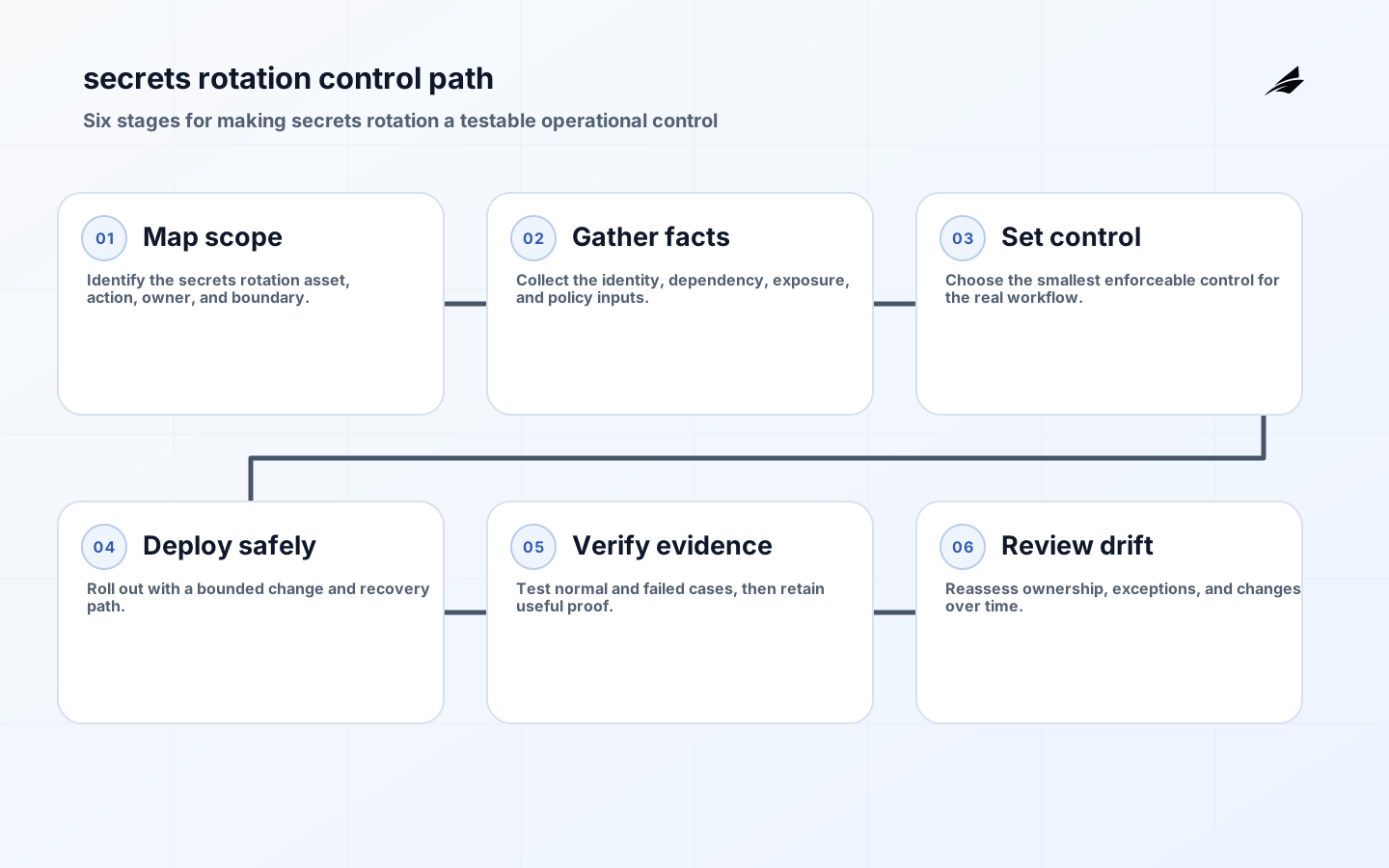
Secrets rotation is often described as a calendar task, but a secret is not secure merely because a new string exists. The useful outcome is a controlled handoff: the intended workload receives a replacement credential, dependent systems accept it, the prior credential loses authority, and operators can prove which version was active at each point. That makes secrets rotation both a containment control and a reliability exercise. It limits the useful life of a leaked value while exposing dependencies that would otherwise stay hidden until an urgent revocation. Start with one credential that reaches a valuable service and trace its consumers, issuance path, storage locations, and recovery owner.
Map the secret lifecycle before automating rotation
Inventory is the first hard problem. A team should distinguish human passwords, API keys, database credentials, signing keys, client secrets, certificates, and cloud access keys because their issuers and rollover mechanics differ. Capture the secret's purpose, owner, consumer identity, privilege, creation time, expiration rule, and the system that can revoke it. A value copied into a build variable, laptop configuration, or vendor console is still part of the lifecycle. Treating a vault as the whole inventory misses the dangerous edges: deployment templates, CI variables, break-glass procedures, and old integration settings.
| Decision point | Practical choice | Evidence to retain |
|---|---|---|
| Credential | Safe rollover pattern | Evidence |
| Database password | Add a version, move pools, then retire the prior version. | Successful connection and retirement timestamp. |
| API client secret | Register replacement, update client, validate exact audience. | Client identifier and authenticated test. |
| Signing key | Publish verifier material before switching the signer. | Key identifier, verification result, retirement date. |
Design secrets rotation controls that can be enforced
Choose a rotation design that supports overlap only where the target system can identify versions safely. A dual-credential pattern lets a client fetch a new value, deploy it, verify authenticated calls, and then retire the old value. For a database account, this may mean a new account or password version plus a connection-pool restart plan. For a signing key, the verifier needs a published key set and a retirement date. Do not rotate by overwriting a value in place if clients may cache it; that turns a security change into an unbounded outage.
- Classify the credential by issuer, privilege, and blast radius.
- Name the workload or person responsible for every consumer.
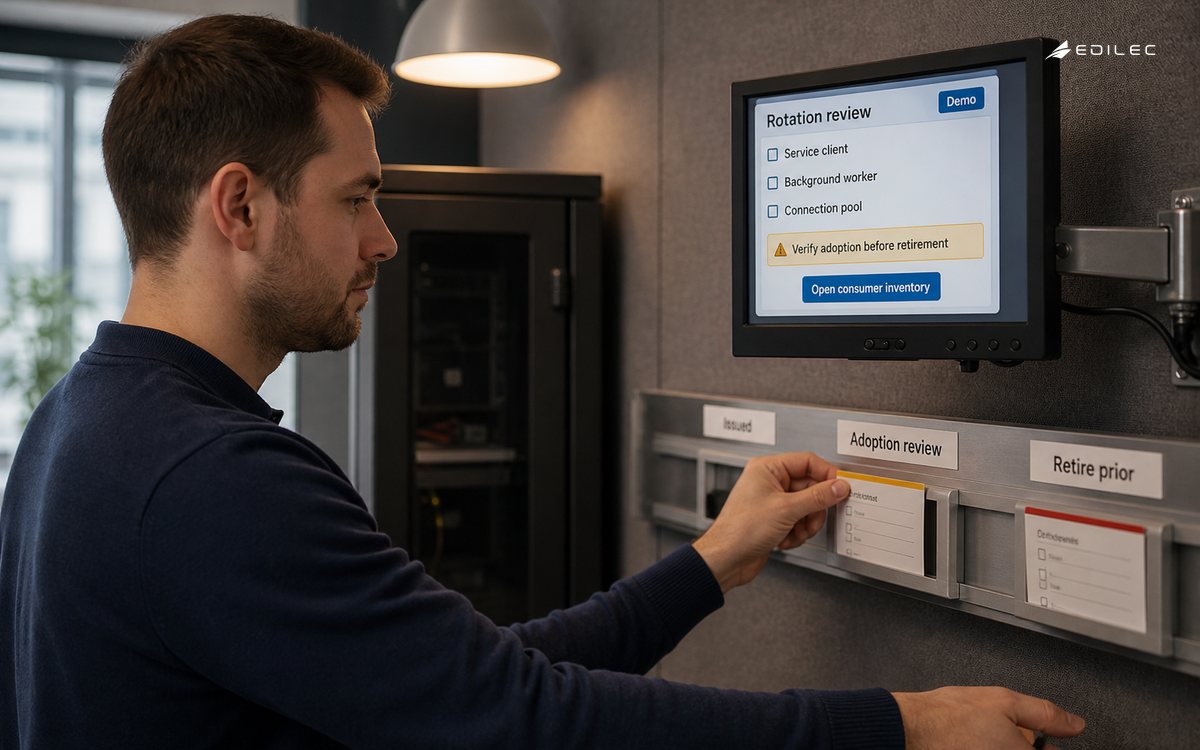
- Use versioned overlap only long enough to verify adoption.
- Revoke through the authoritative issuer and record the result.
- Exercise a failed rotation before relying on the automation.
Operate secrets rotation as a controlled change
Automate the path only after proving the manual sequence. The automation needs least-privileged authority to create, distribute, validate, and revoke, not broad administrative access to every target. Use workload identity where available so the rotator does not become another long-lived secret. Bound retries, make every transition idempotent, and leave an explicit state record for issued, propagated, verified, revoked, and failed. A failed rotation should preserve the known-good value until the designated owner decides otherwise; silent deletion is not a recovery strategy.
Work through a secrets rotation example
A realistic drill is a payment service whose database password is consumed by several deployments. Issue a second password or principal, update one canary deployment, test a real query and transaction rollback, then move the remaining deployments in batches. Confirm that connection pools have discarded the older credential before revocation. The same drill should test a stale worker that wakes after the change, because background jobs are a common source of unexpected authentication failures. Record timestamps and version identifiers, never the secret itself, in the operational evidence.
Test and verify secrets rotation
Test the failure cases that pressure encourages teams to skip: the vault is unavailable, a target API is slow, one client cannot refresh, the new secret has too much scope, or revocation succeeds while an old connection remains live. Each case needs a decision owner and a bounded response. A rotation system is trustworthy when it tells operators what changed, what remains on the old version, and whether the old value is still authorized. Pair lifecycle events with audit logs so an investigation can reconstruct access without exposing credentials.
| Test or review | Expected behavior | Escalate when |
|---|---|---|
| Test | Expected result | Escalate when |
| New version validation | A real protected action succeeds with the replacement. | Any consumer still needs the old version. |
| Vault outage | The system preserves the known-good state and alerts an owner. | Automation would delete or overwrite a working value. |
| Revocation | The issuer rejects the old credential and logs the event. | Old sessions or connections remain useful. |
| Expired exception | The owner renews with a reason or removes it. | No accountable risk decision exists. |
Measure and govern secrets rotation
Measure coverage and safety rather than celebrating the number of jobs scheduled. Useful signals include the share of secrets with a named owner and tested rotation path, age beyond policy, time spent in overlap, failed validation rate, and emergency static exceptions. Review exceptions at the same cadence as privileges. A secret without an owner or feasible rotation plan deserves a visible risk decision, not an assumed exemption. When an acquisition, platform migration, or new vendor changes a dependency, revisit the inventory before the new connection becomes permanent.
Governance should define who may approve an extension, who can invoke emergency revocation, and how an application team demonstrates readiness. The policy can be short, but it must connect a classification to an interval and a tested procedure. High-impact credentials generally justify shorter lifetimes and more careful monitoring; low-impact integration keys may require a practical migration window. The important principle is evidence: a rotation date in a ticket is weaker than proof that consumers used the replacement and the old capability was removed.
A further operational consideration for secrets rotation is that the rotator must identify every consumer before it changes authority, including background workers, connection pools, deployment variables, and break-glass procedures. Give this boundary a named owner and a regular review point. The useful evidence is not a generic attestation; it is a record that identifies the system, decision, and observed result. When the expected control does not hold, the response should be visible and bounded so people do not improvise an unreviewed workaround. This detail is often where a policy becomes an operating practice.
Reliable secrets rotation depends on recognizing that version overlap has to be bounded and observable so operators know precisely which client has adopted the replacement and whether the earlier value still authenticates. Put the rule near the system that can enforce it and make the supporting workflow accessible to legitimate users. Document the inputs, authority, failure response, and recovery owner before relying on automation. That level of specificity helps teams distinguish a true requirement from a historical convenience, and it leaves a reviewer with enough context to assess whether the control still fits the current service.
In a mature secrets rotation program, the authoritative issuer should perform revocation, while evidence records timestamps and version identifiers without ever storing the credential itself. Test the condition through the same path used in production, including an expected failure and a recovery step. Capture concise evidence, then review it when a dependency, team, or threat assumption changes. This keeps the design connected to actual behavior instead of allowing a diagram or written rule to stand in for a control that nobody has recently exercised.
The governance implication for secrets rotation is that changes in scope, public exposure, or CI usage should trigger a lifecycle review because a credential's risk comes from its capability rather than its label. Establish an owner who can make the necessary tradeoff, a time limit for exceptions, and an escalation path for material risk. A short, well-maintained decision record is more useful than a broad policy document because it tells operators what to do when the normal path cannot be followed and how the organization will return to it.
Service owners should publish a rotation readiness checklist alongside deployment documentation. It can state the supported credential version behavior, refresh mechanism, expected validation call, rollback decision, and contact route. That makes secret handling visible to the engineers who own availability without expanding their access to secret material.
When a provider cannot support timely revocation or version overlap, record the limitation as an architectural risk. The response may be a wrapper service, a different credential type, a compensating boundary, or a planned migration. Leaving the limitation implicit creates the illusion that a scheduled job provides containment when the issuer cannot actually withdraw authority.
A sound secrets rotation program makes responsibility practical for application teams. They should know the approved retrieval path, refresh behavior, validation endpoint, and emergency contact, while the security platform retains issuance and revocation authority. This division allows teams to operate their services confidently without normalizing access to raw credentials. Review the arrangement during architecture changes, because a new consumer or deployment method can create a lifecycle gap even when the rotation scheduler continues to run.
Key takeaways
- Classify the credential by issuer, privilege, and blast radius.
- Name the workload or person responsible for every consumer.
- Use versioned overlap only long enough to verify adoption.
- Revoke through the authoritative issuer and record the result.
- Exercise a failed rotation before relying on the automation.
Frequently asked questions
How often should secrets rotate? Set the interval from privilege, exposure, issuer capability, and recovery cost. A shorter interval is not meaningful unless consumers can adopt the replacement and the old value can be revoked reliably.
Can rotation be fully automatic? It can be automated for mature targets, but human ownership remains necessary for failures, exceptions, and changes in dependency behavior.
Conclusion
In conclusion, secrets rotation works when it is treated as an observable credential lifecycle rather than a periodic password reset. Map every consumer, design version overlap deliberately, verify a real request, revoke with a recovery path, and review exceptions. That sequence reduces both credential exposure and the operational fear that usually leaves sensitive values unchanged for too long.