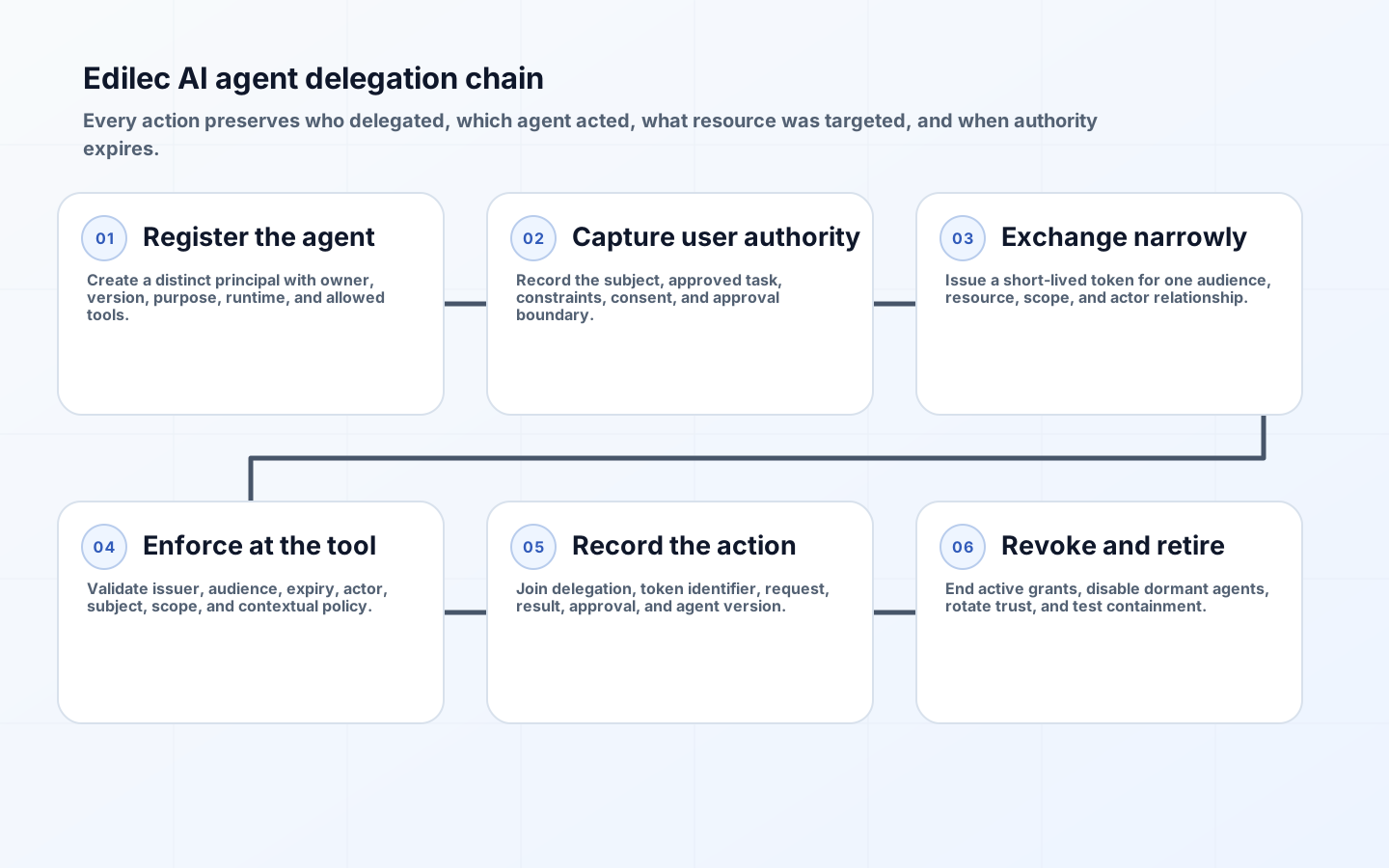
AI agent identity is the distinct principal assigned to an agent runtime so its requests can be authenticated, authorized, attributed, constrained, revoked, and retired independently from users and other automation. A shared service account cannot show which agent version acted, who delegated authority, which task was approved, or when that authority should end. Embedding a user's broad token is worse: compromise or prompt manipulation may turn a bounded task into every action the user could perform.
OAuth token exchange provides useful semantics. RFC 8693 distinguishes impersonation, where the actor becomes indistinguishable from the subject within a rights context, from delegation, where the actor remains separately identified while representing the subject. Agent systems usually benefit from delegation because downstream services and investigators need both identities. The protocol does not supply the trust model or authorization policy; architects must define agent registration, user authority, token claims, tool enforcement, evidence, and revocation.
Register a distinct principal for every AI agent
Create one logical principal per agent product and security boundary, not necessarily per ephemeral process. Record owner, business purpose, model and orchestration version, runtime environment, permitted tools, data classifications, risk tier, deployment identity, approval policy, and retirement date. Separate development, test, and production agents. Forks or tenant-specific agents need distinct identities when policy or blast radius differs. Never let the agent choose its own privileged identifier from prompt content.
Authenticate the runtime through a managed workload identity, attestation, certificate, or protected client mechanism. Rotate bootstrap trust and prevent a development runtime from claiming a production agent. Link each process instance and trace to the registered principal and deployment version. Inventory this identity with other automation, but add agent-specific fields for model, tools, memory store, prompt policy, and human approval. Dormant agents should lose token-minting authority even if their code remains deployed.
Separate agent, user, and system authority
Model at least three participants: the human or system subject requesting an outcome, the agent actor planning or invoking operations, and the resource server that owns the action. The agent's standing identity should permit it to request specific delegations, not grant permanent access to every tool. User authority limits what may be delegated; agent policy can be narrower; resource policy makes the final decision. Preserve tenant and session boundaries so one user's context cannot authorize another user's data.
Classify autonomous maintenance separately from on-behalf-of work. A monitoring agent acting for its own service identity may not have a human subject. A purchasing agent acting on a manager's request must preserve that manager and any approver. A drafting agent may need read access but no send permission. The agent tool permissions guide helps define bounded operations; identity design ensures those bounds remain attributable at token and resource layers.
Design the AI agent identity delegation chain
Capture the authorized task before minting credentials: subject, agent, tenant, goal, target resource, allowed operations, data boundary, monetary or business limit, approval state, validity window, and whether further delegation is permitted. Translate that mandate into machine policy, not free-form prompt text alone. At exchange, authenticate the agent client, validate the subject token or approval artifact, and issue a token only if policy permits this actor to receive that delegation. Link the token to the mandate and trace identifier.

| Claim or binding | Purpose | Validation | Unsafe omission |
|---|---|---|---|
| Issuer and token type | Identify trusted authorization service and format | Exact issuer, signature and expected type | Attacker supplies token from another trust system |
| Subject | Identify user or system whose authority is represented | Active account, tenant and delegation policy | Action cannot be tied to delegator |
| Actor | Identify the distinct agent principal and chain | Registered agent, deployment and allowed delegation | Agent impersonates user invisibly |
| Audience or resource | Bind token to one target service | Exact target match at resource server | Token is replayed at another tool |
| Scope and constraints | Limit operations and business bounds | Resource action plus contextual policy | Broad token outlives task intent |
| Expiry and token ID | Bound exposure and support revocation or correlation | Clock, freshness, replay and denylist policy | Stolen token remains useful and untraceable |
Issue narrow, time-bounded credentials
Prefer just-in-time tokens for a single audience and a small operation set. Make lifetime shorter than the task's meaningful authorization window and require fresh exchange for later work. Avoid refresh tokens unless offline continuation is an explicit, reviewed requirement. For high-impact actions, bind the credential to proof of possession where supported, require step-up or human approval, and use transaction-specific constraints such as amount, account, destination, or record set. One token should not unlock an entire connector merely because the agent may need one method.
The current MCP authorization specification requires resource indicators for HTTP authorization, audience validation by MCP servers, tokens in authorization headers rather than query strings, and forbids token passthrough. It also describes incremental scope challenges. Apply those boundaries to agents: a token received for one MCP server must not be forwarded to another tool, and insufficient scope should trigger bounded step-up or a denied action, not use of a stored all-powerful token.
Enforce authority at every tool and resource
The resource server must validate signature or introspection, issuer, audience, expiry, actor, subject, tenant, scope, mandate status, and contextual policy before performing an operation. Do not rely on the model to remember a prompt prohibition. Validate object-level authorization after resolving identifiers and recheck business conditions that may have changed since planning. Separate preview from commit. Require idempotency keys, concurrency control, and human approval for irreversible or high-impact transactions. Return structured denials the orchestrator cannot reinterpret as success.
Protect against confused-deputy behavior by binding the requested resource and rejecting arbitrary destinations. Tool descriptions and retrieved content are untrusted input; they cannot expand token scope. A tool should not accept a user token intended for another resource, nor should the agent exchange one subject's authority for another tenant. The secure API access guide provides resource-side patterns that remain essential even when the caller is an intelligent agent.
Record an attributable action chain
Join the user request or system trigger, subject, agent principal and version, mandate, approval, token exchange identifier, resource and scope, tool request, authorization decision, material result, and downstream change ID. Record policy versions and timestamps. Minimize prompts, retrieved data, credentials, and tool output in logs; use hashes or artifact references where full evidence belongs in protected storage. Never log bearer tokens. The audit-log architecture guide helps preserve useful evidence without making observability a secret repository.
Design queries before choosing events: Which agent changed this record? For whom? Under what approval? Which credential and policy authorized it? What other actions used the same mandate? Was the result reversed? Can responders identify all tokens minted for a compromised agent version? Attribution should survive handoffs between agents. Represent the actor chain without allowing unlimited delegation depth; cap, validate, and display each hop so responsibility does not disappear into orchestration.
Revoke delegation and retire dormant agents
| Event | Immediate control | Follow-up | Evidence |
|---|---|---|---|
| User withdraws authority | Stop new exchange and revoke active mandates | Expire sessions and reconcile pending actions | Withdrawal and denied use |
| Agent version is compromised | Disable principal or version and target trust | Rotate runtime identity and inspect actions | Issuance stop and incident scope |
| Tool connector is compromised | Reject its audience and suspend related delegations | Restore tool trust and reauthorize | Resource blocks and replacement keys |
| Owner or purpose changes | Freeze privilege expansion | Recertify tools, scopes and risk tier | New owner approval |
| Agent becomes dormant | Remove token-minting authority | Archive configuration and dependencies | No issuance or use during hold |
| Business service retires | Revoke principals, mandates and credentials | Delete trust, roles, memory and schedules | Negative access tests and closure |
Short token lifetimes limit but do not replace revocation. Stop new issuance, disable agent or user principals, invalidate mandates, change resource policy, and revoke sessions as supported. Test how quickly each control takes effect and whether queued jobs retain authority. Maintain a kill path independent of the agent runtime. During retirement, remove schedules, webhooks, client registrations, trust mappings, roles, secrets, memory stores, and approval routes. Monitor for attempted use after disablement before final deletion.
Test identity and delegation boundaries
Test cross-user and cross-tenant context, token replay at another audience, actor omission, expired mandates, scope escalation, unapproved step-up, agent handoff, changed business limits, compromised prompts, tool-instructed token passthrough, concurrent actions, withdrawn consent, disabled agent versions, and issuer outage. Verify denials at the resource, not just in agent traces. Measure overbroad token requests, insufficient-scope loops, approval bypass attempts, orphan principals, dormant issuance, revocation latency, unexplained actions, and recovery from failed exchanges.
Review identity architecture whenever an agent gains a tool, model behavior changes materially, a connector adds methods, a tenant boundary changes, delegation becomes asynchronous, or a new agent-to-agent handoff appears. NIST's zero-trust architecture rejects implicit trust based on location or ownership; agents likewise need current identity and policy evidence for each resource request. Capability growth should produce a deliberate authority review, not silent scope accumulation.
AI agent identity takeaways
- Register each agent security boundary as a distinct, owned, version-linked principal.
- Preserve the human or system subject separately from the acting agent.
- Translate approved tasks into machine-enforced mandates and narrow token claims.
- Issue short-lived credentials for one audience, resource, scope, and delegation chain.
- Validate authority at tools and resources; prompt instructions are not access control.
- Record attributable evidence and test revocation, dormancy, compromise, and retirement end to end.
AI agent identity FAQ
Can an agent use the user's access token? Passing a broad user token through the agent obscures the actor and expands exposure. Prefer exchange or delegation that issues a narrower token preserving both subject and agent for the intended resource.
Does every agent instance need a permanent identity record? Not necessarily. Register the logical agent and deployment identity, then correlate ephemeral instances and traces. Separate permanent principals when ownership, policy, tenant, environment, or blast radius differs.
Is a short-lived token enough to secure an agent? No. It limits exposure duration, but issuer trust, audience, actor and subject, scope, resource authorization, approval, storage, logging, revocation, and prompt or tool attacks still matter.
Conclusion
Distinct agent identity and delegated credentials turn autonomous action into a governable chain. The subject authorizes a bounded task, the registered agent acts visibly, the authorization service issues narrow time-limited authority, and the resource enforces it. When evidence and revocation preserve that chain, organizations can expand agent capability without collapsing users, software, and standing privilege into one shared credential.