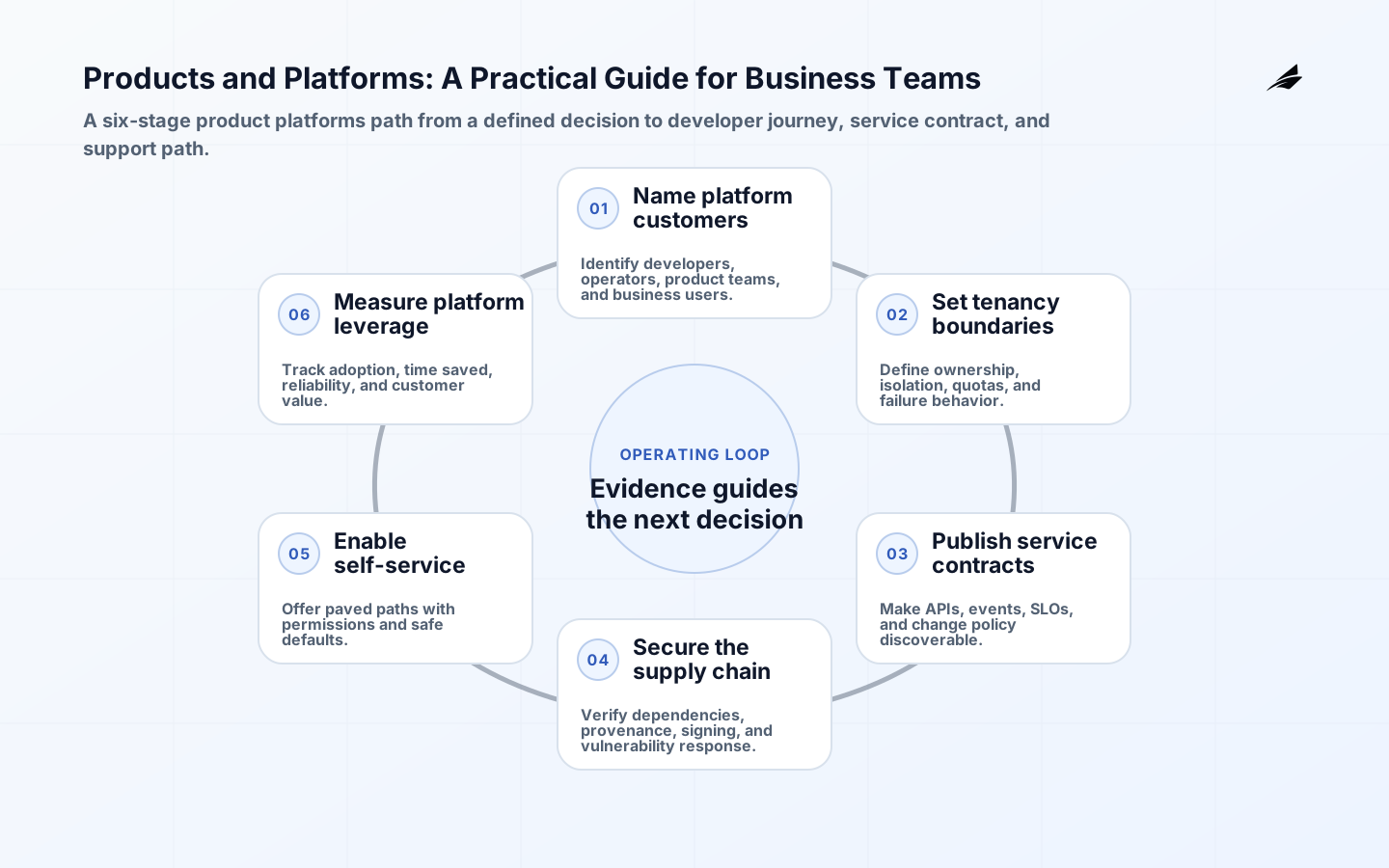
Products and platforms are related operating choices, not interchangeable labels. A product delivers a coherent outcome to a user or buyer. A platform offers reusable capabilities to several product teams or ecosystem participants and must earn adoption from those consumers. This practical guide helps business teams decide what should remain product-specific, what merits shared ownership and how to fund both through their lifecycle. Apply it alongside the implementation checklist, products and platforms FAQ and medical device platforms guide.
The CNCF Platforms White Paper frames internal platforms as curated capabilities and experiences for internal customers. The NIST Secure Software Development Framework provides lifecycle security practices, SLSA 1.2 supplies software supply-chain provenance concepts, and OpenTelemetry signals support portable service evidence. For web products, WCAG 2.2 makes accessibility a testable product requirement rather than a final interface review.
Products and platforms solve different but connected problems. A product delivers an outcome to a user or buyer; a platform supplies reusable capabilities that enable multiple products, teams or partners. Implementation fails when teams call shared infrastructure a platform without treating users as customers, or build a product around internal components rather than a validated need. This products and platforms implementation checklist aligns discovery, architecture, delivery, security, operations and measurement.
Use the products and platforms FAQ and products and platforms FAQ for portfolio decisions. Teams in regulated contexts can compare the medical device platform guide. Begin with a named user and workflow; shared capability should emerge from repeated, evidenced needs rather than a desire to standardize everything.
1. Define the user outcome and platform customer — product platforms
| Question | Product evidence | Platform evidence |
|---|---|---|
| Who is the user? | Segment, role, journey and buyer | Eligible developer or operator teams |
| What improves? | Behavior and outcome baseline | Workflow time, cognitive load or reliability |
| What is shared? | Reusable domain capability | Golden path, service or policy control |
| What stays optional? | Configuration and integration choices | Escape hatch with owned risk |
| What ends support? | Lifecycle and migration policy | Deprecation, replacement and consumer plan |
2. Set product, platform and tenancy boundaries — product platforms
A platform earns its boundary by removing repeated decisions that do not differentiate the consuming product. It may provide identity integration, deployment controls, secret handling, telemetry, or approved data access, while product teams retain their domain and customer decisions. Publish owners, service tiers, dependencies, quotas, support hours, lifecycle, and deprecation. Provide an explicit exception route with a receiving owner; otherwise teams will bypass the platform or turn its private support channel into an unmeasured ticket queue.
For a SaaS product or shared business capability, make tenant isolation a demonstrated behavior. Decide where identity, data, compute, configuration, encryption, and telemetry are separated based on consequence and operating cost. Carry tenant context through requests, jobs, exports, logs, and support actions; test cross-tenant access, deletion, restore, and regional failure. Promise data residency, customer-managed keys, or dedicated control planes only when the team can migrate and recover them without weakening isolation.
3. Approve evolvable architecture and contracts — product platforms
Describe the capability in terms a consuming team can operate: context, data authority, trust boundaries, dependencies, interfaces, and failure behavior. Choose modules where ownership and change patterns support the split, not because a diagram has more boxes. For APIs, state schema, auth, idempotency, error, timeout, retry, version, and rate limits; for events, state identity, ordering, replay, retention, and compatibility. Record the assumptions that would trigger redesign and test the highest-risk consumer path before fixing the roadmap.
A platform or product must make change consumable. Version database and API behavior, support mixed releases where needed, publish deprecation notices with a replacement and date, and expose usage telemetry to both owners and consumers. Give teams contract tests and reproducible environments rather than hand-built exceptions. Set capacity and cost budgets. The architecture is credible when a consumer can understand degraded behavior, recover its data, and leave a capability without an emergency rewrite.
4. Build security, accessibility and supply-chain evidence — product platforms
Accessibility belongs in the product or platform task, not just in its component library. Use WCAG 2.2 to test complete flows: keyboard and focus behavior, zoom, errors, authentication, status messages, and assistive technology. A shared design system helps only when consumers preserve its semantics in composition. Put accessibility and security findings into the same release decision as reliability and cost, with an owner for remediation and a safe path for users who cannot complete the normal interaction.
| Release evidence | Minimum proof | Owner |
|---|---|---|
| User value | Observed journey and acceptance scenario | Product manager |
| Architecture | Decision records, contracts and failure tests | Technical owner |
| Security | Threat model, access tests and supply-chain record | Security owner |
| Accessibility | Automated and human complete-journey tests | Product and accessibility owners |
| Operations | Service objectives, telemetry, recovery and support | Service owner |
5. Deliver self-service with safe defaults — product platforms
A golden path is a tested journey, not a template repository. It should take a team from a clear intent—create a service, obtain an approved environment, deploy, observe, and recover—to a supported result with visible ownership and policy evidence. Show what the automation creates, what it assumes, and where it stops. Measure completion, failure, and assistance required while teams perform real work; private chat and unexplained configuration indicate that the queue has been hidden rather than removed.
Make the common path opinionated and the uncommon path explicit. Use safe defaults, progressive disclosure, and documented interfaces for teams that need to diverge; assign those teams the resulting ownership rather than promising universal support. Keep deployment, permission, and runtime behavior visible enough for a product team to diagnose a failed platform path without waiting for the platform team. Keep a catalog with owner, status, dependencies, objectives, support, and lifecycle, and use observed consumer friction—not the loudest bespoke request—to set priorities.
6. Release, observe and recover — product platforms
Roll out a product or shared capability to a cohort whose work can be observed and contained. Use feature controls, consumer compatibility checks, repeatable and resumable migration, and reconciliation before expanding. Set objectives around completed user or developer journeys as well as component health. Carry consistent context through traces, metrics, and logs using the OpenTelemetry signals model, while filtering tenant, customer, and secret-bearing attributes from operational telemetry.
7. Measure product value and platform leverage — product platforms
Measure value at the point where work becomes easier or more successful. For a product, pair activation or retention with completed jobs, quality, support, and commercial outcomes. For a platform, define eligible consumers before calculating adoption and measure time-to-task, success, reuse, reliability, support load, satisfaction, and cost per useful result. API calls, provisioned environments, or mandatory usage are activity, not value; segment the data so heavy consumers do not conceal broad friction.
Sequence a product and platform roadmap — product platforms
Find repeated friction in real product work before proposing a platform. Shared ownership is justified when several consumers need comparable behavior and one team can improve safety, speed, or cost without owning their domain decisions. Deliver the smallest end-to-end path, onboard willing teams, and measure completed tasks and exceptions. Do not force every product to migrate at once; choose early consumers with meaningful complexity and enough capacity to expose gaps without turning the pilot into an unbounded services queue.
Compare build and buy at the capability boundary, not at the vendor feature-list level. Examine tenancy, regions, interfaces, observability, security evidence, scale pricing, upgrade behavior, portability, and exit for the work consumers actually need. Exercise export and re-import of critical configuration and data. Keep the business contract and decision vocabulary owned internally even when a supplier runs the implementation; otherwise its limits become the organization’s architecture by accident.
Retirement is part of the platform promise. Identify every consumer, announce the reason and date, provide migration examples or tooling, measure remaining use, and keep support available through the agreed window. Confirm that consumers have moved and can recover before removing credentials, data paths, or infrastructure. Preserve the decision and evidence so a future team understands why the capability ended and does not recreate the same dependency under a new name.
Implementation takeaways — product platforms
- Name the product user and platform customer, then baseline their complete workflow.
- Standardize repeated capability while preserving domain ownership and safe exceptions.
- Design tenancy, contracts, compatibility and migration as first-class concerns.
- Make security, supply-chain and accessibility evidence part of release acceptance.
- Provide observable self-service with supported defaults and honest escape hatches.
- Measure realized value and leverage, then deprecate capability that does not earn use.
Frequently asked questions — products and platforms
Is a developer portal an internal platform? — product platforms
No. A portal is an entry point, not the platform itself. The platform must provide supported capabilities, automation, usable interfaces, reliability, ownership, and a team that learns from consumer work. Evaluate whether developers can complete a defined task, understand what was created, recover from failure, and obtain help through the published route. A catalog with no dependable outcome is documentation wrapped around an unresolved queue.
Does a scalable platform require microservices? — product platforms
No. A higher service count can increase coordination, deployment, observability, and support cost without improving the customer or developer outcome. Choose boundaries for load, ownership, failure isolation, and release cadence. A well-structured monolith may be the safer product boundary while demand and team structure are still changing; split only when evidence shows that separation improves the work enough to pay for its operational surface.
Conclusion — products and platforms
Products and platforms reinforce one another when each has a named customer, a boundary, and an operating promise. Validate the outcome, standardize only repetition that has been observed, protect contracts and tenant data, and publish evidence for release and retirement decisions. Keep learning from user and operator work so the shared layer expands where it reduces real friction, changes where it creates risk, and ends where it no longer serves people.
Products and Platforms: A Practical Guide for Business Teams: a decision example
Business teams can distinguish a product from a platform by asking who receives value and how. A product directly serves an external or internal user outcome; a platform provides reusable capabilities that let other teams deliver outcomes with less cognitive load. The distinction is not a hierarchy. An internal platform still needs a customer, a problem statement, a usable interface, documentation, reliability expectations, and a roadmap. Platform Engineering guidance describes this as treating developers as customers rather than as a ticket queue.

Make the product-platform decision inspectable
Write the operating contract before selecting the technology. State what a team can self-serve, what is supported, which defaults are safe, how exceptions work, and what happens during an incident. A golden path should be opinionated enough to reduce decisions while leaving a documented escape hatch for legitimate needs. Include onboarding, access, cost visibility, security checks, observability, and decommissioning. If the platform requires a private meeting for ordinary work, its product design is incomplete.
Prioritize by evidence from user journeys. Observe how teams create services, ship changes, debug production, rotate credentials, and recover failures. Measure lead time, deployment friction, failed changes, time to restore, onboarding time, adoption of supported paths, and support demand. Avoid using usage alone as proof of value: a mandatory platform can have high adoption and still create frustration. Pair quantitative signals with interviews and task observation, then publish the tradeoff behind each roadmap decision.
Govern platform boundaries as a portfolio. Give each capability an accountable owner, lifecycle, service objective, documentation standard, and retirement rule. Product managers and engineers should review reliability, security, cost, and developer experience together. A platform can become a new bottleneck if it centralizes every decision, so set service-level expectations for the platform team and a route for teams to report unmet needs. The goal is an ecosystem that makes delivery easier while keeping responsibility visible.
Frequently asked questions — products and platforms — part 2
Conclusion — products and platforms — part 2
A product platform creates leverage when its customers, contracts, safeguards, self-service paths, and value measures are explicit.