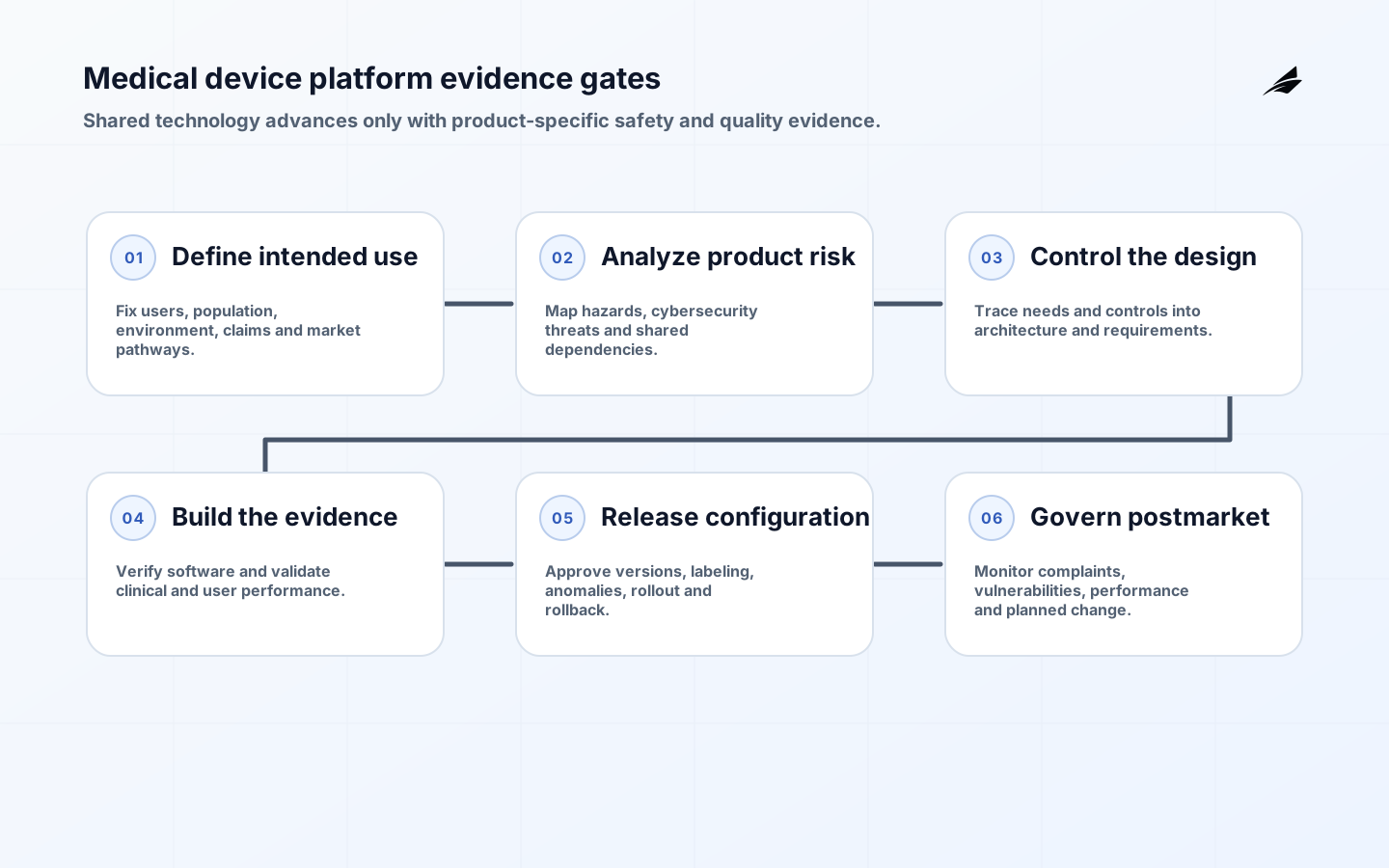
A medical device platform must preserve safety, effectiveness and evidence while software, connected components and operating environments change. It may include device software functions, cloud services, clinician portals, patient applications, analytics, update systems and interfaces to other products. This medical device platform implementation checklist helps product, quality, regulatory, clinical, security and engineering teams agree what the platform does and what evidence is required before release.
Use the medical device platform delivery guide to frame the product strategy and the medical device platform FAQ for common classification and operating questions. Teams working across regulated portfolios should also review the pharma and medical device implementation checklist. Regulatory obligations depend on jurisdiction, intended use and product facts; this checklist supports planning but does not replace regulatory advice.
Freeze intended use before platform architecture
Write intended use, indications, user population, use environment, operating principle and clinical workflow in testable language. Identify every software function and whether it meets the definition of a device in each target market. A shared login, telemetry pipeline or rules engine may serve several products, but its risk contribution changes by context. Maintain a product-to-platform dependency map that shows which marketed devices rely on each common service and which claims that service supports.
Select the regulatory pathway and submission strategy before committing to a release sequence. The FDA's Medical Device Software Guidance Navigator organizes current guidance by topics including device description, interoperability, performance testing, cybersecurity and AI. Record assumptions and obtain agency feedback where uncertainty could materially change evidence or architecture. Do not use a platform label to blur the legal manufacturer, submission owner or product-specific configuration.
| Boundary | Required record | Typical failure if omitted |
|---|---|---|
| Clinical | Intended use, patient population, user and workflow | Validation does not represent actual use |
| Product | Device functions, non-device functions and accessories | Requirements and submission scope become ambiguous |
| Technical | Hardware, software, cloud, network and third-party dependencies | Shared changes affect products without impact review |
| Organizational | Legal manufacturer, suppliers and service responsibilities | Complaints, incidents and corrective actions lose ownership |
| Market | Jurisdictions, pathways, versions and distribution states | A release is legal in one market but not another |
Place platform work inside the quality system
As of February 2, 2026, FDA's Quality Management System Regulation incorporates ISO 13485:2016 by reference and applies to finished device manufacturers within scope. Define how platform requirements, risk management, supplier controls, configuration management, complaints, nonconforming product and corrective action fit the quality system. A software team's agile board is useful work evidence, but it is not automatically a compliant design history or risk record.
Create traceability from user need and hazard control to system requirement, architecture element, verification, validation and release configuration. Shared capabilities need both platform-level requirements and product-specific allocation. For example, the platform can verify authenticated message transport, while a device team validates that delayed or missing measurements are handled safely in its clinical workflow. Define review independence and signatures according to procedure, and keep electronic records attributable and retrievable.
Turn risk analysis into architecture
Model foreseeable sequences of events, including misuse, connectivity loss, stale configuration, incorrect patient association, clock drift, partial update, corrupted data, unavailable cloud service and compromised credentials. Link each risk control to a verifiable behavior. Defense in depth matters when a platform connects products: device-side safe states, message validation, least privilege, tenant and product separation, signed updates, immutable release metadata and monitored administrative actions prevent one fault from becoming fleet-wide harm.
For interoperable functions, define semantics as well as transport. Specify units, precision, identifiers, timestamps, ordering, missing values, status codes, supported versions and behavior for unknown fields. Validate both sides of each interface and test mismatched versions. Labeling and integration instructions should disclose prerequisites, limitations and failure indications. Treat interface simulators and conformance fixtures as controlled test assets so partners can reproduce expected behavior.
- Approve a system architecture that names safety boundaries and shared dependencies.
- Trace hazards to controls, requirements, tests and residual-risk decisions.
- Use unique device, patient, user and software-version identifiers where the workflow requires them.
- Define safe behavior for offline, delayed, duplicated, reordered and malformed messages.
- Control build, signing, release and update credentials with separation of duties.
- Keep a supported-component inventory and a process for vulnerability intake and remediation.
Build software and clinical evidence together
The FDA guidance on premarket submissions for device software functions describes recommended software documentation and uses Basic and Enhanced Documentation Levels according to risk criteria. Design the evidence repository around the applicable submission, not around a generic document list. Preserve architecture, requirements, risk analysis, software description, verification, validation, revision history and unresolved anomalies with consistent version references.
Software verification proves implementation against requirements; design validation proves that the device meets user needs and intended use. Include representative hardware, networks, user roles, environments and data. The IMDRF SaMD clinical evaluation framework distinguishes valid clinical association, analytical or technical validation and clinical validation. Plan those evidence streams early, because a technically correct algorithm can still lack support for the claimed clinical relationship or target population.
| Evidence set | Platform example | Acceptance decision |
|---|---|---|
| Requirements verification | API contracts, access rules, alarms and update behavior | Every requirement passes or has an approved disposition |
| System validation | End-to-end use by representative clinicians or patients | Critical tasks are completed safely in intended conditions |
| Clinical evaluation | Association, technical performance and clinical performance | Evidence supports intended use and claims |
| Cybersecurity | Threat model, SBOM, testing, residual risk and response plan | Security risks are controlled across the product lifecycle |
| Release configuration | Binaries, infrastructure, models, rules, labeling and dependencies | The distributed state matches the approved evidence |
Engineer cybersecurity across the product lifecycle
The February 2026 FDA medical device cybersecurity guidance addresses secure design, labeling and premarket documentation for devices with cybersecurity risk. Establish threat modeling, security requirements, architecture views, a software bill of materials, vulnerability testing and coordinated vulnerability disclosure. Verify that security controls do not create unacceptable clinical delay or prevent an authorized emergency workflow.
Postmarket monitoring needs inventory by device and software version, vulnerability intelligence, exploitability assessment in the actual architecture, complaint correlation and a controlled remediation path. Practice signing-key compromise, urgent configuration change and rollback. Define support periods and communicate end-of-support risk. Cloud monitoring is useful only when the platform can tie an alert to affected products, customers and safety controls and can preserve evidence for investigation.
Control updates and AI-enabled change
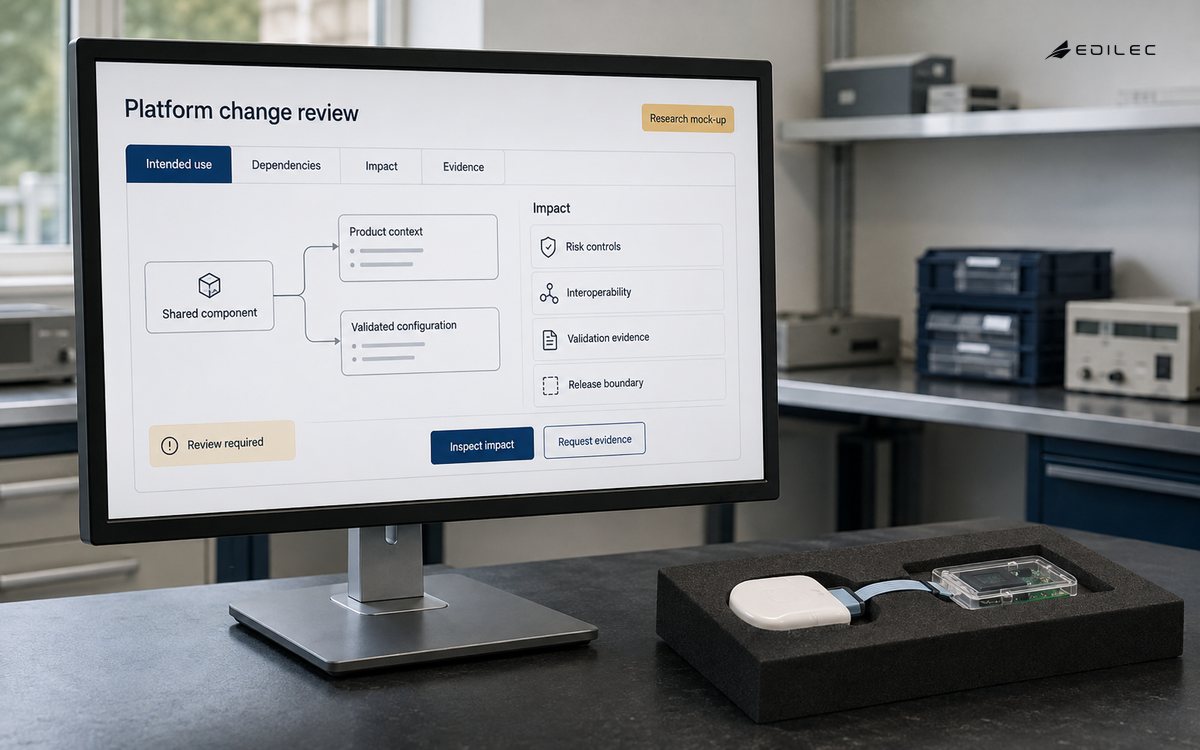
Every change needs product-specific impact analysis: intended use, risk controls, clinical performance, cybersecurity, interoperability, labeling, submissions and validation. Shared components increase the value of automated regression but also increase blast radius. Release in controlled cohorts when permitted, monitor predefined safety and performance indicators, and retain an executable rollback. Keep field configuration within validated bounds; a technically available option is not necessarily an approved product configuration.
For AI-enabled device software, FDA's final predetermined change control plan guidance recommends describing planned modifications, the methodology to develop, validate and implement them, and an impact assessment. A PCCP is not permission for unspecified learning in production. Ensure each implemented modification is within the authorized plan and is supported by the promised data controls, validation, monitoring and transparency.
Implementation example: connected monitoring release
A connected monitoring platform receives measurements from a bedside device, displays trends to clinicians and sends configurable alarms. The product team first ties each shared service to intended use and hazards: identity protects patient association, time synchronization protects trend ordering, message validation protects units, and outage behavior preserves local device operation. Interface fixtures include delayed, duplicated, out-of-order and malformed measurements. Clinical validation uses representative users, hardware, network conditions and alarm workflows rather than a browser-only demonstration.
The release dossier identifies device and cloud software versions, infrastructure configuration, risk controls, verification, validation, cybersecurity evidence, unresolved anomalies and labeling. A staged deployment begins at sites with trained support and a tested rollback. Monitoring links each alert to site, device, software version and safety control. If a shared parsing service changes, impact analysis identifies every dependent device and message version before regression and deployment. This approach lets the platform reuse technology while product evidence remains specific and reviewable.
Supplier control is equally concrete. Cloud and component agreements identify change notice, vulnerability disclosure, availability, support period, data handling and evidence access. The manufacturer keeps an approved supplier record and verifies critical claims rather than relying on sales assurance. Alternate operation is defined for a supplier outage, and the architecture identifies components that cannot be replaced without new verification or regulatory analysis. Supplier monitoring feeds corrective action when service performance or security evidence no longer meets the approved basis.
Key takeaways
- Define intended use, product boundaries and market pathways before platform abstraction.
- Map every shared service to dependent products, claims, hazards and release configurations.
- Keep design controls, software evidence, clinical evaluation and cybersecurity traceable in one quality system.
- Validate interface meaning and failure behavior, not only successful connectivity.
- Plan postmarket vulnerability, complaint and update operations before launch.
- Treat every shared or AI-enabled change as a product-specific regulatory and safety decision.
Can a medical device platform use public cloud services?
Yes, when the architecture and controls support the intended use and applicable requirements. Document supplier responsibilities, regions, access, encryption, availability, backups, monitoring, change notification and exit. Validate the deployed configuration and safe behavior during dependency failure. A cloud provider's certification does not validate the medical device or transfer the manufacturer's responsibility for safety and effectiveness.
Can one platform verification cover several devices?
Platform verification can be reused when requirements, configuration and evidence are genuinely common and controlled. Each device still needs an allocation showing that the shared result applies and product-level validation in its intended workflow. Differences in claims, users, hardware, risk controls or interface configuration may require additional testing. Document the rationale for reuse rather than assuming inheritance.
Conclusion
A dependable medical device platform makes reuse visible and controlled. Intended use leads to risk controls; controls lead to architecture and evidence; released configurations lead to postmarket observation and governed change. That traceable chain lets teams share technology without sharing unexamined risk across products.