SaaS MVP development implementation is ready when the team can state what it needs to learn, deliver one complete customer outcome and operate the result responsibly. An MVP is not a collection of unfinished screens or production controls postponed until traction. It is the smallest credible product experiment that exposes the important business and technical assumptions to real evidence. Readiness therefore includes recovery, security, support and measurement alongside scope and design.
Use this checklist before committing a build budget or moving a prototype into production. The SaaS MVP scope and delivery plan helps frame investment, while the SaaS MVP FAQ covers common decisions. Mark each item ready, intentionally deferred with risk, or blocking; attach evidence and one accountable owner.
Prove the problem and learning objective
Identify a narrow user segment, recurring job, present workaround and consequence. Gather direct observation, interviews, existing records or a concierge trial rather than relying on stated enthusiasm. Write the riskiest assumption and the decision the MVP evidence will support: continue, change audience, change workflow or stop. A broad goal such as validating a platform cannot determine what belongs in the first release.
Choose one primary behavior metric, a baseline, a review period and guardrails for error, support load, unsafe use and cost. Define success and stop thresholds before launch to reduce retrospective storytelling. Metrics should describe completion of the promised outcome, not registrations alone. Record how users are recruited because an internal friendly cohort and an unassisted paying customer provide different evidence.
| Readiness question | Acceptable evidence | Not yet ready |
|---|---|---|
| Is the problem real? | Observed repeated workflow and material friction | Only stakeholder opinion |
| Is the user specific? | Recruitable segment with shared context | Everyone is a target user |
| Is the experiment decisive? | Success, guardrail and stop thresholds | Metrics selected after launch |
| Is the workflow complete? | Core path plus essential recovery | Clickable happy-path screens only |
| Can the team operate it? | Named owner, telemetry and support route | Production responsibility is deferred |
Scope the smallest complete workflow
Map the journey from entry through achieved outcome, including identity, permissions, validation, waiting, notification, payment where relevant, cancellation and support. Name the authoritative record and state transitions. Include the minimum administrative surface for staff to understand and correct a case safely. Exclude personas, channels and integrations that do not change the learning decision. A manual backstage step can be valid if it is disclosed, controlled and measured.
Write acceptance examples using realistic data and failure conditions. Define what happens when an email, identity provider, payment processor or AI service is delayed. Design empty, loading, denied, interrupted and partial-success states. Estimate manual effort per active customer and set a capacity boundary. An MVP can use labor to learn, but hidden operations make unit economics and customer experience impossible to interpret.
Choose an architecture the team can change
Prefer a well-structured monolith and managed infrastructure unless scale, isolation or team boundaries justify more. Define modules around business capabilities, keep interfaces explicit and make one component authoritative for each record. Apply useful Twelve-Factor guidance for configuration, backing services and disposable processes. Record limits, recovery behavior and exit needs for managed services. Avoid technologies the current team cannot secure or debug merely to signal future scale.
Classify data, minimize fields and document purpose, retention, export and deletion. Use stable identifiers and preserve important state history. Plan database migrations from the first release and verify backups through restoration. For multi-tenant products, enforce tenant context in server-side data access and test cross-tenant attempts. Use synthetic or approved protected test data; production copies should not become the easiest way to build a demo environment.
| Launch area | Required evidence | Release blocker |
|---|---|---|
| Authentication | Recovery, session and abuse tests | Shared accounts or unrecoverable lockout |
| Authorization | Role and tenant-isolation tests | Client-side enforcement only |
| Data | Migration rehearsal and restore proof | No verified recovery path |
| Dependencies | Timeout, retry and duplicate-effect tests | Failures lose or repeat customer actions |
| Operations | Dashboard, alert, runbook and owner | No one can diagnose the core journey |
Set non-negotiable security and accessibility baselines
Use NIST's SSDF to establish repository protection, review, secrets handling, dependency checks, secure build, vulnerability intake and response. Select application controls from the OWASP ASVS based on actual risk. Threat-model account creation, invitations, recovery, exports, billing and administrator actions. A penetration test near launch cannot compensate for an authorization model that was never designed.
Adopt WCAG 2.2 for the web experience. Test keyboard use, focus, labels, errors, contrast, zoom and status announcements. Keep forms concise and preserve entered data after recoverable errors. Accessibility is especially important during early learning: if a segment cannot complete the flow, the product may misread exclusion as lack of demand. Include representative users rather than depending solely on automated checks.
Prepare billing, terms and customer support
Define plan, price, trial, renewal, cancellation, refund and feature entitlement behavior. Use a hosted payment flow where appropriate and keep card data out of the application. Make legal terms and privacy information consistent with actual collection and service behavior, obtaining qualified advice for markets and regulated uses. Record accepted terms and effective versions. Do not promise enterprise controls, uptime or data locations the product cannot yet demonstrate.
Give customers a visible support route and service expectation. Build an operator view with account lookup, workflow history and bounded correction actions. Preserve actor and reason for consequential changes. Create response templates for outage, data issue, billing error and security concern, but empower an owner to adapt them. Track the category and time of support work because recurring confusion often identifies the next product improvement more reliably than a feature request list.
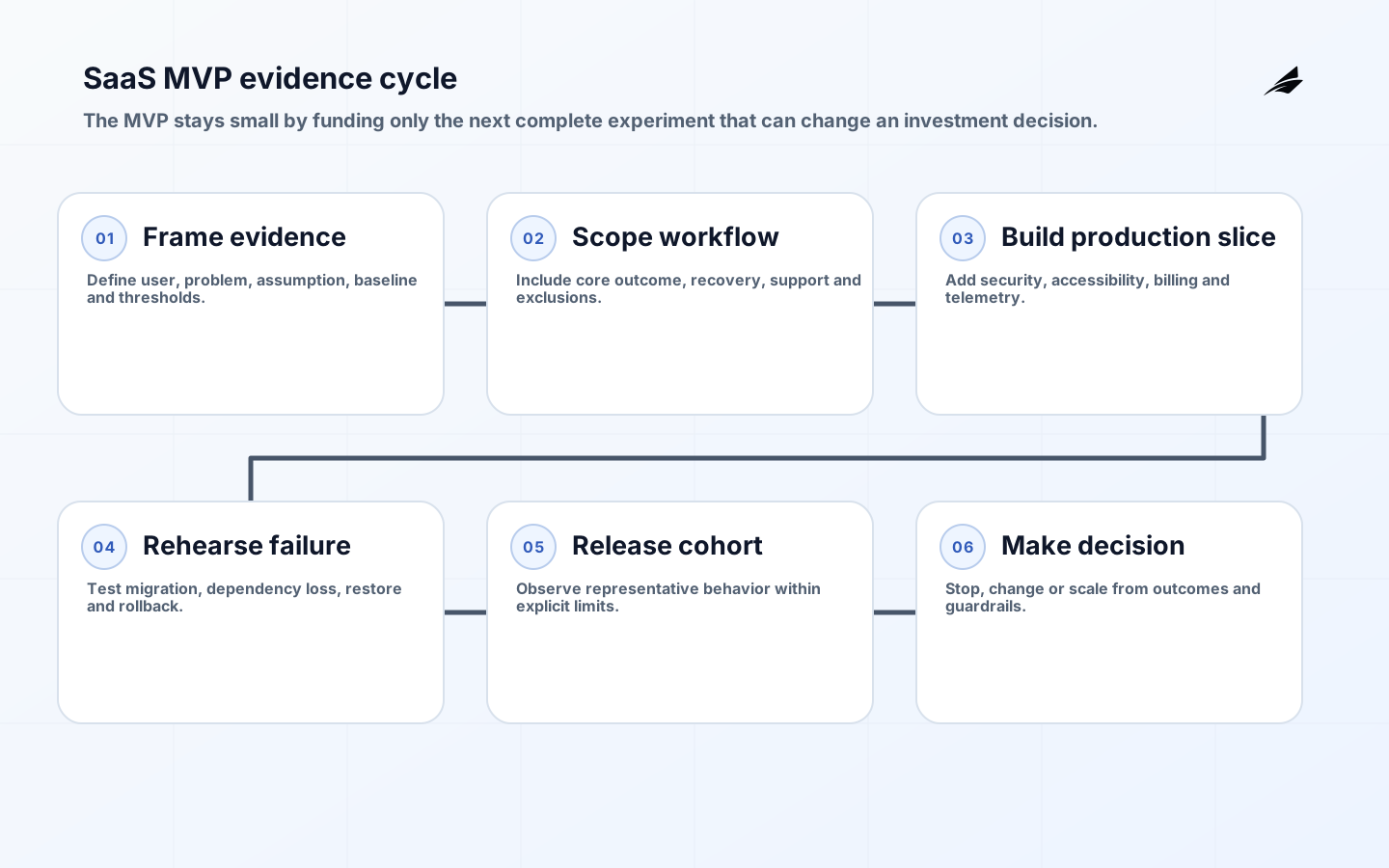
Run a six-stage evidence and release cycle
- Approve the user, problem, riskiest assumption and evidence threshold.
- Map the complete workflow, exceptions, data and explicit exclusions.
- Build one production slice with security, accessibility and support controls.
- Rehearse migration, dependency failure, restoration, rollback and communication.
- Release to a bounded cohort and observe behavior and guardrails.
- Decide to stop, change or scale; then fund the next learning cycle.
Create a repeatable path to production
Protect the main branch, automate build and tests, and produce a traceable immutable artifact. Keep environments sufficiently consistent to expose configuration errors. Use progressive exposure or feature controls for risky changes and define rollback or forward-repair behavior before deployment. Instrument the critical journey with outcome, errors, latency and dependency health. Page only for actionable user impact and send trends to scheduled review.
Track delivery and stability as a system. DORA's guides provide useful software delivery measures, but a young product should not optimize one metric in isolation. Observe time from decision to production, failed changes, recovery, escaped defects and support load. Hold a short post-release review and improve the pipeline or architecture when repeated friction appears. Speed comes from a reliable learning loop, not from removing every gate.
Conduct the final readiness review
Bring product, engineering, security, data, support and commercial owners together with evidence. Review unresolved high-impact risks, launch scope, migration, rollback, monitoring, customer communication, on-call access and cohort criteria. Every blocker needs a decision owner. Avoid a checklist meeting based on verbal confidence; link test results, runbooks, architecture decisions and restored-backup evidence. Record the release decision and assumptions that must be revisited.
Set review dates after launch: an early operational review for defects and support, then an evidence review after enough users complete the journey. Compare with the original thresholds and include users who abandoned. The related implementation plan readiness checklist can support a more detailed delivery audit. Close the cycle with one explicit investment decision and revised assumptions.
Keep an assumption register beside the product backlog. For each assumption, record current evidence, confidence, next test and the feature or cost that depends on it. When production evidence contradicts an assumption, update scope before simply adding requests. This gives founders and engineering partners a shared way to distinguish defects, learning and expansion. It also protects the MVP from becoming a permanent collection of temporary decisions whose rationale has been forgotten.
Key takeaways
- Define the learning decision and thresholds before choosing MVP features.
- Build the smallest complete workflow, including support and recovery.
- Select an operable architecture and protect tenant and customer data from day one.
- Treat security, accessibility, billing and observability as product behavior.
- Release narrowly, compare evidence with guardrails and make an explicit next decision.
Frequently asked questions
Can an MVP contain manual operations?
Yes, when the manual step is controlled, disclosed where relevant, measurable and safe. It can test demand before automation. Define owner, capacity, error checks and customer expectation. Automate it when volume, delay, cost or risk threatens the experiment or service.
How much future scale should the architecture support?
Support the validated near-term horizon with clear measurement and known upgrade paths. Preserve modular boundaries, migrations and operational visibility, but avoid distributed complexity for hypothetical demand. Capacity-test the core journey and define the signal that triggers the next architecture investment.
Is a beta label enough to relax production controls?
No. A label can set expectations about feature completeness, but it does not excuse unsafe data handling, weak authorization or absent recovery. Reduce risk through cohort size, capability limits and disclosure while maintaining controls appropriate to the data and consequence.
Conclusion
A ready SaaS MVP is small in scope but complete in responsibility. It tests a defined assumption through a usable workflow, protects users, preserves data and gives the team enough operational evidence to decide what comes next. Build for learning, release within explicit limits and resist both polished overbuilding and fragile shortcuts that invalidate the experiment.