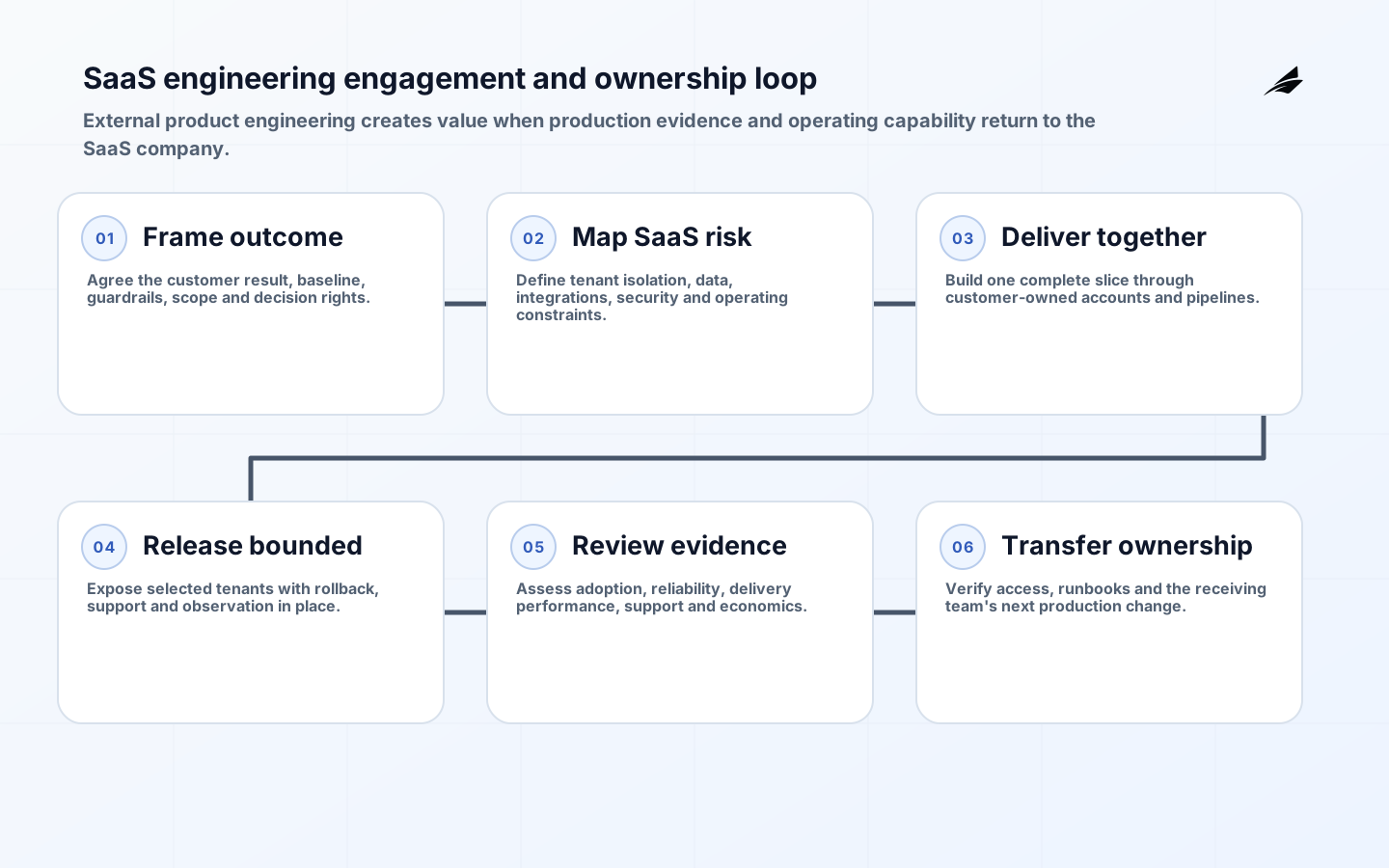
Product engineering services for SaaS companies combine product discovery, experience design, software delivery and production ownership around a measurable customer outcome. The service is broader than supplying developers to a backlog. A capable partner helps decide what evidence justifies a feature, how tenant boundaries are enforced, how releases are observed and how the client's team will own the product after the engagement.
This FAQ is for SaaS founders and product or engineering leaders comparing an external team with hiring, staff augmentation or a fixed-scope build. Use it beside the SaaS product engineering implementation checklist and feature flag strategy to turn sales claims into acceptance evidence.
What should SaaS product engineering services include?
A complete engagement starts with the product outcome, target tenant and existing constraints. Discovery should produce a workflow map, explicit assumptions, baseline measures, risks and a thin production slice. Design should cover customer and operator experiences, including empty, loading, error, permission and recovery states. Engineering includes architecture, data, integrations, tests, security, delivery automation and observability. Product operations cover analytics, support evidence, incident learning and roadmap decisions.
The exact mix depends on the product stage. An early SaaS team may need discovery, design and a first production capability. A scaling company may need tenant isolation, performance, billing, migration or release improvements. A mature product may need modernization without breaking contracts. Ask the provider to state exclusions and client responsibilities. Vague promises to handle “end to end” often hide decisions about content, data migration, security review, customer support and after-hours response.
| Engagement need | Expected output | Acceptance evidence | Client owner |
|---|---|---|---|
| New capability | Outcome, workflow and production slice | Target users complete the bounded task | Product lead |
| Scale constraint | Measured bottleneck and tested change | Load and tenant-impact results | Engineering lead |
| Security improvement | Threats, controls and verification plan | Retained test evidence and risk decisions | Security owner |
| Platform modernization | Incremental target and migration path | Reconciled data and reversible rollout | Platform owner |
| Operating maturity | Telemetry, runbooks and ownership | Receiving team handles a real change | Service owner |
How do you evaluate a SaaS engineering partner?
Evaluate how the team reasons, not only its portfolio. Give candidates a representative workflow and ask them to identify assumptions, tenant risks, failure paths and a first measurable slice. Strong teams distinguish authentication from tenant isolation, discuss authoritative data and idempotency, and ask who operates the feature. AWS's SaaS Lens emphasizes that isolation is foundational and that multi-tenant health must be visible by tenant or tier; a generic cloud diagram is not enough.
Review named people, allocation, decision rights and replacement terms. Confirm who leads product discovery, architecture, design, quality and delivery. Ask to inspect a redacted architecture decision, test strategy, runbook and handover plan. References are most useful when matched to a similar stage and risk profile. A partner that built an enterprise platform may still be a poor fit for rapid founder-led validation, and a prototype studio may not be equipped for regulated production ownership.
What architecture and security questions matter?
Start with tenant context: how it enters a request, how it is validated, how storage is partitioned and how background jobs retain it. Decide pool, silo or hybrid isolation by business and compliance need rather than fashion. Test cross-tenant access continuously. Define onboarding, entitlement, billing, limits, noisy-neighbor controls and tenant-aware telemetry as product capabilities. A separate stack per tenant can still be SaaS, but unified deployment and operations are required to avoid becoming a collection of bespoke installations.
NIST SSDF provides a useful supplier conversation across organizational preparation, software protection, secure production and vulnerability response. OWASP ASVS can anchor application-control verification. Translate both into the engagement: protected repositories, dependency and secret handling, server-side authorization, security tests, artifact traceability and response ownership. Security obligations remain with the SaaS company even when a partner performs work, so the customer must retain access to evidence, risk decisions and supplier dependencies.
| Design area | Question to ask | Evidence before release | Failure to avoid |
|---|---|---|---|
| Tenant isolation | Can one tenant influence another's data or capacity? | Negative authorization and load tests | Relying on UI filters |
| Identity | How are roles, recovery and service identities controlled? | Role matrix and recovery rehearsal | Shared administrator accounts |
| Data | What is authoritative, retained and deletable? | Migration, backup and restore results | Unowned shadow copies |
| Release | Can a change be traced and reversed? | Immutable artifact and rollback criteria | Manual production edits |
| Operations | Can health be viewed per tenant and tier? | Dashboards, alerts and support lookup | Only global averages |
Which engagement and pricing model works best?
Use a short, bounded discovery when scope and feasibility are uncertain. Use a dedicated product team when priorities will evolve through evidence. A fixed price can suit a narrow migration or well-specified integration, but it encourages costly change control when product learning is central. Time and materials offers flexibility only when paired with a prioritized outcome, delivery cadence, transparent capacity and stop rules. Avoid buying a large roadmap before the first risky assumptions are tested.
Compare total operating value, not day rates. Include discovery, coordination, rework, cloud cost, licenses, security assurance, support and transition. Define commercial checkpoints tied to demonstrable software and evidence. The customer should own source repositories, cloud accounts, domains, observability and essential vendor contracts from the start. Payment milestones should not make access hostage to final handover.
How should the client and partner work together?
Name one product decision maker and one technical owner on the client side. Provide timely access to users, subject experts, systems and real examples. Keep a single prioritized backlog connected to outcomes and risks. Weekly reviews should demonstrate working behavior, including failure and operator paths, not report activity. Architecture decisions need context, alternatives and consequences. Security, accessibility and operations belong in normal acceptance criteria rather than late specialist gates.
Use small changes and a repeatable deployment path. DORA's current model balances change lead time and deployment frequency with failed-deployment recovery, change fail rate and deployment rework rate. These measures are diagnostic for one service over time, not a leaderboard between unlike teams. Add product measures such as activation, task completion and support burden so delivery speed remains connected to customer value.
A practical engagement procedure
- Frame the customer outcome, baseline, guardrails and decision deadline.
- Map the current workflow, tenant model, systems, data, constraints and known incidents.
- Select one end-to-end production slice and state what is explicitly deferred.
- Agree architecture, trust boundaries, accessibility target and operational ownership.
- Build through the intended CI/CD path with tests, telemetry and support controls.
- Release to a bounded tenant cohort and compare product and reliability evidence.
- Resolve operational gaps, rehearse handover and let the receiving team ship a change.
- Decide whether to scale, revise or stop based on observed results.
What should handover and warranty cover?
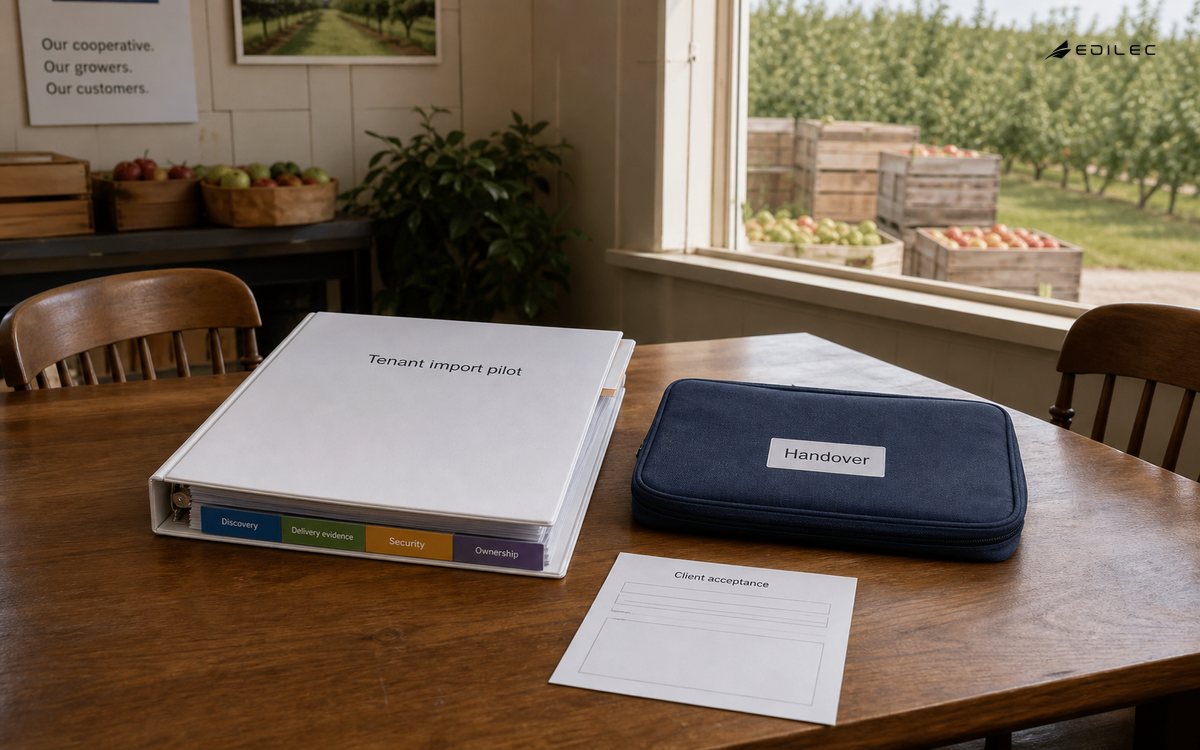
Handover should include source and history, build and infrastructure definitions, architecture decisions, data model, API contracts, dependency inventory, licenses, test evidence, security findings, dashboards, alerts, runbooks, access map, backup and restore procedure, cost baseline and known risks. Verify completeness operationally: the receiving team deploys a representative change, investigates a test alert, restores data and performs a support lookup without private help.
Define defect severity, response expectations and the boundary between warranty defects and new scope before launch. A warranty is not production support. State who monitors service health, who responds to incidents and how provider assistance is engaged. Record unresolved risks with an owner and treatment date. The usage-based reporting guide is especially relevant when metering affects billing or customer trust.
Example: replace a fragile tenant import
Consider a SaaS company whose onboarding team manually repairs CSV imports. A sound engagement would baseline import completion, correction time and support contacts; define a versioned template and validation report; preserve tenant isolation; add idempotent processing and operator-visible failures; then release to a few tenants. Acceptance is not “the importer shipped.” It is a reconciled import, fewer unresolved errors and a support team able to diagnose failures without engineering database access.
Key takeaways
- Buy a measurable product capability, not an unexplained volume of tickets.
- Test tenant isolation, recovery and operability as part of normal delivery.
- Choose commercial terms that allow learning without obscuring accountability.
- Keep repositories, environments and essential accounts under customer control.
- Prove transition by having the receiving team operate and change the product.
Frequently asked questions
How large should an outsourced SaaS product team be?
Size follows the first outcome and dependencies. A small cross-functional team with product, design, engineering and quality capability often outperforms a larger role collection with fragmented ownership. Add specialists for material security, data, accessibility or platform risks, and revisit capacity after the first production evidence.
Who should own intellectual property and cloud accounts?
The contract should state ownership and licenses explicitly for custom work, pre-existing components and third-party dependencies. The SaaS company should control its repositories, cloud organization, domains, signing, observability and production credentials. Qualified counsel should review jurisdiction-specific intellectual-property terms.
How long should the first engagement last?
Long enough to deliver and observe one meaningful production slice. Discovery may take weeks, while delivery depends on integrations, migration, controls and user access. Prefer a checkpoint with explicit continuation criteria over an arbitrary promise to finish an entire product in one fixed period.
Before signing, convert the proposal into a responsibility matrix covering product decisions, user access, data preparation, security review, production approval, incident response and transition. Price the dependencies that sit outside the provider's control. This prevents delays from being treated as mysterious delivery failure and gives both teams a clear escalation route when an assumption changes.
Conclusion
The right product engineering service leaves a SaaS company with more than features. It creates a secure, observable capability, clearer product evidence and a team able to own the next change. Evaluate providers on decisions, production proof and transition behavior; those signals reveal far more than a polished estimate or technology list.