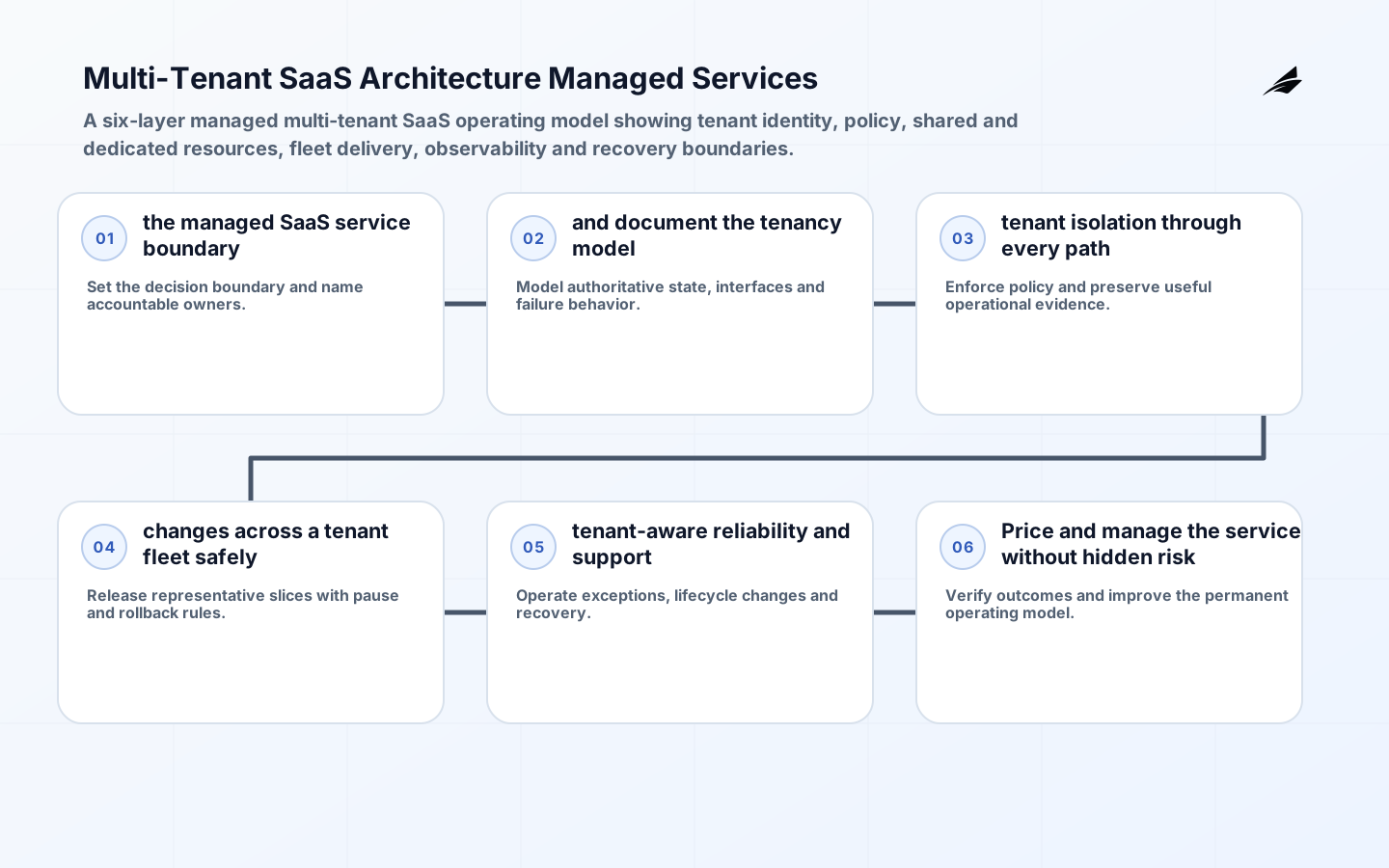
Multi-tenant SaaS architecture managed services are dependable only when product, security and operations teams agree on the business outcome, system boundary, failure behavior and evidence required for release. The work is not complete when a feature appears in a demonstration. It is complete when representative users can perform the intended journey, unauthorized or malformed actions are rejected, operational teams can explain the resulting state, and recovery has been exercised. Together, those expectations provide SaaS product, platform, and operations teams with a practical implementation and review model.
Microsoft describes isolation as a spectrum, while AWS treats tenant isolation as foundational rather than optional. A managed provider therefore needs more than infrastructure access: it needs a precise operating contract for tenant-aware identity, data, compute, release, incident and cost decisions. The approach below uses current primary guidance and makes trade-offs explicit rather than treating one architecture or tool as universally correct. It preserves the existing article URL while replacing generic advice with concrete decisions, tests, ownership and acceptance evidence. Related implementation pages are listed at the end so readers can continue into narrower planning detail.
Define the managed SaaS service boundary
Start by writing the decision or service outcome in one sentence and naming who depends on it. Define acceptable timeliness, accuracy, availability and recovery, then connect those measures to the user journey. For multi-tenant saas architecture managed services, the most important boundary is how tenant context is established, propagated and enforced across every shared or dedicated resource. State exclusions and assumptions openly. A requirement that cannot be observed or tested should be rewritten before it becomes architecture.
For multi-tenant saas architecture managed services, map the actors, records, interfaces and suppliers that participate in the outcome. Include human approvals, scheduled jobs and support actions, not only interactive screens. Assign one accountable owner for the complete journey and technical owners for each component. Record who may accept risk, authorize a consequential change and declare recovery. This avoids a common failure in which every component is monitored but nobody owns the result seen by the customer or business team.
| Planning decision | Evidence required | Stop condition |
|---|---|---|
| Isolation tier | Documented component-level model | Marketing tier has no technical boundary |
| Tenant context | Identity-to-data propagation trace | A client field controls access |
| Service scope | Catalog, responsibility and escalation matrix | Critical task is assumed by both parties |
| Exit | Portable tenant and operational records | Provider-only control plane is required |
Choose and document the tenancy model
Choose pooled, bridged or siloed patterns per component rather than applying one tenancy model to the entire stack. Shared compute with per-tenant databases can be reasonable; dedicated stamps may suit regulated or high-load customers. Maintain a tenant-to-deployment mapping and automate provisioning so premium isolation does not become manual drift. Keep identifiers stable across requests, events, logs and reports so an operator can reconstruct what happened without joining records by guesswork. Define source-of-truth ownership and synchronization behavior for every replicated field. If two systems may legitimately disagree, state which one controls each decision and how reconciliation occurs.
Carry validated tenant context from identity through application, queue, cache and data access. Never infer it from an untrusted request field. Include tenant identifiers in cache keys, object paths, message envelopes, telemetry and cost allocation, while avoiding high-cardinality monitoring that becomes unaffordable. Treat bulk operations and exceptional paths as first-class architecture. Preview target scope, enforce limits, make retries idempotent and preserve enough evidence to distinguish a repeated request from a new instruction. The design should remain understandable under partial failure; silent compensation and hidden manual repair make the apparent success rate unreliable.
Enforce tenant isolation through every path
Authorization must evaluate actor, tenant, target resource and action. Administrative support needs scoped impersonation or delegated access with customer-visible evidence, not a universal back door. Enforce policy at the server or authoritative service boundary rather than trusting a browser, client-supplied role or display filter. Deny by default where consequence warrants it. Test horizontal access, stale membership, disabled accounts, background workers and support tooling because controls often differ outside the primary interface.
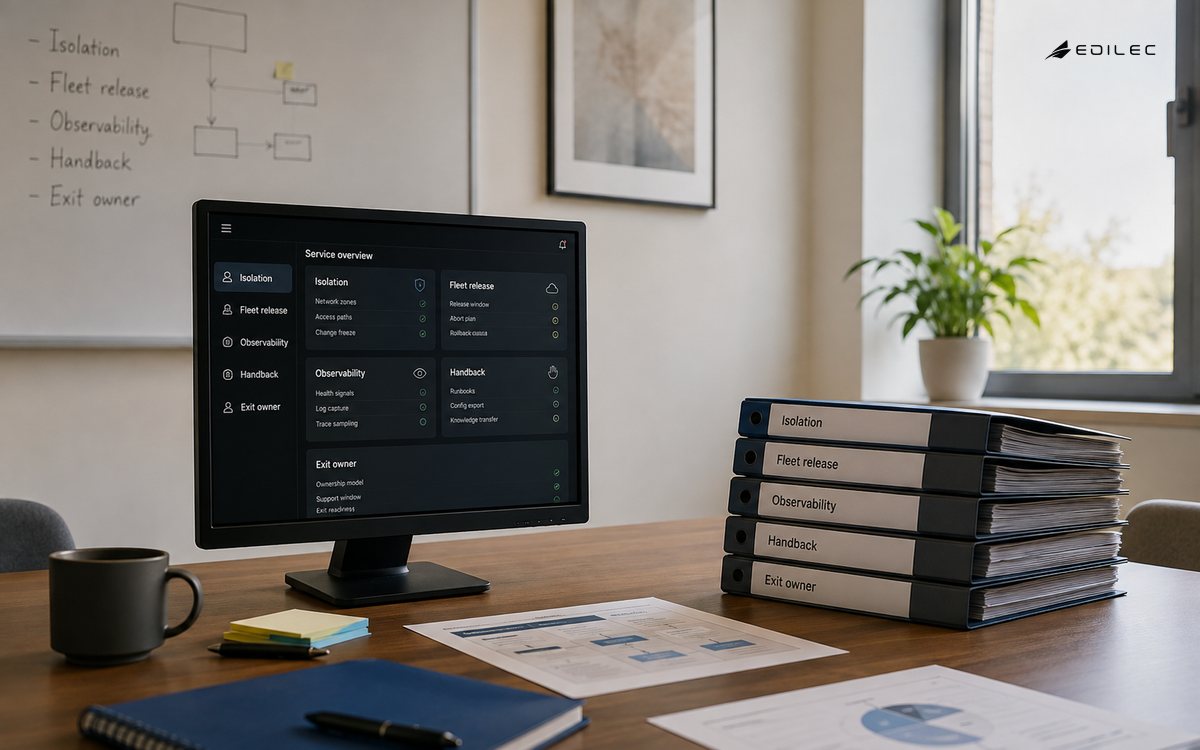
Test cross-tenant reads, writes, searches, exports, background jobs and error paths automatically. Add resource quotas, fair scheduling and admission controls so one tenant cannot consume shared capacity without a visible policy response. Log the decision inputs, policy version, actor, target, outcome and correlation identifier while excluding secrets and unnecessary personal data. Alerts should represent violated expectations rather than raw event volume. Every high-severity alert needs an owner, a runbook and a tested escalation route. Evidence should support both immediate diagnosis and later review.
Deliver changes across a tenant fleet safely
Prove onboarding, ordinary use, bulk work, upgrade and offboarding for both pooled and isolated tiers. Include migration of a tenant between deployment stamps because commercial tier changes and capacity rebalancing eventually require it. Build a representative vertical slice before expanding breadth. The slice should cross the real identity, data, integration and observability paths and include one failure and recovery scenario. Use production-like scale and policy where practical. A prototype that bypasses the hardest dependency proves interface design, not operational readiness.
Use tenant cohorts for progressive delivery and preserve schema compatibility while the fleet is mixed. Rollback must account for data changes and queued work, not only application binaries. Release through observable cohorts with explicit entry, success, pause and rollback rules. Compare technical signals with business outcomes and support contacts. Preserve configuration and data migrations in version-controlled, repeatable mechanisms. When an exception is approved, record its owner, reason, expiry and compensating measure rather than weakening the standard silently.
| Delivery gate | Minimum proof | Owner question |
|---|---|---|
| Isolation | Cross-tenant negative tests and policy logs | Can support prove why access was denied? |
| Performance | Cohort SLOs and quota behavior | Can one tenant degrade another? |
| Release | Progressive fleet update and rollback | Can mixed versions operate safely? |
| Recovery | Single-tenant and stamp restoration exercise | Is blast radius bounded? |
Operate tenant-aware reliability and support
Report service objectives by meaningful tenant cohorts and surface concentration, saturation and noisy-neighbor signals. A global average can remain healthy while a large or region-specific tenant fails. Dashboards should answer what changed, who is affected, whether the result is trustworthy and what action is expected. Separate service health, data quality, security and business outcomes so one healthy aggregate cannot hide another failing dimension. Include freshness and coverage. A green chart built from delayed or incomplete data is a particularly dangerous failure mode.
Support runbooks should identify tenant impact, safe containment, customer communication and evidence export. Managed teams need a catalog that distinguishes routine requests, incidents, changes and customer-owned application defects. Exercise routine and disruptive operations: onboarding, access change, configuration rollout, failed dependency, backup restoration, credential rotation, ownership transfer and retirement. Measure elapsed time and manual effort, then improve the runbook and automation. Operational acceptance belongs before broad launch because the first incident is an expensive place to discover missing authority or evidence.
Price and manage the service without hidden risk
Commercial models should connect tenant tiers to isolation, support, data residency, recovery and capacity guarantees. Track unit cost per tenant or workload driver rather than allocating shared spend equally without explanation. Estimate cost from enduring operating work as well as initial delivery. Include data cleanup, integration change, testing, support, observability, security review, supplier coordination, migration overlap and exit. Distinguish fixed platform cost, variable usage cost and human operating load. An apparently inexpensive design can become costly when every new customer, site or workflow requires bespoke intervention.
The exit plan must include tenant configuration, data, audit evidence, infrastructure code, deployment mapping and operational documentation in usable formats. Provider lock-in is most dangerous when the customer cannot reconstruct tenant boundaries. Maintain a risk register with observable triggers and named treatment owners. Review concentration risk, unsupported dependencies, data-quality gaps, privilege accumulation, performance saturation and recovery uncertainty. Avoid false precision in cost or schedule estimates; give ranges, assumptions and decisions that would change the estimate.
Accept the service with isolation and recovery evidence
Run a deliberate isolation test with two tenants, similar identifiers and mixed background work. Verify that responses, caches, exports, logs and support tools cannot cross the boundary. Acceptance should be demonstrated by a cross-functional team using representative data and identities. Require successful ordinary journeys, rejected unauthorized actions, controlled partial failure, reconciliation, observable recovery and export of required evidence. Sample reported totals against authoritative records rather than accepting dashboard agreement with itself.
Exercise a noisy-neighbor event, tenant migration, failed fleet release and restoration of one tenant without harming others. Reconcile billing and usage after each exercise. Transfer ownership with maintained documentation, source and configuration access, alert routing, support procedures and a backlog of known limitations. Set a review date for assumptions and thresholds. A sustainable result is one the permanent team can explain, operate and improve without relying on the original project members for hidden context.
Review multi-tenant saas architecture managed services: practical faq as a living operating capability after launch. At each review, compare the documented boundary with production configuration, recent incidents, support work, supplier changes and measured outcomes. Sample evidence rather than relying only on aggregate status. Record decisions, owners and due dates, and retire controls or reports that no longer support a real risk or business need. This cadence keeps architecture, policy and day-to-day practice aligned as customer volume, integrations, regulations and team responsibilities change.
Key takeaways
- Document isolation per component and commercial tier.
- Propagate trusted tenant context through every synchronous and asynchronous path.
- Test cross-tenant access and noisy-neighbor behavior continuously.
- Release by observable tenant cohorts with data-compatible rollback.
- Keep tenant data, configuration and operational evidence portable.
Frequently asked questions
Is a dedicated stack still SaaS?
It can be when onboarding, identity, deployment, metering, operations and product evolution remain shared and automated. Dedicated infrastructure trades density for isolation; it should not create a manually maintained custom product.
Can a managed provider own tenant isolation?
The provider can operate controls and supply evidence, but the SaaS company retains accountability for architecture, product authorization and customer commitments. Responsibilities must be explicit at each layer.
Should every metric include a tenant ID?
No. High-cardinality labels can be costly. Use tenant-aware logs or traces, cohort metrics, sampled exemplars and targeted per-tenant views while retaining enough correlation for incidents and billing.
Which SLA matters most for managed multi-tenant SaaS?
Use journey-level availability and latency plus incident, recovery and change objectives, segmented where tenant tiers differ. Infrastructure uptime alone does not prove tenant isolation or product correctness.
Conclusion
A managed multi-tenant SaaS service is credible when tenant boundaries survive ordinary use, background processing, support, release, failure and exit. The operating model should combine explicit component-level isolation, tenant-aware observability, progressive fleet control and portable evidence. That gives the provider clear work to perform and gives the SaaS owner proof that efficiency has not been purchased by weakening customer separation or recoverability.