A SaaS product development company for logistics should begin with the decisions that shippers, carriers, warehouses, dispatchers and customer teams need to make. Logistics software rarely fails because it lacks a map; it fails when identifiers conflict, events arrive late, partner interfaces change, offline work disappears, or nobody owns an exception. Scope should therefore define the operational journey, authoritative records, event semantics, integrations, decision rights and recovery behavior before selecting dashboards or automation.
This guide turns that principle into a commercial and delivery plan. It complements the logistics SaaS implementation checklist and logistics SaaS FAQ. Standards such as GS1 EPCIS and DCSA Track and Trace can reduce semantic differences, but they do not define the entire product, operating agreement or customer experience. The plan must state what will be built, what will be integrated, what remains with partners, and how production acceptance will be proved.
Define scope around one logistics decision chain
Choose a bounded journey such as order-to-dispatch, pickup-to-delivery, container milestone visibility, warehouse receiving, cold-chain exception or proof-of-delivery reconciliation. Identify actors, locations, assets, shipments, handling units, documents and systems. Record the trigger, decisions, expected events, service promises and completion state. Distinguish planned, estimated and actual information. Define which organization can correct an event and how consumers learn that a prior value changed. Avoid an MVP that claims end-to-end logistics while depending on untested manual uploads for critical state.
Prioritize the smallest release that improves a costly decision. A useful first slice may combine carrier onboarding, event normalization, exception queue and customer notification for one lane or mode. Establish baseline measures: missing-event rate, time to detect delay, manual status requests, dwell, failed delivery, claims evidence and reconciliation effort. List exclusions such as freight rating, customs filing or route optimization if they are not in the release. Explicit exclusions prevent adjacent expectations from consuming the budget and obscuring acceptance.
| Scope area | Included decision | Important exclusion | Acceptance evidence |
|---|---|---|---|
| Tracking | Normalize agreed milestone events | Carrier operational control | Known journey replays correctly |
| Exceptions | Route high-impact deviation to owner | Autonomous operational decision | Timed response and closure |
| Documents | Associate approved proof with shipment | Legal validity in every jurisdiction | Access and retention test |
| Analytics | Measure defined service outcomes | Universal predictive ETA | Reconciled denominator and source |
Design identifiers and event semantics before screens
Create a canonical model for parties, locations, products, assets, handling units, shipments, transport equipment and business transactions. Retain source identifiers and mapping confidence instead of forcing uncertain merges. Every event should carry a type, business step, disposition where relevant, object references, event time, record time, location, source, version and correction relationship. GS1 EPCIS provides a common model for visibility events across enterprises, including aggregation and sensor data. Adopt applicable standards at the boundary while keeping internal extensions governed and documented.
Define duplicate, late, out-of-order and contradictory event behavior. Consumers should be able to distinguish an event that happened late from one reported late. Use idempotency and stable correlation for imports and APIs. Preserve raw source messages for a defined period while exposing normalized records to product features. Build reconciliation for expected versus observed milestones and source totals. Data quality should produce an owned queue with reason and correction path, not just a percentage on a dashboard.
Plan integrations and partner onboarding as product capabilities
Inventory carrier, warehouse, ERP, order, telematics, marketplace, customs and customer interfaces. For each, document protocol, schema, authentication, rate, latency, maintenance, support, replay, data rights and failure behavior. Use versioned contracts and representative examples. Validate semantic meaning rather than only schema. A field called “delivered” may refer to terminal receipt, consignee handoff or proof completion. DCSA’s standard demonstrates the value of shared definitions and APIs for container milestones; onboarding still requires testing each provider’s implementation.
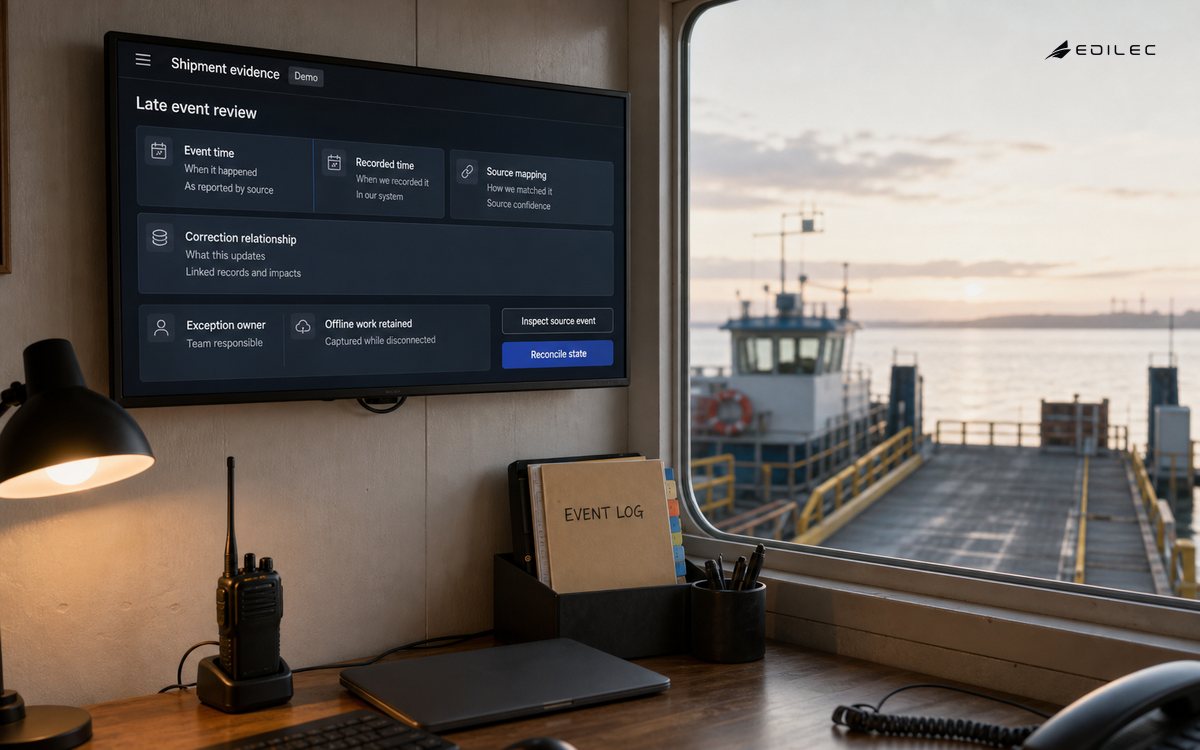
Create an integration gateway that protects the product from partner-specific changes and records message health. Provide self-service credentials, test data, conformance checks and onboarding status where volume justifies it. Apply backpressure, retry with limits, dead-letter handling and manual replay. Do not silently discard malformed messages. Expose partner health to support teams and customers when it affects service. Contract change notice and deprecation periods with material providers, and maintain a fallback import path for bounded continuity.
Design for exceptions, mobility and intermittent connectivity
Operational interfaces should emphasize what requires action now, why, by when and by whom. An exception queue needs severity, customer promise, source evidence, last action, next decision and escalation. Avoid dashboards that aggregate red counts without a recoverable work object. Mobile workflows need large targets, clear state, constrained data entry, camera and scan behavior, and safe interruption. Record drafts and sync state visibly. Users must know whether an action is pending, accepted, rejected or duplicated.
Offline capability should be bounded by risk. Cache only necessary assignments and data, encrypt local storage, expire access, and define conflicts when server state changes. Test clock differences, repeated scans, device loss and partial synchronization. Critical actions may require online authorization; others can be queued with a visible provisional state. Design accessibility and language for the workforce and environment, including gloves, glare, noise and shared equipment. The best workflow reduces radio calls and spreadsheets without hiding operational nuance.
Build security and reliability into the service boundary
Separate tenants and apply least privilege by organization, role, region and purpose. Protect administrator and integration identities with strong authentication, scoped tokens and rotation. Encrypt data in transit and at rest, restrict bulk export, and log access to commercially sensitive records. Threat-model fraudulent proof, location manipulation, account takeover, API abuse, partner compromise and device theft. Establish retention and deletion by record type and contract. Test that one tenant cannot infer another tenant’s routes, customers, volumes or documents.
Define service objectives for event ingestion, API availability, queue age, notification delay and recovery. Design regional, provider and partner failure behavior. Back up configuration, mappings, customer rules and authoritative records, then restore and reconcile them. Observability should connect a customer shipment to source messages, transformations, rules and notifications without exposing unrelated tenant data. Incident runbooks need supplier contacts, containment authority, customer communication and replay. A green infrastructure dashboard does not prove that shipment state is complete.
| Cost component | Sizing driver | Commonly missed item | Control |
|---|---|---|---|
| Product delivery | Journeys, roles and platforms | Operational discovery | Stage acceptance by journey |
| Integration | Partner count and variability | Certification and ongoing change | Per-interface estimate and reserve |
| Cloud operation | Events, retention, queries and regions | Replay and observability | Unit cost dashboard |
| Support | Hours, tenants and exception volume | Partner escalation | Runbook and staffing model |
| Assurance | Data sensitivity and commitments | Penetration, recovery and supplier review | Planned evidence budget |
Estimate cost and commercial risk transparently
Estimate by capability, interface and evidence rather than one blended feature count. Separate discovery, product design, core platform, integrations, migration, mobile work, security, validation, launch and support. State assumptions for partner availability, data quality, event volume, retention, region and service hours. Include contingency for unknown legacy semantics and external certification. Recurring cost includes cloud, mapping maintenance, customer onboarding, support, monitoring and audit. Use unit measures such as cost per active shipment or million events alongside total spend.
Commercial contracts should preserve customer data access, configuration export, interface documentation, security evidence and transition support. Define change control, acceptance, ownership, warranty, incident notification and third-party fees. Avoid fixed-price commitments before representative integrations are examined; use a bounded discovery with clear outputs and re-estimation. Tie payment to accepted operational slices, not code completion. Make dependencies and customer responsibilities explicit, especially access to subject-matter experts, partner sandboxes and data.
Deliver through operational evidence gates
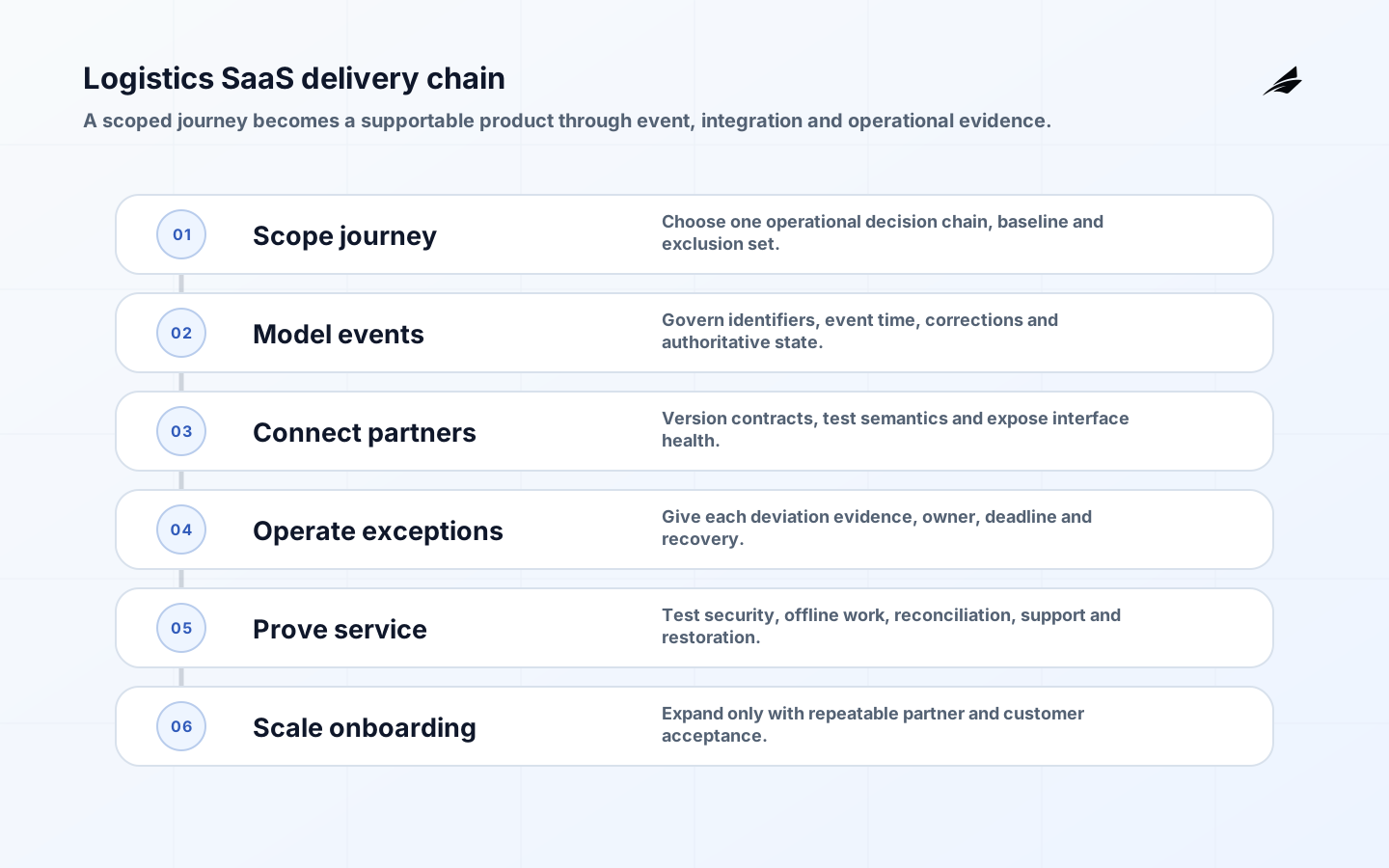
Stage one produces journey maps, data contracts, threat model, prototype and plan. Stage two builds a production-shaped vertical slice with one or two representative integrations. Stage three pilots with controlled customers, lanes or facilities and observes exceptions. Stage four expands through repeatable onboarding and service operations. At every gate, demonstrate user outcome, data reconciliation, security, performance, recovery and support. Keep feature flags and route controls so scope can be reduced without losing the whole service.
Production acceptance should replay known journeys and live representative traffic. Test duplicate and late events, partner outage, offline device, unauthorized access, bulk volume, notification failure, backup restore and configuration export. Measure baseline against pilot using the same definitions. Train support with real cases and transfer runbook ownership. Record unresolved risks with owner and expiry. The system is ready to scale when new customers and partners can be onboarded predictably and exceptions can be resolved from visible evidence.
Key takeaways
- Scope the first release around one operational decision chain.
- Govern identifiers, event time, corrections and reconciliation before visual design.
- Treat partner onboarding and exception handling as core product capabilities.
- Estimate integration change, support and assurance as lifecycle costs.
- Scale through accepted journeys with proven recovery and unit economics.
Frequently asked questions
Should a logistics platform use EPCIS?
Use EPCIS where its visibility-event model and ecosystem fit the business. It can reduce semantic differences, but product-specific workflows, permissions, interfaces and operating rules still require design. Adopt standards deliberately at boundaries.
How long does a logistics SaaS MVP take?
Duration depends heavily on journey scope, integrations, data quality, mobile needs and assurance. A narrow production slice may take months, while multi-mode and multi-region platforms take longer. Estimate after representative interface discovery.
What should remain outside the first release?
Exclude adjacent capabilities that do not improve the selected decision, especially broad optimization, universal ETA, billing or customs functions without evidence and ownership. Keep interfaces for future growth but protect first-release acceptance.
Conclusion
Professional logistics SaaS development makes movement and responsibility inspectable. The product must preserve event meaning across partners, help people resolve exceptions and continue operating through weak connectivity and external failure. Standards accelerate interoperability when combined with explicit ownership, testing and reconciliation.
Before signing off the plan, select one difficult shipment and trace every identifier, event, correction, document, notification and support action. Then disconnect a partner and restore the service. If the team can explain state, protect tenant data and reconcile the journey, the plan is production-shaped. If not, reduce scope and strengthen the operating model.