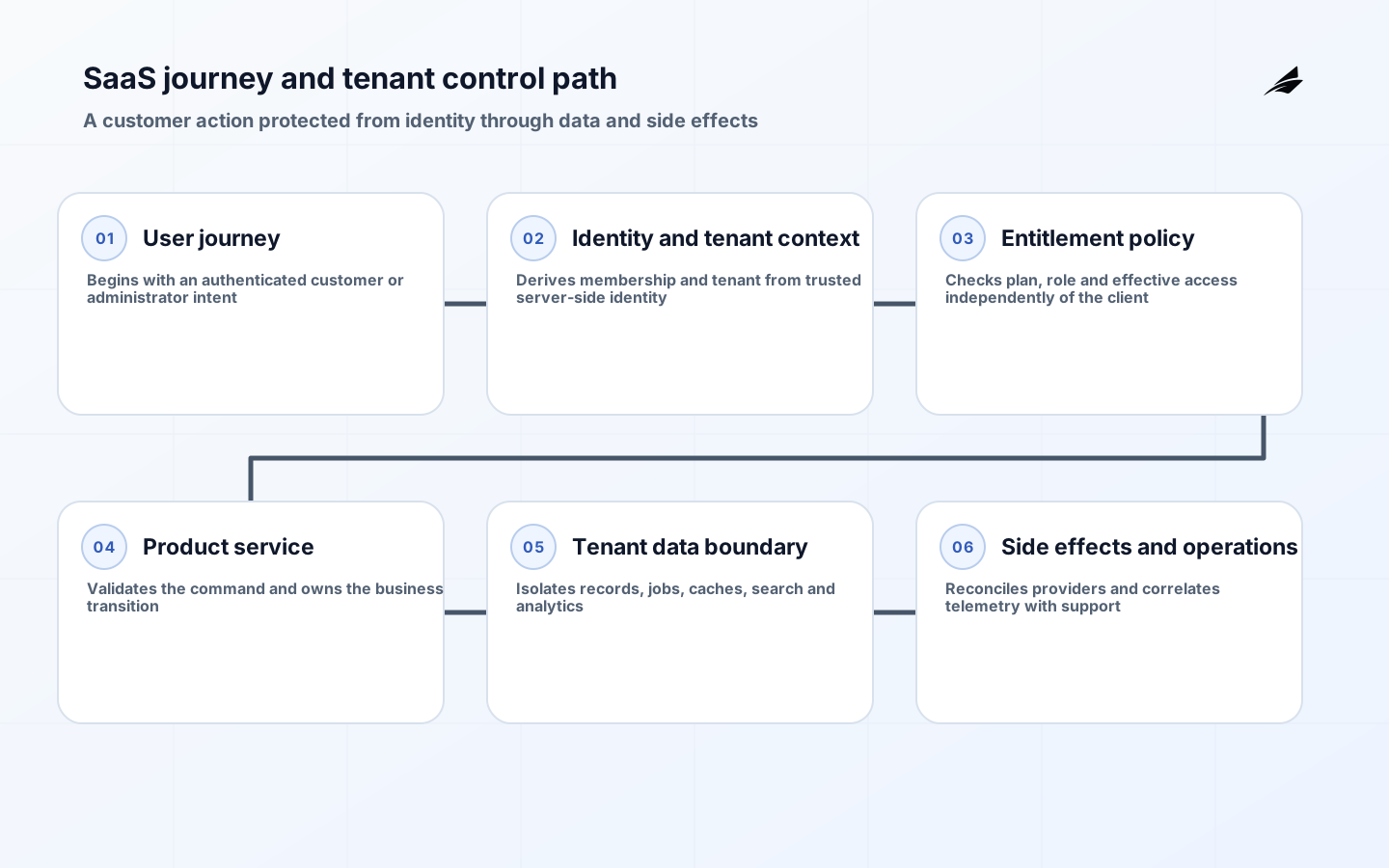
Product engineering services for a SaaS company should improve the product's ability to acquire, serve and retain customers while keeping delivery, security and operations sustainable. The work may include discovery, design, architecture, software development, quality engineering, platform work and production support. A feature list is not an adequate scope. Teams need complete user journeys, tenant and entitlement rules, service objectives, commercial constraints and ownership of the running product. Those decisions shape cost and risk more than the number of screens.
Scope outcomes, journeys and tenant promises
Choose a measurable product outcome and the journey that produces it, such as account activation, first useful result, subscription upgrade or administrator provisioning. Describe target users, context, pain, expected behavior and evidence. Include unhappy paths: invalid input, duplicate request, failed dependency, cancelled payment and lost access. Define which customers, plans, regions and devices are in the first release. Exclude adjacent ideas explicitly. A bounded journey lets product, design, engineering, security and support discuss the same behavior and creates a release that can be observed and reversed.
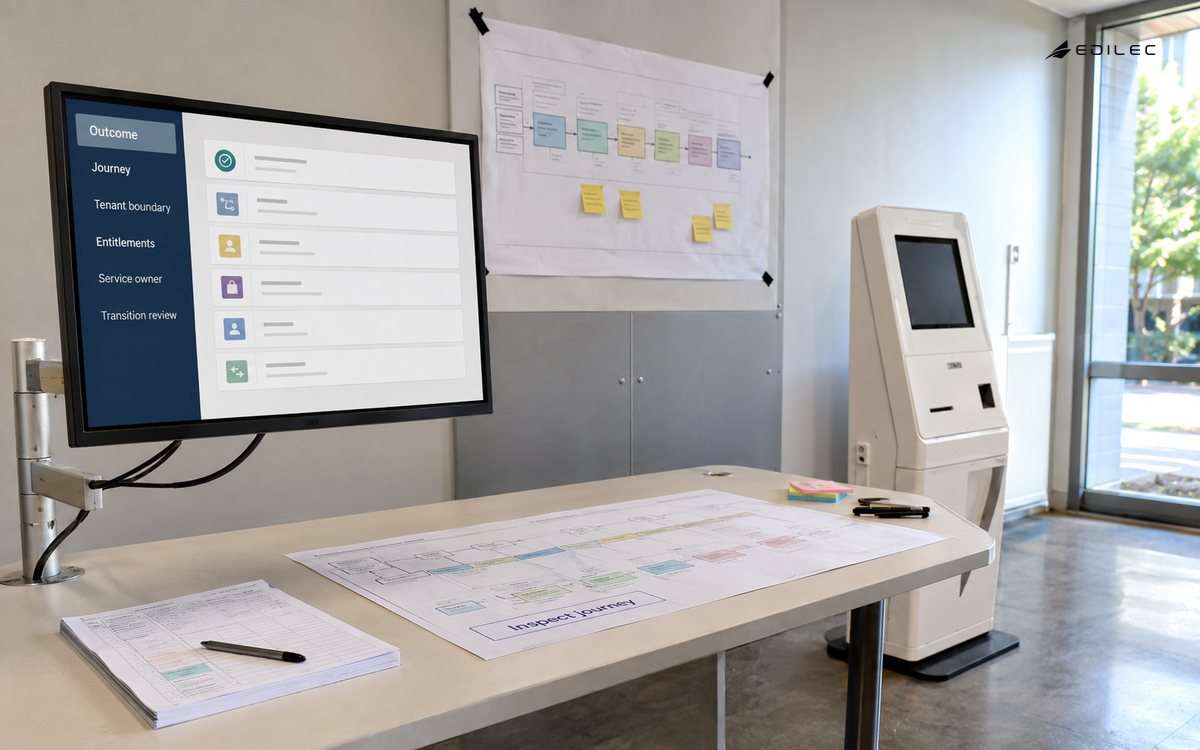
Write the tenant promise early. Decide whether the product supports organizations, workspaces, projects or individual accounts; how membership and roles work; what data and actions are isolated; and how administrators recover access. Separate identity, tenancy, subscription and entitlement concepts. A payment status should not be the only authorization control, and a role name should not silently grant cross-tenant access. Define lifecycle events such as invitation, transfer, suspension, deletion and export. These are core product behaviors, not back-office details.
| Scope layer | Decision | Proof |
|---|---|---|
| Outcome | Which user or business behavior should change? | Baseline, owner and acceptance measure |
| Journey | What complete path and exceptions are included? | Story map and test scenarios |
| Tenant | What boundary isolates data and actions? | Tenant model and authorization tests |
| Commercial | How do plans, trials and entitlements behave? | Versioned catalog and lifecycle examples |
| Service | What reliability and support are promised? | Objectives, runbooks and escalation |
| Transition | How will the release roll out and roll back? | Flags, migration and rollback evidence |
Design the SaaS control plane and data plane
Model control-plane concerns such as tenant provisioning, identity, plans, entitlements, configuration and audit separately from customer workload processing where useful. Every request should derive tenant context from trusted identity and server-side authorization, not a client-provided identifier alone. Apply the tenant boundary consistently in services, jobs, caches, search indexes, object storage, analytics and support tools. Choose shared, partitioned or dedicated infrastructure from isolation, scale, cost and regulatory needs. Document the tradeoff and test it; no tenancy pattern is safe by label.
Define API contracts, data ownership, idempotency and asynchronous state. SaaS journeys cross email, payment, identity and other providers that will fail or retry. Persist business state before emitting side effects, use correlation identifiers, reconcile provider events and make delayed work visible. Treat schema evolution and background jobs as release concerns. Backups must be restorable at the needed scope, and deletion must propagate to derived stores according to policy. Keep regional placement and portability visible if customer promises depend on them.
Make quality a release property
Translate the journey into acceptance examples and layered tests. Unit and component tests protect local behavior; contract tests protect integrations; end-to-end tests cover a small set of critical paths; exploratory and usability work probes surprises. Add security requirements from a suitable baseline such as OWASP ASVS, tailored to the product's risk. Follow NIST SSDF practices for protected development environments, software provenance and vulnerability response. Scan dependencies and artifacts, protect signing and deployment identities, and define supported versions and patch behavior.
Accessibility belongs in design, components, content and testing. Use WCAG 2.2 criteria as a testable baseline for web experiences, while observing actual workflows with assistive technology. Include keyboard operation, focus, errors, status messages and authentication. Performance tests should represent tenant mix, data shape, concurrency, background work and third parties. Check correctness under load; a fast response that later duplicates or loses state is not successful. Set reliability objectives from user journeys and test graceful degradation plus recovery.
| Risk | Early evidence | Control |
|---|---|---|
| Cross-tenant exposure | Authorization varies by endpoint or job | Central policy, tenant-aware storage and adversarial tests |
| Entitlement drift | Billing catalog and product access disagree | Versioned entitlement service and reconciliation |
| Provider coupling | One outage blocks unrelated journeys | Timeouts, queues, degraded modes and ownership |
| Unsafe release | Rollback requires data reversal not designed | Flags, compatible migrations and tested rollback |
| Cloud cost surprise | Shared workload cannot be attributed | Tenant/workload allocation and unit-cost review |
| Support blind spot | Staff cannot establish customer state | Correlated telemetry and protected support tools |
Estimate cost by capability and lifecycle
Cost varies with journey depth, tenancy, integrations, migration, data volume, reliability, compliance, environments and operating hours. Estimate vertical capabilities rather than isolated disciplines: one slice includes design, API, interface, data, tests, deployment, telemetry and support. Separate discovery, initial build, transition and recurring operation. Include internal product and domain time, provider fees, test environments, security remediation, accessibility work, customer migration and early-life support. Keep ranges until prototypes and profiling close the largest unknowns.
Model cloud and vendor cost in product units such as active tenant, transaction or stored volume, while recognizing allocations are approximations. The FinOps Framework emphasizes collaboration among engineering, finance and business stakeholders; cost controls should not be delegated to a monthly bill review. Tag and allocate workloads, set anomaly alerts and review architecture choices against customer value. Contract terms with an engineering partner should cover code and artifact ownership, security practices, staffing continuity, production responsibility, documentation, exit and knowledge transfer.
Use a dual-track, evidence-led delivery plan
Keep discovery slightly ahead of delivery. Product discovery tests the problem, user behavior and solution risk with interviews, prototypes and small experiments. Engineering discovery tests integration, data, performance and security assumptions. Neither should become an endless phase. Commit the next vertical slice only when the team can state the outcome, behavior, constraints and evaluation. Maintain one product backlog with functional and operational work together; reliability, telemetry and migration are not a separate cleanup queue.
- Frame the outcome, journey, target segment and commercial boundary.
- Prove risky assumptions with prototypes, data samples and integration spikes.
- Build one complete production-like slice with security, accessibility and telemetry.
- Release internally, then to a bounded tenant cohort using controlled flags.
- Compare behavior, correctness, reliability, support and cost with the baseline.
- Expand by evidence and retain rollback until migrations and incidents are understood.
- Retire obsolete code, flags, data paths and provider access deliberately.
Instrumentation should connect technical behavior to product journeys without over-collecting personal data. Use traces, metrics and logs with consistent service and correlation context; OpenTelemetry provides common telemetry semantics. Add product events with documented meaning and quality checks. Review activation, completion and retention alongside errors, latency, support contacts and cost. A conversion improvement that increases refunds or access errors is not a win. Define guardrail metrics and stop conditions before the experiment, and avoid interpreting small or biased samples as certainty.
Build durable ownership after launch
A SaaS team needs clear ownership of journeys, services and incidents. Establish service objectives, on-call expectations, escalation, customer communication, vulnerability intake and post-incident learning appropriate to scale. Product managers should see reliability and support signals; engineers should see product and cost outcomes. Reserve capacity for maintenance, dependency upgrades, accessibility defects and operational improvement. Review tenant isolation, privileged access and recovery regularly. Knowledge transfer is proven when the owning team can deploy, diagnose and recover the product without the delivery partner directing every step.
Tenant lifecycle tests should also cover export and deletion. Confirm an authorized administrator can obtain the promised data in a documented format, that export jobs preserve tenant isolation, and that deletion removes or schedules records across operational stores, indexes, caches and analytics according to policy. Record exceptions such as financial records that must be retained, and explain them clearly. These end-of-life paths are easy to postpone, yet they determine portability, privacy operations and the real cost of changing providers or architectures later.
Key takeaways
- Scope complete user journeys and tenant promises, not disconnected features.
- Separate identity, tenancy, subscriptions and entitlements in the domain model.
- Verify isolation and authority through APIs, jobs, caches, analytics and support tools.
- Estimate full vertical slices and steady-state operation, including migration and support.
- Release to bounded cohorts with product, reliability, security, accessibility and cost evidence.
Frequently asked questions
What roles should a SaaS product engineering team include?
The exact mix varies, but the team needs product decision authority, user experience, software and quality engineering, platform or operations capability and access to security, data and domain expertise. Ownership matters more than a fixed role list; every release concern must have a responsible person.
How small should a SaaS MVP be?
Small enough to test one valuable journey for a defined segment, but complete enough to operate safely. Include identity, tenant boundary, support, telemetry, failure handling and data lifecycle required by that promise. Deferring every non-feature concern produces a demo, not a viable service.
Must SaaS products be multi-tenant?
No. Shared, partitioned and dedicated models can all be valid. Choose based on isolation, customization, scale, operational complexity and economics. State the boundary clearly and test it. Hybrid patterns need especially careful routing and lifecycle controls.
How should an engineering partner be evaluated?
Ask for evidence from a representative slice: product reasoning, code review, automated tests, threat modeling, accessibility, deployment, observability, incident response and knowledge transfer. Clarify ownership and exit. Team fit and production discipline matter more than a long generic capability list.
Conclusion
SaaS product engineering joins discovery, design, software and operations around a customer promise. The work becomes manageable when the promise is expressed as a bounded journey with explicit tenant, entitlement, reliability and commercial behavior. Prove the complete slice, test every isolation path and release gradually with correlated evidence. Whole-life cost and durable ownership should shape architecture from day one. That is how a feature delivery engagement becomes a product capability the company can safely scale.