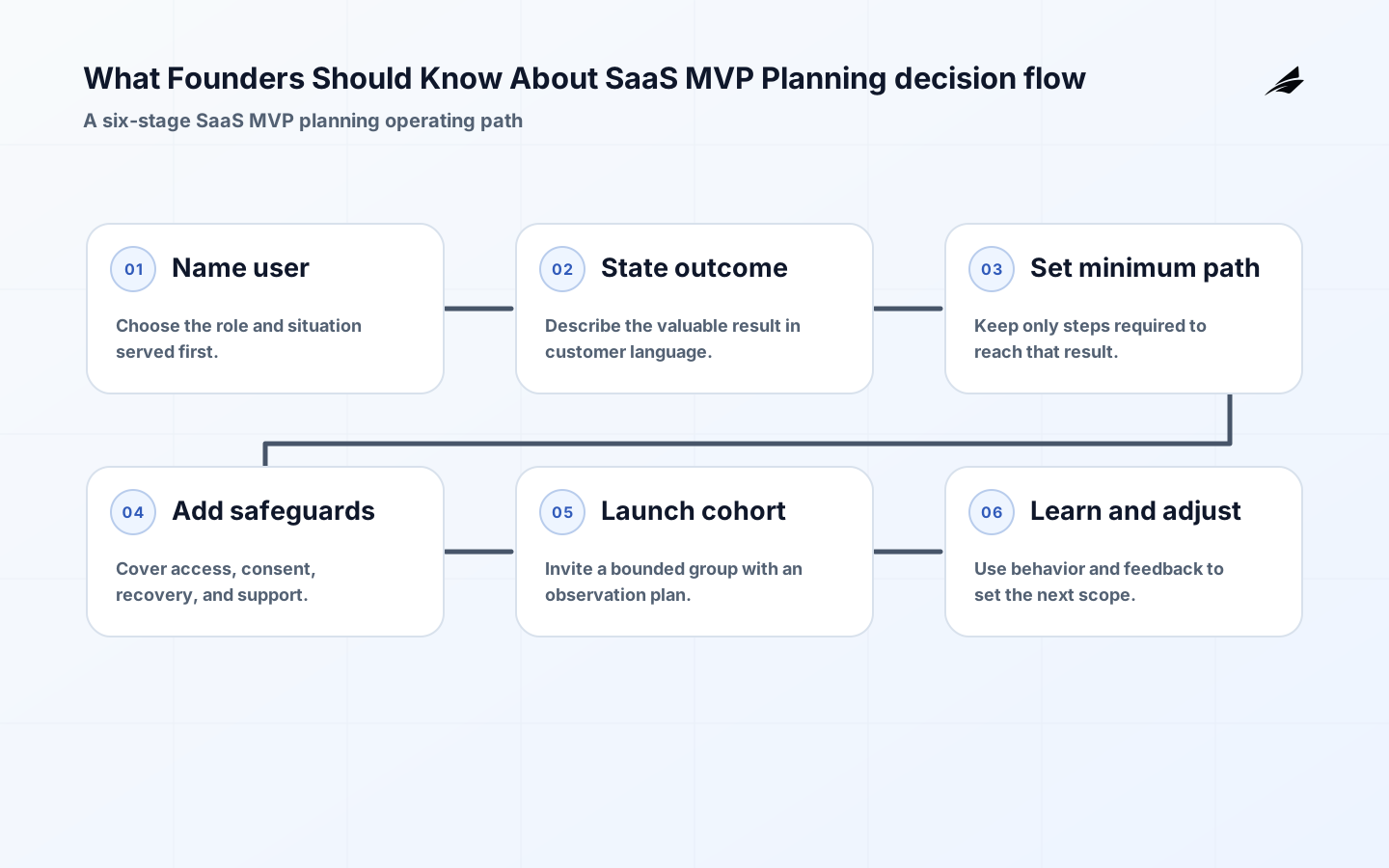
SaaS MVP planning is easiest to get wrong when it is treated as a document, a dashboard, or a single engineering ticket. For founders bringing a new SaaS product to market, it is an operating decision about how people, data, and software produce learn from a complete, supportable customer path rather than a feature inventory. Start with a real case: An MVP can be small without being incomplete. A first user still needs to enter, understand the result, recover from a mistake, and obtain help; omitted platform choices are acceptable only when they do not invalidate the learning. That case forces the team to name the user, the trigger, the authority to act, the records that matter, and the recovery path. It also prevents a familiar failure mode: a polished happy path with no accountable answer when information arrives late, a permission changes, or a customer asks why. This guide treats SaaS MVP planning as a set of decisions that can be tested before scale makes them expensive. The result is not a perfect plan; it is a small, reviewable system that gives product, engineering, operations, and support the same practical picture. For this part of the system, name the accountable owner, supporting evidence, exception route, and next measurable check.
Define the SaaS MVP planning outcome and decision
Write one testable sentence for SaaS MVP planning: a named person or service can complete a defined outcome involving target user, job, minimum workflow, safeguards, launch cohort, and learning loop, and an authorized colleague can explain the result later. Then identify which smallest end-to-end workflow will test the central customer problem credibly. This is deliberately narrower than a vision statement. A decision statement has a subject, a boundary, evidence, and a consequence. Use one ordinary case, one delayed case, and one exception to expose missing rules. For each, capture the initiating event, the inputs that are trusted, the state change, the owner, and the customer-facing effect. The discipline is useful because an ambiguous rule moves downstream as rework. It becomes a conditional in code, a manual workaround in support, or an argument at a launch review. A clear outcome gives the team permission to defer unrelated work while protecting the path that must work. Within this decision boundary, name the accountable owner, supporting evidence, exception route, and next measurable check.
| Question | Decision to record | Evidence before release |
|---|---|---|
| What outcome matters? | A specific result for the intended user. | A walkthrough with a start and end state. |
| Who can decide? | One accountable owner and escalation route. | Named decision rights and review date. |
| What changes state? | Trusted trigger, inputs, and preconditions. | Accepted and rejected examples. |
| How is it explained? | Plain language and a correction path. | A readable record linked to the decision. |
Map the SaaS MVP planning workflow before selecting tools
Map the workflow from the user goal through the last accountable action. For SaaS MVP planning, include the people who initiate, approve, investigate, and experience the outcome, plus the systems that hold or transform important values. At every handoff, write the current state, the allowed next state, the input that permits it, and the record left behind. This simple map exposes whether a team is relying on tacit knowledge. It also separates observation from authority: an operator may need enough context to diagnose a case without the power to change it. The same distinction matters for automation. A service can recommend, route, or calculate while a person retains approval for a policy-changing action. Review the map with a product lead, an engineer, and the person who handles the exception; each will notice a different missing constraint. When implementing this workflow step, name the accountable owner, supporting evidence, exception route, and next measurable check.
Set boundaries, permissions, and data contracts
Treat each value in target user, job, minimum workflow, safeguards, launch cohort, and learning loop as a claim with an origin, effective time, and owner. Decide which system is authoritative, which representations are derived, and what happens when a value is corrected. A data contract should state meaning as well as format: identifier, tenant or workspace scope where relevant, timestamps, version, required fields, and expected behavior for missing or duplicate input. This is where OWASP's verification guidance is useful: authorization belongs on the server-side decision path, not only in the interface. For people-facing flows, WCAG 2.2 reinforces the practical value of clear labels, keyboard operation, and error recovery. Those are not cosmetic upgrades. A usable explanation reduces mistaken action and gives support an evidence trail that survives a handoff. Before releasing this data handoff, name the accountable owner, supporting evidence, exception route, and next measurable check.
| Workflow element | Minimum contract | Operational check |
|---|---|---|
| Identity or actor | Stable identifier and scoped role. | Can an investigator identify who acted? |
| Business state | Allowed transition and effective time. | Can an invalid transition be rejected? |
| Decision input | Source, version, and validation rule. | Can a result be reproduced later? |
| Customer message | Status, next action, and correction route. | Can a user recover without staff intervention? |
Build a thin but complete SaaS MVP planning slice
Build the MVP around one complete customer job. For a collaboration product, that might be inviting a teammate, completing a shared task, and seeing the resulting status; for a reporting product, it might be connecting one data source and receiving one trustworthy output. Include only the setup, identity, data handling, and support needed to make that job credible. A temporary manual onboarding step can be acceptable when the customer knows what happens and the team records the result. A missing recovery path is different: it makes the learning unreliable because a small error ends the journey.
Design operations and recovery into SaaS MVP planning
Operate the first cohort like a deliberate service, not an anonymous traffic source. Choose participants who match the target situation, establish a way to reach help, and decide who will observe behavior without interrupting it. Keep a log of onboarding friction, failures, and requests, but distinguish between what someone says they want and what prevents completion of the central job. If an issue threatens trust or data safety, pause the cohort and fix it before widening access. This protects the relationship with early users, whose candor is more valuable than a vanity signup count.
Measure SaaS MVP planning with decision-quality signals
The MVP scorecard should focus on activation of the promised job, time to first value, completion without assistance, return behavior where relevant, and the reasons people abandon the path. Pair those with operational signals such as support response and failed background work. Do not expand scope because a requested feature sounds adjacent; expand when evidence shows that the current path works and the next constraint is preventing meaningful adoption. The cleanest MVP learning is often a decision to remove a step, narrow a user segment, or say no to a tempting integration.
Common SaaS MVP planning failures to avoid
- Starting with a tool choice before agreeing on the SaaS MVP planning decision and owner.
- Treating the successful path as the specification while leaving correction and escalation implicit.
- Giving broad access because a support or operations role needs context.
- Collecting metrics that cannot be tied back to a user outcome or state transition.
- Calling a manual workaround temporary without an owner, service target, and removal condition.
Run a practical SaaS MVP planning working session
Bring the accountable product owner, engineer, operations representative, and support or customer-facing participant together for ninety minutes. First, walk a routine case and an exception using the same map. Second, list decisions that remain ambiguous and assign an owner and date to each. Third, choose the smallest end-to-end slice and define its acceptance evidence: a test, record, support view, or customer explanation. Finally, agree on the first review signal and the threshold that prompts action. This session is most effective when the group works from a concrete case rather than a backlog of abstract requests. The goal is not agreement on every implementation detail. It is a shared, falsifiable plan for SaaS MVP planning that can survive delivery pressure. For a closely related foundation, see roadmap prioritization checklist. While operating this part of the system, name the accountable owner, supporting evidence, exception route, and next measurable check.
Key takeaways
- SaaS MVP planning begins with an accountable outcome and a clear decision boundary.
- Map routine and exceptional paths before committing architecture or workflow tooling.
- Keep authority, evidence, and customer explanations together at important state changes.
- Deliver a complete first slice with observability and recovery, not a broad collection of partial features.
- Use outcome, reliability, and exception signals to guide the next decision.
Frequently asked questions
When should a team start SaaS MVP planning?
Start SaaS MVP planning before a feature becomes difficult to change, usually when the team can name a target user and a consequential workflow. Early work should be lightweight: a decision statement, a workflow map, and a few examples. The point is to reveal irreversible assumptions before they become software and operational habits. When changing this part of the system, name the accountable owner, supporting evidence, exception route, and next measurable check.
Who owns SaaS MVP planning?
For founders working on SaaS MVP planning, this operating decision should connect customer outcomes, tenant state, entitlements, release controls, support actions, and operating cost to evidence an accountable owner can inspect. One product or process owner should be accountable for the outcome, while engineering owns the technical implementation and operations owns the repeatable handling of work. Shared participation is essential, but shared accountability often leaves exceptions unresolved. Write down the escalation route when decisions cross those responsibilities. In this operating review, move beyond the operating decision only after the owner can show the accepted result, the exception path, and the signal for another review.
What proves SaaS MVP planning is ready to expand?
In SaaS MVP planning, founders should make the relationship between customer outcomes, tenant state, entitlements, release controls, support actions, and operating cost explicit and reviewable. Expansion is justified when the target path works for a bounded audience, the team can explain and recover from predictable exceptions, and the chosen signals show acceptable outcome and reliability. A larger audience is not the proof by itself; evidence from the first cohort and a working support path are stronger signals. This operating review should close the operating decision only when the result, unresolved exception, and next review condition are recorded.
Conclusion
SaaS MVP planning becomes durable when it is designed as a customer outcome plus an operating system: clear authority, meaningful records, scoped access, recovery, and a learning loop. Keep the first version small enough to observe, but complete enough to support. That combination lets founders bringing a new SaaS product to market make the next investment from evidence rather than optimism. To govern this part of the system, name the accountable owner, supporting evidence, exception route, and next measurable check.