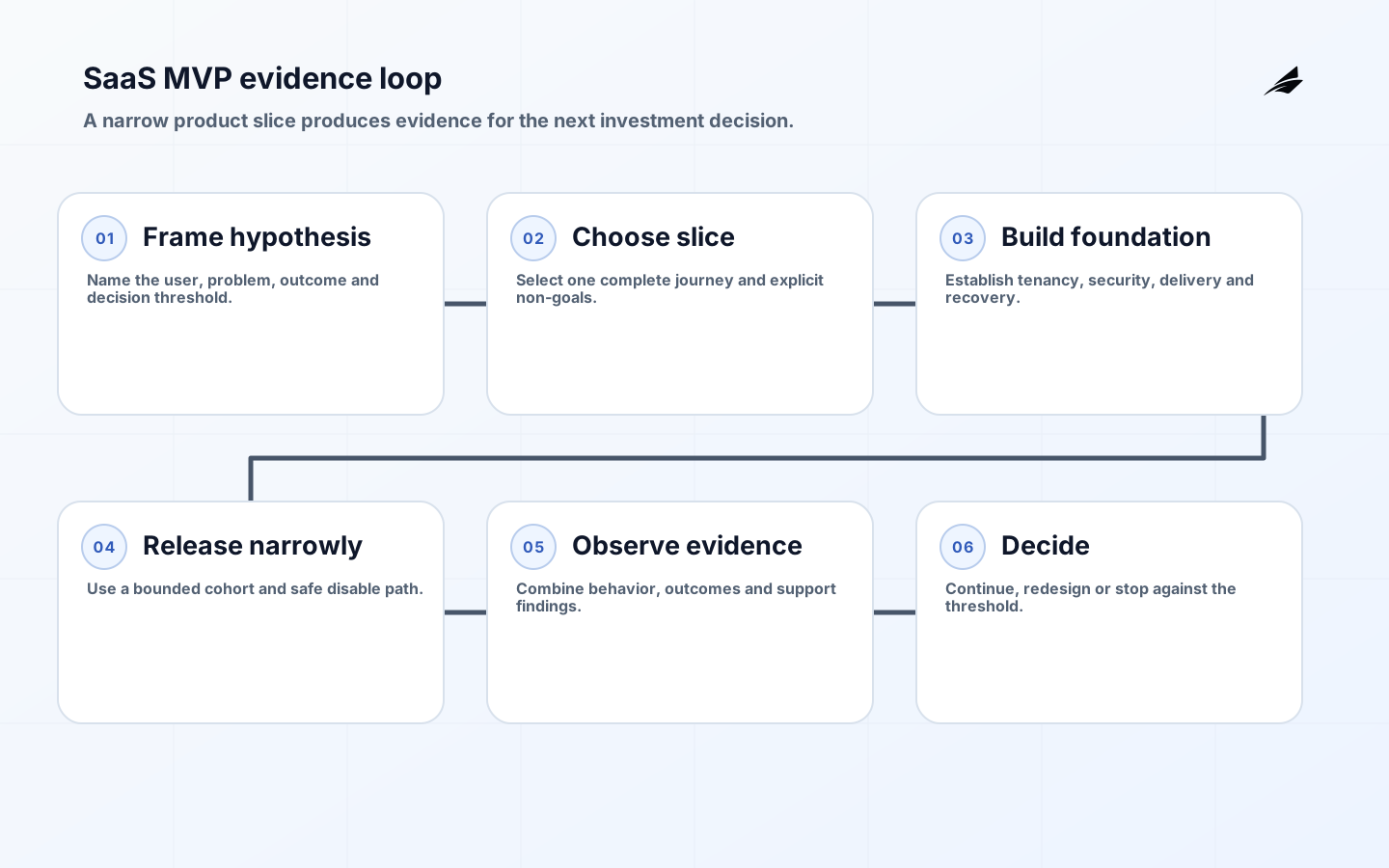
A SaaS minimum viable product is the smallest product that can test a meaningful customer and business assumption under real operating conditions. It is not a large roadmap squeezed into a rushed first release, and it is not permission to postpone tenant isolation, recovery or basic security. For a small business, the best MVP usually completes one valuable workflow for one clearly defined user group and produces evidence that supports a continue, change or stop decision.
The questions below address the decisions founders most often discover too late: what to include, what to leave out, how much foundation is necessary, how to handle subscriptions, and when a pilot is ready for paying customers. DORA guidance on small batches and customer feedback supports short learning cycles. NIST's Secure Software Development Framework and W3C accessibility guidance help ensure that speed does not create avoidable product debt or exclude intended users.
What makes a SaaS MVP genuinely viable?
Viability means a target user can discover or receive access, sign in, complete the core job, understand the result, obtain help and leave or export data under stated conditions. The team must be able to deploy, observe, support and restore that journey. Manual work behind the interface can be acceptable when it is disclosed, secure and economically bounded. A prototype that depends on the founder repairing production data after every session is useful for demonstration, but it is not yet an operable SaaS service.
Write a hypothesis with five elements: user, problem, proposed behavior, expected outcome and decision threshold. For example, a small maintenance company may test whether dispatchers will replace a shared spreadsheet when technicians can update job status from a phone and managers can see exceptions. The MVP need not optimize every route. It must preserve job ownership, permissions and status accurately enough to test adoption. Decide in advance what evidence would justify another investment cycle.
| MVP question | Useful answer | Warning sign |
|---|---|---|
| Who is it for? | A named role in a specific operating context | Everyone who might use software |
| What job is complete? | One end-to-end workflow with a clear result | A collection of disconnected screens |
| What will be learned? | A behavior and outcome tied to a decision | General feedback that cannot change direction |
| What quality is required? | Security, correctness and recovery proportional to consequence | Quality deferred until after customers arrive |
| What is excluded? | Explicit non-goals with a review date | An unlimited backlog called phase two |
Which features should be included in the first release?
Map the full customer journey, then select the thinnest coherent path through it. Most SaaS MVPs need account and tenant setup, authentication, server-side authorization, the core data model, one primary workflow, essential notifications, a support path, audit events for consequential actions, backup and a way to correct or export data. Add billing only if willingness to pay or subscription behavior is part of the current hypothesis; otherwise use a controlled pilot agreement and avoid pretending that a payment page proves value.

Exclude advanced dashboards, broad integrations, configurable workflow builders, multiple personas and fine-grained plan variations unless the hypothesis depends on them. Do not exclude the seams that make the core workflow truthful. A dashboard without reliable ingestion, a collaboration feature without permissions or an automated decision without override and evidence will produce misleading feedback. Review every proposed feature by asking whether its absence prevents the user from completing the tested job or prevents the team from operating it safely.
How much architecture does an MVP need?
Use the simplest supported architecture that preserves the boundaries likely to matter. A modular monolith and managed database can be easier for a small team to understand than distributed services. Separate tenants logically through a consistently enforced tenant context, and use automated negative tests to prove that records, files, cache entries and background jobs cannot cross that boundary. Choose stable platform services, keep configuration in version control and document the few decisions that would be expensive to reverse.
Build a production-like delivery path early. The team should be able to run tests, create a versioned release, deploy it predictably and roll back or disable a risky feature. Database changes need forward-safe migration and backup. External dependencies need timeouts and failure behavior. Avoid premature scale work, but identify likely hard limits such as a provider quota, expensive report or synchronous import. Measure these paths with realistic sample data before onboarding a customer whose workflow depends on them.
What security and privacy work cannot wait?
Define data classes, tenant boundaries, roles, retention and administrative access before coding the workflow. Use a maintained identity provider where practical, require stronger authentication for administrators, enforce authorization on the server and protect secrets outside source. Record sensitive changes such as role grants, exports and billing overrides. NIST SSDF recommends integrating requirements, protected development environments, code review, dependency management, testing and vulnerability response into the development lifecycle rather than attaching a security review after release.
Collect only data needed for the stated service and explain its use. Provide deletion and export behavior that the team can actually execute, including derived records and backups according to policy. Threat-model account takeover, cross-tenant access, unsafe uploads, invitation abuse and support impersonation. Give each material finding an owner and release decision. Automated scanners are inputs; they do not replace authorization tests or review of the workflow's business rules.
How should subscriptions and entitlements work?
Treat billing as an asynchronous system. Map the payment provider's customer and subscription identifiers to an internal organization, verify signed events and process them idempotently because delivery can be delayed or repeated. Derive a clear entitlement state for the application instead of calling the provider during every request. Define trial, active, past-due, cancelled and grace-period behavior. A failed payment should not unexpectedly destroy work or block a legally required export.
Start with few plans and one understandable value measure. Complex per-feature matrices create support and test burden before product value is known. Reconcile invoices, payments and application access on a schedule, and give support a safe view of that state. Test upgrades, downgrades, cancellation, refunds and webhook replay in the provider's test environment. Product, finance and support must use the same definitions; otherwise customers receive contradictory answers.
| Launch gate | Evidence | Stop condition |
|---|---|---|
| Customer value | Target users complete the workflow with representative data | The result depends on hidden expert intervention |
| Tenant safety | Cross-tenant and privilege tests pass | Client-supplied tenant IDs grant access |
| Operability | Another team member deploys and diagnoses the service | Only the original developer can recover it |
| Billing | Entitlements reconcile after duplicate and late events | Payment state corrupts access |
| Recovery | A restore preserves accounts and tenant boundaries | Backup exists but has not been restored |
| Accessibility | Keyboard, focus, labels and error paths are checked | A target user cannot complete the core job |
How should the MVP be tested with customers?
Recruit people who experience the target problem and can use realistic data within approved boundaries. Observe them attempting the workflow rather than leading them through it. Ask what evidence they need to trust the result and what they do next. Combine interviews with product events, support records and outcome measures. Page views are weak evidence; completed work, repeated voluntary use and changed operating behavior are stronger. Record why a participant does not proceed, including procurement or trust barriers.
Release to a bounded cohort. Keep feature flags or another controlled disable path, and establish support coverage during the trial. Review evidence at a fixed cadence against the original hypothesis. Separate a missing core requirement from a customer-specific preference and a usability defect. Close the feedback loop with participants. Small batches reduce the time between observation and correction and make it easier to connect a result to a specific change.
How much should a small-business SaaS MVP cost?
A responsible estimate is a range based on workflow complexity, data sensitivity, integrations, roles, platform needs and launch obligations. Include discovery, design, engineering, testing, cloud environments, observability, security review, content, support preparation and a stabilization period. Separate build cost from recurring hosting, payment fees, messaging, email, monitoring and support. A lower quote may simply omit work that appears later as founder labor or production risk.
Fund by gates. First approve the hypothesis and prototype, then the operable slice, then a limited live cohort, then expansion. Each gate should retire a named uncertainty. Maintain a unit-cost view using the activity that drives spend, such as active organizations, documents processed or stored data. The goal is not perfect economics at low volume; it is knowing whether the likely model can improve without undermining customer value or reliability.
Key takeaways
- Define the learning decision before choosing features.
- Build one complete customer journey with explicit non-goals.
- Establish tenant, security, backup and deployment foundations early.
- Treat billing events and entitlements as asynchronous product state.
- Expand only after target users and the operating team prove the service.
Frequently asked questions
Should an MVP be no-code?
No-code can test workflow and demand quickly when its security, data and integration limits fit. Confirm ownership, export and migration before customer dependence grows. Use custom code when the product's differentiating behavior or control cannot be represented safely.
How many customers are needed?
There is no universal number. Use enough representative participants to expose recurring behavior and important variation. The quality of observation and fit with the target role matter more than a large convenience sample.
When is the MVP finished?
It is complete when the defined hypothesis has credible evidence and the team can make the planned decision. Production support may continue, but the next work should follow a new, explicit hypothesis rather than an endless MVP label.
Conclusion
SaaS MVP development for a small business succeeds when it produces trustworthy learning without creating an unsafe service. Keep the product slice narrow, but exercise the real tenant, billing, support and recovery seams. Observe representative users, measure the intended outcome and use pre-agreed gates to invest further. That discipline gives a founder something more valuable than a quick demo: evidence about whether the product deserves to grow.