SaaS MVP scope for technical founders is the smallest production system that can test a valuable customer outcome, not the smallest amount of code that can be demonstrated. A credible MVP lets a defined user complete one end-to-end job under real constraints, while the team can secure, support, observe and change it. The goal is to reduce product uncertainty without creating avoidable uncertainty about identity, tenant data, billing or recovery.
Use this guide before converting a prototype into a paid pilot. It works alongside the early SaaS product analytics guide, feature flag release strategy and subscription usage reporting architecture so learning, release control and commercial records share one plan.
Define the decision the MVP must inform
Write a hypothesis with four parts: target user, painful situation, changed behavior and observable evidence. 'Teams need an AI dashboard' is not specific enough. 'Support leads will review a prioritized queue each morning and resolve urgent cases before breach' can be tested. Name the investment decision that follows: continue, change segment, revise workflow or stop. A release date is a delivery commitment; it is not a learning threshold.
Select one primary outcome measure and guardrails for errors, unsafe behavior, support effort and cost. Establish a baseline from interviews, workflow observation or current records. Define the pilot cohort and how long the behavior must be observed. Avoid vanity measures such as registrations when the product promise concerns completed work. Qualitative evidence remains important, but record it against specific workflow steps rather than collecting unstructured praise.
| Scope question | Strong MVP answer | Warning sign |
|---|---|---|
| Who is it for? | One role in a named context | Anyone who might use it |
| What job is complete? | One end-to-end transaction with recovery | Several disconnected features |
| What proves value? | Behavioral outcome plus guardrails | Demo approval or page views |
| What happens next? | Predefined continue, change or stop rule | Roadmap proceeds regardless of evidence |
| Who operates it? | Named product and service owners | Founder memory is the runbook |
Scope one complete customer workflow
Map the journey from invitation or discovery through the promised result. Include validation, permissions, empty states, failures, cancellation, notification and support intervention. A thin vertical slice is usually more informative than polished fragments across many modules. Explicitly list exclusions, but do not label essential controls as future features. Authorization, data integrity and recoverability are properties of the workflow, not optional backlog items.
Create a state model for the core record. Name valid transitions, actors, timestamps and correction rules. This prevents status fields from becoming arbitrary labels and makes event tracking meaningful. Decide which system is authoritative for customer, subscription and business data. If the MVP integrates payment, email, identity or an AI service, define timeout, retry, duplicate and provider-unavailable behavior before implementation.
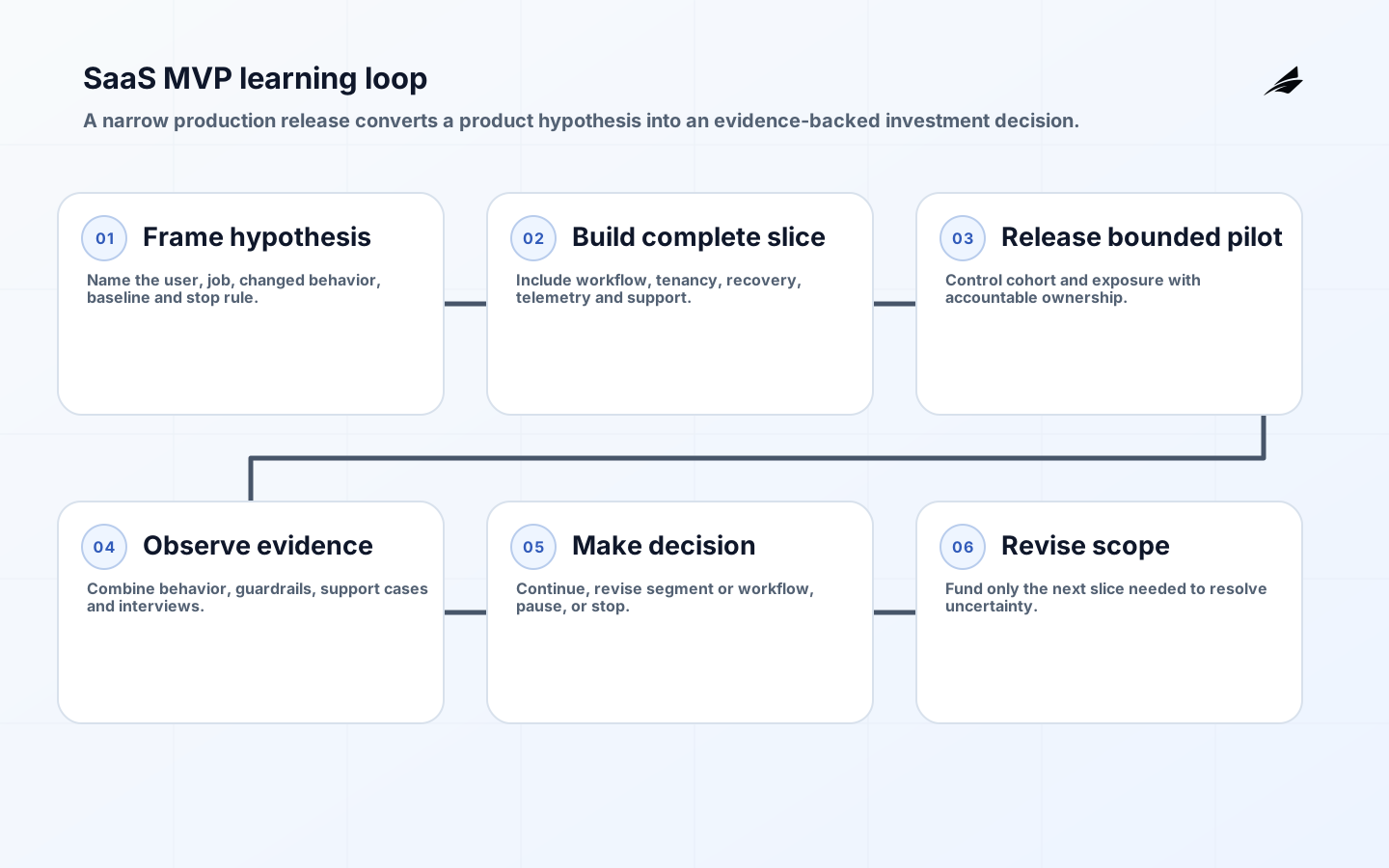
Build the SaaS MVP learning loop
The operating loop is hypothesis, bounded release, observed behavior, support review, decision and revised scope. Product analytics should describe the workflow: activation, first value, successful completion, exception and return use. Pair events with interviews and support cases so the team understands why behavior changed. Instrument the first production slice before the pilot; reconstructing a measurement model after launch often produces ambiguous events and lost baselines.
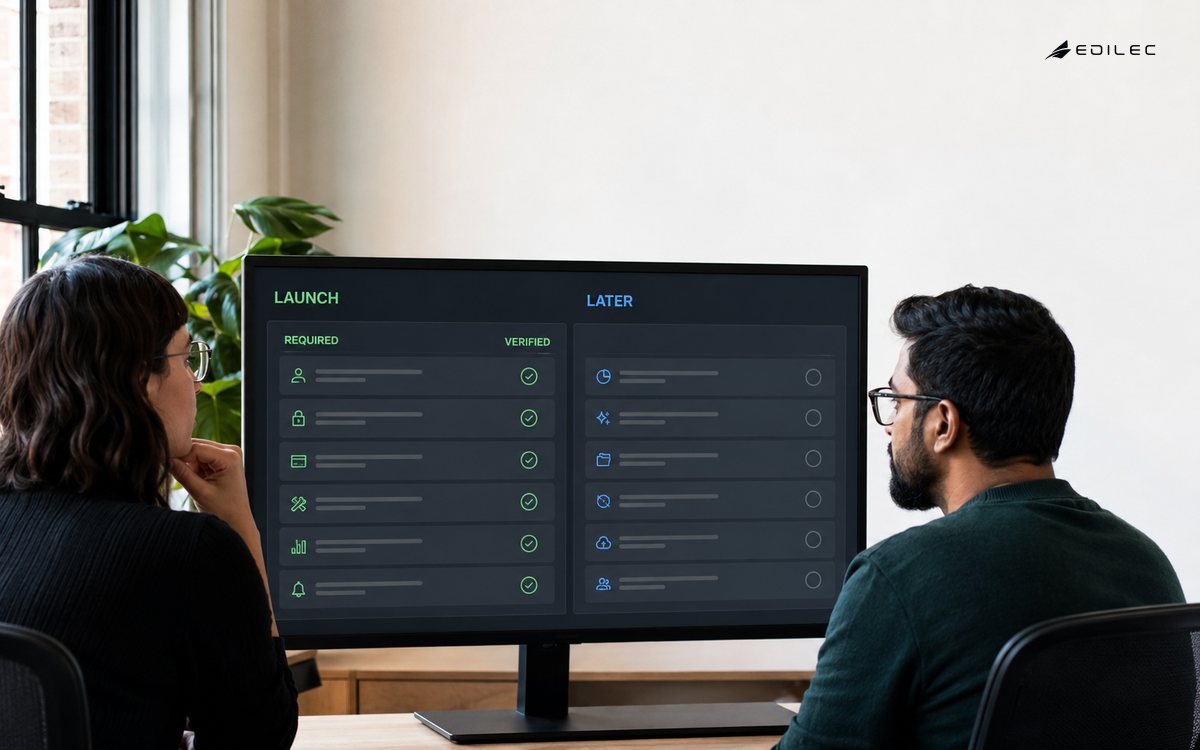
Feature flags can separate deployment from exposure, limit the cohort and provide a fast stop mechanism, but every flag needs an owner, default state and removal date. Keep the experiment population identifiable without leaking sensitive attributes into analytics. Review results on a set cadence and write the next decision. A learning loop fails when evidence is collected but roadmap priorities remain untouched.
Set tenant, identity and data boundaries early
Even a small B2B SaaS product needs a consistent tenant model. Decide whether users can belong to multiple organizations, who can invite or remove members, how ownership transfers and what happens when a subscription ends. Enforce tenant scope on the server and in background work, exports, caches and support tools. Tests should attempt cross-tenant reads and writes using modified identifiers, not only navigate the intended interface.
Minimize personal and customer data, document purpose and retention, encrypt sensitive data in transit and at rest, and keep production secrets out of source and logs. NIST's Secure Software Development Framework provides a useful baseline for repository protection, dependency management, review, release integrity and vulnerability response. Add deletion and export behavior where the product promise or applicable obligations require them; obtain jurisdiction-specific legal advice separately.
Choose architecture the current team can operate
Prefer a modular monolith or a small number of services unless independent scaling, isolation or ownership clearly requires more. Keep module boundaries explicit and migrations repeatable. Managed services can reduce operational load, but the team still owns configuration, access, limits, recovery and cost. The Twelve-Factor principles remain useful for configuration and disposable processes, though they are design guidance rather than a complete production architecture.
Automate build, tests and deployment from versioned configuration. Produce an immutable artifact traceable to source. Protect the main branch and require review for consequential changes. Test business rules, authorization, integrations and the few end-to-end journeys that determine revenue or trust. DORA's delivery metrics should be used as a balanced system: lead time and deployment frequency matter with change failure, recovery and deployment rework, not as isolated speed targets.
| Production capability | MVP minimum | Proof before pilot |
|---|---|---|
| Identity and tenancy | Individual accounts and server-side tenant scope | Cross-tenant and role-change tests |
| Data | Owned schema, migrations, backup and retention | Migration rehearsal and restore result |
| Release | Automated traceable deployment | Staging release and rollback exercise |
| Reliability | Outcome SLI, logs and actionable alerts | Failure drill for one critical dependency |
| Support | Safe lookup and bounded correction | Operator resolves a seeded case |
| Accessibility | Keyboard, focus, labels and clear errors | Critical journey tested against WCAG target |
Include billing, onboarding and support reality
If payment is part of the hypothesis, model plan, entitlement, invoice and cancellation states explicitly. Do not infer product access solely from a redirect after checkout. Process provider events idempotently, reconcile local and provider records, and expose subscription state to support. If the pilot is free, still define entitlement duration and what happens at expiry; indefinite manual access makes conversion evidence unreliable.
Onboarding should bring the target user to first value with minimal founder intervention. Track where setup stalls and make required configuration visible. Provide accessible errors, loading and empty states. Support needs event history, account status and safe corrective actions; direct database edits are not a support workflow. Write escalation and customer communication ownership before the first external user depends on the product.
Release to a bounded cohort and review evidence
- Reconfirm the hypothesis, cohort, baseline, guardrails and stop rule.
- Rehearse migration, deployment, smoke tests, recovery and support lookup.
- Release behind controlled exposure and verify telemetry with real transactions.
- Review customer outcomes, exceptions, reliability, support effort and unit cost.
- Fix integrity or control gaps before expanding the cohort.
- Write the product decision and fund only the next evidence-producing slice.
Use service level indicators tied to customer experience, such as successful workflow completion, processing time or durable record creation. Google SRE guidance recommends starting from what users care about rather than what is easy to measure. Set a realistic initial objective and define what action follows a breach. The product can tolerate imperfection; it cannot learn from failures that are invisible or have no owner.
Plan ownership and founder-independent operation
Document service ownership, deployment access, supplier contacts, data correction, incident command, security intake and customer communication. Keep architecture decisions, environment setup, dependency inventory and known risks with the code. Test the handover by having someone other than the original builder deploy a small change, investigate a seeded failure and restore representative data. Documentation that has never been executed is an assumption.
Set a review after the first production month to compare product evidence, reliability, support demand, security findings and unit cost with the launch baseline. Decide what to automate, simplify or remove. Founder involvement can remain valuable, but the service should not depend on one person's memory for routine recovery or customer state.
Key takeaways
- Define the MVP around a decision and one complete customer outcome.
- Treat tenant isolation, authorization and data recovery as baseline properties.
- Instrument product behavior before the pilot and connect evidence to scope decisions.
- Use the simplest architecture the present team can deploy and support.
- Bound exposure, rehearse failure and stabilize operations before adding breadth.
Frequently asked questions
How long should a SaaS MVP take to build?
There is no responsible universal duration. Timing depends on workflow complexity, integrations, data sensitivity and evidence already available. Estimate the smallest complete production slice, identify uncertainty separately and use milestones for workflow proof, control acceptance and pilot evidence rather than promising a date from screen count.
Does the first release need multi-tenancy?
A B2B SaaS pilot usually needs at least an explicit organization boundary even if infrastructure is shared. The implementation can be simple, but ownership, membership and server-side isolation should be unambiguous. Retrofitting tenant scope after customer data accumulates is risky and expensive.
How much technical debt is acceptable?
Accept reversible shortcuts with a known owner and trigger for removal. Do not defer controls whose absence can corrupt authoritative data, expose another tenant, prevent recovery or make releases untraceable. Record the tradeoff and expected cost rather than using 'MVP' as a blanket exception.
Conclusion
A strong SaaS MVP is narrow in product promise and complete in production behavior. It tests one meaningful workflow with real users while preserving identity, tenant boundaries, data integrity, release control and support evidence. That discipline does not slow learning; it makes the evidence trustworthy enough to guide the next investment.