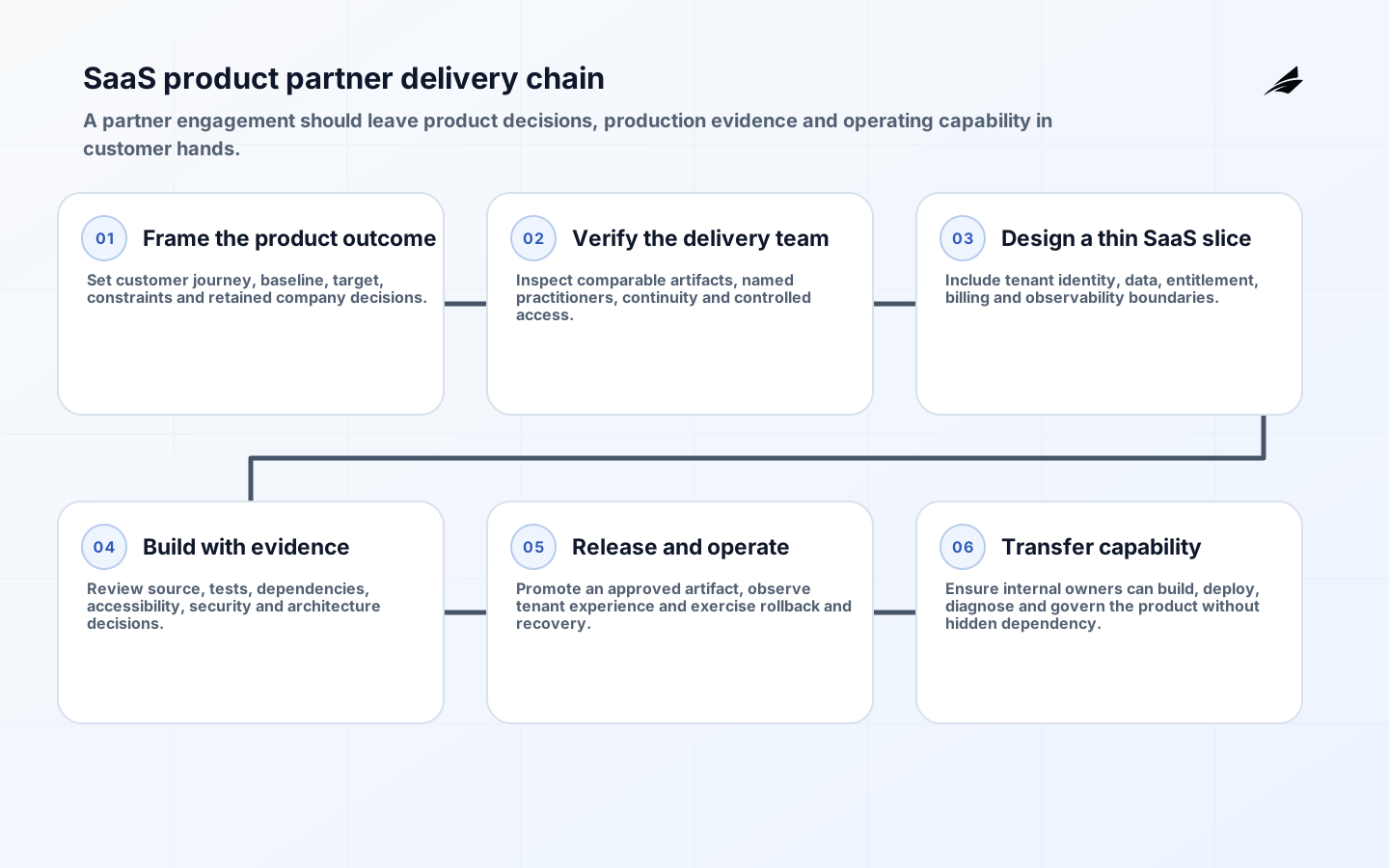
A SaaS product development company for SaaS companies should strengthen product judgment and operating capability, not merely supply developers. The partner must understand tenant identity, onboarding, entitlements, billing, data isolation, support tooling, release safety and the economics of a shared service. Before comparing rates, define the customer outcome and product constraint the engagement must change. A credible provider can show how discovery becomes architecture, reviewed code, migration evidence, observable releases and knowledge your team can continue to own.
Use the companion implementation checklist during due diligence and the SaaS partner FAQ for commercial questions. The ecommerce SaaS delivery plan illustrates additional transaction and catalog constraints. The plan below is designed for an existing SaaS company adding a product line, modernizing a platform or increasing delivery capacity without losing architectural ownership.
Define the product outcome before requesting a team
Describe the user and business change in one page. Include target customer, critical journey, current baseline, desired outcome, constraints, affected systems and the date by which a decision is needed. Distinguish product uncertainty from engineering work. If retention is poor because onboarding is confusing, adding engineers without observing the journey may accelerate the wrong backlog. Ask the partner to propose a thin end-to-end slice that can test value and architecture together.
List retained decisions explicitly. Your company should own product priority, risk appetite, data use, pricing policy, customer commitments and production authorization. A partner may facilitate and recommend, but should not silently make permanent business policy through implementation choices. Define access to customers and subject-matter experts, because a team isolated behind tickets will fill gaps with assumptions.
| Scope element | Evidence before contracting | Acceptance evidence |
|---|---|---|
| Product outcome | Baseline journey and measurable customer problem | Observed improvement or validated learning |
| Architecture | System map, tenant model and constraints | Decision records and tested boundaries |
| Delivery | Thin-slice sequence and dependency plan | Working increments with review artifacts |
| Operations | SLOs, support roles and recovery needs | Telemetry, runbooks and exercised rollback |
| Transfer | Named owners and repository access | Customer team can release and diagnose |
Evaluate capability through inspectable work
Request anonymized architecture decisions, test strategies, deployment evidence, incident learning and examples of product discovery. A polished portfolio proves presentation, not necessarily tenant isolation or production ownership. Interview the people who will lead the work. Ask how they would handle cross-tenant access, billing retries, schema migration, a failed background job and a customer requesting deletion. Strong answers identify trade-offs and evidence rather than naming tools alone.
Check staffing continuity and subcontracting. Identify who owns architecture, product, design, quality, security and delivery; how replacements are approved; and where work and data occur. Verify repository, ticket, design and cloud access are in company-controlled systems where practical. References should match the engagement’s stage and constraints. A startup MVP and a migration of a mature multi-region service require different proof.
Make SaaS architecture part of commercial scope
The statement of work should address tenant identity and lifecycle, data partitioning, entitlements, metering, configuration, asynchronous work, integrations, observability and deletion. Decide which layers are pooled, partitioned or dedicated and how premium isolation is operated. Tenant context must survive APIs, queues, caches, exports and support tools. Cloud-provider multitenancy guidance is useful, but the partner must translate patterns into your customer promises and team capability.
Record nonfunctional acceptance: latency, availability, accessibility, security, privacy, recovery, scale and maintainability. Apply NIST SSDF practices within the chosen development lifecycle and use a verification baseline such as OWASP ASVS for relevant application controls. Accessibility should be tested as a product requirement, not postponed to visual polish. Architecture is complete only when the release and support model can operate it.
Choose an engagement model that preserves decisions
A fixed scope is useful when acceptance is stable and dependencies are understood. A dedicated cross-functional team suits evolving product work but needs outcome governance and budget boundaries. A discovery engagement can reduce uncertainty before a larger commitment. Avoid arrangements that reward output volume without accountability for quality or operating outcomes. Whatever the model, use short review cycles, visible work in progress and a decision log.

Define change control without making learning impossible. New information should update scope, but the effect on cost, schedule and risk must be visible. Set escalation routes for blocked customer decisions and third-party dependencies. Link invoices to agreed capacity or accepted milestones, not to unverifiable percentages complete. Maintain a prioritized exit-ready backlog so the company can pause responsibly if evidence changes.
Estimate cost from team shape and risk retirement
Total cost includes product research, design, engineering, quality, security, infrastructure, data migration, accessibility, documentation, release and support transition. The lowest hourly rate can produce a higher total when communication, rework or weak automation slows feedback. Ask for a range with assumptions: team roles, utilization, environments, external services, migration volume, compliance work and retained customer responsibilities. Reserve budget for unknowns that the first slices are designed to resolve.
| Commercial risk | Contract control | Delivery signal |
|---|---|---|
| Hidden discovery | Fund a bounded discovery with explicit questions | Decisions and experiments replace speculative backlog |
| Vendor dependence | Company-owned repositories, environments and documentation | Internal team can build, release and diagnose |
| Quality deferred | Acceptance includes automated and exploratory evidence | Defect and rollback trends remain visible |
| Architecture drift | Decision records and technical review cadence | Changes trace to constraints and owners |
| Schedule optimism | Ranges, dependency assumptions and thin slices | Forecast updates use observed throughput |
Require production and transfer evidence
Each release should use reviewed source, reproducible artifacts, dependency checks, environment configuration, migration rehearsal and an approval record. Progressive exposure and rollback should match customer risk. Observe service health by tenant where possible. Runbooks need trigger, diagnosis, permitted actions, escalation and recovery verification. A handover document alone does not transfer capability; internal staff should pair on incidents, release the system and restore a representative backup.
Agree post-launch responsibility before the first production change. Define warranty versus ongoing support, severity, response, maintenance windows and vulnerability handling. Review escaped defects, incidents, customer effort, delivery lead time and operating cost. The partner should help the company reduce dependency over time, even when a continuing relationship remains valuable.
Include product analytics in the engagement without turning every event into surveillance. Define the decision each event supports, minimize customer data, document consent or other lawful basis where relevant, and verify tenant boundaries in the analytics path. The partner should implement event schemas, identity stitching, retention and data-quality monitors that your team can own. A feature is not successfully launched when usage cannot be interpreted or when telemetry creates an undocumented privacy liability.
Modernization work needs explicit coexistence. If the partner replaces a billing, identity or data component, map old and new behavior, compatibility period, migration order and customer communication. Run reconciliation and observe both paths before decommissioning. Avoid permanent adapters whose ownership is unclear. Each temporary bridge should have a removal condition and date, because transition code often becomes a hidden critical dependency after the original project finishes.
Review intellectual-property and open-source obligations at release. Identify third-party components, model or data licenses, generated assets and code created before the engagement. Require a dependency record and notices appropriate to distribution. Contract language should not promise ownership that a supplier cannot grant. This review protects future fundraising, acquisition and customer diligence and gives maintainers a clear basis for upgrades.
Set a governance cadence that reflects the product stage. Weekly delivery reviews should resolve blocked product decisions and release evidence; monthly service reviews should examine incidents, reliability, customer support and cost; quarterly reviews should revisit architecture and sourcing risks. Keep each forum small and decision-oriented. Metrics without thresholds and owners create reporting rather than governance. The partner should arrive with evidence and options, while accountable company leaders record the decision and residual risk.
A successful engagement also improves hiring and onboarding. Ask the partner to document domain vocabulary, system boundaries, local development, testing and release in ways a new employee can follow. Pair internal engineers on architectural and operational work instead of assigning them only minor tickets. Measure transfer by independent performance: can a company engineer investigate a tenant incident, change a workflow and release safely without waiting for the supplier? Track unresolved questions from each onboarding attempt and improve the documentation rather than relying on repeated oral explanation. Include product managers and support leads because operational knowledge is not confined to engineering. Rehearse ownership when the lead consultant is unavailable.
Key takeaways
- Buy an outcome and evidence path, not an undifferentiated number of developers.
- Verify SaaS capability through tenant, billing, migration and incident artifacts.
- Keep product policy, risk appetite and production authority with accountable company owners.
- Include security, accessibility, operations and transfer in acceptance from the beginning.
- Use thin slices and transparent change control to retire uncertainty before scaling the team.
Frequently asked questions
| Question | Answer |
|---|---|
| Should a SaaS company outsource product ownership? | A partner can supply product skill, but customer strategy, priority, risk and commitments need accountable internal ownership. |
| Is a fixed-price contract safer? | Only when scope and dependencies are stable; otherwise it can hide contingency or discourage necessary learning. |
| What should a technical trial include? | One end-to-end slice with tenant context, tests, deployment, telemetry and a reviewable architecture decision. |
| Who should own the cloud account? | The SaaS company should retain administrative control, billing visibility and an exit path, with least-privilege partner access. |
| How is success measured? | Combine customer outcome, delivery reliability, defect and incident evidence, operating cost and internal capability transfer. |
Conclusion
Choosing a SaaS product development company for SaaS companies is an operating-model decision. Define the outcome, verify the actual team, contract for SaaS-specific controls and require production evidence with every slice. The strongest partner leaves the product easier to explain, release, secure and operate—and leaves your own team more capable than when the engagement began.