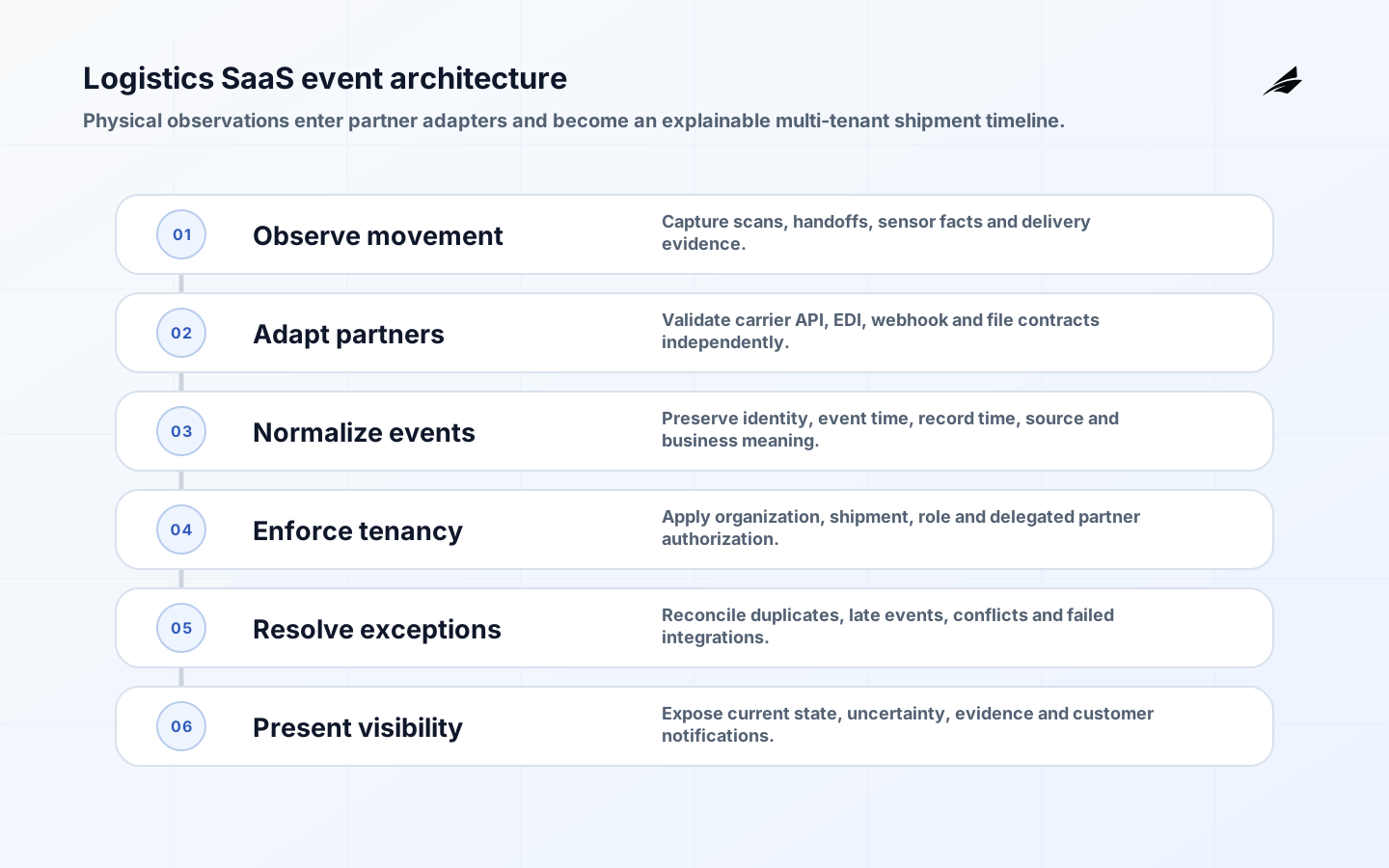
A SaaS product development company for logistics must understand that software state and physical state diverge. A shipment can move while a carrier API is unavailable, a scan can arrive late, and several parties can describe the same load differently. Product quality depends on stable identifiers, event semantics, reconciliation and operator workflows—not only maps and dashboards.
The right partner should turn a specific logistics operation into a multi-tenant product that can be integrated, supported and evolved. This FAQ explains what to evaluate in product discovery, architecture, integrations, mobile work, security, reliability, commercial terms and handover.
What logistics problem should the product own?
Define the operating decision and authoritative record. Examples include booking and tendering, dispatch, yard movement, proof of delivery, exception management, freight audit or customer visibility. Do not combine all of logistics into an MVP. Name the users, parties, modes, geographies, service commitments and systems that remain authoritative.
Map the physical process alongside the digital workflow. Identify when an object is packed, handed over, departed, arrived, delivered or returned, who can observe each event and what evidence exists. GS1 traceability guidance uses critical tracking events and key data elements; that distinction helps prevent status labels from losing operational meaning.
| Domain | Primary record | Critical exception | Outcome |
|---|---|---|---|
| Tendering | Load and carrier offer | No acceptance or capacity | Confirmed movement plan |
| Execution | Shipment and stop events | Late, missed or out-of-sequence event | Current explainable state |
| Proof of delivery | Delivery event and evidence | Damage, shortage or dispute | Verifiable completion |
| Freight audit | Rate, invoice and shipment | Charge mismatch | Approved payable amount |
| Visibility | Normalized event timeline | Conflicting partner data | Reliable customer notice |
How should shipment state be modeled?
Use immutable events with event time, recorded time, source, party, location, object and business meaning. Derive current state through explicit rules. Preserve late and corrected events rather than overwriting history. Separate planned milestones from observed events and predicted times. A prediction should never appear as proof that a physical handoff occurred.
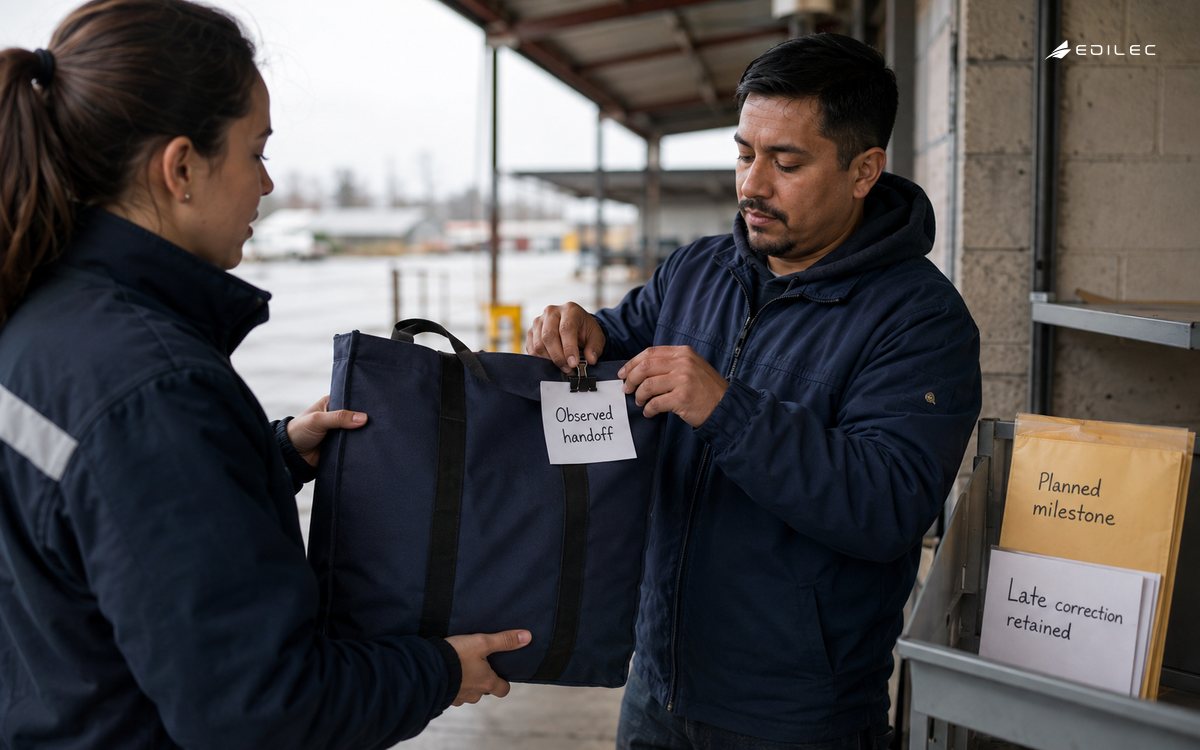
GS1 EPCIS provides a common approach to visibility event data and asks what, where, when and why. A product may use a different internal model, but standardized identifiers and vocabularies can reduce integration ambiguity. Document mapping and confidence for each carrier or partner source.
What makes carrier and customer integrations reliable?
Treat every API, EDI feed, webhook and file exchange as a versioned contract. Define authentication, schema, identifiers, time zones, units, ordering, duplicate behavior, retry, acknowledgements and error ownership. Build an adapter boundary so partner-specific logic does not leak into the product domain.
Use idempotency and durable queues. Preserve raw messages safely for investigation and transformed records for domain processing. Reconcile sent and received counts and unresolved events. Provide an integration console that shows status, last success, error sample and replay controls without exposing credentials or cross-tenant data.
How should multi-tenancy and partner access work?
Model organizations, facilities, users, carriers, customers and delegated relationships explicitly. A user may act for several parties in different contexts. Enforce tenant and resource authorization in every service and query. Do not rely on a tenant ID supplied by the client or filtered only in the interface.
Separate operational collaboration from data ownership. A carrier may update a shipment but should not see unrelated commercial rates. Customers may see their orders while the logistics provider retains internal notes. Test exports, search, notifications and analytics for isolation. Use current OAuth security practices for delegated API access.
What does field and driver experience require?
Design for weak connectivity, small screens, gloves, glare, movement and interrupted work. Cache only necessary assigned data, encrypt it and define expiry. Queue actions locally with stable identities and show synchronization state. Resolve conflicts according to business rules rather than last-write-wins.
Minimize typing through scans and controlled choices, but allow exceptions with evidence. Capture location, photo or signature only with a clear purpose and applicable consent. Test battery, device loss, background restrictions and clock drift. The office console should explain whether an event is confirmed, pending upload or inferred.
| Area | Expected design | Proof |
|---|---|---|
| Event integrity | Immutable identity and late-event rules | Replay and correction tests |
| Tenant isolation | Resource-level enforcement | Cross-tenant negative tests |
| Integration | Versioned adapters and reconciliation | Sandbox plus failure exercise |
| Offline mobile | Encrypted queue and conflict policy | Connectivity-loss test |
| Operations | Telemetry and owned runbooks | Incident and restore exercise |
Which reliability targets matter?
Define service indicators for accepted bookings, processed events, fresh timelines, successful proof uploads and delivered notifications. Availability alone hides stale or incorrect state. Set objectives from customer and operator tolerance. Monitor queue age, source lag, unmatched identifiers and partner-specific failure.
Instrument traces across API, queue, adapter and notification using safe shipment identifiers. OpenTelemetry can standardize telemetry, but product semantics remain the team's responsibility. Test dependency outage, burst volume, duplicate events, restore and regional failure. Document degraded modes such as manual dispatch or delayed tracking.
Which security and privacy controls belong in scope?
Apply the NIST SSDF through requirements, design, build, release and vulnerability response. Protect customer and driver identity, shipment details, locations, rates, documents and API credentials. Use MFA for privileged access, short-lived secrets, encryption and auditable administration. Restrict support access and log cross-tenant operations.
Threat-model fraudulent events, stolen devices, compromised partner credentials, malicious files and unauthorized tracking. Define retention for location and delivery evidence. Security incidents can affect physical operations, so response plans need dispatch and customer communication as well as technical containment.
How should a development partner be evaluated?
Ask the named team to model a representative shipment and failure, not present only a portfolio. Examine product discovery, domain modeling, design, QA, DevOps, security and support capabilities. Verify who will work on integrations and mobile behavior. Review subcontractors, time zones and continuity.
Require acceptance tied to working capability and evidence: architecture decisions, tests, telemetry, runbooks, source code, deployment definitions and known risks. Clarify repository, cloud, domain and vendor-account ownership. The client should be able to operate or transition the product without negotiating access after delivery.
How are scope and cost estimated?
Estimate by product capability, integration class, operating volume, tenant model, mobile requirements, compliance and support. Carrier integrations differ widely; treat discovery and certification separately. Include environments, observability, data migration, security testing, store release, documentation and production support.
Use a paid discovery or thin vertical slice to retire the hardest assumptions. Keep contingency for partner access and data quality. Compare fixed scope, capacity and milestone models based on uncertainty. Avoid a low MVP estimate that omits reconciliation, tenant isolation or operations—the features that make logistics software trustworthy.
How should the logistics product be operated after launch?
Create operating ownership for shipment events, partner adapters, tenant access, mobile releases and customer communication. A new carrier version or code-list change is a product release. Monitor adapter lag, rejected messages, unmatched identifiers and replay volume by partner. Give integration specialists a safe way to inspect and reprocess events without editing shipment truth directly.
Run incident response around physical and digital impact. A delayed tracking feed may not stop freight, while a broken dispatch integration can. Establish severity, carrier escalation and customer notice from the affected workflow. After restoration, reconcile event timelines and actions taken during degraded service. Do not close the incident at API recovery if customer records remain wrong.
Review roadmap evidence with operations: exception categories, manual corrections, source quality, support cost and service-objective burn. Product improvements should reduce coordination and ambiguity, not only add visibility widgets. Reserve capacity for adapter maintenance, security and data repair because the external network continues to change after initial delivery.
Customer onboarding should test identifiers, event mappings, access and service expectations before production traffic. Use a controlled shipment set and compare both parties' timelines. Record unsupported statuses and manual steps. A repeatable onboarding kit reduces bespoke behavior without pretending every shipper or carrier follows the same process.
Define data exit for every tenant before onboarding. Test exports of shipment history, documents, users and configuration with stable identifiers and timestamps. State which derived analytics or provider logs are included and when retained copies are deleted. Portability is part of a credible logistics SaaS service, especially when operational history supports claims and audits.
Related reading
Continue with Logistics SaaS Scope and Delivery, the Logistics SaaS Implementation Checklist, and IoT Software for Logistics for connected-device considerations.
Frequently asked questions
Should logistics software use real-time tracking? Use the freshness the decision requires. Label observed, delayed and predicted states clearly; “real time” should not imply evidence that a source cannot provide.
Can one product support multiple carriers? Yes, with a stable domain model and versioned adapters. Each carrier mapping, authentication and failure behavior still requires testing and monitoring.
Who should own the source code and cloud accounts? The commercial agreement should state ownership, but client-controlled repositories and production accounts usually make governance and transition easier.
What is a credible first release? A complete slice for one shipment class and integration that includes identity, event processing, exception handling, telemetry and operator support.
Key takeaways
- Model physical events and uncertainty before designing dashboards.
- Isolate partner mappings behind tested adapters and reconciliation.
- Enforce tenant and resource access throughout the service.
- Design mobile workflows for offline evidence and conflict handling.
- Select a partner on operating proof, not interface demonstrations alone.
Conclusion
A logistics SaaS product earns trust by explaining where its state came from and what remains uncertain. The development partner must combine domain events, resilient integrations, secure tenancy, field ergonomics and production operations into one product discipline. That foundation supports new carriers and workflows without turning every integration into a new source of truth.