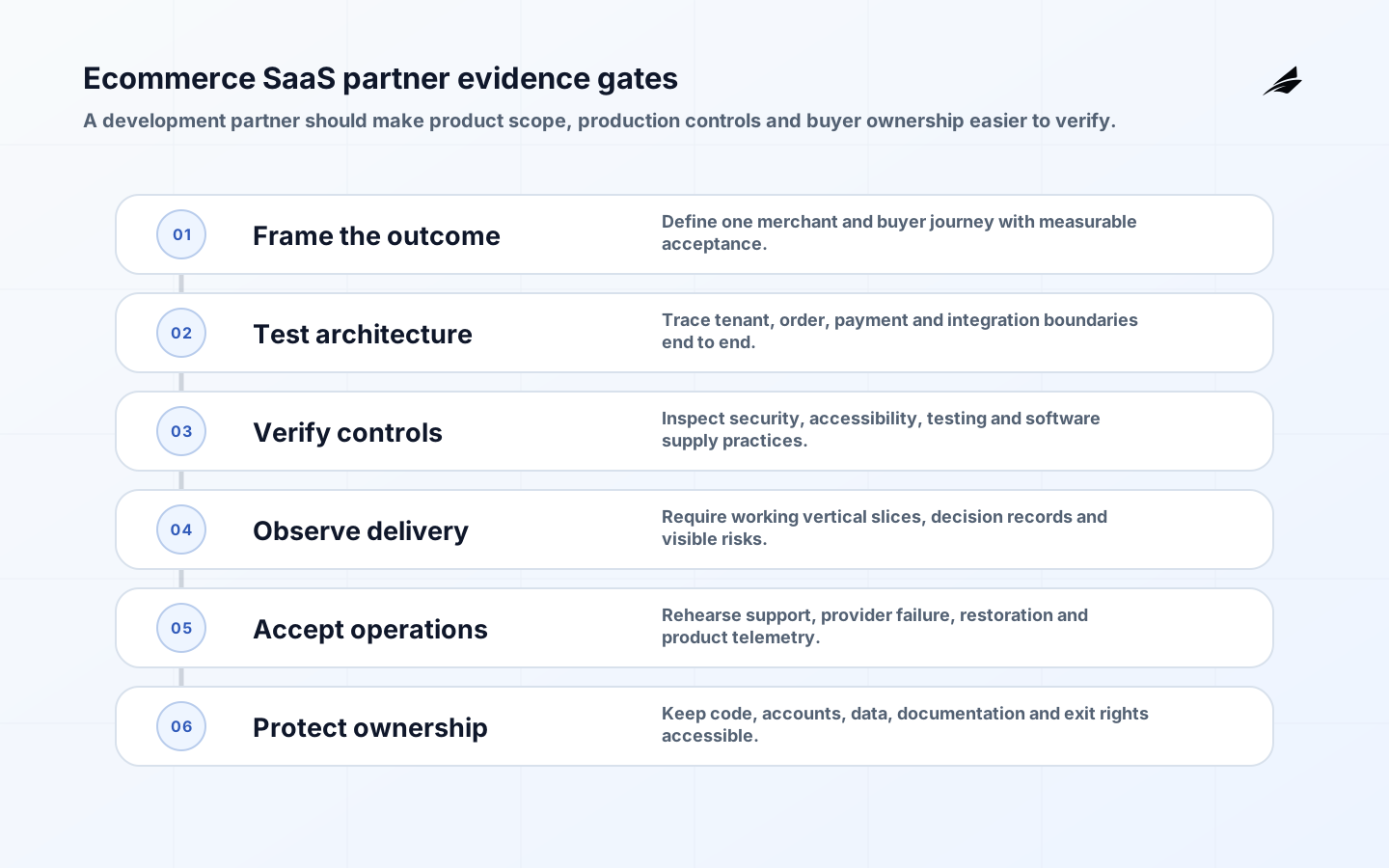
An ecommerce SaaS product development company should help a buyer turn a commercial model into dependable software, not merely supply developers. The product must keep tenant data isolated, prices and inventory correct, payments idempotent, integrations observable and releases recoverable. It must also give merchants or operators a usable configuration surface and support team. Partner evaluation should therefore examine product reasoning, production evidence and ownership boundaries as closely as team size and hourly rate.
This FAQ supports buyers comparing an external product team, dedicated engineering team or blended delivery model. The companion scope, cost and risk guide and production implementation checklist cover sequencing in more detail. The answers here focus on evidence that can be verified before contract signature and during the first release.
What should the first product scope contain?
Begin with one merchant and buyer journey, the business outcome, the systems it crosses and the acceptance evidence. A first release might onboard a merchant, publish a catalog, accept an order and reconcile payment. Define customer and operator roles, countries, currencies, channels, volume assumptions and service hours. Separate launch requirements from future marketplace, subscription, loyalty or omnichannel ambitions. A narrow complete journey exposes architecture and operations better than a wide prototype of disconnected screens.
Require a product brief that includes exclusions and decision owners. State whether the product owns catalog, inventory, checkout, order, payment, tax, shipping or reporting records, and which services remain external. Define the administrative workflows for configuration, support and correction. Buyers should be able to trace every proposed feature to revenue, risk, operational effort or learning. A partner that cannot challenge scope is likely to optimize for output rather than product outcome.
| Evaluation area | Evidence to request | Weak signal |
|---|---|---|
| Product discovery | Journey, assumptions and measurable acceptance | Feature list without exclusions |
| Architecture | Tenant and system-of-record decisions | Generic cloud diagram |
| Delivery | Working increments and release evidence | Progress reported as hours |
| Operations | Monitoring, support and recovery rehearsal | Support deferred until launch |
| Ownership | Repository, accounts, records and exit plan | Supplier-controlled access only |
Which architecture decisions should the partner explain?
Ask how the design represents tenant identity in every request, job, event, cache key and operational record. The AWS SaaS Lens emphasizes that multi-tenant architecture must connect technical decisions to tenant context and operational visibility. Compare pooled, siloed and hybrid isolation based on consequence and economics. Authorization must be enforced server-side, and support access must be attributable. Tenant customization should use versioned configuration or bounded extension points rather than forks.
Trace one order across catalog, price, inventory, checkout, payment, fulfilment and notification. Each boundary needs a stable business identifier, contract, timeout, retry and reconciliation path. Stripe documents idempotency for safely retrying requests, but the application must decide what constitutes one business intent. Webhook consumers should authenticate, persist, queue and deduplicate messages. A buyer should see how the product handles unknown outcomes, not only the successful sequence.
How can a buyer evaluate security and quality?
Request a security architecture and control backlog tied to the actual product. It should cover tenant isolation, customer and workforce identity, account recovery, secrets, payment scope, data retention, privileged access, logging, dependencies and vulnerability response. NIST SSDF describes organization, software protection, secure production and vulnerability practices; OWASP ASVS provides verifiable application requirements. Certifications can support assurance but cannot prove that this product’s authorization and integration logic is correct.
Review the test strategy for price, promotion, inventory and payment invariants, API compatibility, accessibility, migrations and failure recovery. Ask to see one failed build, defect trace and production incident review with sensitive details removed. A mature team can explain why a test exists and what happens when it fails. It will not promise that automation eliminates human review. WCAG 2.2 acceptance should include keyboard and assistive-technology checks across the actual checkout and admin journeys.
Which engagement and delivery model is appropriate?
A fixed scope can work for a bounded migration or integration with stable acceptance criteria. A product discovery and iterative build is better when customer behavior or solution fit remains uncertain. A dedicated team suits a sustained roadmap when the buyer can provide product decisions and domain access. Managed delivery adds outcome and operational ownership but requires precise service boundaries. The contract label matters less than whether authority, decisions, evidence and change are clear.

Use short increments that end in demonstrable product behavior. Discovery should produce risks and decisions, not months of presentation. The first engineering slice should include deployment, monitoring and support basics so the path to production is tested early. Maintain one decision log, backlog and release record accessible to both organizations. Define response times for product questions and acceptance; a supplier cannot compensate indefinitely for unavailable business owners.
| Cost component | What changes it | How to control uncertainty |
|---|---|---|
| Discovery | Number of journeys and unknown dependencies | Timebox spikes and decide with evidence |
| Product build | Roles, channels, rules and integrations | Release complete vertical slices |
| Assurance | Payment, privacy, security and accessibility scope | Select controls by consequence early |
| Operations | Service hours, volume and recovery objectives | Define SLOs and runbooks before launch |
| Change | Provider and market evolution | Version contracts and fund maintenance |
How should cost, contract and intellectual property be handled?
Compare total product cost: discovery, design, engineering, cloud, third-party fees, testing, security review, data migration, support and ongoing change. A low rate can be offset by coordination, rework or weak operational ownership. Ask for assumptions and ranges around uncertain integrations and migration data. Pay for accepted outcomes or transparent capacity with visible evidence, not a false fixed estimate that quietly removes quality or pushes exceptions into change requests.
The buyer should control source repositories, cloud and vendor accounts, domains, certificates, analytics and production records or have guaranteed immediate access. The contract must define ownership of custom code, pre-existing components, open-source obligations, design files, documentation and data. Require confidentiality, incident notice, subcontractor transparency and secure deletion. Avoid clauses that make routine portability dependent on supplier consent while respecting legitimate reusable supplier assets.
What operational readiness should be demonstrated?
Before launch, require a service map, SLOs, alert ownership, escalation, backup and restore evidence, incident roles, capacity result and a runbook for payment, order and integration exceptions. Support staff should trace a customer problem using approved tools without unrestricted database access. Product leaders should understand which indicators stop rollout. The team should rehearse provider timeout, duplicate webhook, delayed queue, tenant-specific fault and failed migration.
After launch, monitor product and technical outcomes together: onboarding completion, checkout conversion, payment ambiguity, order exceptions, merchant support burden, error budgets and cloud unit cost. Segment by tenant plan or architecture without exposing tenant data. Review repeated incidents and manual fixes as product signals. The partner should transfer operational knowledge continuously through pairing, runbooks and shared incidents rather than scheduling a final handover.
What does a safe supplier exit look like?
Design exit before dependency becomes urgent. Maintain architecture, deployment instructions, environment inventory, data dictionaries, API contracts, runbooks, decision history and known risks in buyer-accessible systems. Define export formats and timeframes for source, data, logs and tickets. Ensure more than one person understands critical paths. Periodically ask an internal or alternate engineer to deploy a nonproduction environment from documented sources.
A transition plan should identify credentials, accounts, licenses, domains, repositories, signing assets and vendor relationships that must move. Revoke supplier access only after continuity and evidence are preserved. If the product uses proprietary accelerators, document the runtime and maintenance dependency explicitly. A strong partner does not make itself valuable by making departure dangerous; it earns continued work by improving product outcomes and reducing hidden risk.
Run a working-session evaluation before awarding the engagement
Give the proposed team a realistic scenario: a payment provider times out after accepting a request, inventory changes before checkout, or a merchant needs a tenant-specific approval without a product fork. Ask the product lead, architect, engineer and delivery owner to reason together. Look for clarifying questions, explicit assumptions, business-state modeling, reversible experiments and operational consequences. A polished sales presentation is less informative than observing how the actual team handles uncertainty and disagreement.
After the session, request a short decision note rather than free implementation work. It should describe the unknowns, alternative designs, recommended first slice, acceptance evidence and risks requiring buyer action. Compare notes from shortlisted partners using the same rubric. References should be asked about production incidents, handover and change behavior, not only launch satisfaction. This process helps distinguish a staff supplier from a product engineering partner capable of owning outcomes transparently.
Key takeaways
- Evaluate product reasoning and production evidence, not resumes alone.
- Require explicit tenant, order, payment and integration boundaries.
- Choose an engagement model that matches uncertainty and buyer decision capacity.
- Keep repositories, accounts, operational records and exit rights accessible.
- Accept launch through security, support, recovery and business evidence.
Frequently asked questions
Should the partner have built the exact same ecommerce product before?
Relevant domain experience helps, but an exact clone can bring stale assumptions. Look for demonstrated handling of similar consequences: tenant isolation, pricing rules, payment ambiguity, integrations, migrations and operational scale. Ask the team to reason through your specific journey.
Is a fixed-price contract safer?
It is safer only when scope and acceptance are stable. For uncertain product work, fixed price may hide contingency or discourage learning. Timeboxed discovery followed by milestone or capacity-based delivery with transparent evidence often manages uncertainty more honestly.
How quickly should a partner deliver the first production slice?
The correct pace depends on integrations and risk, but a team should expose one end-to-end path early. The slice should include identity, deployment, monitoring and support, not merely a prototype. Its purpose is to test the delivery system and key assumptions.
Conclusion
The right ecommerce SaaS development partner makes the product easier to own. It translates business rules into testable boundaries, exposes uncertainty, ships complete increments and leaves operational evidence behind. Buyers should contract for that capability and preserve control of code, accounts, data and decisions. A relationship becomes durable when it reduces dependency risk while improving customer and merchant outcomes.