Choosing a SaaS product development company for small business is a decision about ownership and delivery risk, not a search for the longest technology list. The right partner can turn a narrow business advantage into a dependable product while making cost, security and operational work visible. The wrong arrangement can leave the buyer with attractive screens, unclear intellectual property, fragile infrastructure and no practical way to maintain or transfer the service.
A useful evaluation begins with the business outcome and constraints: who pays, which repeated job the product improves, what information it handles, what must integrate, how quickly evidence is needed and what the business can operate after launch. The small-business implementation checklist covers execution detail; this FAQ focuses on selecting and governing a partner.
What should a small business define before requesting proposals?
Write a one-page product brief describing target users, their current workflow, the painful decision or handoff, the first measurable outcome and explicit exclusions. Include known data, identity, integration, compliance, accessibility and availability constraints. Separate assumptions from confirmed facts. A partner should be able to challenge the brief and propose a discovery plan rather than converting every sentence directly into a feature estimate.
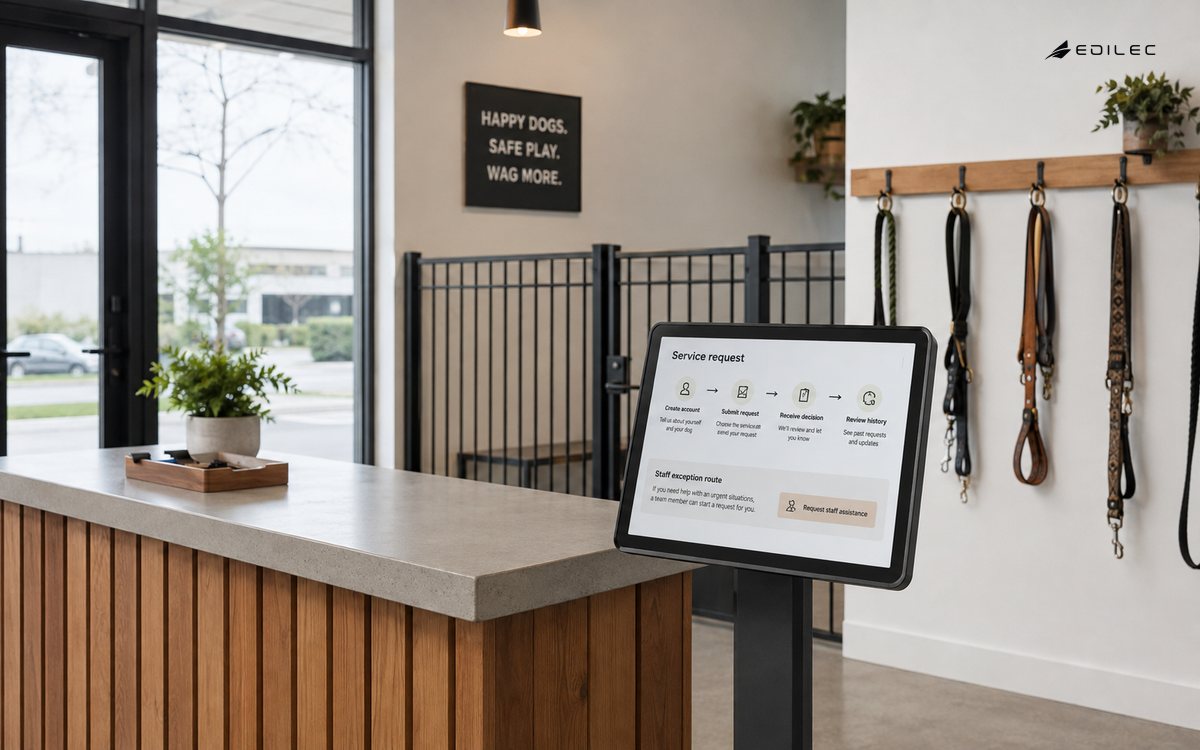
Define a first usable release as one complete journey with an owner and acceptance evidence. For example, a customer may create an account, submit a request, receive a decision and review its history, while staff can authenticate, process exceptions and recover a failed integration. This is more estimable than a list containing CRM, AI, analytics and mobile app. It also gives the business an early point to test demand and operating fit.
| Proposal area | Useful evidence | Warning sign |
|---|---|---|
| Discovery | Named workshops, decisions and artifacts | Fixed certainty before workflows are examined |
| Delivery | Small reviewable slices and acceptance criteria | One large handover near the deadline |
| Security | Threat, access, dependency and release practices | A generic claim that the cloud is secure |
| Operations | Monitoring, backup, incident and ownership plan | Launch is treated as project completion |
| Exit | Repository, data, credentials and transition terms | Access depends on continuing with the supplier |
How can a buyer evaluate the team behind the proposal?
Meet the people who will do the work, not only sales staff. Ask a product lead to explain how uncertainty becomes scope, an engineer to walk through a recent architecture decision, a designer to demonstrate accessible workflow research and an operator to explain recovery. Request redacted examples of decision records, test evidence, release notes and incident learning. Strong teams describe tradeoffs and boundaries; they do not promise that one framework eliminates complexity.
Check references with questions about behavior: Were risks raised early? Did estimates change with evidence? Could the client inspect progress? Was documentation usable? How were defects and incidents handled? Confirm who is an employee or subcontractor, where work occurs, how access is controlled and whether key roles are actually available. A company logo is not the delivery team.
What architecture and security evidence is proportionate?
Small does not mean exempt from sound engineering. Ask for a context diagram, major data flows, tenant isolation approach, identity model, integration boundaries, deployment path and known scaling constraints. Architecture should favor maintained managed services where they reduce operational burden, but preserve export and recovery. Avoid premature microservices and custom infrastructure without a measured need. Simplicity is a reliability strategy when ownership is clear.
Use NIST SSDF, CISA secure-by-design principles and OWASP ASVS as shared vocabulary. The partner should protect source and build access, review dependencies, manage secrets, test authorization, record administrative actions, remediate vulnerabilities and deploy safely. Define who monitors alerts and pays for fixes. Accessibility should be part of design and acceptance under WCAG, not an optional cleanup after customer complaints.
| Control | Minimum delivery evidence | Operational owner |
|---|---|---|
| Identity | MFA for privileged access and role tests | Product owner and engineering |
| Software supply chain | Protected repository, reviewed dependencies and reproducible releases | Engineering partner |
| Data protection | Classification, encryption, retention and export rules | Business data owner |
| Resilience | Restore test and incident contact path | Named service operator |
| Accessibility | Keyboard, labels, errors and representative user checks | Product and design owners |
Which pricing and contract model works best?
Fixed price works for a genuinely understood, bounded deliverable. Time-based delivery works for discovery and evolving product work, provided spending is capped by short horizons and reviewed outcomes. A hybrid often fits: fixed discovery artifacts, then funded delivery increments with explicit acceptance. Compare total cost including cloud, third-party services, testing, support, security work, migration and product management. A low build quote can be expensive if it excludes everything required to operate.
The agreement should address intellectual property, open-source obligations, confidentiality, security duties, incident notification, data processing, service levels, change control, warranty, liability, subcontractors and termination. Ensure the business controls domains, cloud tenancy, source repository, signing accounts, analytics and production credentials or has guaranteed administrative access. Legal review should adapt these points to jurisdiction and risk; technical promises need matching evidence and acceptance criteria.
How should delivery be governed without a large internal team?
Name one empowered business product owner who can clarify priorities and accept outcomes. Hold a weekly working review of real software, decisions, spend and risks. Keep a visible backlog and decision log, but do not turn governance into status theatre. Each increment should include code, tests, documentation, deployment and operational changes needed for that slice. Progress is accepted behavior in a representative environment, not completed tickets.
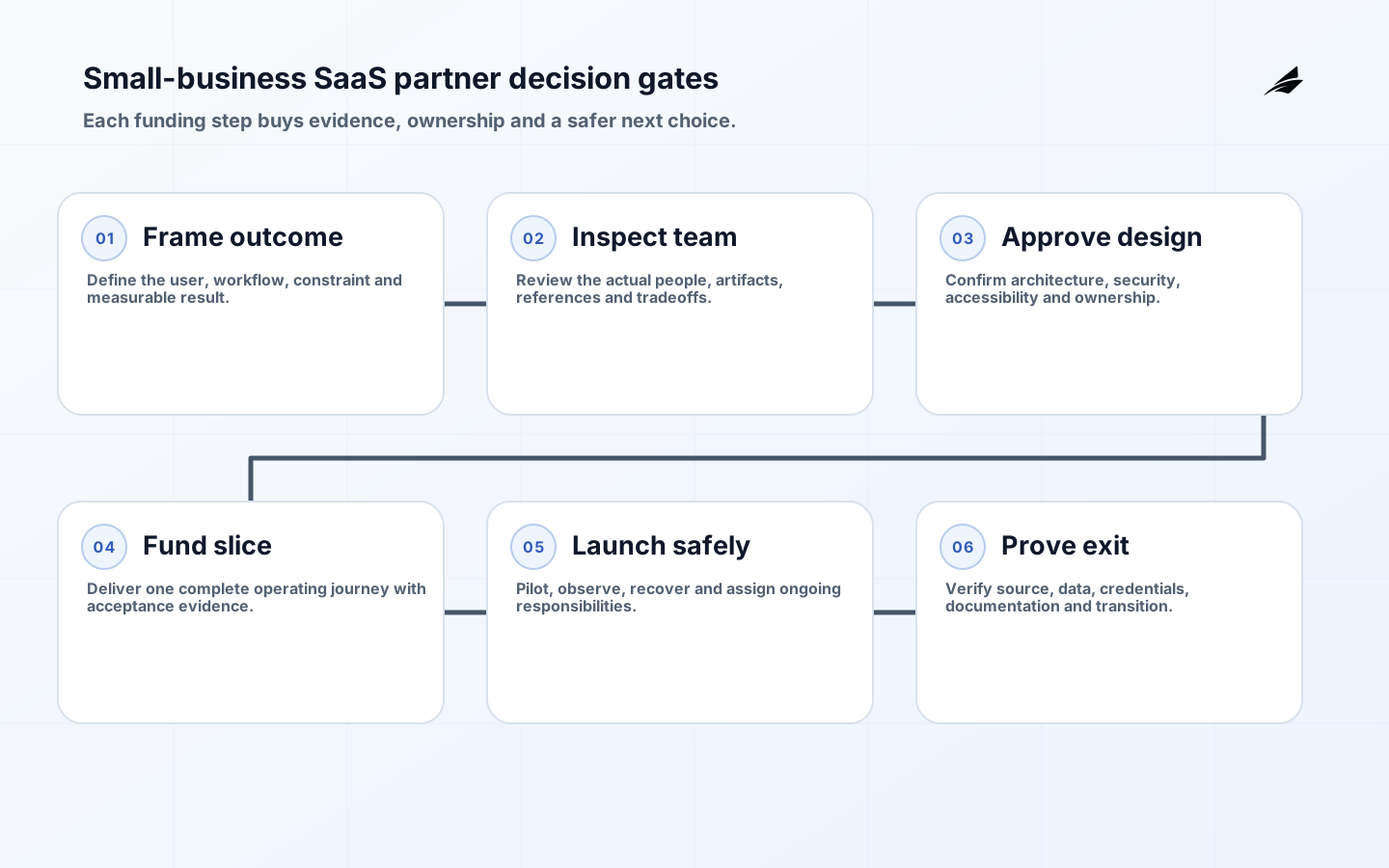
Use stage gates at discovery, architecture, first workflow, pilot, public release and operational transfer. At each gate review customer evidence, unresolved assumptions, security and accessibility findings, cost forecast and recovery readiness. Stop or reshape work when evidence is weak. A small business protects capital by making continuation a deliberate decision, not by forcing every original feature through to launch.
What should happen after launch and at exit?
Before launch, assign monitoring, support, backup, incident, vulnerability, dependency update and cloud-cost responsibilities. Define a service objective for the most important customer journey and collect the signals needed to understand failures. Schedule maintenance funding. Software that earns revenue but has no owner for updates becomes a growing liability, even if the first release was well built.
Test exit while the relationship is healthy. The business should be able to clone the repository, build from documented instructions, access infrastructure definitions, export data in a usable format, identify licenses and rotate supplier credentials. Set transition assistance and deletion evidence in the agreement. Portability does not require changing suppliers; it keeps the partnership accountable and reduces the cost of future decisions.
What should be in every accepted delivery slice?
Acceptance should include the working behavior, source changes, automated tests, migration or configuration, security considerations, accessibility evidence, release notes and operator documentation required for that slice. The product owner should see the feature in a representative environment and verify the business outcome. Engineering should show how failures are observed and reversed. Any deferred work needs a named owner, consequence and date rather than disappearing into an informal message thread.
Keep a lightweight asset register covering repository, cloud accounts, domains, certificates, third-party subscriptions, data stores, backups, build credentials and analytics. Record the business administrator and renewal or transfer process. Review it at major releases. Small organizations are especially vulnerable when one contractor's personal account owns a critical service. Establishing control early costs little compared with recovering access during an outage or supplier dispute.
Ask the partner to estimate the next twelve months of maintenance and service operation as well as the first build. Include security updates, platform upgrades, monitoring, support, incident response, backups and small product changes. This reveals whether the proposed architecture fits the business's continuing capacity. A technically impressive design that requires a larger permanent team than the company can fund is not a suitable solution.
Key takeaways
- Define one complete customer outcome before requesting a broad estimate.
- Evaluate the actual team through artifacts, tradeoffs and references.
- Make security, accessibility and operations part of acceptance.
- Fund small evidence-backed increments with a clear product owner.
- Control source, infrastructure, data and credentials, and test the exit path.
Frequently asked questions
How much does a small-business SaaS product cost?
There is no responsible universal figure. Cost follows workflow depth, integrations, data sensitivity, platforms, reliability, design research and operating model. Ask for a range by delivery slice with assumptions and recurring costs. Compare the cost of proving the risky parts first rather than estimating the imagined finished platform.
Can a business proceed without a CTO?
Yes, but it still needs independent technical judgment. A fractional technical adviser can review architecture, security, estimates and ownership while the business product owner governs outcomes. Do not make the supplier the only party able to assess its own work.
How quickly should an MVP launch?
Launch when a narrow journey is safe, understandable and measurable for a real cohort. Calendar speed is secondary to learning speed. A smaller workflow with support and recovery may generate evidence sooner than a rushed broad release that creates avoidable customer harm.
Conclusion
A good SaaS product development company helps a small business make better product decisions and leaves it with a service it can understand, operate and move. Judge partners by evidence, ownership and behavior under uncertainty. The best relationship is transparent enough that the buyer never has to choose between blind trust and micromanagement.
Begin with a bounded discovery, inspect the actual team's work, and contract for control of the durable assets. Then release in small operating slices. That approach preserves cash, exposes risk early and creates a healthier foundation for growth.