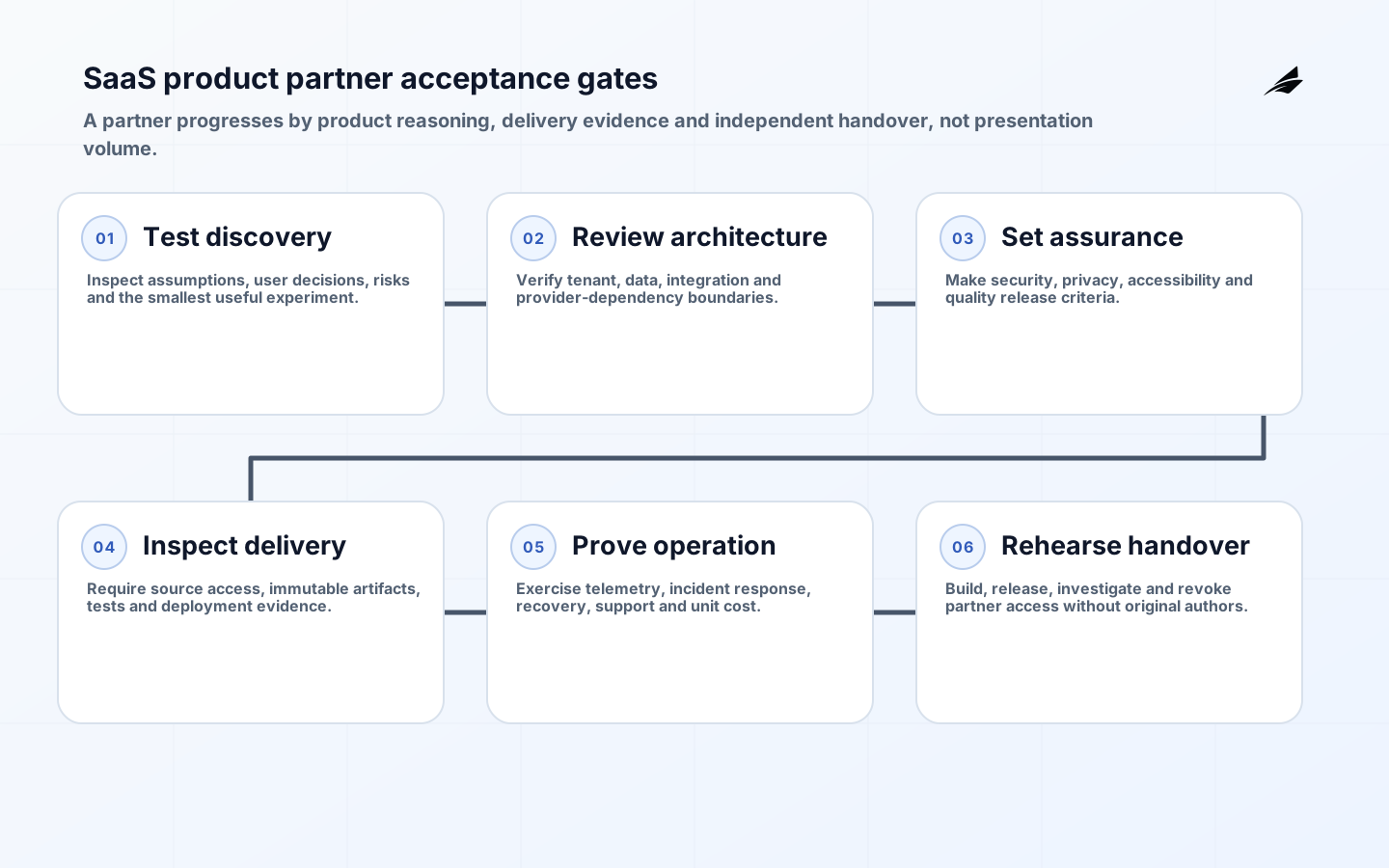
A SaaS product development partner should increase delivery capacity without becoming the only party that understands the product. The selection decision is therefore about operating model as much as coding skill. A strong partner can turn product intent into tested increments, make architecture and risk visible, operate a secure delivery path and leave the customer with usable source, documentation and decision history. A weak arrangement optimizes demos while tenancy, billing, support, recovery and ownership remain ambiguous.
Use this checklist during evaluation, contracting and delivery. It focuses on evidence rather than claims. NIST SSDF and OWASP ASVS provide secure-development and verification baselines; DORA provides balanced delivery measures; WCAG 2.2 defines current accessibility criteria; and OpenTelemetry provides common telemetry concepts. The customer still needs to set product outcomes, data obligations and risk tolerance. No external team can infer those decisions safely from a feature list.
1. Test discovery and product reasoning before scale
Give candidates a bounded product problem and ask them to identify users, decisions, assumptions, constraints and smallest useful release. Look for questions about account structure, source of truth, exception handling, support and success measures. A credible partner distinguishes validated facts from hypotheses and proposes a way to test the riskiest one. Be cautious when discovery immediately produces a fixed feature backlog and architecture without examining customer workflow or existing systems.
Define decision rights. The customer should own product priority, pricing, legal obligations and risk acceptance. The partner may own technical design within agreed constraints and should document material decisions and alternatives. Establish one product owner, one technical owner and an escalation path. Workshops need outputs such as journey maps, data boundaries, acceptance examples and architecture records; meeting volume is not evidence of discovery quality.
| Evaluation area | Ask for | Warning sign |
|---|---|---|
| Discovery | Assumptions, risks and test plan | Immediate fixed estimate from a short brief |
| Architecture | Tenant and data-boundary explanation | Generic cloud diagram |
| Delivery | Recent artifact and release evidence | Only screenshots or velocity |
| Security | Requirements, threat model and remediation flow | Pen test deferred to launch |
| Handover | Example runbook and repository structure | Knowledge transfer promised at the end |
2. Verify tenant, data and integration architecture
Require the partner to model person, organization, membership, workspace and entitlement separately where the product needs them. Every server operation should enforce tenant and resource authorization. Decide pooled, siloed or hybrid isolation for compute and data from consequence, scale and cost. Document tenant provisioning, deletion, export, regional placement and support access. Test cross-tenant negative cases early. A tenant ID in a database row is not sufficient if caches, queues, files or analytics lose that context.

Map authoritative systems and integration contracts. Use idempotency for retryable changes, version APIs and events, and define delayed or duplicate behavior. Plan schema evolution while old and new application versions coexist. Keep product logic out of opaque vendor workflows where it cannot be tested. Architecture acceptance should include representative load, dependency failure, data reconciliation and an exit path for provider-specific components that create material lock-in.
3. Put security, privacy and accessibility in the definition of done
Translate NIST SSDF practices into responsibilities for secure environments, protected source, reviewed design, dependency management, verification and vulnerability response. Choose an OWASP ASVS target and version appropriate to risk, then include traceable requirements and negative tests. Threat-model tenant isolation, account recovery, administrator functions, billing, exports and integrations. Require individual production access, short-lived credentials and complete audit. Findings need severity, exploitability, owner, due date and retest.
Classify personal and confidential data, state purpose and retention, and control production-data use in development. Build export and deletion workflows with verification. Make WCAG 2.2 acceptance part of components and journeys rather than an audit after design freezes. Test keyboard, screen reader, zoom, focus, errors and accessible authentication. Security and accessibility defects are product defects; separate late workstreams increase cost and leave architectural issues unresolved.
4. Inspect the delivery system, not just sprint output
The customer should have continuous access to source, backlog, build results, artifacts and environments. Protect branches and release identities, isolate builds and deploy immutable artifacts. Define review, test and promotion rules. Demonstrate rollback or roll-forward for application and database changes. DORA measures such as change lead time, deployment frequency, failed-deployment recovery time and change fail rate help identify constraints, but should be examined by product or service and never used to rank individuals.
Use small vertical releases that include interface, data, security, telemetry and operation. Acceptance examples should cover normal, boundary and failure behavior. Automate unit, integration, contract, security and accessibility checks where they provide reliable feedback. Manage flaky tests as defects. Preserve artifact digest, environment, configuration and approval evidence. A milestone is complete only when the increment is deployable, observable and supportable, not when code has been merged.
| Delivery gate | Evidence | Customer acceptance |
|---|---|---|
| Product slice | Journey and measurable outcome | User can complete the intended decision |
| Security | Threats, controls and negative tests | Residual risk is explicit |
| Quality | Automated and exploratory results | Critical behavior is reproducible |
| Operations | Telemetry, alerts, runbook and recovery | Owner can diagnose and restore |
| Commercial | Accepted scope and change record | Invoice maps to completed evidence |
| Handover | Source, access, docs and rehearsal | Customer team operates independently |
5. Design reliability, support and cost before launch
Define service-level indicators from user journeys and set objectives based on business consequence. Instrument traces, metrics and logs with consistent service and tenant-safe context. Every alert needs an owner and response. Establish incident command, severity, communication and post-incident review. Test backup restoration, dependency loss, credential rotation and a bad release. If the partner provides support, specify hours, access, response targets and retained customer duties.
Model cloud, software, observability, support and partner costs through expected growth. Track unit economics where meaningful. The partner can recommend optimization but the customer decides resilience and product tradeoffs. Require visibility into provider accounts, commitments and licenses. Avoid an architecture whose operation is affordable only at pilot volume. Review forecast variance and cost anomalies in the same service governance as reliability and roadmap.
6. Make commercial terms and handover operational
Define intellectual-property ownership, third-party licenses, repository and cloud ownership, subcontractors, confidentiality, vulnerability notification and data locations. Separate fixed deliverables from capacity and managed operations. Change control should record impact and decision without becoming a tax on ordinary refinement. Tie payment to accepted evidence rather than subjective completion percentages. Include reasonable transition assistance and access return.
Handover starts on day one. Keep architecture decisions, data dictionaries, runbooks, environment procedures and support knowledge current. Pair customer engineers with partner engineers and rotate ownership. Rehearse onboarding a new developer, releasing a change, investigating an alert and restoring data without the original author. Before final acceptance, transfer administrative control, rotate credentials and verify that the customer can build from source and operate production.
Worked example: evaluating a partner with one tenant workflow
A SaaS company asks two shortlisted partners to implement organization invitation and role assignment against a provided product brief. The stronger team challenges an ambiguous administrator role, models membership separately from person identity and writes negative cases for cross-tenant access and excessive delegation. It delivers a small API and interface through an isolated build, includes a threat note, accessible error behavior, telemetry and a deployment record. The weaker team presents more screens but stores the organization ID from the browser without a server-side ownership check.
Reviewers score reasoning, security, test quality, maintainability and handover rather than visual volume. A customer engineer follows the runbook to build and deploy the stronger submission, then revokes the partner’s access. The partner explains tradeoffs and adds an architecture record after review. The trial does not predict every future challenge, but it reveals the team’s normal evidence and collaboration habits before a large commercial commitment.
The final agreement keeps repositories and cloud accounts under customer control, names product and technical decision owners, and requires each milestone to include operational evidence. A monthly architecture and service review handles recurring risks; ordinary backlog refinement does not require a contractual change. Knowledge transfer is measured through paired ownership and independent releases throughout delivery. This structure preserves flexibility without leaving acceptance or exit to goodwill.
The customer also records the skills it must retain internally: product ownership, architecture authority, security acceptance and service operation. Outsourcing implementation does not outsource these accountable decisions.
Named deputies prevent those responsibilities from depending on one customer employee.
Key takeaways
- Evaluate product reasoning and risk discovery before team size.
- Require explicit tenant, data and integration boundaries.
- Make security, accessibility and operations part of every increment.
- Keep continuous customer access to source, environments and evidence.
- Rehearse independent operation before final handover.
Frequently asked questions
Fixed price or dedicated team?
Fixed price fits well-understood bounded outputs; capacity fits evolving product discovery. Many programs use fixed discovery and milestones followed by governed capacity. In both cases, define acceptance and decision rights.
Who should own the repositories and cloud accounts?
The customer should usually own authoritative repositories and production accounts, granting the partner controlled access. This reduces exit risk and keeps audit visibility.
How quickly should an MVP launch?
Speed depends on risk and integration. The right target is the smallest useful, secure and operable product slice, not a date that omits tenant isolation, recovery or evidence and creates expensive rework.
Conclusion
The best SaaS development partner leaves the product stronger and the customer more capable. Select for transparent reasoning, tested delivery and operable handover. When architecture, security, product outcomes and commercial evidence share one acceptance model, external capacity becomes durable leverage instead of long-term dependency.