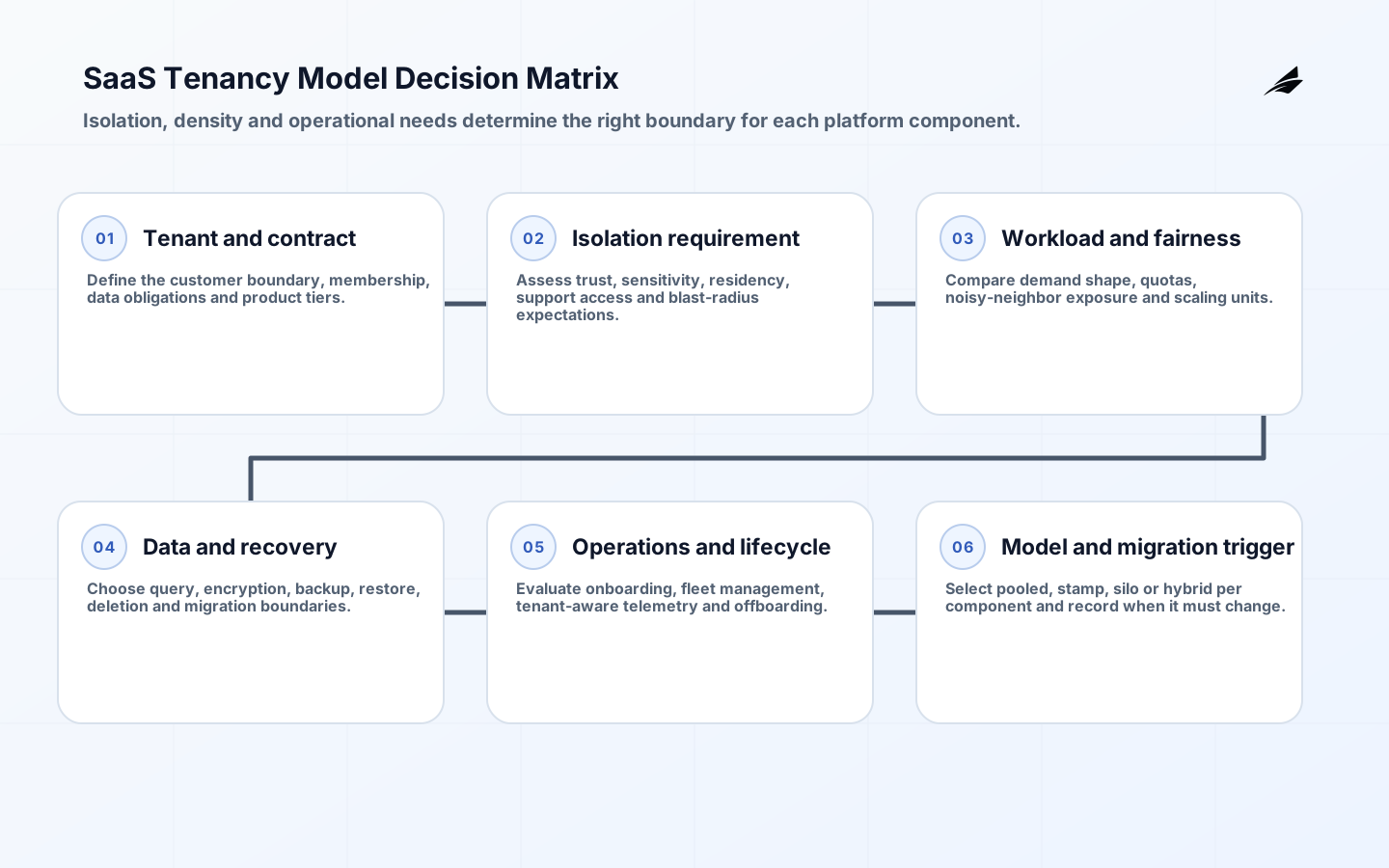
A multi-tenant SaaS architecture serves multiple customer or organizational tenants while sharing at least some application or infrastructure components. Multitenancy is an architecture choice; SaaS is a business and operating model. A product may mix pooled services, tenant-group deployment stamps and dedicated resources while maintaining one product lifecycle.
Selecting a development company requires more than reviewing cloud certifications. The team must connect tenant identity, isolation, onboarding, entitlements, data lifecycle, observability and commercial tiers. The questions below expose whether those decisions are explicit and testable. A build sequence is available in the multi-tenant SaaS architecture implementation checklist.
What exactly is a tenant?
Define the tenant from the product and contractual relationship. In B2B SaaS, a tenant often maps to a customer organization with many users. In an internal platform, it may be a business unit. Do not automatically equate an application tenant with an identity-provider directory tenant. Record membership, delegated administration, cross-tenant user cases, mergers, transfers and offboarding.
Which tenancy model should we choose?
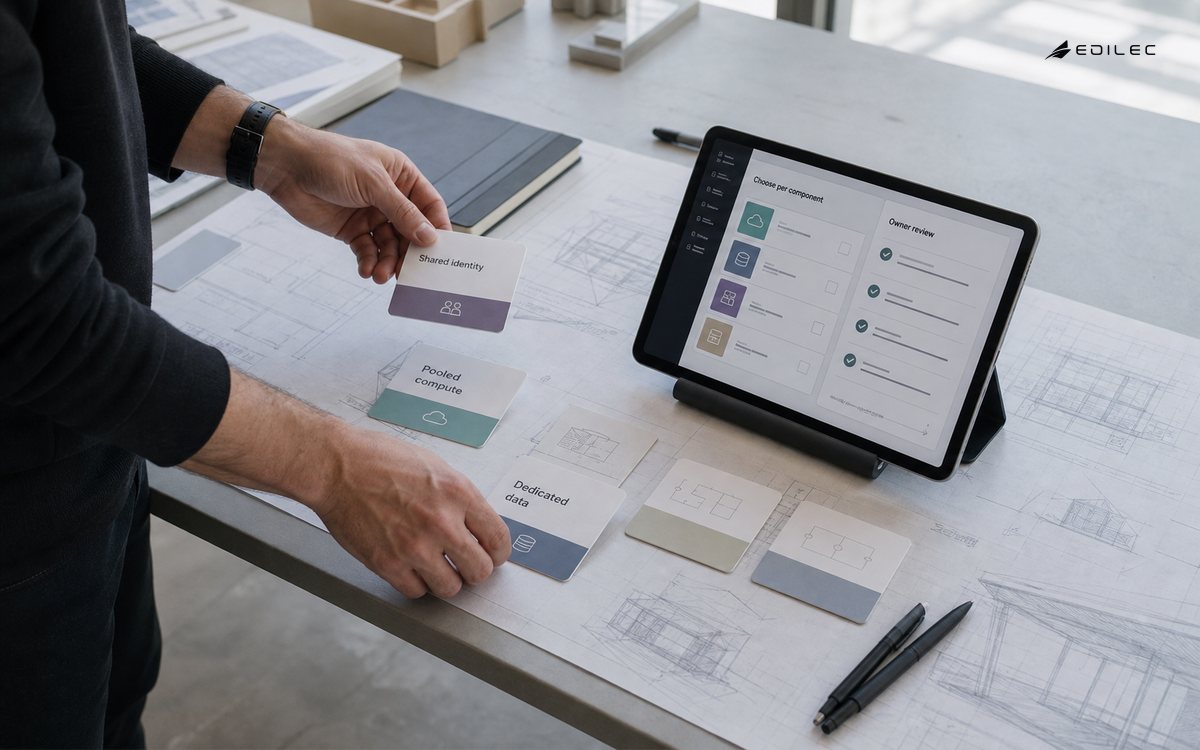
Common models include pooled resources shared by many tenants, siloed resources dedicated to one tenant, and bridge or stamp models that mix sharing and isolation. Choose per component. Identity may be shared while a regulated data store is dedicated; stateless compute may be pooled while high-volume tenants receive an isolated worker pool.
| Model | Useful when | Primary tradeoff |
|---|---|---|
| Pooled | Tenants have compatible controls and variable demand benefits from sharing | Requires rigorous logical isolation and fair-use controls. |
| Siloed | Contractual, regulatory, performance or customization needs require dedicated resources | Higher provisioning and fleet-management burden. |
| Deployment stamp | Groups of tenants can share a repeatable regional or capacity unit | Needs placement, balancing and stamp-aware operations. |
| Hybrid by component | Different layers have different isolation needs | More architecture and support paths to govern. |
| Tier-based | Commercial tiers align with explicit resource and service differences | Entitlements must not become code forks. |
Microsoft's multitenant guidance emphasizes tradeoffs among isolation, scale, cost efficiency, performance, complexity and manageability. Avoid choosing a model solely from an expected tenant count. Include data sensitivity, trust between tenants, regional needs, workload shape, recovery, customization and operational maturity.
What does tenant isolation require?
Isolation means one tenant cannot access or affect another beyond explicitly designed sharing. It spans identity, authorization, application context, caches, databases, object storage, queues, search indexes, telemetry, support tools and backups. AWS's SaaS Lens treats isolation as foundational, not an optional premium feature.
Tenant context should be derived from a trusted identity and server-side mapping, then propagated through services in a tamper-resistant form. Never rely only on a tenant identifier supplied in a URL or body. Each resource access must be authorized for the resolved tenant. Negative tests should attempt cross-tenant reads, writes, searches, exports and administrative actions.
How should tenant data be stored?
Options include shared tables with a tenant key, separate schemas, separate databases or dedicated deployments. Shared tables can provide density, while separate databases can increase isolation and simplify some tenant-specific operations. The right choice depends on query patterns, transaction boundaries, scale, compliance, restore granularity, migration and operating capability.
Database row-level security can provide defense in depth where supported, but it must be enabled, correctly scoped and tested with the actual application roles. PostgreSQL documentation notes that table owners and roles with bypass privileges can bypass row security in normal conditions. Application authorization and restricted database roles remain necessary.
| Data concern | Design question | Proof |
|---|---|---|
| Isolation | Can every query and background job be constrained to one tenant? | Automated negative tests and restricted runtime roles. |
| Encryption | Which keys and rotation boundary are required? | Key inventory, access policy and rotation exercise. |
| Backup and restore | Can one tenant be restored without overwriting others? | Tenant-level recovery or documented alternative with rehearsal. |
| Residency | Where may primary, replica, backup and telemetry data exist? | Placement policy and deployed-resource inventory. |
| Deletion | What records, indexes, files, events and backups are in scope? | Lifecycle workflow and deletion evidence. |
| Analytics | How is cross-tenant aggregation authorized and de-identified? | Purpose, access review and tested query boundary. |
How should identity and authorization work?
Separate platform identity, tenant membership and product entitlement. Authenticate users and workloads with a trusted provider, map them to tenant memberships, and evaluate permissions for the requested resource and action. Support users require a distinct, audited elevation path. A platform administrator should not silently inherit access to all customer content.
NIST zero trust guidance rejects implicit trust based only on network location. Apply that principle to internal services: each request carries an authenticated workload and tenant context, and services authorize the resource. Short-lived credentials, scoped permissions and explicit service-to-service policy reduce blast radius.
How do we control noisy neighbors?
Measure consumption by tenant and workload class. Apply quotas, concurrency limits, queue partitioning, fair scheduling and query safeguards. Reserve capacity or isolate heavy tenants when sharing cannot meet objectives. Kubernetes documentation notes that resource quotas help fairness but do not protect every shared resource, such as network traffic.
A global service dashboard can look healthy while one tenant is starved. Create tenant- and tier-aware views for latency, errors, queue age, throttling and resource use. Control metric cardinality and restrict access so observability does not become a cross-tenant data leak.
What is the SaaS control plane?
The control plane manages tenant lifecycle and placement: onboarding, configuration, entitlements, deployment allocation, identity connections, metering, suspension and offboarding. The data plane serves product workloads. Keeping these concerns explicit helps teams automate consistent tenant operations without placing broad management authority inside every request path.
Treat the control plane as production software. It needs authorization, audit, idempotent workflows, reconciliation and recovery. An interrupted onboarding flow should be resumable, and offboarding should not delete data before retention and contractual checks complete.
How should tenant customization be handled?
Prefer configuration, entitlements, themes, extension points and versioned integrations over customer-specific code branches. Every tenant should remain on a governable product version. Validate configuration combinations and protect high-risk settings with policy. A requested customization that changes core behavior may signal a separate product capability rather than a one-off fork.
What should we ask a SaaS architecture development company?
- Show how tenant identity is established and propagated without trusting client input.
- Explain isolation controls for application, data, cache, queue, storage, search and telemetry.
- Compare pooled, siloed and stamp options against our specific risks and operating model.
- Demonstrate cross-tenant negative tests and tenant-level incident investigation.
- Describe onboarding, migration, offboarding, deletion and restore workflows.
- Define repository, infrastructure, documentation, observability and exit ownership.
- Explain how the product can change tenancy models as tenant profiles evolve.
Ask for architecture decision records, threat models, runnable infrastructure, contract tests, operational dashboards and recovery evidence. A polished diagram is not proof of isolation. The partner should state assumptions and residual risks, and should avoid promising a universal architecture before discovery.
How do we migrate an existing single-tenant product?
First identify every place customer context is implicit: database instances, hostnames, configuration files, queues, scheduled jobs, caches, logs and operator habits. Introduce a canonical tenant identity and testable context boundary. Move one bounded capability or tenant cohort at a time rather than adding a tenant_id column everywhere in one release.
Reconcile records and permissions after each move. Preserve a rollback path that does not merge tenant data incorrectly. Some existing customers may remain on dedicated stacks while new customers use pooled or stamped infrastructure; the control plane and operating model should support both without product forks.
Example: B2B workflow product
Consider a workflow product where each customer has users, forms, approvals and exports. Shared stateless services resolve tenant context from authenticated membership. Records include a tenant key and database policy provides defense in depth. Files use tenant-scoped paths and access policies. Background jobs carry trusted tenant context and queues enforce per-tenant concurrency.
A tenant with regional residency requirements is placed in a separate deployment stamp through the control plane. The same release artifact and configuration model apply. Operations can inspect health by tenant and stamp, while support access requires an approved, time-bounded session. Cross-tenant tests run on every release.
What are the major architecture risks?
| Risk | Control | Early signal |
|---|---|---|
| Cross-tenant data access | Trusted context, resource authorization and negative testing | Queries or exports lack tenant predicates or policy enforcement. |
| Noisy neighbor | Per-tenant telemetry, quotas, fair queues and isolation options | One tenant's growth changes another's latency. |
| Control-plane inconsistency | Idempotent workflows and catalog reconciliation | Tenant catalog and deployed resources disagree. |
| Customer code forks | Configuration and extension contracts on one release train | Release count or patch lag differs by customer. |
| Irrecoverable tenant data | Restore design aligned to tenancy model | Only whole-platform recovery has been tested. |
| Cost blindness | Tenant-aware consumption and allocation model | High-cost behavior cannot be attributed or governed. |
How should the architecture be rolled out?
- Define tenant, product tiers, data obligations and isolation requirements.
- Choose tenancy models per component and record tradeoffs and migration triggers.
- Build a thin vertical slice across identity, data, background work, telemetry and lifecycle.
- Prove cross-tenant denial, noisy-neighbor controls, backup or restore and deployment rollback.
- Onboard an internal or controlled tenant cohort with explicit support and stop conditions.
- Expand by cohort or deployment stamp while reviewing tenant-level service and cost evidence.
- Exercise offboarding, deletion, incident access and movement between isolation models.
Key takeaways
- Define a tenant from the product and contract before choosing infrastructure.
- Treat isolation as an end-to-end property across every shared state and operational tool.
- Choose pooled, siloed, stamp or hybrid models per component and preserve migration options.
- Make the control plane, tenant-aware observability and lifecycle automation first-class product capabilities.
- Select a development partner by testable evidence, ownership clarity and operational design.
Additional frequently asked questions
Does multi-tenant SaaS require microservices?
No. A modular monolith can enforce strong tenant boundaries with lower operational complexity. Choose service boundaries when independent scaling, ownership or deployment needs justify distributed failure and data complexity.
Does Kubernetes provide tenant isolation automatically?
No. Namespaces help organize and scope policies, but Kubernetes documentation calls for RBAC, quotas, network policy and other controls according to the trust model. Stronger isolation may require virtual or dedicated clusters and separate data controls.
Is dedicated infrastructure still SaaS?
It can be. SaaS concerns include a shared product lifecycle, onboarding, operations and customer experience. Dedicated resources trade density for isolation or performance; they do not require a separate codebase.
Conclusion
Multi-tenant SaaS architecture is a set of explicit product and operating decisions, not a single database pattern. A capable development company should help prove tenant identity, isolation, fairness, lifecycle and recovery in a narrow slice, then scale through repeatable cohorts without fragmenting the product.