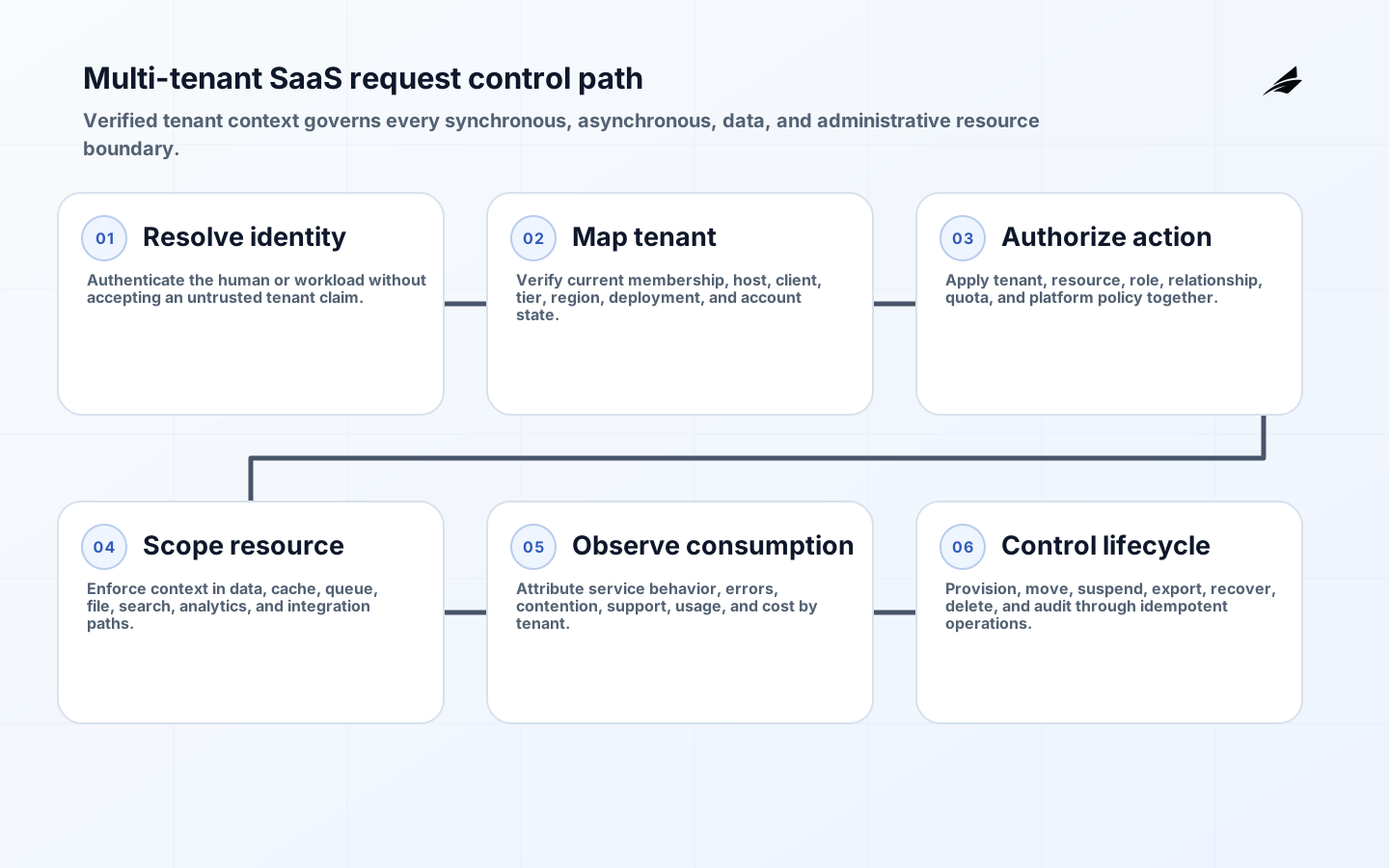
A multi-tenant SaaS architecture development company should deliver one product operating model that safely serves many customer organizations, not a collection of custom installations with a shared logo. Multitenancy affects identity, data, compute, configuration, deployment, support, telemetry, metering, recovery, and commercial packaging. The central design decision is where resources are pooled and where they are siloed, with isolation enforced independently of ordinary user authentication.
Use this guide to scope a partner or internal program. Compare adjacent delivery concerns in the startup SaaS development guide, the finance SaaS plan, and the logistics SaaS plan. Domain obligations change, but each plan should make tenancy and authority testable.
Define tenant, user, deployment, and service tier
Write what a tenant represents: customer organization, division, workspace, household, reseller, or another commercial boundary. A tenant contains users but is not identical to an identity-provider directory. Define membership, invitations, federation, delegated administration, cross-tenant users, mergers, splits, transfer, suspension, export, and deletion. Then distinguish logical tenant from deployment or stamp so the platform can move or group tenants without changing their business identity.
Capture isolation and service expectations by capability. A premium tenant may need a dedicated database while sharing stateless compute; a regulated workflow may require regional placement; trial tenants may use a dense pooled tier. Microsoft’s multitenancy guidance describes isolation as a spectrum, and AWS emphasizes that tenant isolation is separate from authentication. Document what is shared, enforcement point, failure domain, cost, quota, and migration path for every major resource.
| Model | Useful when | Primary cost or risk |
|---|---|---|
| Pooled | High tenant count and common requirements reward efficiency | Application policy must prevent cross-tenant access and contention |
| Siloed | High isolation, customization, or compliance justifies dedicated resources | Fleet cost and operational drift grow without automation |
| Bridge or hybrid | Different tiers or components need different isolation | Routing, observability, and migration become more complex |
| Deployment stamps | Scale or geography requires repeatable groups of tenants | Control plane must map tenants and operate many stamps consistently |
Carry trusted tenant context through every request
Resolve tenant context from a trusted relationship among host, client, authenticated subject, membership, and platform mapping. Do not trust a tenant ID supplied in a request body or header without authorization. Propagate the verified context through synchronous calls, queues, jobs, caches, files, analytics, search, and outbound events. Every resource query and key should be tenant-scoped by construction, with platform administration using a separate, narrowly controlled path.
Centralize policy patterns without hiding business rules. Middleware can require tenant context and reject missing scope, but each service still owns resource-level authorization. Include tenant identity in audit events, traces, quotas, and idempotency keys while preventing it from leaking sensitive labels. Test users with membership in multiple tenants, revoked membership, support impersonation, background jobs, imports, and asynchronous callbacks. Cross-tenant negative tests belong in every release pipeline.
Choose data isolation and lifecycle deliberately
Compare shared schema, schema-per-tenant, database-per-tenant, account-per-tenant, and hybrid partitions against isolation, scale, query patterns, restore granularity, regional placement, encryption, analytics, migration, and cost. Shared tables require tenant keys in every relevant constraint and query. Separate databases improve some isolation and recovery properties but create fleet migration and connection challenges. Infrastructure separation does not remove the need for application authorization.
Design provisioning, schema change, backup, point-in-time recovery, tenant export, legal hold, retention, deletion, and movement between tiers before launch. A whole-database restore can roll back unaffected tenants; plan tenant-level reconstruction or a controlled reconciliation method when that consequence is unacceptable. Keep analytics and support copies under the same tenant policy. Use per-tenant encryption keys only when the security and deletion benefits justify key-fleet operations.
| Acceptance area | Test | Pass evidence |
|---|---|---|
| Isolation | Attempt reads, writes, search, cache, files, and jobs across tenants | Every path denies and records the correct boundary |
| Contention | Run one abusive or peak tenant beside normal tenants | Rate, queue, and resource controls preserve tier objectives |
| Lifecycle | Provision, move, suspend, export, delete, and recover a tenant | Control plane completes idempotently with audit history |
| Deployment | Roll forward and back across stamps and schema versions | Tenants remain compatible and correctly routed |
| Metering | Reconcile usage with platform events and invoices | Consumption is attributable without exposing tenant data |
Build an idempotent tenant control plane
The control plane owns tenant catalog, tier, region, deployment mapping, provisioning state, policy, entitlements, quotas, lifecycle operations, and administrative evidence. The data plane serves normal product traffic. Keep boundaries explicit so an unavailable control plane does not automatically stop active tenant work, while preventing stale control data from granting access. Long-running operations should expose state, retry safely, compensate partial work, and support operator intervention without direct database edits.
Automate stamps and dedicated resources from versioned infrastructure. Use progressive deployment across cohorts, preserving compatibility when tenants run temporarily on different versions. Configuration should be typed, validated, inherited from product policy, and bounded; per-tenant forks destroy upgrade efficiency. Treat support access as a control-plane workflow with request, approval, reason, time limit, visible session, actions, and review.
Control noisy neighbors and tenant-aware operations
Set quotas, rate limits, concurrency limits, queue fairness, timeouts, storage bounds, and workload admission by tier and operation. Detect heavy tenants before a shared component reaches its cliff. Isolate resource-intensive jobs or move exceptional tenants to another stamp through a rehearsed path. Avoid global locks and unbounded tenant loops. Capacity tests need realistic tenant distributions, not only a single aggregate load number.
Instrument metrics, logs, and traces with approved tenant context so operations can separate platform-wide failure from one tenant’s workload. Measure onboarding, active use, errors, latency, queue age, resource consumption, support load, and cost per tenant or cohort. AWS expenditure guidance calls for a consumption mapping model because shared resources cannot be allocated with tags alone. Feed unit economics into tier design and architecture, not only monthly reporting.
Deliver one production slice before platform expansion
- Define the tenant, commercial tiers, critical journey, isolation requirements, and operating objectives.
- Select pooling and siloing per component and document tenant-context enforcement.
- Build identity, tenant catalog, provisioning, one data path, audit, telemetry, quota, and recovery as one slice.
- Run cross-tenant, contention, migration, rollback, backup, and control-plane failure tests.
- Release a bounded cohort and reconcile experience, reliability, usage, support, and unit cost.
- Expand capabilities and stamps only after platform operations can own the next tenant and next change.
Set partner scope, cost drivers, and risk ownership
The engagement scope should include domain and tenancy model, reference architecture, threat model, data design, control plane, identity, provisioning, deployment automation, observability, metering, recovery, tests, migration, runbooks, and capability transfer. Price discovery separately from build and state assumptions about tenant count, tier mix, data volume, regions, integrations, compliance, migration quality, and support hours. A fixed estimate without these variables simply hides contingency.
Major risks include cross-tenant exposure, pooled-resource contention, unbounded customization, fleet drift, tenant-level recovery gaps, identity ambiguity, inaccurate metering, and dependence on a partner for platform changes. Assign each risk to a decision owner and acceptance test. Require source, infrastructure definitions, architecture decisions, test evidence, access under customer control, runbooks, dependency inventory, known risks, and a demonstrated release by the receiving team before handover.
Key takeaways
- Define tenancy as a business boundary and separate it from users and deployments.
- Choose pooled, siloed, or hybrid isolation for each component using explicit tradeoffs.
- Propagate verified tenant context through data, cache, queue, file, analytics, and administration paths.
- Build lifecycle, observability, metering, recovery, and fleet automation into the first slice.
- Accept the platform through cross-tenant, contention, migration, and operating evidence.
Frequently asked questions
Does multi-tenant SaaS require one shared database?
No. Multitenancy is a product and operating model, not one storage topology. Shared tables, separate schemas, separate databases, dedicated accounts, and hybrids can all support SaaS. Choose per component from isolation, scale, recovery, region, cost, and fleet-management requirements, and preserve one unified onboarding, deployment, and operating experience.
Are microservices necessary for tenant isolation?
No. A modular monolith can enforce strong tenant context and data boundaries, while poorly designed services can leak across tenants. Decompose when independent scale, failure isolation, data ownership, or team responsibility justifies it. Every service adds contracts, deployment, telemetry, and consistency work, so isolation acceptance must cover the complete path regardless of architecture style.
Can an existing single-tenant product migrate incrementally?
Yes. Introduce stable tenant identity, catalog, authorization, data ownership, and automation around one bounded workflow. Migrate a cohort into a pooled or stamped model, reconcile state, and keep rollback. Do not merely add tenant_id columns everywhere. The program must address administration, jobs, files, analytics, recovery, support, deployment, and commercial tiers.
Plan tenant migration as a first-class product capability. A move between pooled and dedicated tiers may require snapshot, change capture, temporary write restrictions, routing update, cache invalidation, key changes, search rebuild, integration coordination, and reconciliation. Define whether the tenant remains available, how long the move may take, and who communicates. Exercise failure after each stage so the platform can return the tenant to a known placement without duplicate or lost effects.
Operational tooling must respect tenancy too. Status pages, support search, bulk administration, analytics exports, and incident queries can become privileged cross-tenant paths even when customer APIs are correct. Apply scoped defaults, explicit elevation, reason and time bounds, result limits, redaction, and immutable evidence. Test these tools with the same seriousness as application endpoints because a convenient operator shortcut can bypass the platform’s strongest isolation design.
Conclusion
A multi-tenant SaaS platform is successful when sharing becomes an intentional economic choice and isolation remains verifiable. Define tenant and deployment clearly, carry trusted context through every resource, automate lifecycle through a control plane, contain contention, and observe usage and cost by tenant. Deliver these capabilities in one production slice, then scale the fleet only after the organization can safely onboard, operate, recover, move, and retire tenants.