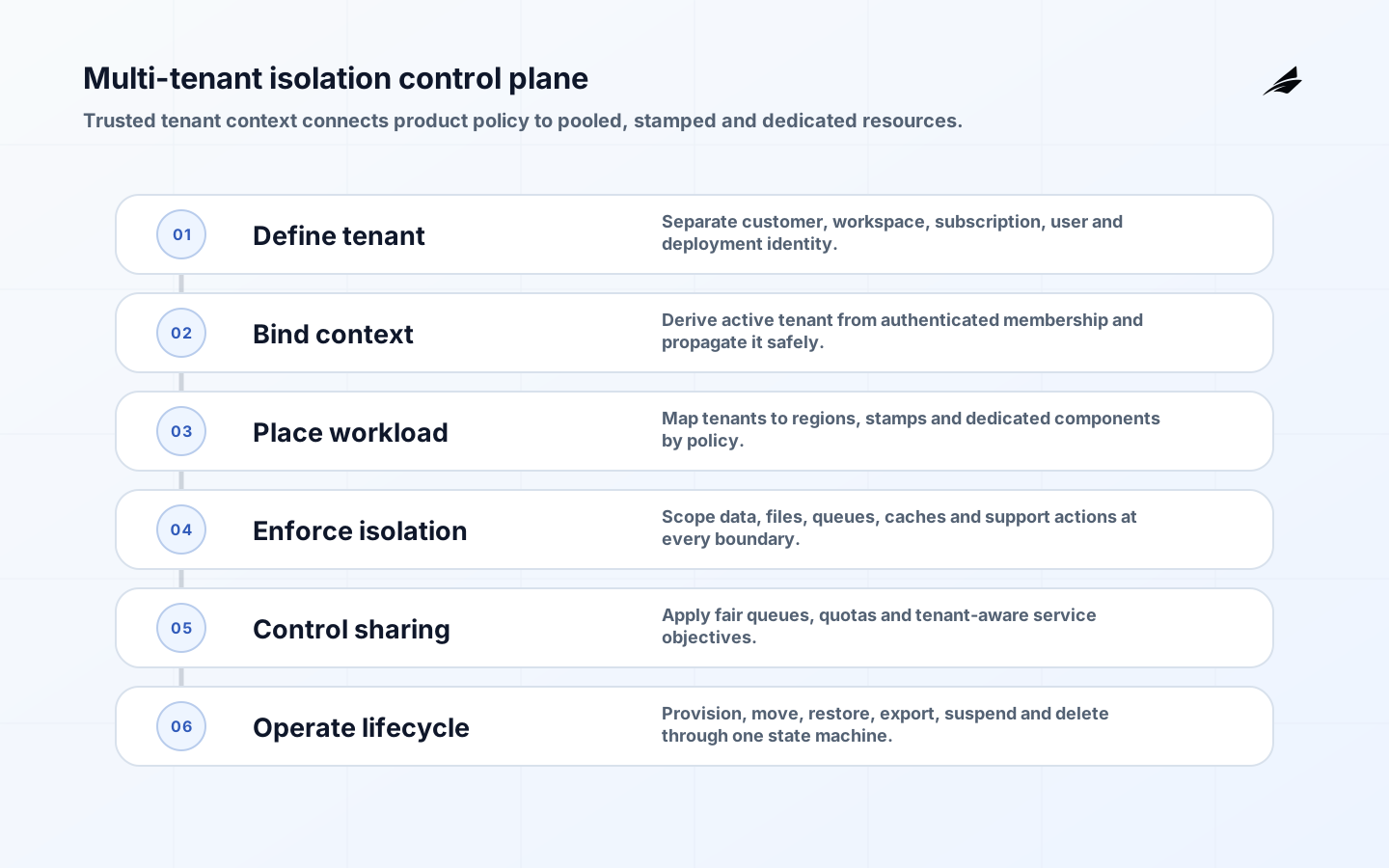
Multi-tenant architecture planning is the work of deciding which customer resources are shared, which are isolated, and how every request carries a trustworthy tenant context from identity through application logic, storage, telemetry and billing. It is not accomplished by adding a tenant_id column after the product is built. The architecture must prevent cross-tenant access, contain noisy-neighbor effects, support different commercial tiers and let operators locate, move, restore and delete one tenant without improvising in production.
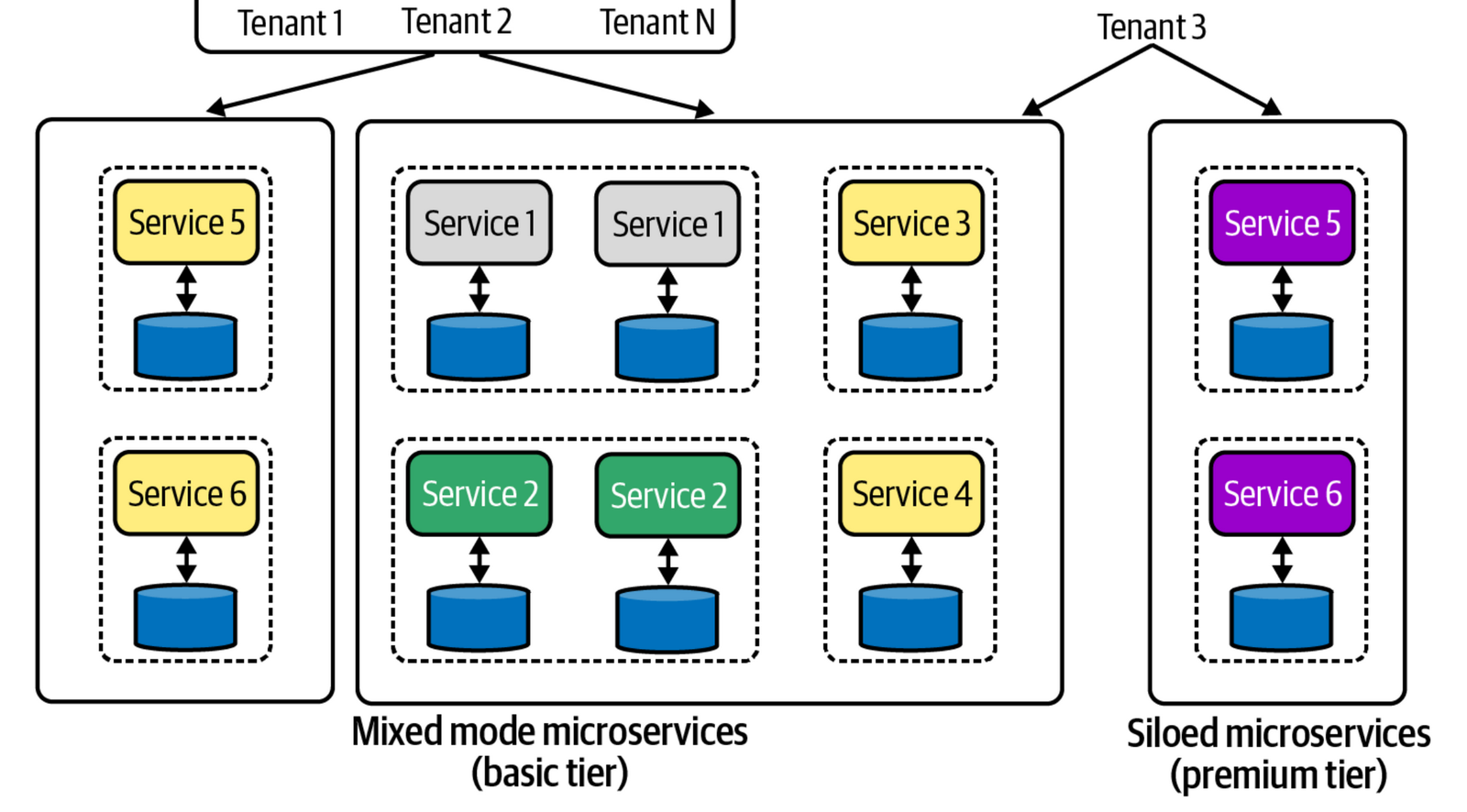
A useful plan starts with the product and risk model. Microsoft describes isolation as a spectrum rather than a binary choice, while the AWS SaaS Lens treats tenant isolation as foundational. Those positions lead to a practical rule: select isolation separately for compute, data, messaging, search, files, secrets and analytics, then preserve one control plane for onboarding and operations. A premium tenant may receive a dedicated database or deployment stamp without turning the product into a collection of unrelated custom installations.
Define the tenant before choosing infrastructure
Write down what a tenant represents: a company, legal entity, workspace, region, family or business unit. Then model the relationship between tenants, users, subscriptions and deployments. One customer can need multiple tenants for production and testing, data residency or subsidiary separation; one deployment can serve many tenants. Keep these concepts distinct in identifiers and administration. Otherwise a later request to merge accounts, split a subsidiary or move a tenant between regions becomes a dangerous database rewrite.
Capture isolation drivers for each segment: confidentiality, regulatory scope, performance, customization, recovery objectives, geography and price. Convert them into testable requirements. “Enterprise isolation” is vague; “customer A has a dedicated data store, its own encryption key, a fixed region and a two-hour recovery objective” can guide architecture and acceptance. Include expected tenant count, size distribution, peak behavior and growth because the efficient design for twenty large customers differs from one for a hundred thousand small workspaces.
| Decision | Questions to answer | Evidence before build |
|---|---|---|
| Tenant boundary | What organization or workspace owns data and configuration? | Canonical tenant identifier and lifecycle model |
| Isolation level | Which components may be pooled, bridged or siloed? | Per-component isolation matrix with rationale |
| Placement | How is a tenant mapped to a region and deployment stamp? | Routing record, capacity rules and move procedure |
| Commercial tier | Which isolation and service objectives are sellable options? | Entitlement model linked to architecture |
| Lifecycle | How are create, suspend, export, restore and delete handled? | Idempotent workflows and retained evidence |
Make tenant context an enforced security boundary
Derive tenant context from an authenticated relationship, not from a request parameter that the caller can freely change. Bind the user or workload identity to authorized tenant memberships, select the active tenant explicitly, and pass a signed or server-side context through synchronous and asynchronous calls. Every repository, query, object key, cache key and message should require that context. Administrative support access needs the same discipline: time-bound elevation, reason, approval where warranted and an audit trail that identifies both operator and affected tenant.
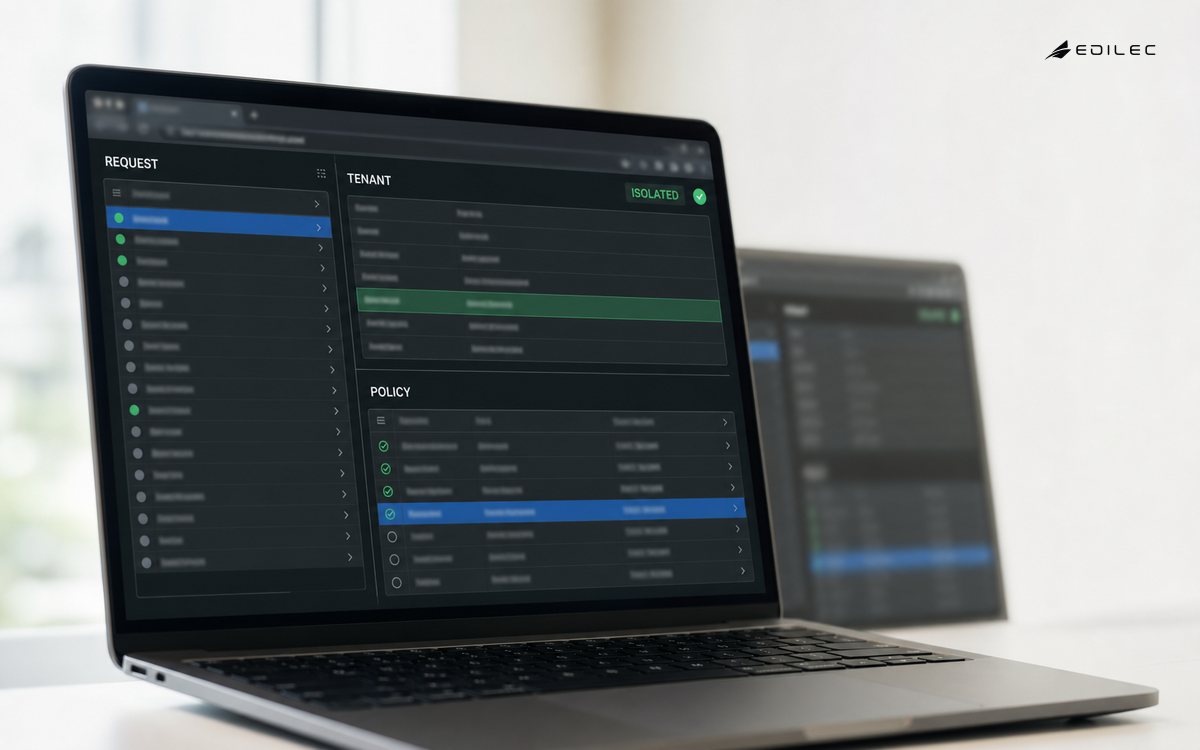
Authorization tests must attempt cross-tenant reads and writes at API, background-job, export and analytics boundaries. Include guessed identifiers, stale tokens, shared caches, retries and bulk operations. Data access helpers can make safe behavior the default, but they do not remove the need for database constraints, row-level policies or separate stores where consequence demands stronger isolation. Logs should contain a non-sensitive tenant identifier for correlation while excluding secrets and personal data.
Choose data and deployment patterns deliberately
A pooled database offers efficient utilization and fleet-wide change, but requires every access path to enforce the tenant boundary and every index to reflect tenant-scoped query patterns. Database-per-tenant improves data isolation and tenant-level restore but increases provisioning, migration and connection-management work. Deployment stamps group tenants into repeatable units with bounded capacity and blast radius. Many mature products use a hybrid: pooled defaults, stamps for scale and region, and selected silos for exceptional requirements.
Keep schema evolution compatible across the fleet. Version migrations, canary them by stamp or tenant cohort, and record the current version for every placement. Tenant movement should be a designed workflow: quiesce or replicate writes, copy data with integrity checks, switch routing atomically, observe, and retain a rehearsed rollback. Backups must support the promised restore granularity. A shared database backup is not proof that one customer can be restored without overwriting other customers.
Control noisy neighbors and shared limits
Model load per tenant and per scarce resource: request concurrency, queue depth, database connections, storage, search indexing, outbound integrations and expensive reports. Apply quotas, rate limits and fair scheduling at the boundary where contention occurs. A single global request limit can still allow one tenant to consume a worker pool or database. Separate interactive and batch capacity, bound fan-out, and make back-pressure visible to the calling workflow rather than silently dropping work.
Capacity tests should mix realistic tenant profiles rather than multiplying one happy path. Include one large tenant, many small tenants, bursty imports and slow downstream integrations. Measure service objectives by tenant tier and by stamp so an acceptable fleet average cannot hide a harmed customer. Where hard isolation is promised, test resource and failure containment directly. Where pooling is accepted, document the guardrails and the conditions that trigger movement to another stamp or dedicated component.
Design a unified tenant control plane
The control plane should own tenant creation, placement, entitlements, configuration, identity federation, metering, suspension, export and deletion. These operations need stable state machines and idempotency because onboarding can partially fail across identity, database, storage and billing systems. Keep product configuration versioned and distinguish customer-selectable settings from internal feature flags. Avoid hand-edited production records; they create invisible tenant variants that cannot be reproduced or audited.
Use OpenTelemetry traces, metrics and logs to follow a request through shared services, but control tenant-cardinality costs. Dashboards should answer which tenants are affected, whether impact is isolated to a stamp, which dependency is saturated and whether a recent release changed the distribution. Metering should reconcile product events with billing without using the bill as the only operational record. Support tools need scoped views and safe diagnostic actions, not unrestricted database access.
| Readiness area | Acceptance test | Failure that test prevents |
|---|---|---|
| Isolation | Attempt every critical operation with another tenant’s identifiers | Cross-tenant data exposure or modification |
| Provisioning | Replay onboarding after failures at each step | Duplicate or half-created tenants |
| Performance | Run mixed profiles with a deliberately abusive tenant | Noisy-neighbor impact hidden by averages |
| Mobility | Move a tenant between stamps and roll back | Unsafe region, tier or capacity migration |
| Recovery | Restore one tenant and reconcile dependent records | Fleet-wide recovery for a tenant-level incident |
| Deletion | Remove data across primary, search, file and analytics stores | Incomplete offboarding and retention violations |
Turn the plan into an implementation sequence
Begin with a thin vertical slice: authenticate two tenants, execute the same workflow, store data, emit tenant-aware telemetry and prove denial across boundaries. Add automated provisioning before tenant count makes manual setup attractive. Next, introduce placement and limits, then exercise movement, restore and deletion. Keep architecture decisions beside tests and operating runbooks so later teams know why a boundary exists. Review the model whenever a new data store, asynchronous path, analytics sink or customer tier is introduced.
- Define tenant, user, subscription and deployment identifiers and their lifecycle states.
- Select pooling, bridging or siloing for each component with explicit risk and cost reasons.
- Implement trusted tenant context and deny cross-tenant access in every execution path.
- Automate provisioning, placement, configuration and schema migration through one control plane.
- Add quotas, fair scheduling and tenant-aware service objectives before load grows.
- Exercise tenant move, restore, export, suspension and deletion as production capabilities.
Review architecture readiness with product and operations
Hold a design review using one real tenant from each intended segment. Walk through sign-in, authorization, normal work, an expensive request, support access, billing, suspension and recovery. Require the team to point to the enforcement and telemetry at every step rather than answer from an architecture slide. Repeat the exercise with a compromised user, a stale membership and a tenant mapped to the wrong deployment. The review should produce owned defects, accepted risks and explicit launch conditions.
Treat the isolation model as a product commitment that must survive organizational change. Record decisions in version-controlled documentation, link them to automated tests and assign a review trigger for new regions, tiers, stores or service boundaries. Security, data, reliability, finance and support should agree that they can operate the model. A design that only its original architect can explain is not ready for a growing SaaS business.
Key takeaways
- Tenant identity, customer identity and deployment placement are related but distinct concepts.
- Isolation should be selected and tested per component, not described with one product-wide label.
- A hybrid pool, stamp and silo model can preserve SaaS operations while serving exceptional tenants.
- Tenant-aware authorization, observability, capacity and lifecycle automation are part of the product architecture.
- The plan is incomplete until one tenant can be moved, restored and deleted safely.
Frequently asked questions
Is a separate database required for every SaaS tenant?
No. Pooled, schema-separated, database-per-tenant and deployment-stamp models all have valid uses. Choose based on consequence, scale, cost, recovery and operational capability, and enforce tenant context regardless of the storage pattern.
What is the noisy-neighbor problem in SaaS?
It occurs when one tenant consumes shared resources and degrades another tenant’s service. Prevent it with per-tenant limits, fair queues, capacity isolation, workload separation and tenant-level telemetry rather than fleet averages alone.
When should a tenant receive dedicated infrastructure?
Dedicated components are reasonable for regulatory isolation, predictable high load, regional constraints or a paid service tier. They should still use the same automated onboarding, release, telemetry and support control plane as pooled tenants.
Conclusion
Good multi-tenant architecture planning does not search for one universally correct topology. It establishes trustworthy tenant context, proportionate isolation, bounded sharing and repeatable lifecycle operations. When those decisions are backed by cross-tenant tests, mixed-load evidence and rehearsed recovery, the product can gain SaaS economies without making customer separation an assumption hidden in application code.