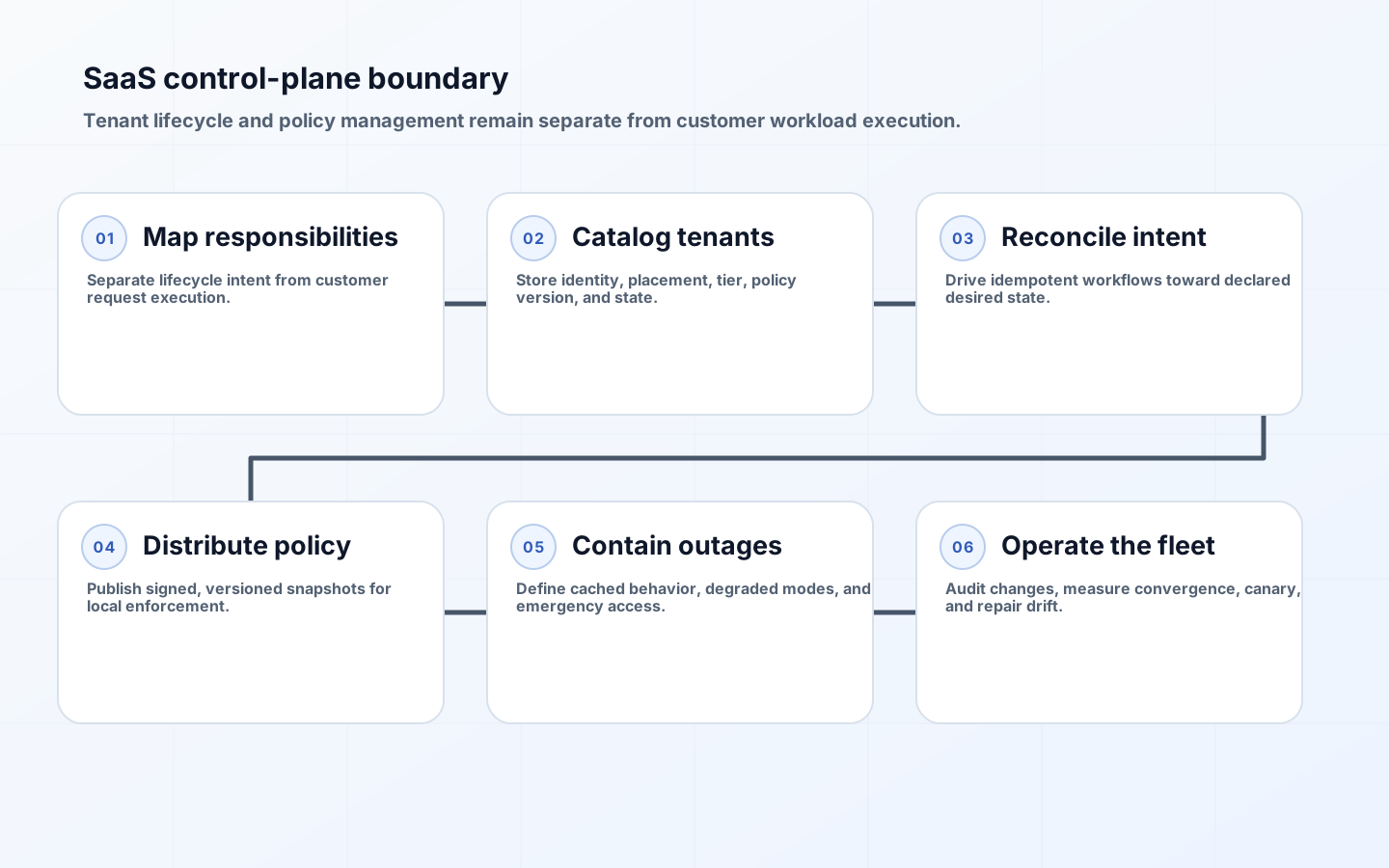
A SaaS control plane architecture gives the provider one governed place to manage tenant lifecycle and platform intent. It onboards and offboards tenants, records placement and tier, distributes policy, coordinates maintenance, tracks consumption, and supports operators. The SaaS data plane serves customer requests and runs tenant workloads. Separating those responsibilities protects request paths from administrative complexity and lets platform teams automate fleet changes without embedding provisioning logic in every product service.
The boundary is conceptual before it is physical. Microsoft describes the data plane as user interaction and the control plane as higher-level access, provisioning, and maintenance. AWS uses control and application plane language for similar SaaS concerns. Kubernetes offers a useful systems analogy: control-plane components maintain desired cluster state while nodes run workloads. A SaaS design may deploy the planes separately or initially share infrastructure, but their APIs, authority, failure behavior, and ownership should remain explicit.
Map responsibilities before drawing services

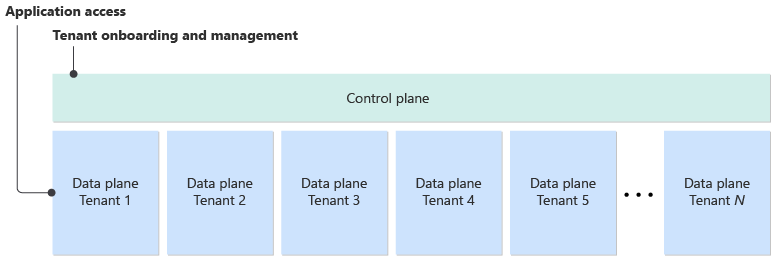
List every tenant and fleet operation: registration, identity binding, plan selection, regional placement, resource provisioning, configuration, entitlements, domain verification, key rotation, upgrade rings, usage aggregation, suspension, export, deletion, and evidence retention. Classify each as control intent, data-plane enforcement, or shared foundation. A control plane may decide that tenant A belongs in cell 4 with policy version 18; the data plane routes requests there and enforces that policy locally. Keep the declarative decision separate from high-volume evaluation.
Do not put ordinary tenant business administration in the provider control plane automatically. A customer's workspace admin inviting a user or changing a project can remain a data-plane product function, even though it controls customer data. Provider operations that change deployment, tier, placement, security baseline, or lifecycle belong in the platform control plane. The deciding questions are who has authority, what blast radius exists, and whether the action manages the service or uses it.
| Capability | Control-plane responsibility | Data-plane responsibility | Boundary test |
|---|---|---|---|
| Tenant onboarding | Create catalog identity and desired placement | Initialize product workspace | Can retry without duplicate tenant? |
| Policy | Approve and version tenant policy | Enforce local evaluated snapshot | Can requests continue during control outage? |
| Deployment | Select ring and reconcile desired version | Serve current compatible version | Is rollout independent of user traffic? |
| Metering | Aggregate usage and apply commercial context | Emit trusted usage events | Can billing be reproduced? |
| Support | Authorize bounded provider action | Expose tenant-safe diagnostics | Is access temporary and audited? |
Make the tenant catalog an authoritative registry
Store immutable tenant identity, customer relationship, lifecycle state, deployment or cell placement, residency, tier, policy version, configuration references, identity-provider binding, domains, resource identifiers, creation and deletion state, and owners. Keep secrets in a vault and sensitive commercial text in appropriate systems, referenced rather than copied. Version catalog records and audit every change. The catalog is not a spreadsheet once frequent automation depends on it, although Azure guidance notes a manual catalog can be a valid early approach for very small tenant counts.
Define invariants: one active placement per workload class, allowed regions for residency, valid state transitions, unique verified domain ownership, and compatible policy and software versions. Use conditional writes to prevent concurrent lifecycle operations. Make reads highly available, but restrict mutations through authenticated, authorized commands. Downstream systems should consume change events idempotently and be able to rebuild projections from authoritative records. A catalog edit should never directly masquerade as proof that infrastructure converged.
Reconcile desired state through durable workflows
Express lifecycle operations as desired state plus a workflow instance. Onboarding might validate contract and region, reserve placement, provision resources, configure identity, seed the workspace, run acceptance checks, activate routing, and mark ready. Give each step an idempotency key, state, attempt, output reference, timeout, and compensation. Retries should inspect existing resources before creating new ones. A failed step leaves a resumable operation and visible tenant state, not a half-provisioned environment hidden behind a success response.
Prefer reconciliation for operations where eventual convergence is acceptable. Controllers compare desired and observed state, apply one bounded change, and record evidence. Use explicit orchestration when ordering, human approval, or compensation matters. Keep provider APIs asynchronous for long operations: return an operation resource with status and safe reasons. Model terminal failed, blocked, canceled, and partially decommissioned states. Deletion should include retention holds, export, credential revocation, routing removal, resource disposal, and verifiable data deletion rather than one destructive call.
Distribute policy snapshots for local enforcement
The control plane owns approved policy intent; request-serving components should enforce a signed or integrity-protected, versioned snapshot near the workload. Include tenant, policy version, effective time, schema version, and expiry or refresh expectations. Validate compatibility before activation. Cache the last known good snapshot and define which changes require immediate revocation. Avoid a synchronous control-plane call on every customer request, which turns an administrative dependency into a platform-wide availability and latency bottleneck.
Define fail behavior per policy. Security revocation may require fail closed or a short emergency validity window; a cosmetic configuration can continue stale. Entitlement increases can wait for verified distribution, while decreases need explicit timing and customer communication. Record the policy version used for consequential decisions. Detect distribution lag and data-plane rejection of incompatible snapshots. Emergency overrides must be narrow, time-limited, approved, visible, and retired automatically.
| Failure | Data-plane behavior | Control response | Recovery evidence |
|---|---|---|---|
| Control API unavailable | Serve with last valid local state | Restore API without request-path failover | No unauthorized or lost tenant work |
| Catalog replica stale | Route only from bounded valid map | Repair replication and compare versions | Placement convergence |
| Provisioning step fails | Tenant remains nonready or prior state | Resume or compensate workflow | Acceptance suite passes |
| Bad policy release | Reject incompatible snapshot or retain prior | Stop rollout and revert intent | Fleet version and behavior verified |
| Data-plane cell fails | Route only under tested recovery policy | Relocate or restore through workflow | Tenant state and data reconciled |
Engineer control-plane resilience and privilege
Protect control mutations with strong workload and operator identity, least privilege, separation of duties, approval for high-impact changes, conditional access, and immutable audit. Separate tenant self-service permissions from provider administration. Support just-in-time support access scoped to tenant, action, and duration. Never expose raw control credentials to data-plane workloads. Use distinct nonproduction planes and prevent them from provisioning into production without explicit, constrained interfaces.
Set service objectives around lifecycle and convergence: onboarding duration, policy propagation, placement accuracy, workflow backlog, and recovery. Multi-region design must address the hard problem of mutation authority and duplicate operations, not merely add replicas. Back up the catalog and workflow state, rehearse restoration, and verify existing data planes continue serving with cached policy during control recovery. A control plane is itself a critical product, with releases, capacity, observability, incident response, and disaster recovery.
Document bootstrap dependencies and recovery order. A restored control plane may need identity, keys, network, database, queues, artifact registry, and cloud-management APIs before reconciliation can resume. Keep tested break-glass procedures for a tightly bounded set of actions, with independent audit and automatic expiry. Recovery is complete only after catalog, routing, deployed resources, policy versions, and workflow states agree; an available admin interface alone does not prove fleet authority is correct.
Evolve the boundary with platform scale
A small SaaS can begin with an internal admin application, catalog database, infrastructure-as-code pipeline, and auditable runbooks. Introduce durable workflow automation where event frequency and inconsistency justify it. Add placement, metering, maintenance, and policy services as responsibilities become independently complex. Avoid splitting services merely to imitate a hyperscaler. Preserve stable commands, events, state machines, and ownership so the architecture can evolve from a modular application to separate services without rewriting tenant semantics.
Test the plane boundary with scenarios: duplicate signup, changed region during provisioning, payment-tier update during deployment, expired domain proof, policy schema mismatch, control outage during peak traffic, operator mistake, cell evacuation, and offboarding under legal hold. Verify customer requests remain correctly authorized and tenant work is neither routed to a partial environment nor deleted prematurely. Measure reconciliation drift and perform periodic fleet audits against cloud resources, identity systems, routing, and billing.
Key takeaways
- Separate provider lifecycle intent and fleet management from high-volume customer request execution.
- Use an authoritative, versioned tenant catalog with invariants, controlled mutations, and observed-state evidence.
- Implement long-running lifecycle operations as idempotent, resumable workflows or desired-state reconciliation.
- Distribute versioned policy for local enforcement so control-plane outages do not automatically become data-plane outages.
- Treat the control plane as a privileged production product with explicit SLOs, disaster recovery, audit, and incremental evolution.
Frequently asked questions
Must control and data planes use separate infrastructure?
No. Early systems can share deployment while preserving logical modules, APIs, authority, and failure behavior. Physical separation becomes useful for security, scaling, ownership, or availability, but the responsibility boundary should exist first.
Does authentication belong in the control plane?
Identity-provider configuration and tenant binding are control concerns; authenticating and authorizing ordinary user requests is a data-plane responsibility using locally available trusted policy and identity evidence. The exact shared services depend on the product.
What should happen when the control plane is down?
Existing tenant workloads should normally continue with last known valid placement and policy for a bounded period. New onboarding and administrative changes can queue or fail clearly. Security-critical revocation needs a separately designed propagation and fail policy.
Conclusion
A clear SaaS plane boundary converts tenant operations into governed platform capabilities. The control plane declares, reconciles, and audits lifecycle intent; the data plane executes customer work from compatible local state. With durable workflows, policy distribution, privilege controls, and independent failure modes, the provider can grow the fleet without making every management action part of every request.