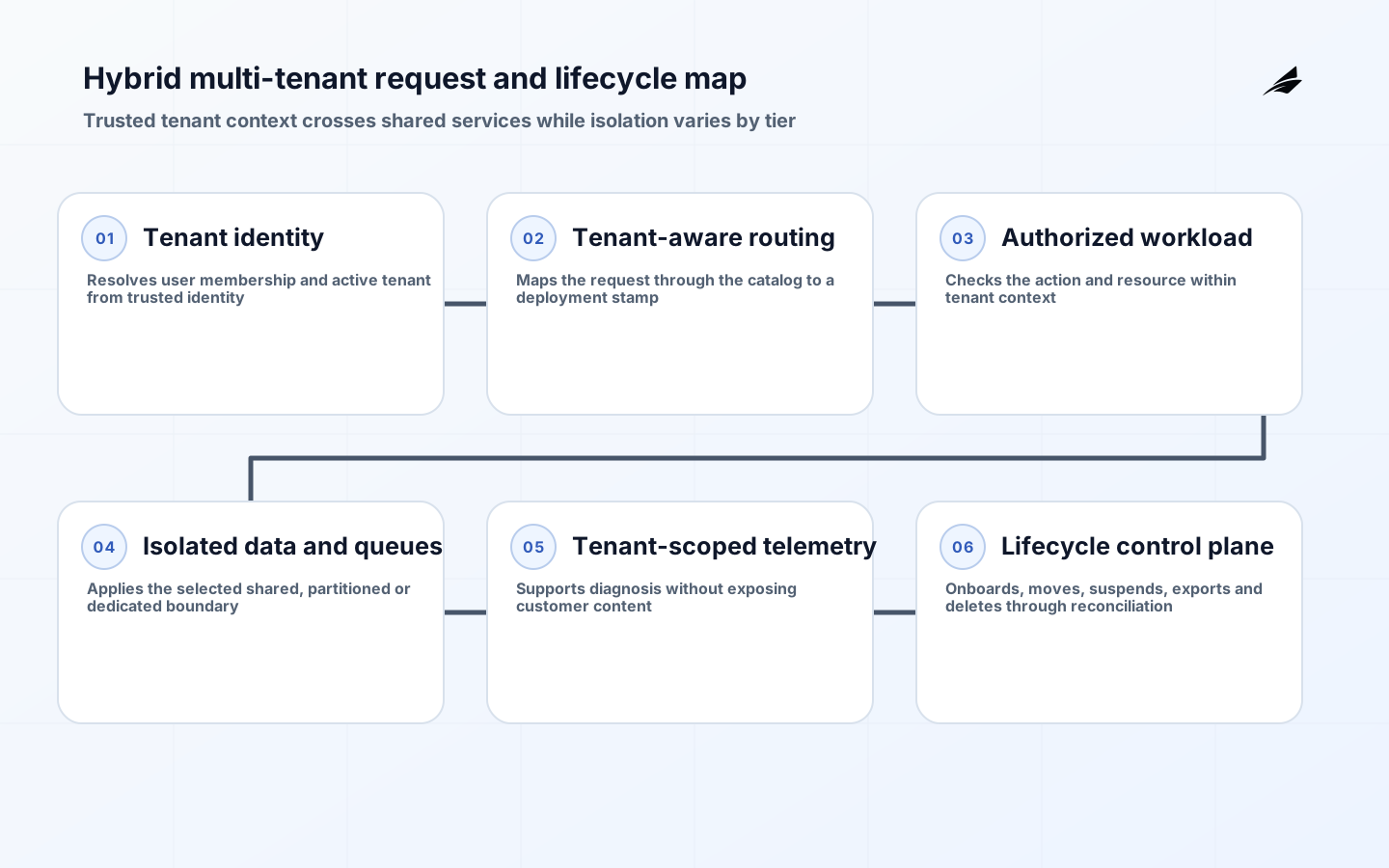
Multi-tenancy means one solution serves distinct customer or organizational groups called tenants. A tenant is not merely a user role: it is a security, data, configuration, billing and operational boundary containing users and resources. The architecture may share every technical component, dedicate complete deployments, or combine shared and isolated tiers. The right design is therefore not a binary choice between single-tenant and multi-tenant software. It is a set of explicit isolation decisions for each resource and lifecycle.
The central trade-off is density versus isolation. Sharing compute and data infrastructure can lower unit cost and simplify fleet maintenance, but it increases the consequences of authorization defects, resource contention and shared failure. Dedicated resources can strengthen fault and performance boundaries while increasing provisioning, upgrade and observability work. A credible architecture relates these choices to customer obligations, scale, workload shape, regional constraints and the team's ability to automate operations.
Key takeaways
- Carry a trusted tenant context from identity through authorization, storage, jobs, caches, logs and metrics.
- Choose isolation per component; most useful designs are hybrid rather than uniformly shared or dedicated.
- Separate the control plane for tenant lifecycle from the data plane that serves tenant workloads.
- Test cross-tenant denial as a first-class security property, including asynchronous and failure paths.
- Control noisy neighbors with quotas, admission rules, fair scheduling and stamp-level containment.
- Design tenant movement, export and deletion before scale makes them emergency projects.
Choose an isolation model from requirements
Start with a tenant profile: data sensitivity, regulatory and contractual obligations, geography, expected load, customization, recovery objectives and willingness to pay for dedicated capacity. Then map each architecture tier. Identity may be shared while databases are dedicated; shared application workers may process tenant-partitioned queues; a small number of high-assurance tenants may receive separate deployment stamps. Microsoft guidance describes isolation as a continuum, which is a better model than assuming every component must follow one pattern.
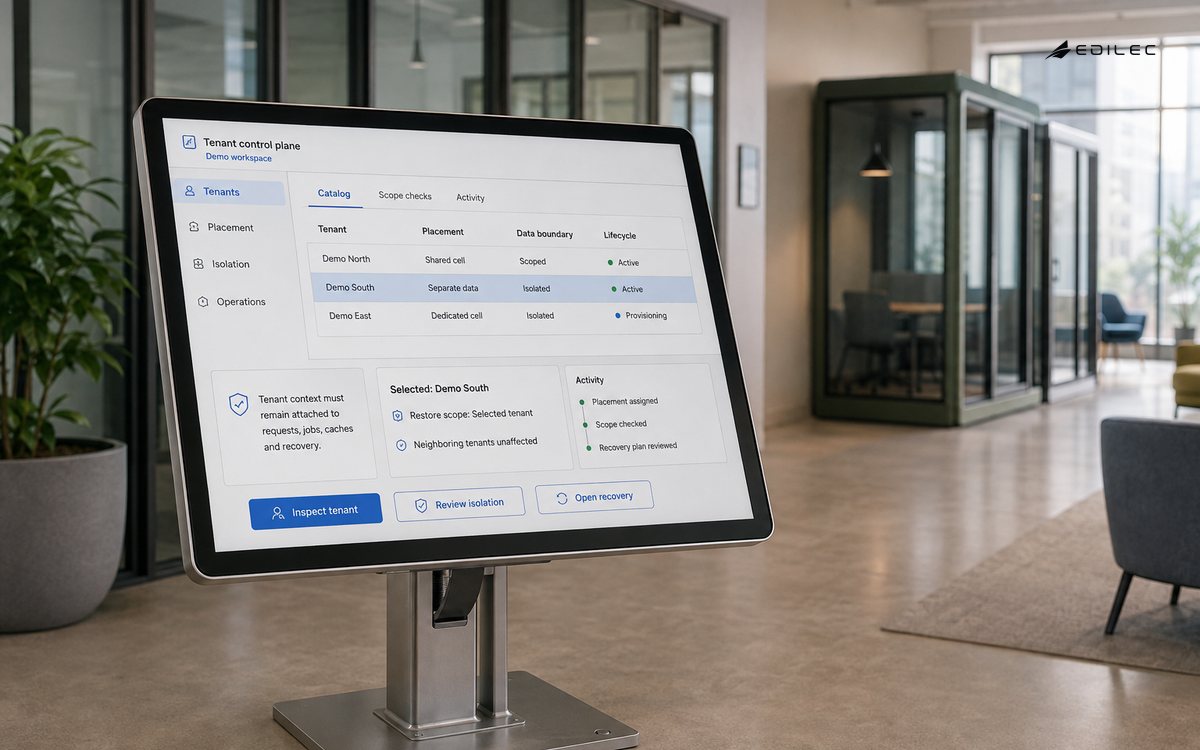
Deployment stamps, also called cells or scale units, create repeatable groups of resources that serve one or more tenants. They limit blast radius, provide a scale-out boundary and permit progressive upgrades. A tenant catalog maps each tenant to its stamp, data locations, plan, configuration and lifecycle state. Stamps do not automatically create application-level isolation: shared components still require tenant-aware authorization, storage keys, cache namespaces and telemetry. Dedicated infrastructure reduces some risks but does not excuse weak controls.
| Pattern | Advantages | Costs and risks | Good fit |
|---|---|---|---|
| Fully shared | High density and one fleet to update | Largest shared blast radius; application must enforce isolation everywhere | Many similar tenants with moderate workloads |
| Shared compute, isolated data | Data boundary and restore are clearer | Connection routing and fleet schema changes are harder | Sensitive data with common application behavior |
| Deployment stamps | Contained failure and horizontal scale | Catalog, placement and fleet automation are required | Growing SaaS with regional or tiered requirements |
| Dedicated tenant stack | Strong resource and performance separation | Higher unit cost and operational multiplication | Few high-assurance or unusually large tenants |
| Hybrid tiers | Matches isolation to risk and commercial plans | More patterns to test and support | Products with materially different tenant classes |
Propagate tenant identity without trusting input
Authentication establishes who a principal is; tenant isolation decides which tenant resources that principal may access. AWS guidance explicitly separates those concerns. Resolve tenant membership from a trusted identity or server-side mapping, not a caller-controlled header. Bind user, tenant, role and relevant resource attributes into an authorization decision at the service boundary. Administrative and support access needs separate privileged workflows, justification, time limits and audit records.
The tenant context must survive every hop. Include it in internal authorization, database access policies, object paths, queue messages, scheduled jobs, cache keys, search filters, rate-limit keys, feature evaluation, logs and traces. Reject a request or job when context is absent or inconsistent; silently assigning a default tenant creates dangerous failure behavior. NIST zero trust guidance supports evaluating access to resources explicitly rather than relying on network location. Service identities need tenant-scoped authority too.
Design data isolation, encryption and lifecycle together
Common relational patterns include shared tables with a tenant key, separate schemas, separate databases and separate accounts or clusters. Shared tables maximize density but put heavy weight on query discipline and database-enforced policies where available. Separate databases simplify tenant-level backup, restore and deletion while increasing connection and migration management. Select according to assurance, scale and operations, not fashion. Every unique constraint and lookup in a shared model should consider whether tenant identity belongs in the key.
Encryption choices include provider-managed keys, service keys and tenant-specific keys. Customer-managed keys may satisfy contractual control but create rotation, availability, revocation and support obligations. Inventory all tenant data, including logs, search indexes, analytics, caches, test copies and backups. Define retention, legal hold, export, deletion and tenant movement for each. Restoring a shared database to recover one tenant can overwrite others, so build logical recovery or isolated restore-and-extract procedures and rehearse them.
| Data concern | Required design decision | Verification |
|---|---|---|
| Request isolation | How tenant context enters every query | Negative tests using another tenant's identifiers |
| Background work | How jobs retain identity and authorization | Queue and retry tests with mismatched context |
| Caches and search | How namespaces and filters are enforced | Cross-tenant collision and filter tests |
| Backup and restore | How one tenant is recovered without harming others | Timed tenant-level recovery exercise |
| Analytics | How aggregation is authorized and de-identified | Lineage review and access tests |
| Deletion and export | Which copies are included and how completion is proven | Reconciliation across primary and derived stores |
Treat the tenant control plane as a critical product
The control plane manages onboarding, placement, configuration, entitlements, key references, upgrades, suspension, movement and offboarding. Its tenant catalog should be authoritative for routing and lifecycle state, with controlled writes and version history. Workflows must be idempotent because provisioning retries are normal. Use reconciliation to compare desired state with deployed resources. A partially provisioned tenant needs an observable state and recovery path instead of manual database edits.
Separate control-plane permissions from ordinary tenant traffic and protect high-impact operations with strong authentication and approval where warranted. Control-plane failure should not necessarily stop established tenant workloads; cache routing data carefully with bounded staleness. Conversely, data-plane compromise should not grant fleet administration. Test catalog loss, duplicate events, interrupted provisioning, stamp capacity exhaustion and a failed tenant move. The control plane deserves service objectives, threat modeling and disaster recovery like any other critical system.
Contain noisy neighbors and shared failures
Measure consumption per tenant at admission and at constrained resources. Apply rate limits, concurrency limits, queue partitions, database workload controls and storage quotas according to product plans and safety needs. Fair scheduling is often better than a single global queue. Large batch exports should not starve interactive work. Detect concentration: one customer may span many users, and several tenants may share an upstream provider. Capacity planning should consider uneven distributions rather than an average tenant that does not exist.
Observability needs both fleet and tenant views. Tag telemetry with a protected tenant pseudonym and stamp identifier while avoiding sensitive content. Monitor saturation, throttling, latency, errors and queue age by tier and stamp; allow support to diagnose one tenant under governed access. Define fault containment and recovery objectives. Practice failure while checking isolation: a degraded cache, retry storm or restored database must not mix contexts or let one tenant consume recovery capacity intended for all.
Prove isolation with delivery and security tests
Create an isolation test matrix across APIs, direct object references, search, exports, files, notifications, webhooks, jobs, caches, support tools and administrative functions. For each, attempt access with valid identities from the wrong tenant, stale memberships, altered tenant fields and missing context. Include errors and timeouts because fallback code is frequently less protected. Seed distinctive synthetic markers per test tenant so leakage is detectable. Run critical negative tests in continuous delivery and repeat broader adversarial testing before material changes.
Release by stamp or tenant cohort with feature flags whose evaluation is tenant-aware. Watch security denials, error rates, saturation and product outcomes before expansion. Schema evolution must support mixed application versions during rollout. Maintain an emergency disable path that can isolate a tenant or feature without corrupting lifecycle state. A rollback must restore compatible application, configuration and data behavior; simply redeploying an old binary may be unsafe after an irreversible schema change.
Frequently asked questions
Is a shared database inherently insecure?
No, but it concentrates reliance on correct tenant-aware access. Use database constraints or row-level controls where appropriate, centralized query patterns, protected context, code review and strong negative testing. If obligations or team capability require a stronger boundary, choose separate databases or deployments. The decision should follow risk and operational evidence.
What is the difference between a tenant and a user?
A user is an identity that acts in the system. A tenant is the organization or group boundary that contains users, resources, configuration and commercial state. One person may belong to multiple tenants, so the application must establish active tenant context and authorize each action against it.
How should tenant customization be handled?
Prefer validated configuration, entitlements and extension points over code forks. Version configuration, define safe defaults and test combinations. Tenant-specific deployments may be justified for material isolation or performance needs, but unmanaged forks turn upgrades and security fixes into separate products.
Conclusion
A multi-tenant architecture succeeds when sharing is intentional and isolation is demonstrable. Define the tenant boundary, select isolation independently for each tier, and propagate trusted context through synchronous and asynchronous work. Build a resilient control plane, plan data lifecycle and tenant movement, and contain resource contention with fair limits and stamps. Most importantly, test that the system refuses cross-tenant access during ordinary, privileged and failed operations. That evidence allows SaaS economics to scale without asking customers to rely on an undocumented promise.