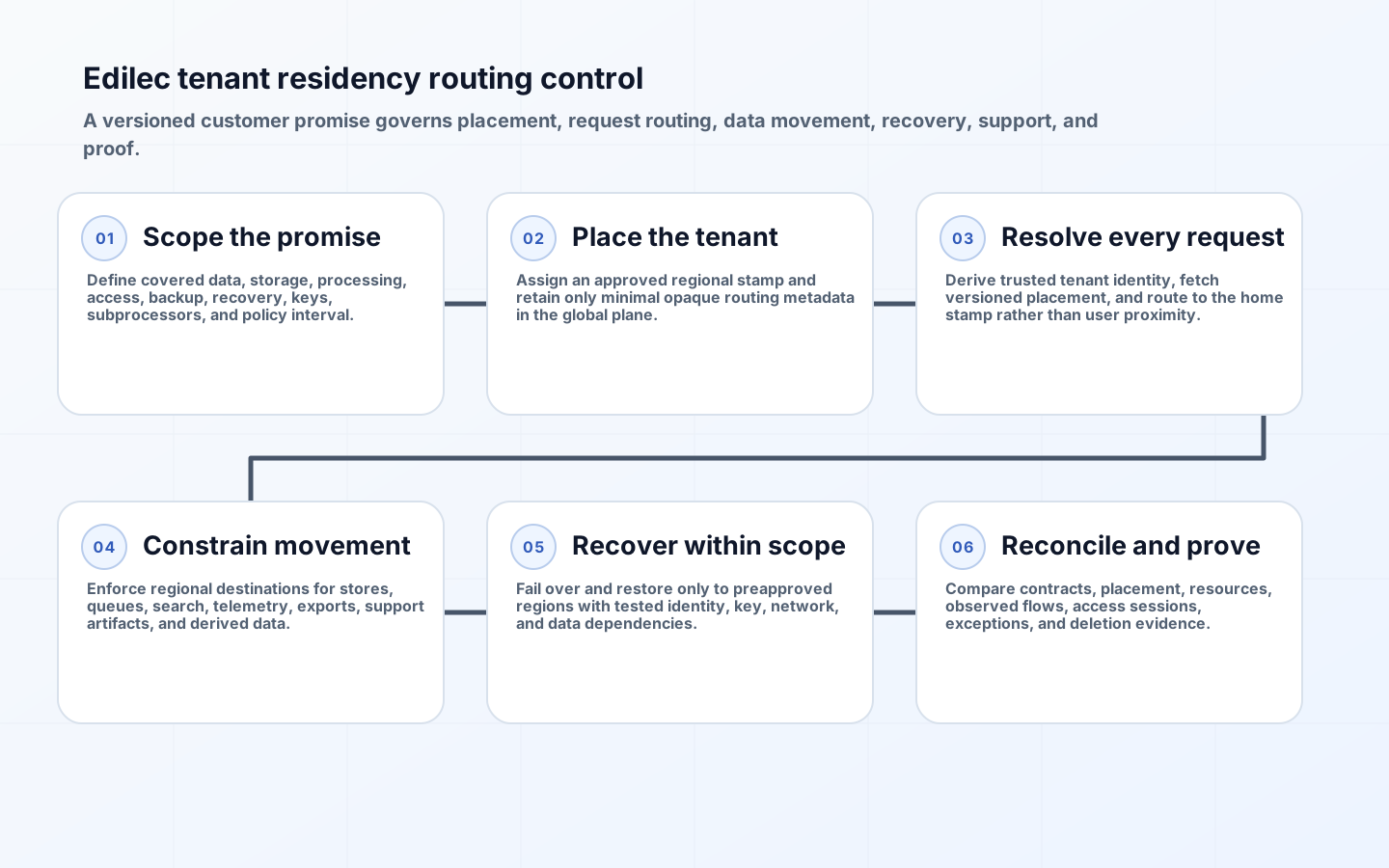
SaaS data residency architecture begins with a precise promise, not a region selector in an onboarding form. A customer may require primary records to stay in one geography while also caring about backups, search indexes, telemetry, support access, subprocessors, disaster recovery, and administrator metadata. If engineering interprets residency as database location alone, hidden copies and operational paths can violate the intended boundary.
Residency, sovereignty, transfer compliance, and localization are related but not interchangeable. Residency describes where data is stored or processed under an agreed scope. Sovereignty concerns the laws and authorities applicable to data. Transfer rules govern movement or remote access across jurisdictions. Localization can require a local copy or exclusive local handling. Legal and privacy specialists must interpret obligations; architecture must turn the approved interpretation into enforceable placement and access controls.
Write a machine-actionable residency policy
For each offer and contract, record covered tenants, data classes, permitted regions, prohibited locations, allowed processing purposes, backup boundary, recovery region, support locations, subprocessors, encryption and key location, deletion behavior, exceptions, and evidence. Version the policy and retain the effective interval because an existing tenant's promise may differ from the current catalog. Avoid a single Boolean called EU resident; it cannot represent permitted failover, derived telemetry, or later contract amendments.
| Data or operation | Placement question | Typical hidden copy | Required evidence |
|---|---|---|---|
| Authoritative records | Where may reads, writes, and replicas occur? | Cross-region read replica | Database and replication configuration |
| Objects and attachments | Where are originals, thumbnails, and malware samples? | Global media processor cache | Bucket policy, lifecycle, processor region |
| Search and analytics | May derived indexes leave the region? | Central warehouse extract | Lineage, destination, minimization rule |
| Backups and recovery | Which recovery locations are approved? | Provider-managed copy | Backup inventory and restore test |
| Logs and traces | Which payload fields are permitted? | Global observability backend | Telemetry schema and routing rule |
| Support access | From where may people or tools access content? | Ticket attachment or screen recording | Access decision, session log, approval |
| Control-plane metadata | What global fields are necessary? | Tenant names and admin emails | Field-level classification and retention |
GDPR does not reduce to keeping data in the EU. Its Chapter V sets conditions for transfers to third countries and onward transfers. The official GDPR text must be interpreted for the actual processing and parties. A region architecture can support compliance, but it does not by itself establish a lawful basis, transfer mechanism, processor agreement, or response to government access.
Separate a minimal global control plane from regional data planes
Use regional deployment stamps that contain application services, transactional stores, object storage, queues, indexes, keys where required, and regional operational tooling. Keep the global plane small: tenant identifier, approved home stamp, policy version, routing status, product tier, and opaque operational health. Microsoft describes a deployment stamp as an independently deployed scale unit that can hold a subset of tenants and support multi-region placement.
A global service becomes part of the residency design whenever it receives covered data. Do not send customer content, queries, attachments, or raw identifiers to the placement directory. Prefer opaque tenant IDs and coarse health. Replicate the routing map only to approved control-plane locations, encrypt it, and audit modifications. Design static fallback for existing tenants so a placement-service outage does not redirect them to a convenient but unauthorized region.
Route by authoritative tenant placement, not user proximity
Resolve tenant identity from a trusted host name, token claim, or account lookup, then fetch the active placement record and route to that stamp. Geography-based edge routing may select a nearby ingress, but ingress must forward to the tenant's home region. A traveling user should not move the data plane. Cache mappings with a version and short bounded staleness, and reject ambiguous or missing tenant context instead of guessing from IP address.
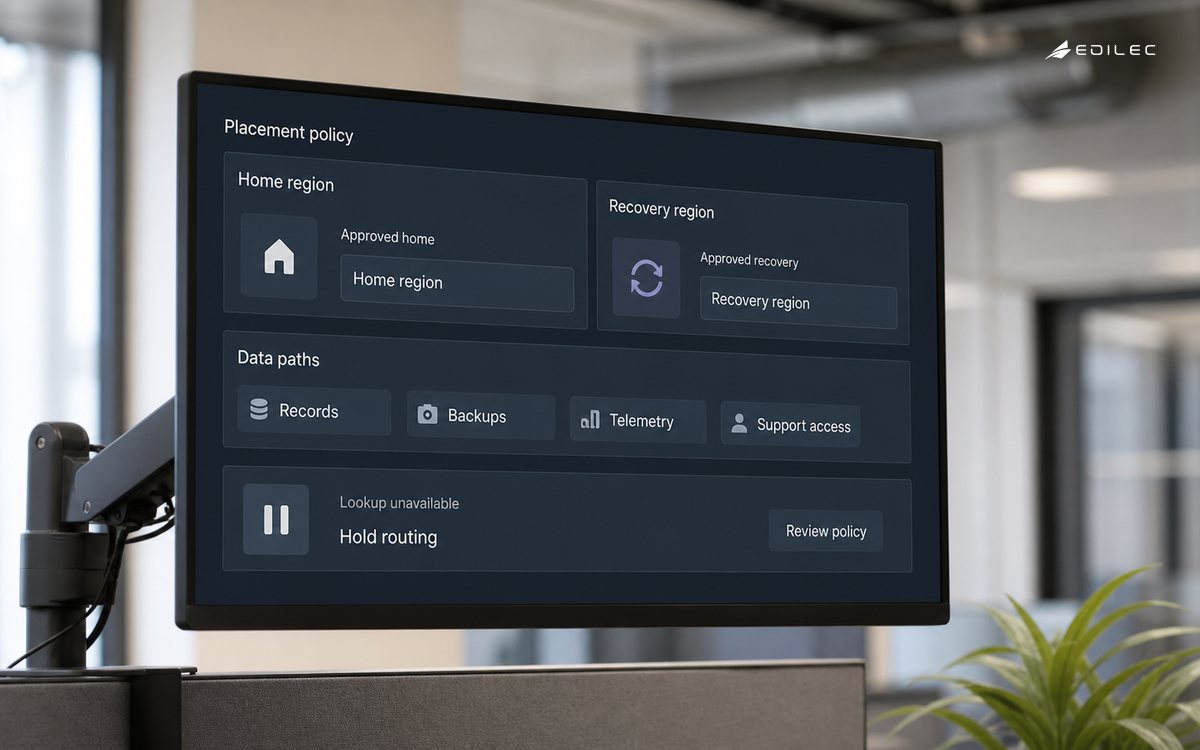
| Condition | Unsafe reaction | Preferred behavior | Customer impact |
|---|---|---|---|
| Placement lookup unavailable | Send to nearest healthy region | Use signed cached mapping or fail closed | Possible temporary unavailability, no boundary breach |
| Home stamp degraded | Fail over to any region | Use only preapproved recovery stamp and mode | Service follows contracted recovery posture |
| Tenant move in progress | Let caches choose either stamp | Version mapping, fence writers, forward reads by phase | Controlled transition |
| Token region conflicts | Trust client-supplied region | Trust authoritative placement and alert | Potential request rejection |
| New region capacity full | Place tenant elsewhere silently | Block onboarding or obtain approved alternative | Delayed activation |
| Global edge logs content | Retain full request globally | Redact at edge and emit regional detail | Reduced central diagnostics |
Cloud region properties require exact service verification. AWS states in its fault isolation guidance that resources and data created in one Region do not exist in another unless a replication or copy feature is explicitly used. That is a useful default, not proof for every managed service feature. Inventory each service's data plane, control plane, support, backup, key, and telemetry behavior against the contract.
Control every path that can move data
- Classify fields and artifacts at creation, including derived data and diagnostic payloads.
- Attach tenant and approved-region context to storage, queue, analytics, and export operations.
- Enforce destination policy in shared libraries, infrastructure policy, and cloud organization controls.
- Route logs, traces, backups, search documents, and support artifacts through region-aware pipelines.
- Scan configurations and sampled records for unauthorized regions or global stores.
- Record approved transfers and exceptions with purpose, owner, expiry, and compensating controls.
Pay special attention to asynchronous systems. A regional service can publish to a global message bus, invoke a third-party processor, or write a dead-letter queue elsewhere. Put destination region and policy version in deployment configuration, not in untrusted message payloads. Encrypt messages in transit and at rest, minimize content, and set regional dead-letter and replay tooling. Replaying an old event must not bypass a tenant's newer placement policy.
Design backup and disaster recovery inside the promise
Availability and residency can conflict. A cross-continent replica may improve recovery but exceed the allowed boundary; keeping all copies in one metropolitan risk area may satisfy a narrow location promise but weaken resilience. Offer clear recovery classes: multi-zone within the region, a second approved region within the geography, customer-approved cross-border recovery, or backup-only recovery with a longer objective. Price and document the tradeoff rather than enabling replication by default.
Test restore to the exact permitted destination and verify keys, identities, network policy, queues, search indexes, and placement metadata. Recovery automation must ask whether the candidate region is authorized for the tenant and data class. Record actual recovery point and recovery time by stamp. If emergency access or movement is contemplated, legal and contractual authorization must be designed before an incident, not inferred under pressure.
Govern support, analytics, and operational access
Remote viewing can be a transfer even when storage remains regional, depending on applicable law and facts. Build support modes that expose metadata first, require a case and purpose for content access, apply tenant and region policy, issue time-bounded credentials, mask sensitive fields, and record the session. Regional support staffing or in-region privileged access workstations may be necessary for stronger promises. Copying records into a global ticket system defeats the boundary.
The European Data Protection Board's supplementary measures recommendations provide a structured process for transfer analysis and supplementary safeguards. Engineering inputs include a real transfer map, encryption and key control, access paths, data minimization, and subprocessor behavior. Encryption is valuable, but a processor that must decrypt data to provide the service still has access; architecture claims should reflect that reality.
Move a tenant between regions as a controlled migration
Tenant moves need a state machine: approved, provisioning, initial copy, continuous replication, validating, write-fenced, cut over, observing, and source deleting. Freeze policy changes during the critical window. Copy with tenant-scoped credentials, reconcile counts and business invariants at a watermark, switch the versioned placement record, invalidate caches, and monitor requests reaching the old stamp. Keep rollback within the approved locations.
Deletion of the old location is part of completion. Remove databases, objects, replicas, queues, indexes, caches, derived analytics, local backups according to retention policy, and stale support artifacts. Cloud deletion may transition data into provider-managed retention before physical erasure; document the service behavior accurately. Produce a migration evidence record that identifies scope, source, destination, validation, cutover, rollback window, and deletion milestones.
Key takeaways
- Define residency by data class, operation, location, access, recovery, and effective policy version.
- Keep global control-plane data minimal and place customer content in regional stamps.
- Route from trusted tenant placement; proximity is never authority.
- Include telemetry, backups, support, indexes, queues, keys, and subprocessors in the boundary.
- Fail over only to preapproved locations and test restore within those constraints.
- Continuously reconcile policy with deployed resources and observed data movement.
SaaS data residency FAQ
Can a global CDN be used for a resident tenant?
Often for public static assets, but customer-specific content, request logs, edge functions, and cache locations need separate review. Configure cache keys, regions, logging, headers, and origin routing deliberately. A CDN marketing label is not evidence that every cached object and log remains in scope.
Does customer-managed encryption solve residency?
It can strengthen control and reduce some access risks, especially when keys remain in an approved region, but it does not relocate data or automatically make a transfer lawful. Services that process plaintext still require decryption. Key backups, administrators, metadata, and emergency procedures also belong in the assessment.
How can global product analytics coexist with residency?
Collect the minimum approved regional events, aggregate or de-identify them under a reviewed standard, and export only allowed fields and dimensions. Preserve enough regional lineage to prove the transformation. Some contracts may prohibit even derived exports, so analytics needs a policy-aware routing and suppression layer.
Conclusion
Regional infrastructure becomes trustworthy only when it enforces the actual customer promise across normal operations, failure, support, and deletion. A policy-aware placement map, regional stamps, complete movement inventory, constrained recovery, and verifiable tenant migration turn data residency from a sales checkbox into an operable SaaS capability.