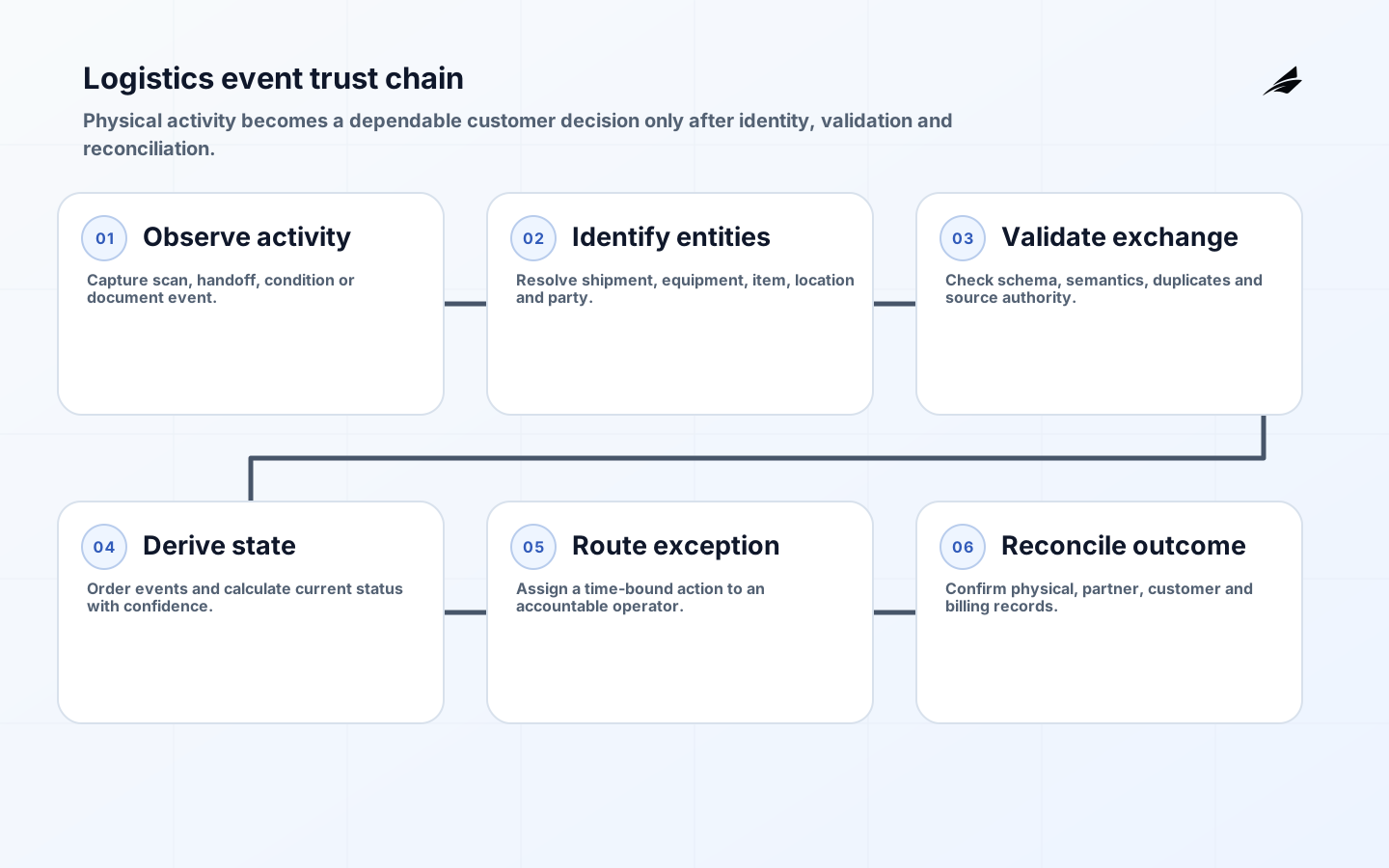
Logistics SaaS Product Development: Implementation Checklist requires more than selecting tools or assembling a feature list. The implementation must connect a defined business outcome to data, authority, failure behavior and permanent ownership. This guide explains the decisions a buyer, product leader and delivery team should settle before committing the full build. It uses current primary standards where they define a useful control, while keeping the architecture proportional to the actual workflow and consequence.
The practical goal is an operable service: people can complete the intended work, understand state and exceptions, and recover when a dependency or decision fails. Scope therefore includes discovery, design, integration, security, delivery, rollout and support. The sections below can be used for proposal review, architecture workshops and acceptance planning. Related reading includes SaaS Product Development Company for Logistics: Scope, Cost, Risks and Delivery Plan, Choosing a SaaS Product Development Company for Logistics: FAQ, IoT Software Development for Logistics: Architecture and Delivery FAQ.
Anchor the product in one logistics decision
Choose a bounded operating decision such as whether a shipment is at risk, whether a handoff is complete, which exception requires intervention or whether an invoice matches delivered service. Identify the people, clock and consequence. Avoid starting with a generic control tower: visibility without action definitions produces a crowded map. Observe work across carrier, warehouse, shipper and customer roles, including spreadsheets and messages used to repair system gaps. Define the first release by the event chain and exception it improves, then name the source records and owners needed to prove that improvement.
Write acceptance around a real scenario, such as a missed transshipment that requires customer notice and rebooking. Specify the latest useful detection time and which evidence authorizes an intervention. Include the cost of false alarms and missed exceptions. This clarifies whether the product needs event normalization, prediction or simply faster workflow ownership. Product analytics should record the decision and resulting operational outcome.
Model events, identifiers and corrections
Logistics state is reconstructed from events reported by different parties. Use stable identifiers for shipment, consignment, equipment, trade item, location, party and document, with cross-reference tables where partners use different keys. Represent what happened, when, where, why and by whom; GS1 EPCIS provides a standards-based visibility event model, while DCSA defines common container-shipping track-and-trace structures. Keep event occurrence time separate from receipt and processing time. Corrections should supersede or annotate history with provenance rather than silently rewriting it.
Govern identifier resolution as its own service. Partner references can be recycled, reformatted or scoped to an account; never assume a displayed number is globally unique. Record mapping confidence and effective periods. Event corrections need reason, issuer and relationship to the original. Define timezone and daylight-saving handling for planned and actual milestones. Test partial quantities, split shipments, consolidation and equipment substitution.
| Area | Decision | Evidence |
|---|---|---|
| Domain object | Stable identity | Critical event question |
| Shipment or consignment | Business shipment reference plus partner mappings | Which planned movement and obligations apply? |
| Transport equipment | Container, trailer or vehicle identifier | Where is the physical unit and in whose custody? |
| Location | Standard or governed location code | Where did the event occur and at what granularity? |
| Trade item | GS1 or governed product identifier | What quantity and condition changed? |
| Document | Versioned business-document identifier | Which instruction or evidence authorized the action? |
Treat partner integration as a product surface
Each carrier, warehouse or customs interface has its own freshness, limits and semantics. Create a canonical boundary but retain the raw payload and mapping version for diagnosis. Validate schema and business rules, quarantine invalid messages, deduplicate retries and expose connector health. Design webhooks and polling with idempotency. The UN/CEFACT multimodal reference model can inform shared semantics across modes without forcing every partner into one syntax. Contract tests should use representative partner fixtures and verify backward compatibility before a mapping or canonical schema is promoted.
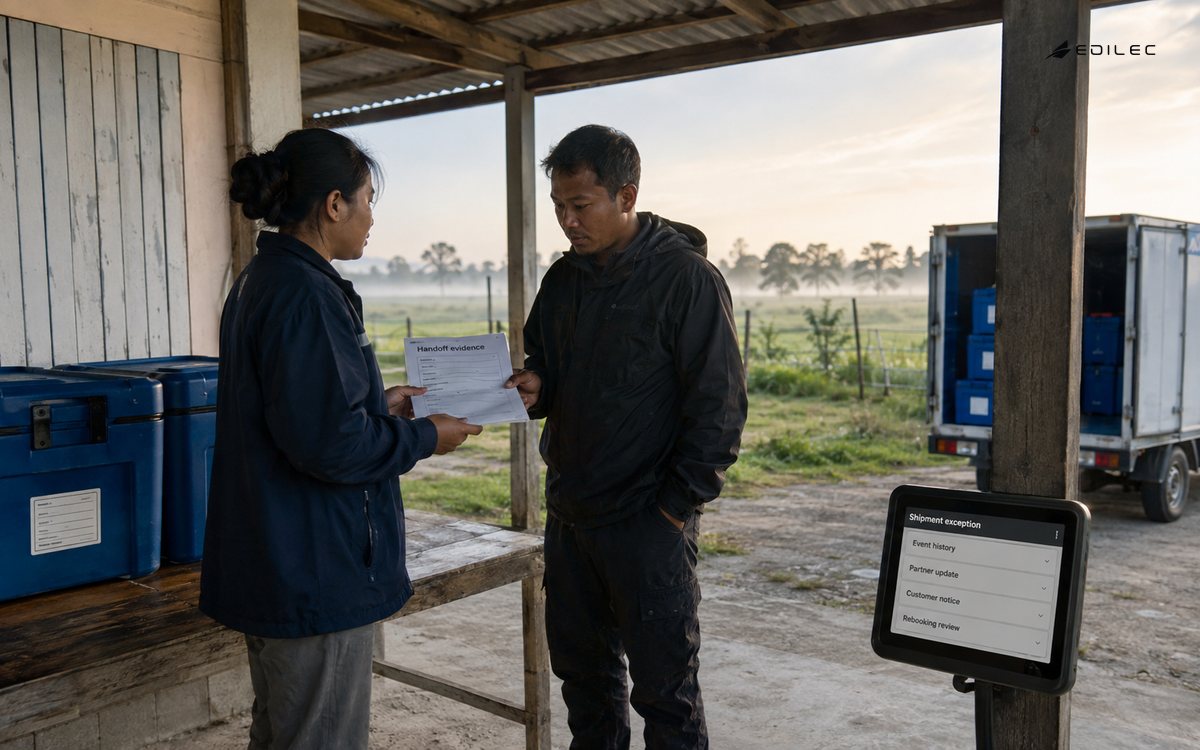
Provide a partner onboarding kit with supported protocol, security, schema, code lists, examples, certification tests and support contacts. Monitor payload acceptance separately from semantic completeness. A connector that returns HTTP success while omitting milestone identity is not healthy. Version mappings independently so one partner correction does not force all connectors to release. Keep replay bounded and observable to avoid re-notifying customers or duplicating billing events.
Design for devices, poor connectivity and time
Drivers, yards and warehouses operate with intermittent networks, shared devices and imperfect clocks. Define which actions can occur offline, how identities and permissions are cached, how conflicts are resolved and when an action expires. Use locally generated identifiers and monotonic sequence information where possible. Show pending and rejected state clearly; do not tell a user that proof of delivery is complete before synchronization and validation. Test low bandwidth, clock drift, duplicate scans, device loss and delayed uploads. Preserve an audit trail that links the local action to the accepted server event.
Protect offline stores with device-bound credentials, minimal data and expiry. Establish how a lost device is revoked before it reconnects. Conflict policy should reflect the action: two inventory counts may need review, while duplicate scan events may safely collapse. Provide a visible sync history and support export for disputed proof. Device software rollout needs compatibility with server APIs and a rollback plan for field fleets.
Bound tenant data and commercial rules
Multi-tenant logistics products often include shippers, brokers, carriers and customers with overlapping but unequal access. Authorization must consider organization, role, contractual relationship, shipment and field sensitivity. Test every query, export, notification and cache for isolation. Keep pricing, surcharge, SLA and workflow configuration versioned because historical decisions depend on rules active at the time. Separate product configuration from custom code. If a customer-specific variation cannot be represented and tested as data, estimate the ongoing release and support cost before accepting it.
Model delegated access for subcontractors and temporary partners with expiry linked to the business relationship. Avoid copying entire shipment records into tenant-specific stores without a deletion and correction strategy. Apply policy to event subscriptions as well as interactive queries. Test inference through counts, search suggestions and predictable identifiers. Billing entitlements must not be confused with authorization to sensitive operational or customs data.
| Area | Question | Control |
|---|---|---|
| Test scenario | Expected behavior | Evidence |
| Duplicate webhook | One event accepted, retries acknowledged safely | Idempotency and ingestion record |
| Late correction | Timeline updates without erasing prior report | Correction provenance and recalculated state |
| Offline proof | Action remains pending until accepted | Device record linked to server event |
| Partner outage | Freshness warning and bounded retry | Connector health and queue age |
| Tenant export | Only authorized fields and shipments included | Policy decision and export audit |
Engineer for late, conflicting and missing evidence
A tracking product should distinguish no event, late event, contradictory event and failed ingestion. Set freshness expectations by source and route segment. Derive predictions from observable facts but label confidence and preserve the underlying events. Use OpenTelemetry traces, metrics and logs to connect connector activity, processing and customer queries without putting sensitive cargo data in generic telemetry. Define recovery objectives, replay behavior and reconciliation reports. A restore is incomplete until derived state and customer-visible timelines agree with the authoritative event store.
Set replay checkpoints and deterministic transformation versions so derived state can be rebuilt. Preserve dead-letter records with ownership and privacy controls; a growing quarantine is an operational incident, not archival storage. Capacity tests should include burst patterns around vessel events, warehouse waves and partner recovery after outage. Monitor consumer lag and notification age against the business decision window rather than only infrastructure utilization.
Roll out by lane and prove operations
Select a lane, partner set and shipment profile that reveal real complexity but permit recovery. Replay historical events, shadow current operations and compare exception decisions. Establish support for partner onboarding, mapping errors, data disputes and peak events. Progressive release should control tenant and connector exposure independently. Acceptance includes security tests, accessibility for operational screens, load at event bursts, disaster recovery, billing reconciliation and a runbook exercise. Expand only after measured data completeness and operational ownership are stable, not merely after the interface looks complete.
Agree a daily reconciliation with operations during the pilot: expected shipments, received events, unresolved mappings, late data and actions taken. Hold review sessions with users from every handoff, not only the sponsoring team. Prepare client-facing status for data-provider outages. Define commercial support for new connectors and code-list changes. The expansion decision should use several complete operating cycles, including at least one failure exercise.
Key takeaways
- Start with an operating decision and its event chain, not a generic control tower.
- Use stable identifiers and provenance-preserving corrections.
- Make partner mappings, offline behavior and tenant authorization testable.
- Scale by lane only after completeness, recovery and ownership are proven.
Frequently asked questions
Must a logistics SaaS product implement EPCIS?
Not always, but EPCIS is a strong reference when interoperable supply-chain visibility events are required. The product may use a narrower internal model while mapping accurately at its exchange boundary.
Does tracking need to be real time?
It needs a defined freshness appropriate to each decision. A warehouse scan may need seconds; a vessel milestone may update less often. Showing source age is more honest than presenting all data as live.
What belongs in the first release?
One lane or workflow, a small partner set, authoritative events, exception handling, role-based access, reconciliation and operable telemetry. Forecasting and broad optimization should follow reliable event capture.
Conclusion
Logistics SaaS product development is an interoperability and operations problem as much as an interface project. A professional implementation establishes event semantics, stable identity, partner contracts, offline and degraded behavior, tenant boundaries and evidence-based rollout. When those foundations are explicit, the product can add prediction and optimization without hiding uncertain or inconsistent physical-world state. Keep standards mappings and partner certification current as modes, markets and operational responsibilities expand.