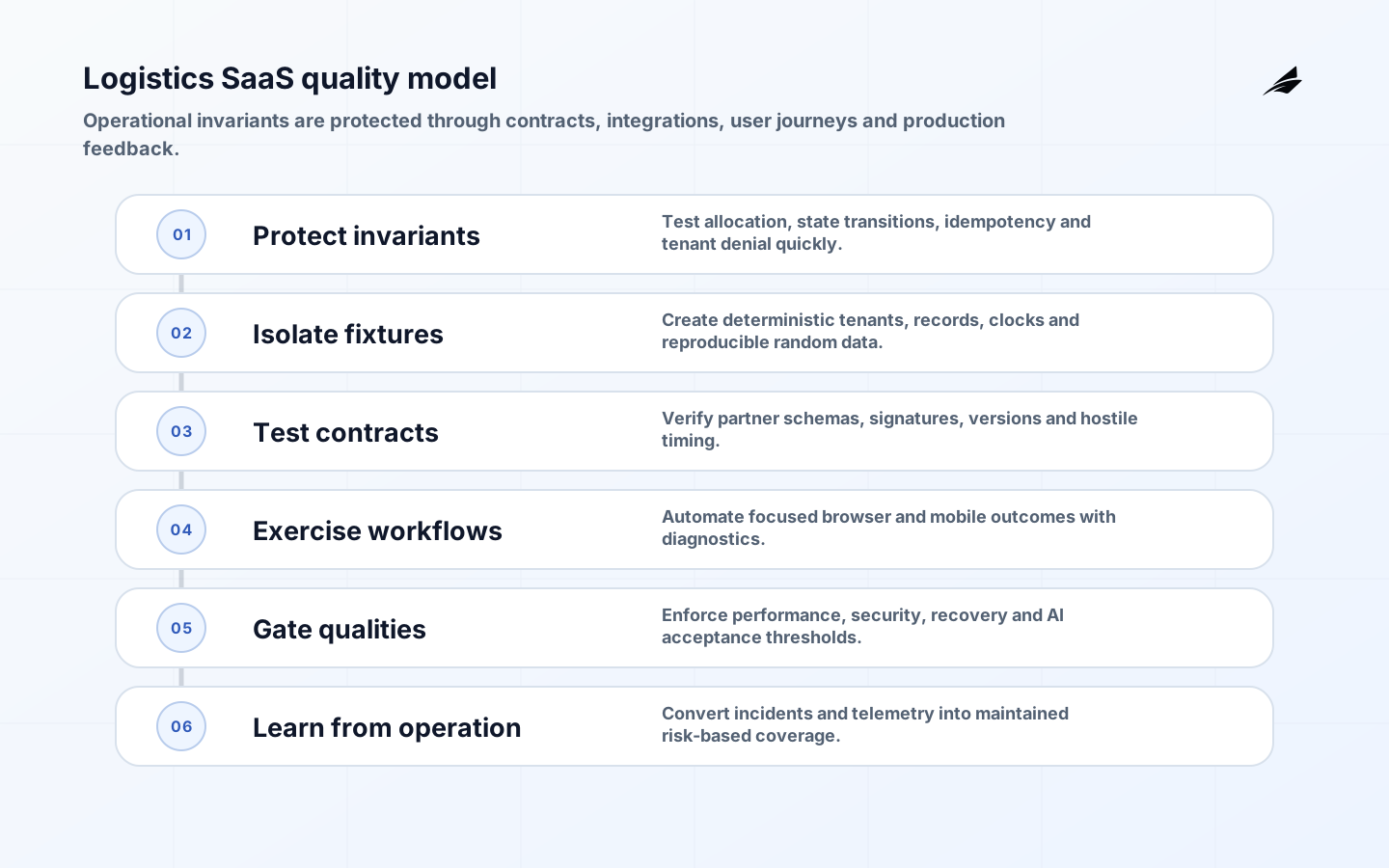
QA automation for logistics SaaS must verify that operational truth survives timing, retries, partial connectivity and many external systems. A shipment can appear complete in the interface while inventory is wrong, a carrier update was duplicated or another tenant can see the record. The test strategy therefore needs business-state assertions across order, allocation, pick, pack, dispatch, tracking, exception and settlement. Browser automation is useful, but it is only one layer beside contract, integration, concurrency, performance and recovery tests.
Playwright recommends isolated tests that verify user-visible behavior, k6 turns performance expectations into thresholds, and OpenTelemetry traces show request paths through distributed systems. If AI is used for document extraction, ETA prediction or exception classification, NIST AI RMF adds use-case evaluation and monitoring. The implementation checklist below combines those practices into a maintainable suite tied to logistics risks rather than a large count of fragile scripted clicks.
Build the test model from logistics risks
Map the lifecycle and system of record for order, inventory, shipment, package, route, invoice and return. Identify invariants: stock cannot be allocated twice, a shipment transition must be legal, a carrier event must be idempotent, one tenant cannot access another tenant, and a retried label request cannot create two billable labels. Capture clocks, units, currencies, locations and time zones. These rules are more durable than screen layout and should anchor API, integration and browser tests.
Rank workflows by customer and operational consequence. Test the high-value happy path, then missing scans, late events, short picks, partial shipments, carrier outage, warehouse disconnect, cancellation during fulfilment and reconciliation after recovery. Use production incident history and support cases to build examples. Maintain a compact risk-to-test map so removed or duplicated tests are visible and a passing suite has a clear meaning.
| Layer | Primary purpose | Logistics example |
|---|---|---|
| Unit and property | Protect rules and invariants quickly | Allocation never produces negative available stock |
| Contract | Detect producer and consumer drift | Carrier webhook schema and signature behavior |
| Integration | Verify state across real boundaries | Order acceptance creates exactly one fulfilment job |
| Browser and mobile | Verify role-visible workflow | Picker handles substitution and offline retry |
| Performance | Protect latency, throughput and queues | Peak order import meets completion threshold |
| Recovery | Prove replay and reconciliation | Backlog drains without duplicate shipment effects |
Create deterministic tenants and data fixtures
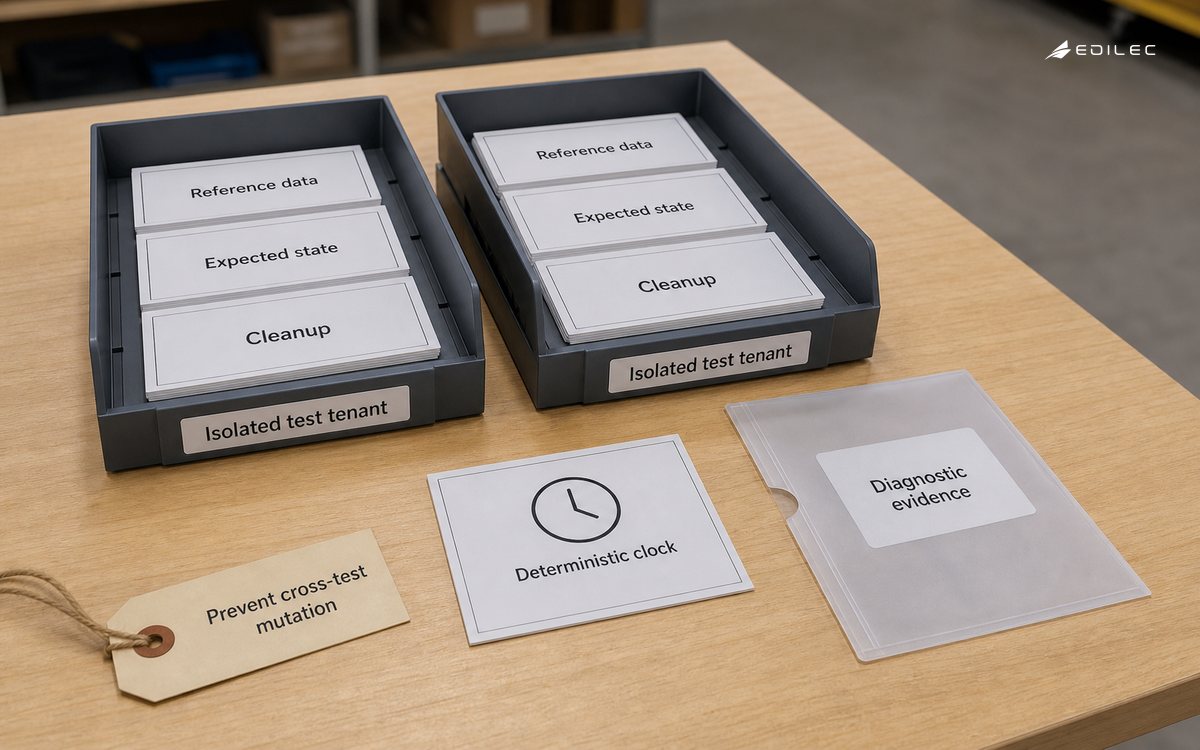
Give each test an isolated tenant or namespace, stable reference data and deterministic clocks where possible. Playwright browser contexts isolate cookies and storage, but database, queue and object-store records still need separation. Create data through supported APIs or fixtures that mirror production validation, not direct inserts that bypass behavior. Generate unique business identifiers and clean up by tenant lifecycle. Preserve failed-test data long enough for diagnosis while preventing it from contaminating the next run.
Model realistic dimensions: multi-warehouse inventory, split shipments, hazardous or temperature-controlled attributes, different carrier services, time zones and large catalogs. Keep personal and commercial production data out of test systems. Version reference datasets with the test suite. For randomized or property tests, record the seed so a failure can be reproduced. Avoid one golden account that every parallel test mutates; it creates order dependence and false flakiness.
Test integrations as unreliable peers
Use provider sandboxes where they are faithful, contract tests for schemas and controlled simulators for failure. Exercise delayed, duplicate, out-of-order, malformed and signed-with-wrong-key messages. Verify timeouts, backoff, idempotency, dead-letter routing and operator visibility. Reconcile against the authoritative carrier, ERP, WMS or payment state. A mock that always responds immediately cannot prove production behavior, while tests that depend entirely on an external sandbox become slow and unpredictable.
Maintain example payloads from published specifications and approved incidents, with sensitive fields removed. Version adapters and test both supported old and new contract versions during partner transitions. Validate units and rounding, not only JSON shape. For webhooks, test authentication before parsing, replay protection and acknowledgement behavior. For outbound calls, prove that retries do not repeat non-idempotent business effects. Every permanent failure should create an owned work item with enough evidence to resolve it.
Keep browser and mobile tests focused
Automate user-visible critical paths with accessible roles, labels and stable domain identifiers. Avoid selectors tied to CSS structure. Use page or workflow objects only where they clarify intent. A browser test should state a business outcome, such as “dispatcher reroutes a delayed shipment and the customer status updates,” rather than reproduce every implementation step. Capture traces, screenshots and network logs on retry or failure so diagnosis does not require rerunning an intermittent scenario.
Run supported browsers and representative mobile viewports through projects. For warehouse devices, add tests for scan bursts, camera permission, network loss, resume, duplicate scan and battery-conscious synchronization. Separate visual regression from workflow correctness so harmless rendering changes do not block every functional release. Keep a small release-blocking suite and a broader scheduled suite; a massive end-to-end suite that takes hours and fails randomly will be ignored.
Automate performance, security and AI quality gates
Define k6 thresholds for business journeys: accepted orders, tracking updates, allocation latency, queue age and error rate. Test mixed tenants and peak events, then verify that one importer cannot starve interactive work. Correlate scenarios with traces, metrics and logs. Add authorization tests across every tenant-scoped endpoint and export. Scan dependencies and secrets, but do not confuse tool output with application authorization or workflow abuse testing.
Where AI extracts documents or classifies exceptions, create versioned evaluation sets with representative formats, languages, damage and ambiguity. Measure field accuracy, unsafe routing, abstention, evidence and downstream operational effect. Human reviewers need a correction path; corrections should feed evaluation before they influence retraining. Gate model, prompt or retrieval changes like code and monitor drift and overrides after release. Never let an unvalidated generated value directly commit a shipment or payment action.
| Release gate | Evidence | Block when |
|---|---|---|
| Business invariants | API and integration assertions under retry and concurrency | Duplicate, lost or illegal state occurs |
| Tenant isolation | Cross-tenant negative tests for UI, API, jobs and exports | Any unauthorized observation or action succeeds |
| Critical journeys | Stable browser/mobile tests with diagnostic traces | Supported user cannot complete work |
| Performance | Thresholds for latency, correctness, queue and fairness | Objective or capacity boundary is breached |
| Recovery | Replay, reconciliation and backlog-drain exercise | State cannot return to authoritative truth |
| AI behavior | Versioned evaluation, abstention and human-review evidence | Unsafe error or unsupported input is automated |
Introduce the suite in stages
Start with business invariants and contract tests around the most incident-prone workflow. Add isolated integration fixtures, then a small set of browser journeys. Instrument tests and services before scaling parallelism. Quarantine only with owner, reason and expiry; silent retries can hide reliability problems. Review failure rate, diagnostic time, escaped defects and runtime. Delete redundant tests when lower layers cover the same risk more reliably. Quality automation is a maintained product with users, cost and service objectives.
- Map lifecycle states, authoritative records, invariants and highest-consequence failures.
- Create tenant-isolated fixtures, deterministic identifiers and reproducible time and random data.
- Add contract and integration tests for delayed, duplicate and failed partner behavior.
- Automate a small set of critical browser and mobile journeys with rich diagnostics.
- Gate performance, isolation, recovery and any AI behavior with explicit thresholds.
- Measure suite trust, runtime and escaped defects; remove flaky or redundant tests.
Measure whether the automation program is trusted
Track escaped defects by business risk, test failure reproducibility, time to diagnose, suite runtime, quarantine age and the share of critical workflows with current evidence. A rising test count is not a success measure. Review tests after incidents and product changes to add missing risk coverage and remove obsolete assertions. Give teams ownership by domain so fixtures and contracts evolve with the software instead of becoming a separate QA artifact that lags releases.
Use production feedback carefully. Telemetry and support cases can reveal scenarios and data distributions, but production customer data should not be copied casually into testing. Create sanitized reproductions and preserve the incident-to-test link. Where a defect cannot be reproduced deterministically, improve observability or build a fault-injection scenario. The goal is a learning loop in which failures strengthen a maintainable layer of the suite rather than adding another brittle end-to-end script.
Key takeaways
- Logistics quality is defined by correct business state across retries and integrations.
- Isolate test tenants and data as well as browser sessions.
- Use contracts and failure simulators to test partner systems without depending on perfect sandboxes.
- Keep end-to-end tests small, user-visible and diagnosable.
- AI, performance, security and recovery require explicit release evidence.
Frequently asked questions
Which logistics tests should be automated first?
Start with high-consequence invariants and integration behavior: duplicate order or label prevention, inventory allocation, legal shipment transitions, tenant isolation and recovery from delayed partner events.
Should every manual test become an end-to-end browser test?
No. Put deterministic rules in unit or property tests, schemas in contract tests and boundary behavior in integration tests. Use browsers for a small number of critical user-visible workflows.
How should flaky tests be handled?
Diagnose the source using traces and retained fixtures. Fix product races, environment instability or test design. Temporary quarantine needs an owner and expiry; repeated automatic retries should not turn an unreliable gate green.
Conclusion
A reliable logistics SaaS test program proves operational truth, not just screen behavior. Risk-based invariants, isolated fixtures, hostile integration scenarios, focused user journeys and nonfunctional gates create evidence that releases can survive real supply-chain timing. The suite stays valuable when it is observable, maintained and intentionally smaller than the complete set of possible clicks.