Ecommerce SaaS product development is dependable only when product, security and operations teams agree on the business outcome, system boundary, failure behavior and evidence required for release. The work is not complete when a feature appears in a demonstration. It is complete when representative users can perform the intended journey, unauthorized or malformed actions are rejected, operational teams can explain the resulting state, and recovery has been exercised. This guide turns those expectations into a practical implementation and review model for commerce founders, product managers and engineering teams.
Commerce software coordinates product facts, availability, price, promotion, payment, tax, fulfillment, returns and customer communication. Search and payment standards add external contracts that must remain accurate as inventory and prices change. The approach below uses current primary guidance and makes trade-offs explicit rather than treating one architecture or tool as universally correct. It preserves the existing article URL while replacing generic advice with concrete decisions, tests, ownership and acceptance evidence. Related implementation pages are listed at the end so readers can continue into narrower planning detail.
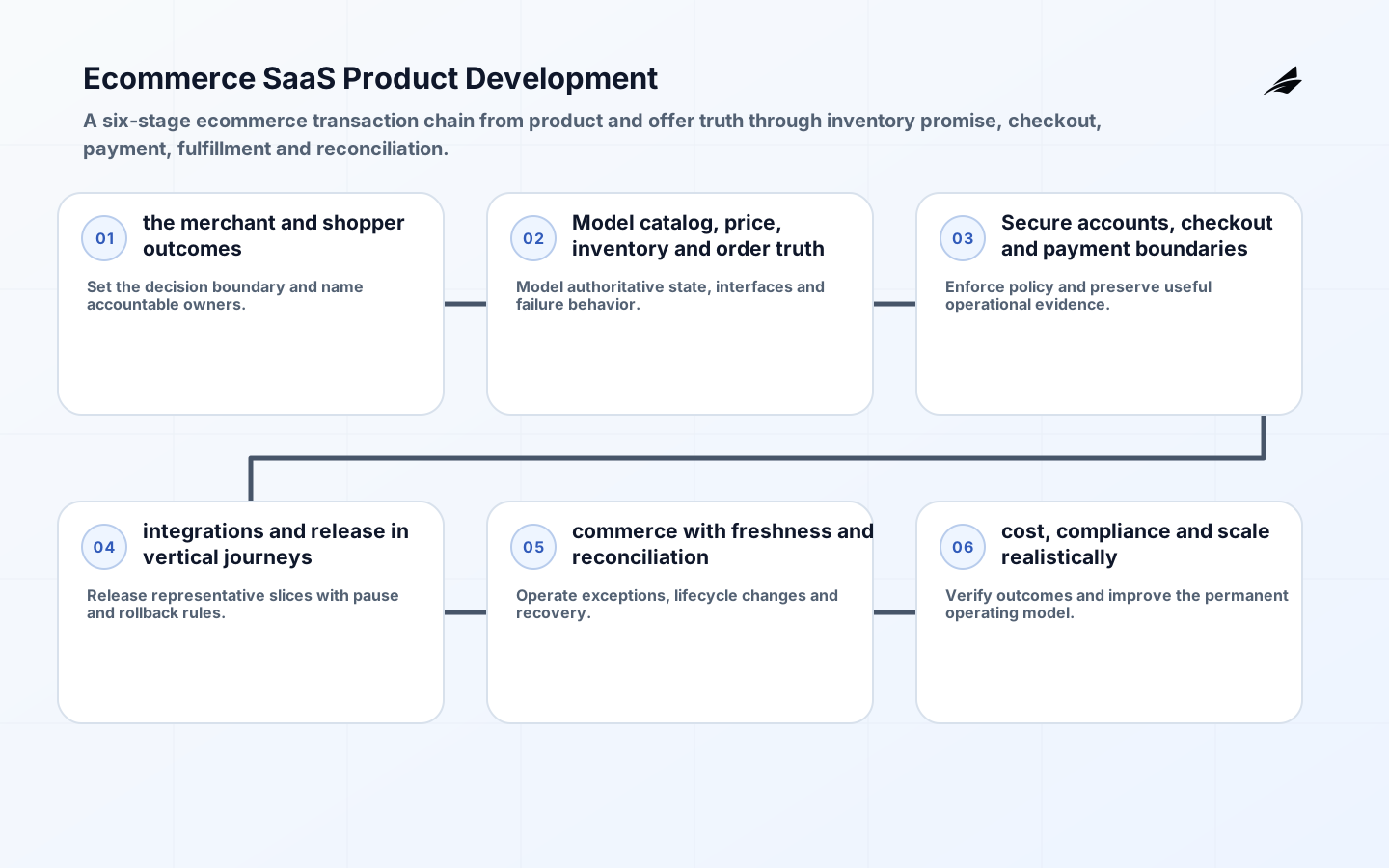
Define the merchant and shopper outcomes
Start by writing the decision or service outcome in one sentence and naming who depends on it. Define acceptable timeliness, accuracy, availability and recovery, then connect those measures to the user journey. For ecommerce saas product development, the most important boundary is which system owns each product, price, stock, order and payment state and how transitions are reconciled. State exclusions and assumptions openly. A requirement that cannot be observed or tested should be rewritten before it becomes architecture.
For ecommerce saas product development, map the actors, records, interfaces and suppliers that participate in the outcome. Include human approvals, scheduled jobs and support actions, not only interactive screens. Assign one accountable owner for the complete journey and technical owners for each component. Record who may accept risk, authorize a consequential change and declare recovery. This avoids a common failure in which every component is monitored but nobody owns the result seen by the customer or business team.
| Planning decision | Evidence required | Stop condition |
|---|---|---|
| Catalog truth | Field ownership and variant model | Same SKU means different objects |
| Inventory promise | Reservation and release rules | Concurrent carts oversell stock |
| Payment | Provider boundary and state machine | Redirect is treated as authorization |
| Order | Immutable commercial facts and event history | Manual repair cannot be audited |
Model catalog, price, inventory and order truth
Use stable identifiers for product, variant, offer, location, customer, cart, order, payment and fulfillment. Separate descriptive catalog data from sellable offers and inventory promises. Model money with currency and minor-unit discipline; preserve the price and tax basis accepted by the shopper. Keep identifiers stable across requests, events, logs and reports so an operator can reconstruct what happened without joining records by guesswork. Define source-of-truth ownership and synchronization behavior for every replicated field. If two systems may legitimately disagree, state which one controls each decision and how reconciliation occurs.
Represent order and payment lifecycles as explicit state machines. Webhook retries and delayed fulfillment events require idempotency and reconciliation. Never infer payment success from a browser redirect alone, and do not reduce a partial refund or split shipment to a single ambiguous status. Treat bulk operations and exceptional paths as first-class architecture. Preview target scope, enforce limits, make retries idempotent and preserve enough evidence to distinguish a repeated request from a new instruction. The design should remain understandable under partial failure; silent compensation and hidden manual repair make the apparent success rate unreliable.
Secure accounts, checkout and payment boundaries
Minimize payment-data scope with an appropriate validated provider and understand which merchant pages can still affect the transaction. Inventory payment-page scripts, authorize them and detect tampering according to applicable PCI DSS responsibilities. Enforce policy at the server or authoritative service boundary rather than trusting a browser, client-supplied role or display filter. Deny by default where consequence warrants it. Test horizontal access, stale membership, disabled accounts, background workers and support tooling because controls often differ outside the primary interface.

Protect customer and merchant administration separately. Require server-side authorization for store, market, order and refund actions. Test account takeover, coupon abuse, price manipulation, inventory races and cross-merchant access. Log the decision inputs, policy version, actor, target, outcome and correlation identifier while excluding secrets and unnecessary personal data. Alerts should represent violated expectations rather than raw event volume. Every high-severity alert needs an owner, a runbook and a tested escalation route. Evidence should support both immediate diagnosis and later review.
Build integrations and release in vertical journeys
Build one complete journey from product import and merchandising through checkout, payment, order routing, fulfillment event, notification, refund and accounting export. This reveals ownership gaps hidden by isolated feature demos. Build a representative vertical slice before expanding breadth. The slice should cross the real identity, data, integration and observability paths and include one failure and recovery scenario. Use production-like scale and policy where practical. A prototype that bypasses the hardest dependency proves interface design, not operational readiness.
Use test payment modes plus controlled production verification, representative catalogs and realistic stock contention. Release merchant cohorts progressively and preserve compatibility for themes, APIs, feeds and webhooks. Release through observable cohorts with explicit entry, success, pause and rollback rules. Compare technical signals with business outcomes and support contacts. Preserve configuration and data migrations in version-controlled, repeatable mechanisms. When an exception is approved, record its owner, reason, expiry and compensating measure rather than weakening the standard silently.
| Delivery gate | Minimum proof | Owner question |
|---|---|---|
| Checkout | Price, stock, tax and payment scenarios | Who owns a partial failure? |
| Security | Cross-merchant and payment-page tests | Can one tenant affect another? |
| Discovery | Structured-data and feed validation | Do page and feed facts agree? |
| Operations | Refund and inventory reconciliation | Can exceptions be closed without data edits? |
Operate commerce with freshness and reconciliation
Monitor catalog and feed freshness, add-to-cart and checkout errors, authorization decline categories, oversell, stuck orders, webhook age, refund completion and product-page crawlability. Separate customer behavior from system failure. Dashboards should answer what changed, who is affected, whether the result is trustworthy and what action is expected. Separate service health, data quality, security and business outcomes so one healthy aggregate cannot hide another failing dimension. Include freshness and coverage. A green chart built from delayed or incomplete data is a particularly dangerous failure mode.
Reconcile orders, payments, refunds, inventory and fulfillment against authoritative providers daily or more frequently according to volume. Queue mismatches for owned resolution instead of silently correcting financial records. Exercise routine and disruptive operations: onboarding, access change, configuration rollout, failed dependency, backup restoration, credential rotation, ownership transfer and retirement. Measure elapsed time and manual effort, then improve the runbook and automation. Operational acceptance belongs before broad launch because the first incident is an expensive place to discover missing authority or evidence.
Plan cost, compliance and scale realistically
Estimate by markets, channels, catalog complexity, integrations, traffic shape and operational volume. Include fraud tooling, payment fees, search, media, observability, support and merchant onboarding rather than only compute. Estimate cost from enduring operating work as well as initial delivery. Include data cleanup, integration change, testing, support, observability, security review, supplier coordination, migration overlap and exit. Distinguish fixed platform cost, variable usage cost and human operating load. An apparently inexpensive design can become costly when every new customer, site or workflow requires bespoke intervention.
Compliance scope depends on architecture and merchant obligations. Validate payment, privacy, tax, accessibility and consumer-protection requirements with accountable specialists; do not advertise a platform feature as universal compliance. Maintain a risk register with observable triggers and named treatment owners. Review concentration risk, unsupported dependencies, data-quality gaps, privilege accumulation, performance saturation and recovery uncertainty. Avoid false precision in cost or schedule estimates; give ranges, assumptions and decisions that would change the estimate.
Accept the platform through complete order journeys
Run successful, declined, timed-out, duplicated and abandoned checkout scenarios. Verify inventory reservation, order state, customer message and financial reconciliation for each. Acceptance should be demonstrated by a cross-functional team using representative data and identities. Require successful ordinary journeys, rejected unauthorized actions, controlled partial failure, reconciliation, observable recovery and export of required evidence. Sample reported totals against authoritative records rather than accepting dashboard agreement with itself.
Validate Product structured data in initial HTML where appropriate, crawlable product images, canonical variants, feed consistency and accessibility through keyboard and assistive-technology checks. Transfer ownership with maintained documentation, source and configuration access, alert routing, support procedures and a backlog of known limitations. Set a review date for assumptions and thresholds. A sustainable result is one the permanent team can explain, operate and improve without relying on the original project members for hidden context.
Review ecommerce saas product development: production implementation checklist as a living operating capability after launch. At each review, compare the documented boundary with production configuration, recent incidents, support work, supplier changes and measured outcomes. Sample evidence rather than relying only on aggregate status. Record decisions, owners and due dates, and retire controls or reports that no longer support a real risk or business need. This cadence keeps architecture, policy and day-to-day practice aligned as customer volume, integrations, regulations and team responsibilities change.
Key takeaways
- Assign ownership for every commerce fact and lifecycle.
- Use idempotent state machines for orders, payments and fulfillment.
- Keep payment scope and merchant administration tightly controlled.
- Validate shopper journeys, product discovery and accessibility together.
- Reconcile financial and inventory state continuously.
Frequently asked questions
What should an ecommerce SaaS MVP include?
One complete, supportable selling journey with catalog, price, stock, checkout, outsourced payment, order, notification, basic fulfillment and refund. Add fewer channels until state ownership and reconciliation are proven.
Does headless commerce improve scalability?
It can separate channel experience from commerce services, but it adds API, caching, preview, release and operational complexity. Choose it for a clear channel or team need, not as a default badge.
Does using a payment provider remove PCI DSS responsibility?
No. It may reduce scope, but merchant pages, scripts, integrations and service-provider validation can remain relevant. Confirm the exact payment flow and applicable assessment with qualified guidance.
How should product pages expose changing price and stock?
Keep visible page content, structured Product data and merchant feeds consistent and fresh. Use crawlable URLs and images, canonical variant rules and server-rendered initial markup where fast-changing facts need reliable discovery.
Conclusion
Professional ecommerce SaaS is an operational system of record, not a collection of storefront screens. A strong implementation connects catalog truth to stock promises, payment evidence, order transitions and fulfillment while protecting merchant boundaries and shopper trust. Complete-journey tests, explicit state ownership and continuous reconciliation create the foundation for adding markets, channels and merchants without multiplying hidden manual repair.