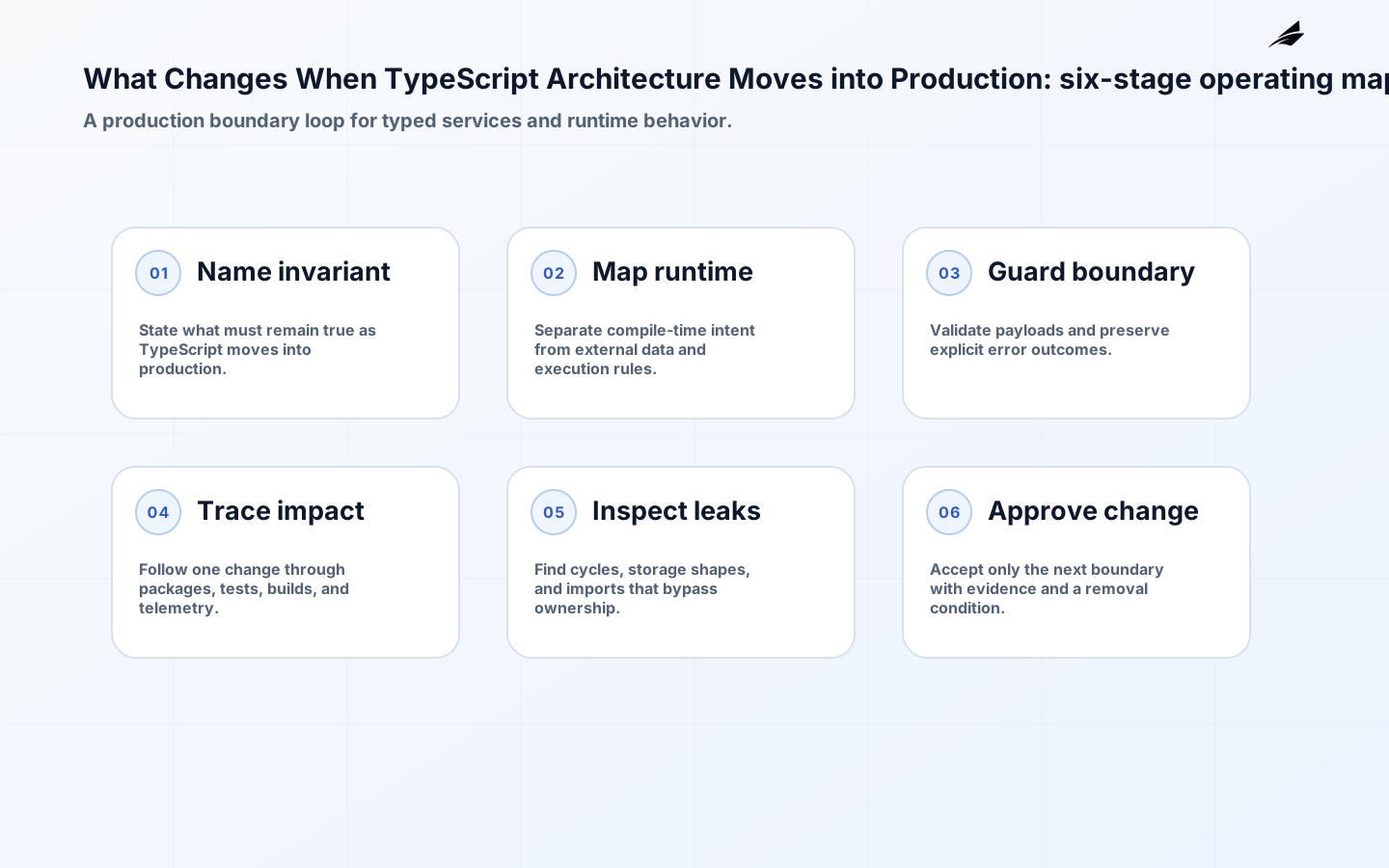
TypeScript architecture becomes a production concern when the codebase must outlive the people who made its first decisions. Type annotations can make local intent clearer, but they do not validate a network request, repair an unclear domain boundary, or decide who owns a breaking change. The architectural gain comes from using types to describe stable contracts, contain unreliable input, and make dependency direction visible. That distinction matters because a compile-clean system can still accept malformed messages, expose a data capability to the wrong caller, or tie every feature to a shared utility layer. Production TypeScript needs a model for both compile-time confidence and runtime behavior.
Place TypeScript types at meaningful boundaries
Begin by naming the boundaries where information changes trust level: browser input, HTTP requests, queue messages, files, database rows, third-party webhooks, and public package APIs. At each one, parse and validate actual values before treating them as a domain object. A TypeScript assertion or cast changes what the compiler believes; it does not change the value received at runtime. Keep the untrusted representation distinct from the validated representation, and return explicit errors that callers can act on. Inside a bounded domain, discriminated unions and narrow interfaces can make invalid states harder to express. At public edges, prefer deliberate versioned contracts over exporting internal implementation shapes that consumers will accidentally depend upon.
| Boundary | TypeScript role | Runtime responsibility |
|---|---|---|
| HTTP request | Describe the accepted command | Parse, authenticate, and validate input |
| Domain service | Model valid states and transitions | Apply authorization and business rules |
| Database adapter | Separate persistence shape from domain shape | Handle nulls, migrations, and failures |
| Public package | Expose a stable contract | Manage compatibility and release notes |
Use module structure to enforce dependency direction
Folder names alone do not create architecture. Decide which code may depend on which other code, then make that direction easy to see in imports and build configuration. A domain module should not reach into a web framework or database client merely because it is convenient; adapters can depend on the domain, while the domain accepts small interfaces for effects it needs. Keep shared packages genuinely small and cohesive. A giant common package often becomes a hidden second application that couples unrelated features. TypeScript project references can help large repositories split compilation into smaller projects, improve build behavior, and express logical grouping, but they should reflect an already understood dependency graph rather than mask a circular one.
- Can a domain decision be tested without starting the HTTP server or database?
- Does every external message pass through one parsing and validation path?
- Do dependency rules prevent UI, infrastructure, and domain code from importing each other freely?
- Are public types intentionally released and documented rather than leaked from internals?
- Can a new package be built and type-checked without compiling the entire estate unnecessarily?
Design TypeScript changes for compatibility
Structural typing makes it tempting to add optional fields casually, but production callers may serialize, persist, or interpret values differently than expected. Treat changes to request and event shapes as contract changes. Add fields with defaults where possible, accept old and new forms during a bounded transition, and publish a migration date for callers. For internal refactors, use compiler errors as a map, then review the semantic changes the compiler cannot see: authorization, ordering, retry behavior, and user-visible errors. Type-level tests and contract tests can protect intentional shapes, while integration tests show whether real adapters obey them. The goal is not maximum abstraction; it is a system in which a change has a legible blast radius.
| Change | Safer approach | Evidence before removal |
|---|---|---|
| Rename a public field | Accept both names and emit one canonical form | Consumers have migrated |
| Split a package | Publish a facade and move imports gradually | No callers use the old entry point |
| Tighten a union | Measure real values before rejecting old cases | Invalid cases have a correction route |
| Change a database shape | Map through an adapter during migration | Backfill and rollback are rehearsed |
Operate the runtime, not only the type checker
Production evidence should show where validation fails, which contract version is in use, and whether a change is increasing error rates or latency. Log structured, non-sensitive reasons for rejection and connect them to correlation identifiers so support can follow one request across services. Keep source maps and deploy identifiers available for diagnosis, but protect them as part of the delivery pipeline. The React state design guide is a useful companion for the client boundary: TypeScript can describe a state model, but UI ownership and async behavior still require deliberate design. Review dependency upgrades as operational changes too, especially when module resolution, emitted JavaScript, or supported runtime versions shift. Record the compatibility decision beside the release so a later maintainer can tell whether a failure came from application logic, a package change, or the runtime itself.
Keep TypeScript architecture legible in delivery
Architecture remains useful only when ordinary delivery reinforces it. Give code owners and reviewers a short way to ask boundary questions: has a transport shape leaked into the domain, is a dependency moving in the wrong direction, does a public type need a compatibility note, and what happens with an unexpected runtime value? Tooling can enforce import restrictions, unused exports, exhaustive switches, and package boundaries, but a failing rule should teach rather than become background noise. Build and test commands should work from a fresh checkout, and release automation should show the emitted artifact and target runtime. When a boundary must be crossed for a practical reason, record the exception and its cleanup condition. This keeps architectural intent available to the next engineer without requiring them to reconstruct it from a long history of pull requests.
Review TypeScript boundaries before release
- Identify every incoming value that changed shape and prove it is parsed at runtime before any cast, database operation, authorization decision, or downstream request relies on it.
- Check whether a newly exported type exposes persistence details, framework objects, or optional fields that consumers could treat as a lasting public guarantee.
- Trace imports from the changed module and question any new dependency that reaches across a domain, infrastructure, UI, or package ownership boundary.
- Run the compiled artifact on the supported runtime, because module resolution, emitted JavaScript, environment variables, and source maps are operational concerns beyond type checking.
- Test compatibility with an older caller or event producer when the change crosses a versioned boundary, including unknown fields, missing fields, and meaningful default values.
- Make validation failures observable with safe structured reasons, then review the signal after release to catch real input variants that were not represented in fixtures.
Prefer small architectural tests over broad assertions about style. A test that proves untrusted input cannot reach a domain command, or that a package cannot import an infrastructure adapter, protects a real boundary. Review those tests when the business changes, because an obsolete rule is as misleading as an untested assumption. Architecture should be a useful constraint on change, not a ceremony that obscures the code's purpose.
Reference material for production TypeScript
The TypeScript Handbook and project references guidance explain the language and build features behind these choices. Node's module documentation helps teams reason about runtime loading behavior, while OWASP's Input Validation Cheat Sheet reinforces the need to validate untrusted data. Together, they support a boundary-first approach rather than the unsafe assumption that a type annotation validates the outside world.
Prepare TypeScript architecture for production pressure
Production changes the meaning of a TypeScript architecture. A local type error is helpful, but production also brings malformed input, version skew, partial deploys, long-lived workers, and operators who need to understand the current state. Design the boundary so compile-time intent, runtime checks, telemetry, and rollback tell the same story. The system should fail in a way that preserves a useful next action.
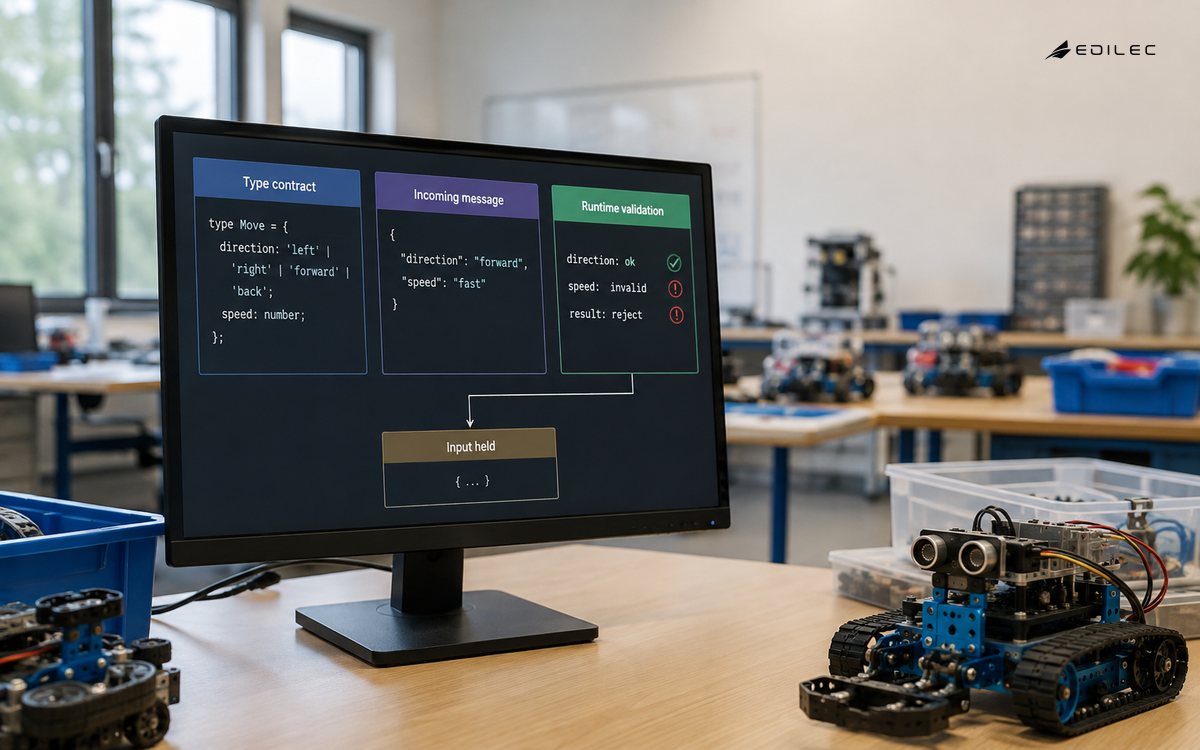
Keep contract types close to the boundary that owns them. An HTTP request, event payload, and database row may describe the same business concept while having different optionality and lifecycle rules. Convert explicitly rather than passing one shape through every layer. This makes migrations visible and prevents a provider’s accidental field or naming decision from becoming an internal invariant.
When deploying multiple versions, assume old and new code coexist. Add fields compatibly, tolerate unknown fields, and sequence data migrations so readers and writers overlap safely. For event-driven systems, version the event contract and make consumers observable. A TypeScript compile across one repository cannot prove compatibility with an already-running service or a stored message.
Runtime validation should produce an operational classification. Distinguish malformed external data, unsupported versions, authorization failures, and internal invariant violations. Include a correlation identifier and safe field-level context, then choose whether the message is rejected, retried, quarantined, or escalated. The classification determines the test and the dashboard; a generic “bad request” loses that information.
Use architecture fitness checks that match your production risks: dependency-direction rules, contract tests, strict compiler settings, migration rehearsals, and a sample of real payloads with sensitive values removed. Review failures as design feedback. If a check is routinely bypassed because it is too slow or noisy, fix the feedback loop instead of declaring the boundary optional.
| Pressure | Design response | Proof |
|---|---|---|
| Version skew | Compatible readers and writers | Mixed-version contract test |
| Untrusted input | Parse at edge | Invalid payload fixture and metric |
| Long-lived worker | Explicit lifecycle state | Restart and replay rehearsal |
| Dependency drift | Locked public contracts | Upgrade diff and consumer test |
TypeScript architecture takeaways
- Validate actual values at every trust boundary.
- Model domain states separately from transport and persistence shapes.
- Use dependency direction and project references to reflect real ownership.
- Treat public type changes as compatibility work.
- Monitor runtime rejection and contract-version signals after release.
For a related decision, compare this approach with What Changes When React State Design Moves into Production, What Changes When Caching Strategy Moves into Production, What Changes When Software Modernization Moves into Production. In a production TypeScript service, each adjacent article treats a different boundary; use the links to test whether the same ownership, evidence, and recovery expectations hold in the surrounding system.
What Changes When TypeScript Architecture Moves into Production FAQ
What is the first decision for what changes when typescript architecture moves into production?
For production typescript architecture: contracts, runtime checks and safe change, begin by naming the user or operational outcome, the accountable owner, and the evidence that will show whether the outcome is safe. In a production TypeScript service, that boundary determines the smallest useful first implementation and gives the team a shared test for scope.
How should a team handle failure in what changes when typescript architecture moves into production?
In production typescript architecture: contracts, runtime checks and safe change, classify each failure by its next safe action: correct, retry, reconcile, escalate, or stop. In a production TypeScript service, preserve state and a correlation record so a person does not guess whether the first attempt took effect, especially when the boundary can create an external side effect.
When is the implementation ready to expand?
Expand production typescript architecture: contracts, runtime checks and safe change after a representative path works with realistic data, known exceptions, observable ownership, and a rehearsed recovery. In a production TypeScript service, a larger rollout should add confidence, not conceal unresolved ambiguity in a wider queue.
Conclusion: operate what changes when typescript architecture moves into production with evidence
The durable version of what changes when typescript architecture moves into production is not the one with the most components. In a production TypeScript service, it is the one whose promise is explicit, whose boundaries are understandable, whose failure states preserve a safe next action, and whose evidence reaches the people responsible for the result. In a production TypeScript service, start with one complete path, measure what users and operators actually experience, and let observed risk decide where the next investment belongs.