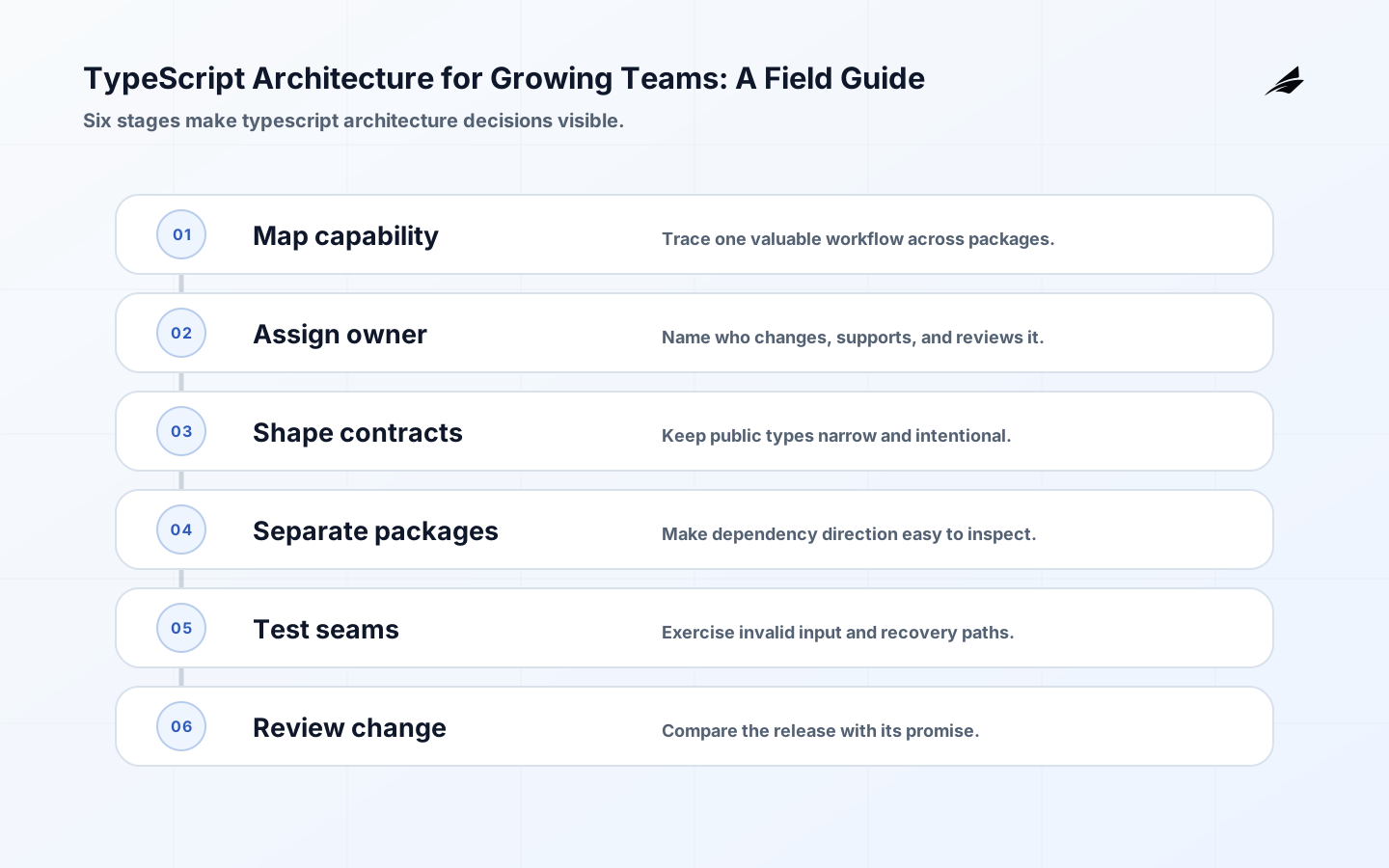
Growing teams usually feel architecture pain first at import boundaries and shared data shapes. A checkout change unexpectedly affects reporting; a package exposes a database type to a browser; two teams interpret “active” differently. Start by mapping dependencies around one high-value capability, then move business rules behind a small domain-facing interface. Use project references or package boundaries when they make ownership and build behavior clearer, not as decoration.
Make the TypeScript architecture decision explicit
Write a short decision record for TypeScript architecture. State the outcome it protects, accountable owner, trusted inputs, rule that produces an outcome, and behavior when a required fact is unknown. Important concerns include runtime validation, trusted models, dependency direction, and buildable projects. This gives product, engineering, security, and operations one object to challenge. It also separates a genuine boundary from an implementation preference, so a later tool change does not quietly change the service promise.

| Question | Decision to record | Evidence to retain |
|---|---|---|
| Scope | Which users, callers, records, or workflows are affected? | Named owner and affected path. |
| Compatibility | What behavior remains stable during change? | Examples and contract tests. |
| Failure | What happens when input or dependency is uncertain? | Runbook and observable outcome. |
Set package boundaries before implementation
Treat TypeScript architecture as a boundary design exercise. Put validation where untrusted information enters, authorization where consequential work begins, and durable evidence where an action cannot simply be repeated. Common failure modes are any-shaped input, circular dependencies, shared internal types, and hidden configuration. A diagram is not enough: tests should exercise malformed or late input, loss of a dependency, and the human correction route. Make private details difficult to depend on and public behavior easy to inspect in examples, tests, and logs. The TypeScript handbook’s project references provide a concrete build-boundary model when packages need independent ownership and compilation.
- Name who can change the TypeScript architecture contract and how exceptions expire.
- Keep authority, validation, and irreversible actions at explicit boundaries.
- Define how retries, partial completion, and correction affect the final outcome.
- Review the boundary when a new consumer, privilege, or data class appears.
Build TypeScript architecture for inspection and change
A dependable implementation uses narrow public vocabularies, project references, and reproducible generated code. Prefer a small public surface with examples that clients, operators, and reviewers can test. Keep business policy separate from transport, framework, or storage details so it can be exercised without recreating the environment. Make the happy path, denied path, and recovery path equally explicit. For sensitive data, minimize what crosses the boundary and retain only the audit evidence needed to explain a result. This narrows the blast radius of a change and makes reversibility a property of design.
| Design concern | Practical control | Review prompt |
|---|---|---|
| Contract | Published examples, validation, and change policy. | Could an independent consumer use this safely? |
| State | One authority for consequential facts. | What proves which value is current? |
| Recovery | Bounded retry and correction evidence. | Can an operator repair this without guessing? |
Operate the TypeScript architecture path as a product
Instrumentation should follow the complete outcome, not just process health. For TypeScript architecture, monitor type-check time, validation failures, dependency cycles, artifacts, and release IDs. Correlate a request or trigger with the decision, side effect, and recovery action while avoiding unnecessary personal data. Define who acknowledges an alert, what evidence they inspect first, and which action is safe under pressure. Periodic incident review should ask whether the system lacked context, an ownership boundary, a test, or a recovery control. That feedback informs the next design decision. NIST’s Secure Software Development Framework is a useful release-control reference for turning ownership, verification, and correction into repeatable practice.
Release a boundary slice with evidence
Use a reversible first release for TypeScript architecture: start with a narrow path, define acceptance signals, and keep a correction mechanism available while the team learns. Compare real outcomes with a baseline rather than judging the change from implementation effort. The related guide A Field Guide to React State Design for Growing Teams is a useful companion because adjacent engineering choices often share identifiers, ownership, and failure behavior.
- State the first reversible slice and the people or systems it affects.
- Define acceptance signals before enabling broader traffic.
- Keep rollback or a correction route available during the learning period.
- Record the decision, evidence, and follow-up owner after each release gate.
Apply practical controls to TypeScript architecture
Types should clarify responsibility at a boundary, not spread speculative abstractions through a codebase. Parse unknown input into a validated form, represent domain invariants with narrow types, and return explicit results for expected failure. Keep runtime schema validation close to the wire because a static type assertion cannot protect a deployed service from malformed JSON or configuration. Expose package types only when they are a supported contract; otherwise hide them behind functions or domain commands. This lets compiler guidance reinforce, rather than replace, design judgment. For API-facing packages, OWASP’s API security risks keep validation, authorization, and exposure concerns visible at the boundary.
Create a working agreement for TypeScript architecture
Review architecture by following a real request from input to side effect. Can a reader identify which module validates it, which policy decides it, which adapter persists it, and which test proves the behavior? If not, improve the vocabulary or dependency direction before adding a framework. Build configuration deserves the same care: strict settings, aliases, generated types, and project references should be reproducible in CI and locally. A reliable build is a collaborative interface, especially when several teams change the same workspace. Bazel’s dependency guidance reinforces the value of making dependency edges explicit and reviewable.
Use evidence to govern TypeScript architecture
Good governance for TypeScript architecture is lightweight but specific. Before a consequential change, name the expected result, the signal that will show it, the person who can decide whether to expand, and the condition that requires a pause. During release, preserve a before-and-after record of the relevant behavior rather than relying on memory. After release, compare actual outcomes with the original assumption and make the follow-up visible. This approach does not eliminate uncertainty; it prevents uncertainty from becoming invisible work for support, security, and the next engineering team.
Evidence should be useful to different people without exposing more data than they need. A product owner may need adoption and completion rates, an operator needs correlation and failure context, and a reviewer needs the changed contract and tests. Give each audience a deliberate view of the same operating reality. When a measure moves unexpectedly, investigate the user path and system boundary before declaring success or failure. That habit turns TypeScript architecture from a one-time project into a maintained capability with accountable decisions.
Choose the next TypeScript architecture improvement
Choose the next improvement by reducing the uncertainty that most affects real work. Prefer a narrow control, test, or observability change that can be completed and evaluated over a broad redesign with no intermediate proof. Keep the decision reversible where possible, invite the people who operate the path into the review, and state what will be retired when the new behavior is trusted. In TypeScript architecture, disciplined small steps create durable progress because each step leaves behind a clearer contract and better evidence for the one that follows. Related guidance includes TypeScript architecture for founders, monorepo structure for growing teams, and technical debt in production.
Key takeaways
- TypeScript architecture succeeds when its contract is clear to builders and operators.
- A small observable release creates better information than a broad untested launch.
- Compatibility, security, and recovery are design responsibilities, not release-day chores.
- Use metrics and real failures to revise assumptions rather than defend an initial plan.
Frequently asked questions (FAQ)
Architecture quality is visible in change review. Ask whether a developer can locate the rule, run the narrow test, understand the affected consumers, and roll back the release without reading the entire repository. If the answer is no, record the specific boundary that failed. A focused boundary improvement is easier to fund and verify than a broad promise to reorganize the codebase. When should a team invest in TypeScript architecture? Invest when the current approach creates repeated risk, manual effort, unclear ownership, or blocked product change. Start with the outcome that matters to users or operators and choose controls that can be observed. A fashionable pattern is not enough; the decision should explain which constraint it removes and what responsibility it introduces. This keeps investment proportional and lets the team defer work that is merely hypothetical.
For TypeScript architecture, document package boundaries, runtime validation points, public types, build configuration, and generated-code source. A developer should be able to trace a value from untrusted input to a trusted domain model without guessing.
For growing teams, architecture earns its keep when a new contributor can make a safe change without private historical knowledge. Provide one small example per public boundary, show the rejected and recovery paths, and keep package ownership close to the code that enforces it. Review dependency changes for blast radius before they land, especially when a shared utility reaches browser, service, and data-access packages. The goal is not maximum isolation; it is a codebase where responsibility, build behavior, and change impact can be explained in one sitting.
Conclusion
TypeScript architecture becomes durable when it is treated as an operating commitment. Make the boundary visible, test the promise consumers depend on, release a reversible slice, and retain evidence for repair. Those habits give teams room to move quickly without quietly transferring today's uncertainty to the people who must support the system tomorrow. Keep revisiting TypeScript architecture as the product, its integrations, and its operating conditions evolve; a current decision is more valuable than a perfect but forgotten initial design. In TypeScript work, that means making runtime validation and package contracts visible wherever values cross a trust or ownership boundary.