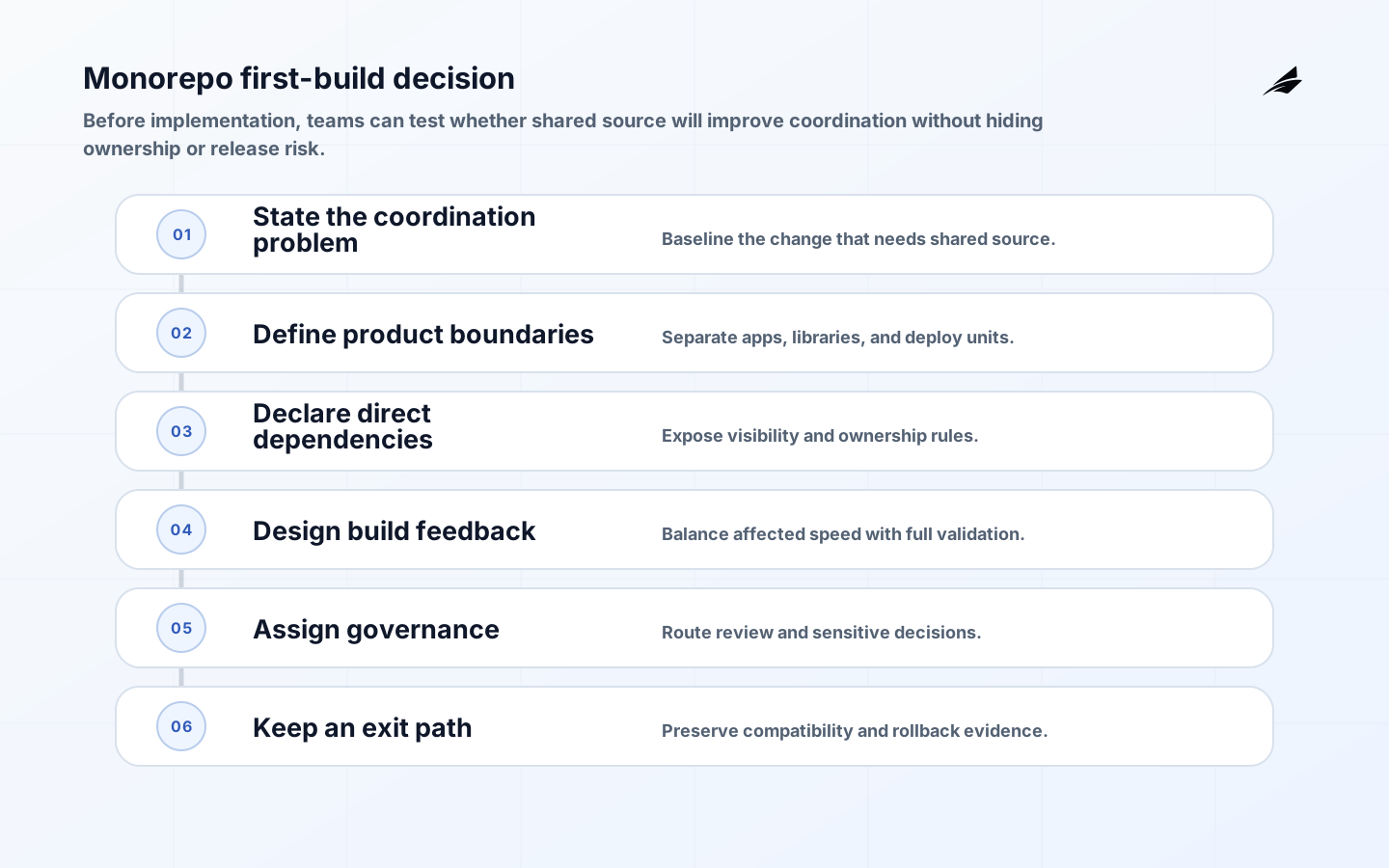
The monorepo structure decision is an operating choice made before a repository contains enough history to reveal its costs. The promise is attractive: one change can update an API, client, shared type, and test in one review. The risk is equally practical: unrelated teams inherit the same build queue, private code becomes importable, and no one knows which package owns a contract. An IT manager or engineering lead can make the decision useful by requiring evidence about coordination, ownership, build scope, and release responsibility before a folder layout becomes permanent.
Frame the decision around a representative change rather than a diagram. Ask whether one team must update several deployable units atomically, whether shared code is truly governed as a product, and whether the organization can support dependency and review hygiene. Compare the result with internal tool UX decisions, a field guide to Node.js APIs, event-driven systems for growing teams, and TypeScript architecture in production. Those adjacent topics often reveal whether the proposed repository boundary is real.
State the coordination problem in plain language
A credible decision record names the products, teams, shared contracts, and change patterns that justify a common repository. It also says what the repository will not solve. It will not automatically fix unclear domain ownership, incompatible release schedules, missing test data, or a poor local development experience. NIST’s Secure Software Development Framework is a helpful reminder that source protection, review, dependency management, and release evidence remain lifecycle responsibilities regardless of repository shape. If the expected benefit is faster coordinated change, define a baseline for the current coordination cost.
| Question | Decision to record | Evidence to retain |
|---|---|---|
| Why one repository? | Which recurring change crosses current boundaries? | Recent example and baseline time. |
| Who owns it? | Which team approves each package or contract? | Owner map and review route. |
| What is shared? | Which exports are intentionally reusable? | Public surface and consumer tests. |
| What can release together? | Which units share compatibility or deployment? | Version and rollout rule. |
| How is it tested? | Which checks run for each change class? | Affected graph and clean-run sample. |
Set product and package boundaries before implementation
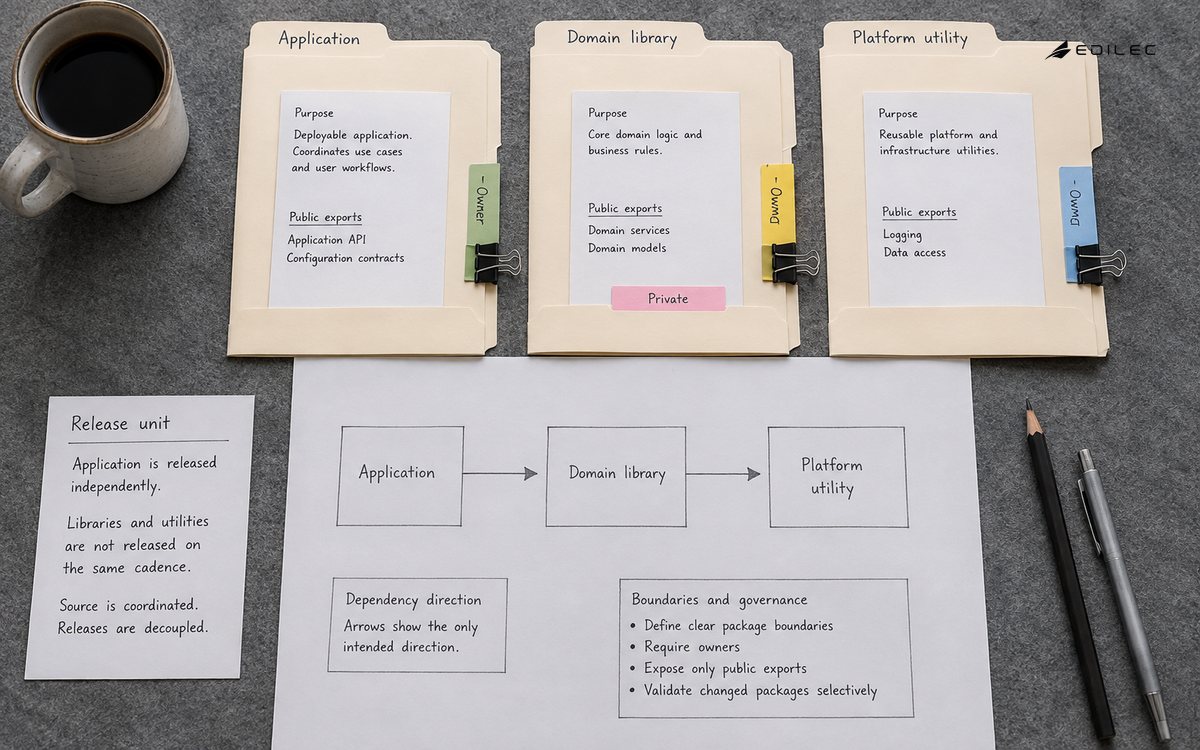
Separate deployable applications, domain libraries, platform utilities, test fixtures, and generated artifacts. Give each package one purpose and a named owner. Decide whether the repository exposes source paths or published-like entry points; the latter usually makes consumers depend on an intentional surface. Use CODEOWNERS or a similar rule to route sensitive changes, but do not treat an automatically requested reviewer as proof of good architecture. A package that can be imported by every application may be public by accident. Write the allowed dependency directions and identify the few exceptions that require explicit approval.
Make direct dependencies and visibility reviewable
A build can succeed while a package relies on a transitive dependency that another package happens to expose. That hidden relationship becomes a breaking change when the intermediary is refactored. Bazel’s build reference offers a useful vocabulary for targets, attributes, visibility, and declared relationships; apply the principle even if your JavaScript tool uses different names. Require packages to declare direct dependencies, keep private modules private, and fail CI when a consumer reaches through an internal path. Review dependency additions for runtime, licensing, security, and ownership implications rather than treating them as install commands.
Use build boundaries to control feedback
The first build should be predictable before it is optimized. Define separate compilation or test units, then connect them with an explicit graph. TypeScript Project References can support incremental builds and clearer project relationships for TypeScript code. Measure a clean checkout, an application-only edit, a shared-library edit, and a generated-schema edit. If every change runs everything, the structure may need better graph information; if a narrow change skips a required integration check, the graph is incomplete. Preserve both fast feedback and periodic full validation.
Assign governance without creating a permanent queue
Not every change deserves the same approval path. Let a team own its application, require maintainers for shared packages, and route security-sensitive or public API changes to specialists early. The OWASP API Security risks reference reinforces why inventory, authorization, and object-level boundaries matter; a shared repository can make an API easier to find without making its consumers safer. Define service levels for reviewers, a substitute owner, and an escalation path. An approval rule that no one can meet will produce bypasses rather than better assurance.
- Who can add a new shared package and what evidence is required?
- Who approves a breaking export or a change to authentication or authorization code?
- Which team responds when a shared build or dependency blocks several products?
- How does a new maintainer learn the package contract and release rule?
- What happens when a package has no active owner or its consumers disagree?
- Which repository signals trigger a design review rather than another build optimization?
Make release coupling a conscious trade-off
A monorepo enables atomic source changes, but it does not require all products to deploy together. Decide whether versioning is coordinated, independent, or mixed. If a shared package changes, state which consumers must be rebuilt, which can adopt it later, and what compatibility window exists. Record migration steps for database schemas, generated clients, and background workers. A single commit may still need a staged release. Review the release unit with the teams who operate it, because repository convenience should not create an outage or a large rollback surface.
Build the first slice and keep an exit path
Start with one cross-project workflow that has visible pain and a credible owner. Inventory commands, dependencies, deployment artifacts, secrets, test fixtures, and release gates before moving code. Preserve the old build or repository as a fallback until the new path proves the same outcome. Compare review wait, clean-build time, affected-test precision, release coordination, and incident diagnosis. If the slice does not improve the intended measure, document why and adjust or stop. A monorepo decision is reversible only when the team keeps package contracts and deployment ownership clearer than the source layout itself.
| Decision risk | Control to add | Evidence that changes the decision |
|---|---|---|
| Unrelated products become coupled | Define product roots and independent release rules. | Cross-product rollback or queue incidents. |
| Shared library grows without boundary | Require owner, API surface, and consumer tests. | Export growth and breaking-change frequency. |
| Affected build is incomplete | Run clean full builds on a cadence. | Missed test or production defect. |
| Review becomes a gate | Use tiered owners and response targets. | Review age, bypass, and escalation patterns. |
| Migration cannot be reversed | Keep parallel release and data compatibility steps. | Unresolved rollback dependency. |
Review the repository after the first build
After the first few releases, review whether the repository is producing the promised coordination. Useful signals include percentage of changes that touch multiple products, affected-test precision, clean-build frequency, cache correctness, review response time, dependency churn, package ownership gaps, and emergency release coupling. Read the signals by change class; a shared type edit should not be compared with a documentation edit. Use the review to add one boundary rule or remove one unnecessary ceremony. The objective is a repository that helps teams decide, not a scorecard that rewards more packages or more tooling.
Hold a decision review before migration
Invite the people who will live with the repository rather than only the group proposing it. Ask a product owner to describe the cross-project outcome, an application team to describe the local release, a platform owner to explain build and cache evidence, and a security or operations owner to identify sensitive paths. Walk through one normal change and one rollback. If the conversation stays at the level of folders and tools, bring it back to a user-visible outcome, a dependency decision, or an operator action. The review is successful when it narrows uncertainty, not when every participant becomes an advocate for the same layout.
Record unresolved questions with owners and dates. A missing package owner, an unclear data migration, or an untested build edge is not a reason to hide the risk in a later phase. It is a reason to bound the first slice. Keep a no-go outcome available when the evidence says that separate repositories, a published package, or a smaller shared workspace would be safer. This discipline protects the team from investing in a structure whose main benefit is that it postpones a hard ownership decision.
Key takeaways
- Name a recurring cross-boundary change and baseline its cost.
- Define application, library, platform, fixture, and generated-artifact ownership.
- Require direct dependencies, explicit exports, and enforceable direction rules.
- Separate fast affected feedback from periodic clean and full validation.
- Document which packages release together and how a staged migration rolls back.
- Review the structure from operating signals, then tighten, grow, or split it deliberately.
Monorepo structure FAQ
When is a multi-repository model a better choice?
Prefer separate repositories when products have unrelated ownership, release schedules, access boundaries, or technology lifecycles and rarely need atomic changes. A monorepo can still work, but it must earn its shared coordination cost with concrete evidence.
Does a monorepo require one build?
No. A common source repository can contain independent build and deployment units. The important design is the dependency and compatibility graph, along with the checks that prove a change’s actual impact.
Who should own shared packages?
Give each shared package a named maintainer with a public contract, review path, and support expectation. If nobody can explain the package’s user and outcome, it may be a private implementation that should not be shared.
Conclusion
The right monorepo structure is the one that makes coordinated change safer without hiding who owns the result. Decide from real cross-project work, enforce package boundaries, measure affected validation, and keep releases and recovery visible. A clear decision record gives the team permission to adopt a monorepo when it helps and the discipline to stop when it does not.