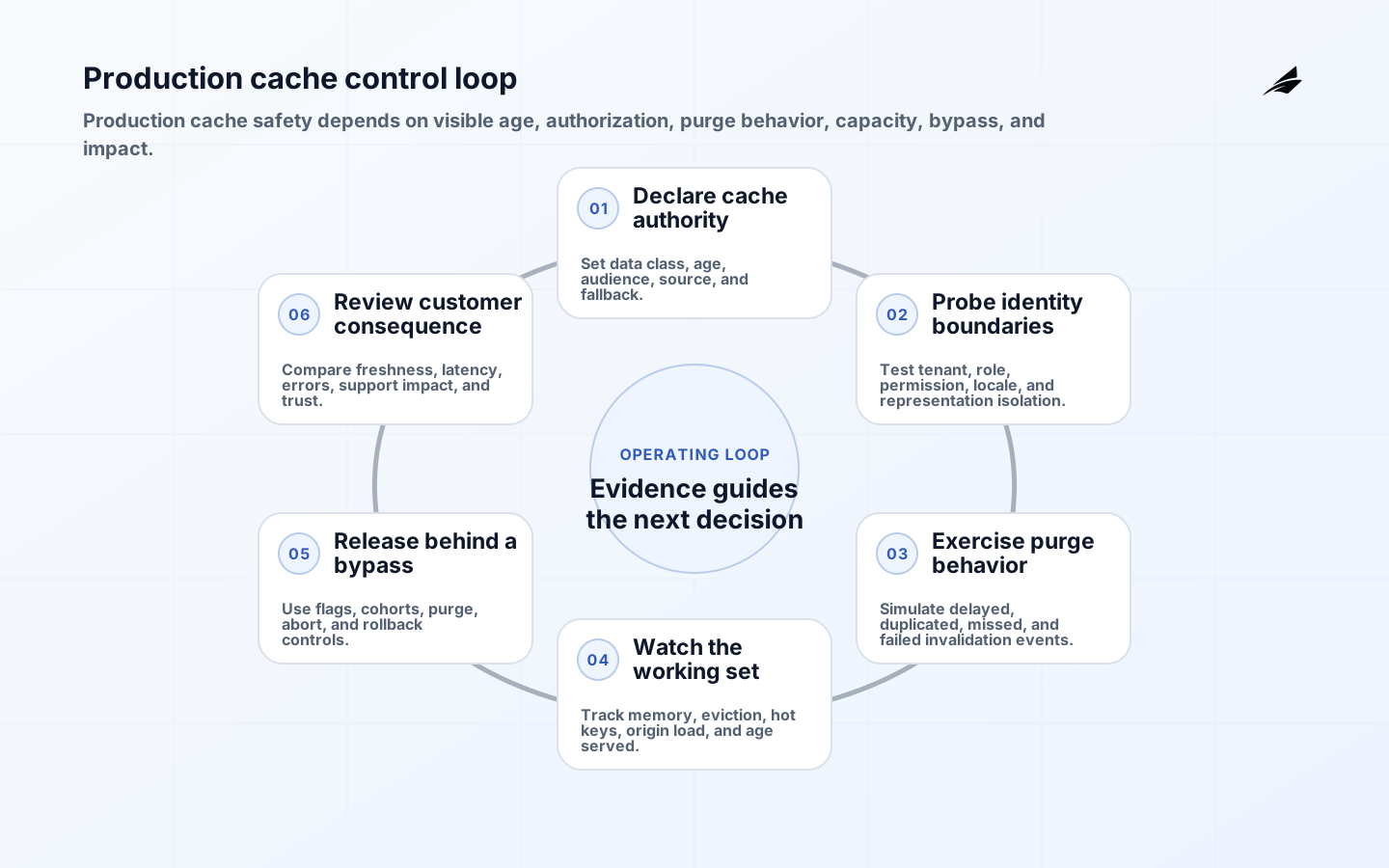
When a caching strategy moves into production, it becomes a correctness and operations change. A cache miss can increase origin load; a hit can return a representation that is old, scoped incorrectly, or no longer authorized. Production design therefore needs more than a TTL and a dashboard. Define the value being reused, the audience, the freshness promise, the invalidation event, the capacity envelope, and the safe behavior when the origin or cache is unavailable. RFC 9111, Redis eviction guidance, and AWS ElastiCache best practices provide concrete references for HTTP reuse, memory pressure, and managed-cache operations.
Define the production purpose
Compare the baseline with a concrete target: lower tail latency on a read-heavy route, fewer expensive origin calls, or a bounded availability improvement during a dependency outage. Capture the business cost of old data. A product description and an entitlement decision may both be read frequently, but they do not have the same tolerance for staleness. OWASP’s REST Security Cheat Sheet reinforces that authorization and cache behavior must be considered together. Record the authority, audience, lifetime, fallback, and owner for each cached representation. This classification prevents a successful experiment on harmless content from being copied into a consequential workflow.

| Contract | Decision | Operational proof |
|---|---|---|
| Freshness | Maximum acceptable age | Age histogram by response class |
| Scope | Tenant, user, role, locale | Key review and isolation test |
| Invalidation | TTL, purge, version, revalidation | Event and purge audit |
| Fallback | Origin, stale, empty, or error | Failure drill with owner |
Make scope and authorization testable
Cache keys must encode all response-changing inputs. Test tenant, user, role, locale, currency, feature flag, and representation version combinations. Never rely on a later UI filter to protect a shared cached response. Review headers, logs, and metrics for sensitive values. When permissions change, decide whether existing entries are purged, versioned, or made unusable through a short lifetime. OWASP’s REST guidance is a useful companion for checking authentication, authorization, and information disclosure around the endpoint that the cache accelerates.
Rehearse invalidation and revalidation
Production events are delayed, duplicated, and occasionally lost. Test a write followed by an immediate read, an out-of-order update, a retry, a failed purge, and a cache restart. If stale-while-revalidate is allowed, show the age and ensure the refresh is bounded. If stale-on-error is allowed, document which actions may not use it. Versioning can make releases safer but can temporarily double capacity. The rule is simple: every freshness choice needs a failure story and a way for an operator to see what happened.
| Scenario | Expected result | Abort signal |
|---|---|---|
| Cold cache | Origin remains within capacity | Queue or tail latency spikes |
| Hot key | Requests coalesce or are bounded | Origin stampede |
| Missed purge | Stale window stays within contract | Critical data remains old |
| Cache outage | Bypass or degraded mode works | Requests fail without recovery |
Operate capacity and eviction
Measure working set, object size, churn, hit ratio by class, evictions, memory pressure, network, and hot keys. AWS recommends treating cache capacity and connection behavior as operational concerns, not afterthoughts; the same principle applies to any provider. Redis eviction policy changes which values survive pressure, so select it from measured access patterns. Set alerts on symptoms that affect users, not only utilization. A full cache, a slow cache, and an empty cache can all produce different origin failure modes.
Release with evidence and a bypass
Use a feature flag, progressive traffic, a purge or version switch, and a documented bypass. Compare cache-on and cache-off cohorts for latency, error, freshness, and business outcomes. Keep enough correlation to explain a request without recording personal data. Update runbooks, on-call ownership, and incident alerts before expansion. If a cache cannot be disabled safely, its rollout is incomplete. After the first week, review whether the measured benefit remains when workload, content, and deployment conditions change.
- Treat every cached result as a copy with an explicit correctness contract.
- Test scope with multiple identities and permission changes.
- Rehearse delayed, duplicated, missed, and failed invalidation.
- Measure age, evictions, origin fallback, hot keys, and customer impact.
- Provide bypass, purge, rollout, and rollback controls.
- Review the cache as a service dependency with a named owner.
Caching strategy takeaways
Production caching changes what users see and what operators must recover. Make freshness, scope, invalidation, capacity, fallback, and evidence explicit. Roll out gradually and preserve a bypass. The production standard is not a high hit ratio; it is a service that remains correct and explainable under change and failure.
Production cache incident guidance
When users report old availability, first classify the problem: wrong key, missed purge, delayed origin, permitted stale mode, or cache outage. Compare one response with the authority, inspect age and version, identify affected cohorts, and bypass only the unsafe route. Repair or replay the event, purge the affected version, and verify agreement before restoring traffic. A post-incident review should add a test for the real failure and improve the runbook. It should also answer who owns the source data, the invalidation consumer, and the customer promise. Production caching is ready when the team can contain a correctness issue without guessing or flushing the whole estate.
Production-cache decision signals
Production readiness includes an incident walkthrough. First identify whether old data came from a wrong key, missed invalidation, delayed origin, allowed stale mode, or cache outage. Compare a response with authority, inspect age and version, and identify affected tenants before bypassing only the unsafe action. Reconcile the invalidation event or replay it, retire the affected representation, and confirm source agreement before restoring traffic. Do not flush a shared cache without estimating the origin surge. After recovery, add a test for the exact failure, update the alert, and check that source-data, event-consumer, on-call, and customer-communication owners are named. Ask whether stale data could authorize an irreversible action; if so, change the contract rather than only shortening TTL.
A production incident walkthrough
Use the incident record to distinguish an identity-key defect from a missed purge, delayed origin, permitted stale mode, or cache outage. Check one response against authority, inspect age and version, identify affected tenants, and bypass only the unsafe action. Next repair the event consumer or replay its durable record, invalidate the affected representation, and confirm agreement with the source. Do not flush a shared cache without estimating the origin surge. Close the review by adding a test for the exact failure, updating the alert, and naming source-data, event-consumer, on-call, and customer-communication owners. If stale data could authorize an irreversible action, change the contract instead of merely shortening TTL.
A production cache incident walkthrough
Imagine an availability page begins showing an old supplier value after a catalog update. The first response is classification, not a blanket flush. Check whether the key omitted a tenant or representation dimension, whether an invalidation event was delayed or dropped, whether the origin was slow, whether stale-on-error was allowed, or whether the cache itself is unavailable. Compare one cached response with the authoritative record, inspect its age and version, identify affected tenants and actions, and bypass only the unsafe route. If checkout rechecks authority, display may be degraded while purchase correctness remains protected; if the cache controls an entitlement or irreversible action, traffic must return to the source. Reconcile the event stream, invalidate the affected representation, and confirm source agreement before restoring traffic. Do not flush a shared estate without estimating the resulting origin surge. Add a test for the real failure, an alert for age beyond contract, and a runbook naming the data owner, invalidation consumer, on-call responder, and customer communicator. A production cache is ready only when the team can explain what was served and why, then demonstrate a safe route back to authoritative behavior.
| Decision | Evidence to collect | Stop or change when |
|---|---|---|
| Scope | Representative workflow, owner, and measurable baseline | The boundary or outcome remains ambiguous |
| Safety | Negative, failure, recovery, and permission scenarios | A critical state has no tested response |
| Operations | Telemetry, runbook, capacity, and escalation | No named owner can respond |
| Release | Cohort, rollback, comparison, and acceptance record | The result cannot be compared with baseline |
Production rollout should be cohort-based. Start with one representation, one tenant group, and a bypass flag. Baseline origin latency, error rate, request volume, payload size, memory, eviction, hot keys, and correction work. Test cold start, warm read, simultaneous misses, expiry, purge, restart, permission change, malformed data, and origin timeout. Define an abort threshold before exposure increases. Compare cache-on and bypass cohorts for customer latency, freshness age, errors, and business outcome. Review whether a stale copy can be used during an outage, and make that decision per action rather than per endpoint. A short TTL does not repair a wrong key, unsafe sharing, or missed invalidation; it only bounds part of the stale window.
Which cache signal deserves the next action?
Have the cache owner, data owner, and service owner inspect the evidence together. For production caching, let freshness, failure, and rollout observations determine the next decision instead of using feature volume as a proxy.
Caching strategy FAQ
Can production serve stale data during an outage?
Sometimes, but only when the data class and user action allow it. Define the maximum age, show or log the degraded state, and prohibit stale answers where they could authorize an unsafe or irreversible action.
What if invalidation fails?
Make failure visible, retry safely, bound the stale window, and provide a purge or version control. A silent failed purge is a correctness incident waiting to happen.
Which metric matters most?
Use a set: customer latency and errors, freshness age, origin relief, hit ratio by class, eviction, invalidation success, and recovery time. No single cache metric represents service quality.
Conclusion
The move to production is where caching becomes accountable. Tie reuse to a clear data contract, test identity and invalidation, operate capacity deliberately, and keep a reversible rollout path. That discipline turns a performance technique into a dependable service capability.