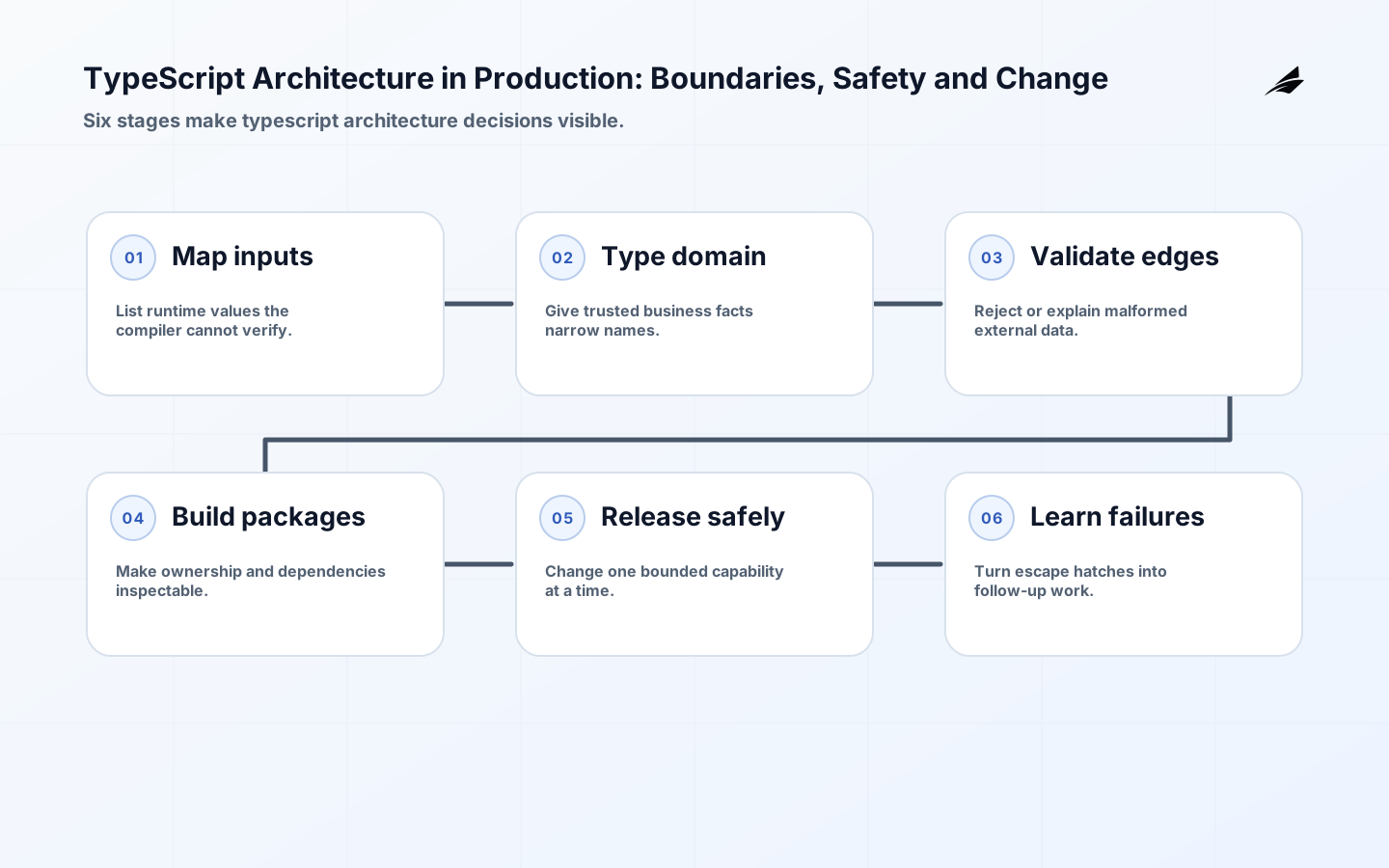
Production changes the TypeScript architecture conversation because compile-time confidence now meets runtime inputs, deployment boundaries, and independent team ownership. A request body, queue message, environment variable, or database row can still violate an interface. Keep validation at those edges, map external data into domain types, and avoid letting an inferred type become a claim about reality. The most valuable architecture rule is often the simplest: unsafe values are converted once, near the boundary, and trusted only after the conversion succeeds.
Define the typescript architecture boundary
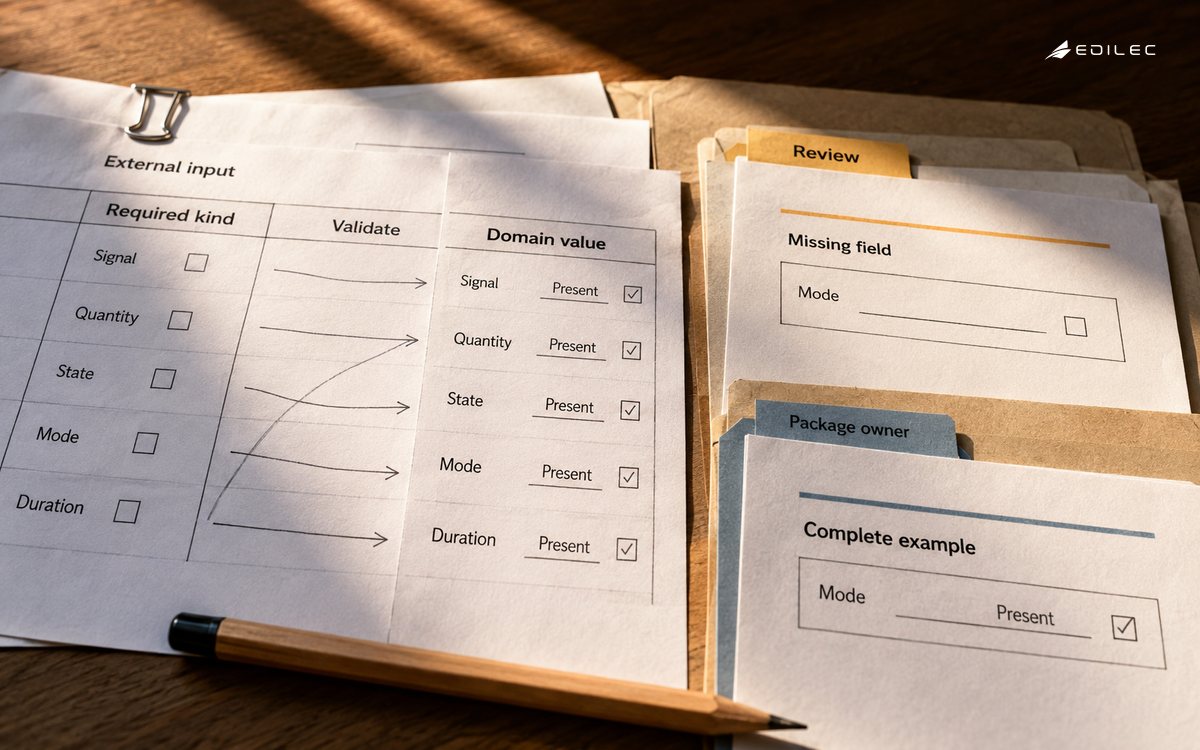
Production TypeScript architecture begins at the boundary between values the compiler can trust and values arriving from users, networks, queues, databases, or configuration. Types describe an internal expectation; they do not validate runtime data. Define modules that own parsing and validation, then pass narrow, meaningful domain values inward instead of letting untrusted shapes leak through the application.
| Decision area | Question to settle | Evidence to keep |
|---|---|---|
| User outcome | Which task does typescript architecture make safer or faster? | A named journey and success measure. |
| Authority | Which record, policy, or team decides the result? | Owner and reference for the rule. |
| Boundary | What is promised, and what is deliberately out of scope? | A concise contract with examples. |
| Recovery | What happens when work is delayed, denied, or ambiguous? | A recovery rule and escalation owner. |
Make typescript architecture behavior explicit
Use strict compiler settings as a design aid, not as a badge. Model absence, error outcomes, and state transitions directly rather than defeating them with assertions. Public package APIs should export stable contracts while keeping implementation types private. When a service crosses a process boundary, pair TypeScript types with a runtime schema and an explicit compatibility policy.
Use authoritative material as an anchor for the underlying mechanism, then write the local product decision in plain language. TypeScript Handbook and TypeScript strict option are useful starting points because they distinguish protocol or platform capability from the contract a particular team must operate. The implementation should leave an engineer, operator, and affected user able to answer the same questions: what happened, which rule applied, and what can happen next.
Design typescript architecture for failure and recovery
Unsafe casts and broad any types often hide until a production integration returns a field in an unexpected form. Instrument validation failures with a safe correlation reference, reject invalid data before irreversible work, and decide whether an unknown value is a user-correctable error, a retryable upstream condition, or an incident. A compile-successful build is not proof that its inputs are safe.
| Condition | Safe system behavior | Owner response |
|---|---|---|
| Invalid or unexpected input | Reject or isolate it before a durable side effect where possible. | Give a correctable explanation or review route. |
| Repeated work | Recognize the same business intent without creating a duplicate outcome. | Return or reconcile the existing record. |
| Slow dependency | Bound waiting and preserve the state needed to resume. | Observe consequence and escalate by impact. |
| Uncertain completion | Do not imply success without durable evidence. | Reconcile against the authoritative record. |
Deliver typescript architecture in controlled steps
Adopt stricter settings incrementally where a wholesale change would block delivery. Start with a bounded package or request path, remove one class of unsafe assumptions, and preserve behavior with tests. Keep generated types and API clients versioned with their source contracts. This allows a team to improve safety while still shipping value, rather than creating a permanent branch for a theoretical perfect type system.
Observe the typescript architecture outcome
Review compiler escape hatches, runtime validation failures, build duration, dependency boundaries, and error rates by operation. A rising count of any casts near integration code is an architectural signal. The same is true when on-call responders cannot identify which external payload produced a failure because the system discarded context too early.
Instrumentation should support a decision, not merely collect activity. Combine the system signal with the user or business reference that explains its consequence. The guidance in TypeScript narrowing and Node.js TypeScript can inform the technical choice, but the team still needs thresholds, an on-call response, and a review cadence appropriate to this product. Keep those decisions close to the code and rollout record so they survive a handoff.
Common typescript architecture traps
Do not model every business concept as a deep generic abstraction. Types should clarify ownership and legal states for the engineers who maintain the code. Prefer a small number of well-named domain types, explicit adapters at boundaries, and tests of runtime behavior over elaborate declarations that obscure the actual control flow.
Implementation checkpoints for typescript architecture
Before broad rollout, write one representative normal example, one denied or invalid example, one delayed or repeated-work example, and one operator recovery example. Assign a technical owner and a business owner where the change affects a durable record. Review whether monitoring can distinguish a healthy request from a completed outcome. These checkpoints make typescript architecture concrete enough to test without turning delivery into a paperwork ritual.
Use relevant connected reading when the next design question crosses a boundary. What Changes When React State Design Moves into Production, What Changes When Caching Strategy Moves into Production, What Changes When Software Modernization Moves into Production, How It Managers Should Think About Authentication Flows provide adjacent engineering context, but only link a reader toward the decision they need to make next. The decisive evidence remains the behavior of this system with representative data, real permissions, and a recovery route that has been exercised.
Use typescript architecture evidence to decide the next step
A boundary test for a TypeScript service can begin with a queue message that has an unknown field, a missing discriminator, and a valid business identifier. The parser should report the invalid shape safely, while the domain layer never receives a value it cannot interpret. Then test the same message after a schema addition. This shows whether the code uses types to clarify compatible evolution or merely relies on a cast that postpones failure until an unrelated branch.
Strictness improves through ownership, not a single cleanup sprint. Track each temporary escape hatch to the integration or module that owns it, add a reason and removal condition, and reduce the most consequential ones first. That approach lets a team retain delivery pace while making every boundary more explicit and every runtime failure easier to classify.
TypeScript architecture takeaways
- Start typescript architecture from a specific outcome, owner, and source of authority.
- Write behavior for normal, denied, delayed, repeated, and ambiguous conditions.
- Make a narrow release observable before expanding it.
- Keep recovery evidence connected to a durable business reference.
- Use standards to inform the implementation, then document the local decision.
TypeScript architecture FAQ
Use a small migration to test the architecture. Move one capability behind a typed service boundary, turn on strict checks for its packages, and track the failures by category: missing null handling, implicit any, incompatible data shapes, or import cycles. That inventory tells leaders whether the next investment is code cleanup, contract clarification, or team training. It also gives the rollout a measurable finish line beyond “the build is green.” Where should a team start with typescript architecture?
Start with one valuable journey where failure would be costly, confusing, or slow to recover. Map the user, the authoritative record, the permission boundary, the dependency, and the current fallback. Then state one testable promise for the successful outcome and one for recovery. This gives typescript architecture a useful initial boundary instead of an abstract platform ambition.
What counts as enough proof before expansion?
The team should be able to demonstrate representative behavior, identify ownership, detect a failed outcome, and run the recovery route without improvising during an incident. Automated checks matter, but pair them with rollout observation, support feedback, and reconciliation when a durable side effect matters. Evidence should become stronger as the cost of a wrong result increases. For typescript architecture, that proof should cover the boundary most likely to create an incorrect or unrecoverable outcome.
Do tools or standards solve the operating decision?
No. A framework, specification, or dashboard can make a sound practice easier to repeat, but it cannot decide acceptable delay, data authority, access limits, or customer consequence for this product. Use tools to make the chosen rule visible and testable. Keep a named owner responsible for revisiting the rule when the workflow, traffic, or risk changes. In typescript architecture, make the tool output traceable to the owner and decision it is meant to support.
A boundary inventory should distinguish defects that change runtime behavior from cleanup that only improves maintainability. A missing null check on an external response is an immediate correctness risk; a duplicated internal alias may be a useful follow-up once the contract is stable. Rank findings by user consequence, frequency, and ease of containment. Preserve the original payload when investigation requires it, but expose only the validated domain value to downstream code. This gives teams a practical order for modernization and prevents a large compiler migration from hiding the few unsafe edges that matter most in production.
Conclusion: make typescript architecture accountable
Strong typescript architecture makes the route from intent to outcome understandable. It defines a promise, exposes the conditions that threaten it, and leaves enough evidence for the next engineer or operator to act with confidence. Start small, prove the difficult path, and let observed use shape the next increment. That is how a useful engineering practice becomes dependable production software.