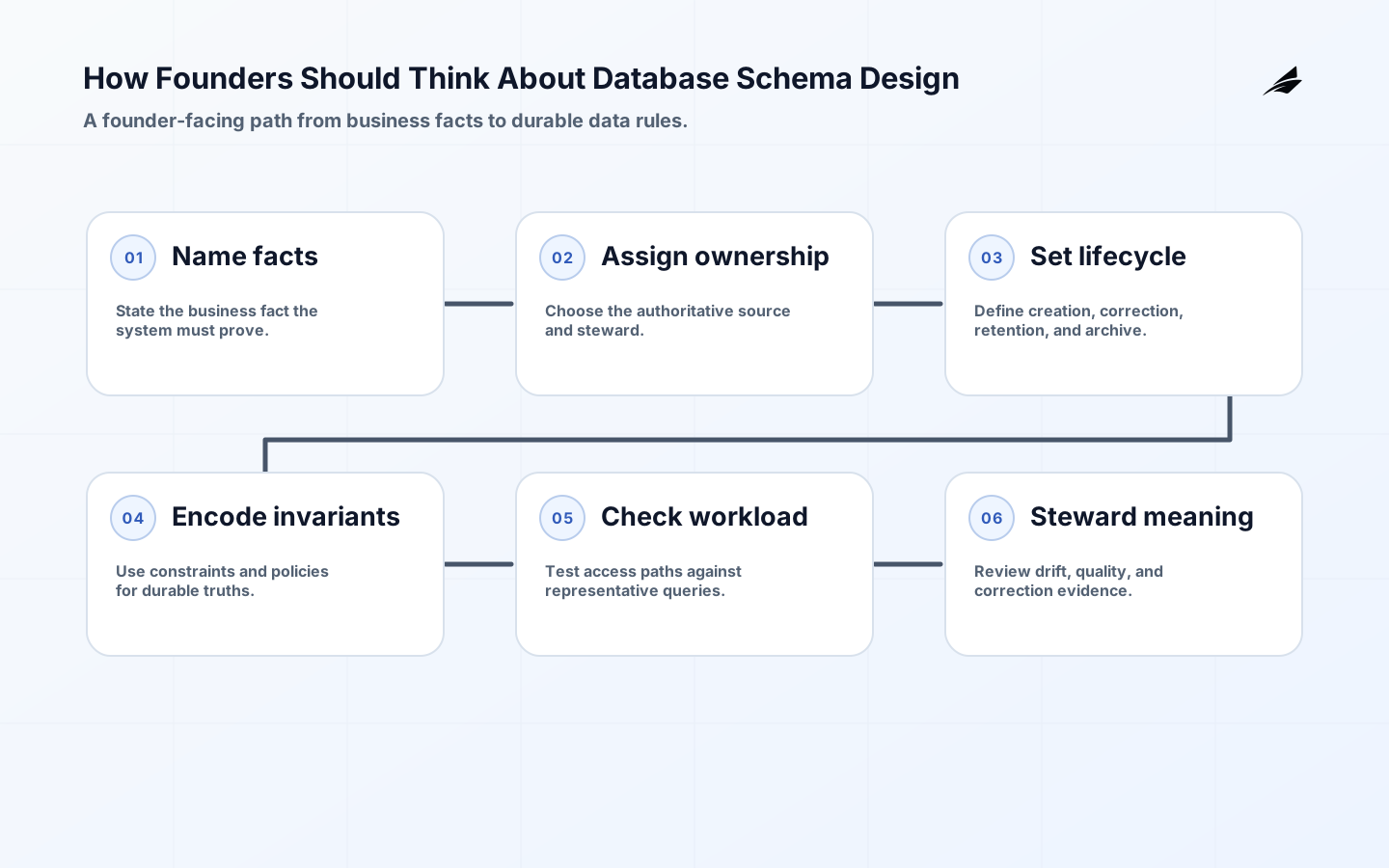
Database schema design matters when a fast-growing product needs to support invoices, refunds, and customer corrections, but the original schema stores a current balance without a trustworthy history of how it changed. This guide is for founders who need to make database schema design a product decision about facts, invariants, history, and change rather than a one-time table diagram. The planning unit is a business fact with identity, lifecycle, owner, integrity rule, retention need, and access pattern. Schema design should preserve ownership evidence.
Start with the fact the product must prove
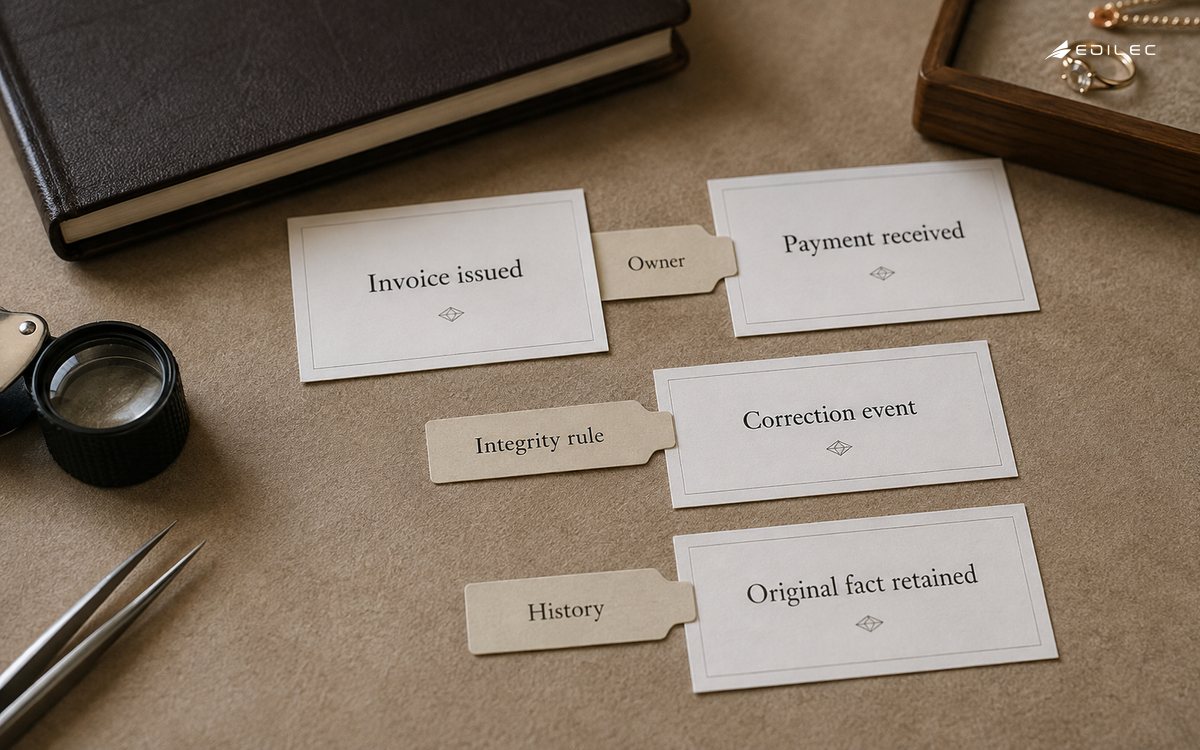
Database schema design is where a product decides what it will be able to prove later. A current balance, status, or permission can be convenient, but a founder should ask how it was derived, who was allowed to change it, and how a correction will be explained. Start by naming business facts and their lifecycle. “Invoice issued” and “payment received” are different facts even if a screen displays one combined account state.
| Question | Working rule | Evidence to collect |
|---|---|---|
| Outcome | Name the decision or task that must improve. | a fast-growing product needs to support invoices, refunds, and customer corrections, but the original schema stores a current balance without a trustworthy history of how it changed |
| Authority | Identify who owns the fact and who may change it. | a business fact with identity, lifecycle, owner, integrity rule, retention need, and access pattern |
| Risk | Describe the costly failure before selecting technology. | adding columns for each new screen without modelling invariants, migrations, historical meaning, and the queries that operations must run |
| Measure | Choose a signal that can change the next investment decision. | migration duration and rollback readiness, constraint violations, query plans for critical paths, data-correction volume, reconciliation differences, and restore-test results |
Map entity authority and stewardship
Choose identifiers that survive the real life of the product. A database primary key may be an internal implementation detail, while a public reference needs a stable format, an ownership rule, and a clear relationship to imported or merged records. Do not rely on a display name or a mutable email address as the only identity. Make tenant boundaries explicit in keys and queries where the product serves multiple organizations.
Schema design should preserve dependency direction. Schema design should preserve release cadence. For adjacent implementation concerns, read What Changes When Database Schema Design Moves into Production, What Changes When Caching Strategy Moves into Production, and Test Strategy for Custom Software. Schema design should preserve affected-target tests.
| Boundary | Decision to make | Operational check |
|---|---|---|
| Input | Define identity, required fields, and validation responsibility. | Can an invalid database schema design request be rejected with a useful reason? |
| Authority | State the source of truth and who can override it. | Can a reviewer explain which record or rule produced the database schema design result? |
| Change | Version behavior that clients, users, or operators rely on. | Can the team deploy a compatible change and observe its effect? |
| Recovery | Give failures an owner, reference, and safe next action. | Can support resolve a disputed case without an unsafe workaround? |
Design one lifecycle and its evidence
Put durable invariants where they cannot be skipped by one application path. The PostgreSQL constraints documentation covers not-null, unique, primary-key, foreign-key, and check constraints. Use them for facts that must hold regardless of which worker or admin tool writes the row. Application validation remains valuable for good messages and richer rules, but it cannot replace integrity protection when several writers exist.
Model history deliberately. Some domains need immutable events, some need effective-dated records, and most need a way to correct an error without pretending the original observation never happened. Record what the business means by “updated”: was the underlying event corrected, was a new policy applied, or did a reviewer override a value? This is the difference between a schema that supports an audit conversation and one that creates a reconciliation mystery.
- Write one database schema design decision record with owner, boundary, and success condition.
- Collect ordinary, invalid, delayed, and contradictory examples before estimating broad scope.
- Assign an accountable operator for exceptions and a named escalation path.
- Schema design should preserve ownership evidence.
- Test the recovery path as deliberately as the successful path.
- Review migration duration and rollback readiness, constraint violations, query plans for critical paths, data-correction volume, reconciliation differences, and restore-test results after the first release before expanding the design.
Choose constraints that preserve delivery
Indexes serve access patterns, not table aesthetics. PostgreSQL notes that indexes can make retrieval faster but add write overhead. Measure the slow or frequent queries that matter to a user journey, inspect plans with realistic data, and select indexes that match filtering and ordering. Avoid adding an index simply because a column sounds important. Each one changes write cost, migration risk, storage use, and the maintenance burden.
Translate database guidance into workload tests
Schema design should preserve contract versioning. Useful references include PostgreSQL constraints documentation, PostgreSQL indexes documentation, PostgreSQL transactions documentation, PostgreSQL backup documentation. Schema design should preserve migration checkpoints. In this database schema design context, turn the guidance into concrete configuration, review evidence, and runbooks that a team can use during a release or incident.
Track correctness, latency, and repair
Schema migration is production work. Expand first when possible: add compatible structures, deploy code that can read both forms, backfill under control, verify counts and behavior, then contract after callers have moved. A transactional migration is not necessarily a safe migration if it locks a busy table or produces a long replication delay. Rehearse on representative data and define the compensating action before declaring the change routine.
Backups and restores are part of design because retention has no value if the team cannot recover the facts it needs. Test restore procedures, document ownership, and protect sensitive data in copies used for development and troubleshooting. Review the schema after a real support case: could the team answer what happened without a manual data patch? If not, make the next change improve the model, not merely the report.
Key takeaways
- Database schema design should begin with a real operational decision, not an abstract technology preference.
- Use a business fact with identity, lifecycle, owner, integrity rule, retention need, and access pattern as the unit of planning and review.
- Make authority, change behavior, and recovery visible before scaling a design.
- Schema design should preserve dependency direction.
- Let migration duration and rollback readiness, constraint violations, query plans for critical paths, data-correction volume, reconciliation differences, and restore-test results determine whether the next increment is justified.
Frequently asked questions
What is the smallest useful scope for database schema design? Choose one schema-backed workflow with a named owner, durable facts, and an explicit correction route. Schema design should preserve rollback evidence. It does not need to centralize every adjacent process.
When should a person intervene? A data owner should decide when a proposed schema change weakens an invariant, changes historical interpretation, or needs a manual correction. The decision should include migration evidence and a plan to protect existing records.
How do we know the design is ready to expand? Add schema scope after migrations are rehearsed on representative data, integrity constraints protect the intended facts, and restore tests support the recovery objective. More tables do not by themselves create a reliable data model.
Conclusion
Database schema design becomes a durable advantage when the team designs the decision, authority, evidence, and recovery path together. For a fast-growing product that needs to support invoices, refunds, and customer corrections while the original schema stores only a current balance, keep the first change narrow enough to observe and use real operating signals to guide the next investment. Schema design should preserve review scope.
Define facts, lifecycles, and owners
Begin with facts the business must be able to defend: who owns an account, which order was accepted, what amount was charged, and which event changed a status. Write those facts as nouns and transitions before choosing table names. A schema that mirrors the current screen can work for a prototype, but it often hides history and makes corrections ambiguous. A founder-friendly design makes the source of truth visible so product decisions can change without silently rewriting the past.
| Decision | Choose first when | Evidence to keep |
|---|---|---|
| Boundary | The outcome has one accountable owner. | Named owner, input and success condition. |
| Fallback | A dependency can be slow, unavailable or wrong. | Visible state, retry rule and escalation path. |
| Change | The system will learn or scale after launch. | Migration, review cadence and stop condition. |
Balance integrity with query cost
Use constraints to protect invariants at the database boundary. A unique constraint can prevent two active subscriptions for the same plan; a foreign key can stop an orphaned line item; a check constraint can reject a negative quantity where the domain disallows it. Application validation still matters for helpful messages, but it should not be the only guard. The database is the last shared witness when multiple workers, retries or imports write at the same time.
Choose indexes from real access paths. If the first workflow lists a tenant’s open orders by updated time, index that tenant and status pattern; do not add an index for every column because indexes also consume storage and make writes more expensive. Review query plans with representative data before a launch. Keep a short record of why each important index exists and which request or report would regress if it were removed.
Test migrations against real data
Plan for change with additive migrations, backfills and reversible releases. Add a nullable field, write both representations while readers are compatible, backfill in controlled batches, then enforce the new invariant and remove the old path later. Test backups by restoring them, not by trusting a successful job log. For a founder, that discipline is a growth advantage: it keeps a product’s core facts recoverable while the team learns what the market actually needs.
| Signal | Healthy question | Action when it drifts |
|---|---|---|
| Outcome | Did the intended business result happen? | Inspect examples and pause unsafe scope. |
| Reliability | Can the path recover from delay or duplication? | Use retry, replay or manual review controls. |
| Ownership | Can a named person explain the current state? | Route the exception and update the runbook. |
Schema design gives database entities a durable boundary, live-traffic migration guidance shows how that boundary behaves under load, and technical-debt review helps decide when a shortcut deserves repayment. Use the linked guides to connect a modelling choice to its production consequence.
A useful schema proposal names the business fact, its owner, its lifecycle, and the evidence needed to change it safely. Start with one consequential workflow; add broader entities only after queries, corrections, and retention obligations are observable.