Database schema design becomes production engineering when a table is no longer an implementation detail. Its constraints protect business rules, its indexes set the cost of common questions, its records support audits and recovery, and its changes must coexist with running application versions. A schema that looks tidy in an entity diagram can still permit duplicate payments, lose the meaning of a historical decision, or lock a critical table during a release. Start with the facts the organization must preserve and the invariants that must always hold. Then choose data types, keys, constraints, relationships, access rules, and migration steps that make those rules enforceable where they need to be enforced.
Express database invariants close to the data

An invariant is a rule that remains true despite bugs, retries, concurrent requests, or incomplete application deployments. Examples include one active entitlement per account and plan, a payment reference that cannot be duplicated, a child record that must have a valid owner, or a balance that cannot cross a stated boundary without a recorded adjustment. Application validation improves the user experience, but it cannot be the only defense when several workers or services write the same data. PostgreSQL documentation describes not-null, unique, primary-key, foreign-key, check, and exclusion constraints; choose the narrowest control that expresses the rule. Do not invent a constraint that only appears to work under current rows while future operations can violate the underlying assumption.
| Invariant | Schema mechanism | Application complement |
|---|---|---|
| A value is required | NOT NULL | Clear field-level validation |
| A business key is unique | UNIQUE constraint or index | Conflict response and reconciliation |
| Relationship must exist | FOREIGN KEY | Deliberate deletion policy |
| Value is within a row-level rule | CHECK constraint | Domain error explanation |
Model ownership, time, and history deliberately
Separate facts that have different owners or lifecycles. An order, payment attempt, invoice, and entitlement may be related, but merging them into one mutable status column makes correction and audit difficult. Record stable identifiers, creation and change times where needed, source of a state change, and the relationship between a command and its resulting records. Avoid storing derived totals as an unquestioned source of truth when they can drift; if a materialized value is needed for performance, document its refresh and reconciliation rule. Temporal requirements deserve specific design: a current address is not the same thing as the address used for a historical invoice. Decide what must remain reconstructable before retention, deletion, and anonymization policies make that answer impossible later.
- Which record is authoritative for this business fact?
- Can two writers create a contradiction under normal concurrency?
- What identifier connects a retry to the original command?
- Which historical values must remain explainable after a customer changes data?
- Which deletion, retention, and access policy applies to each sensitive field?
Release schema changes through compatible migration stages
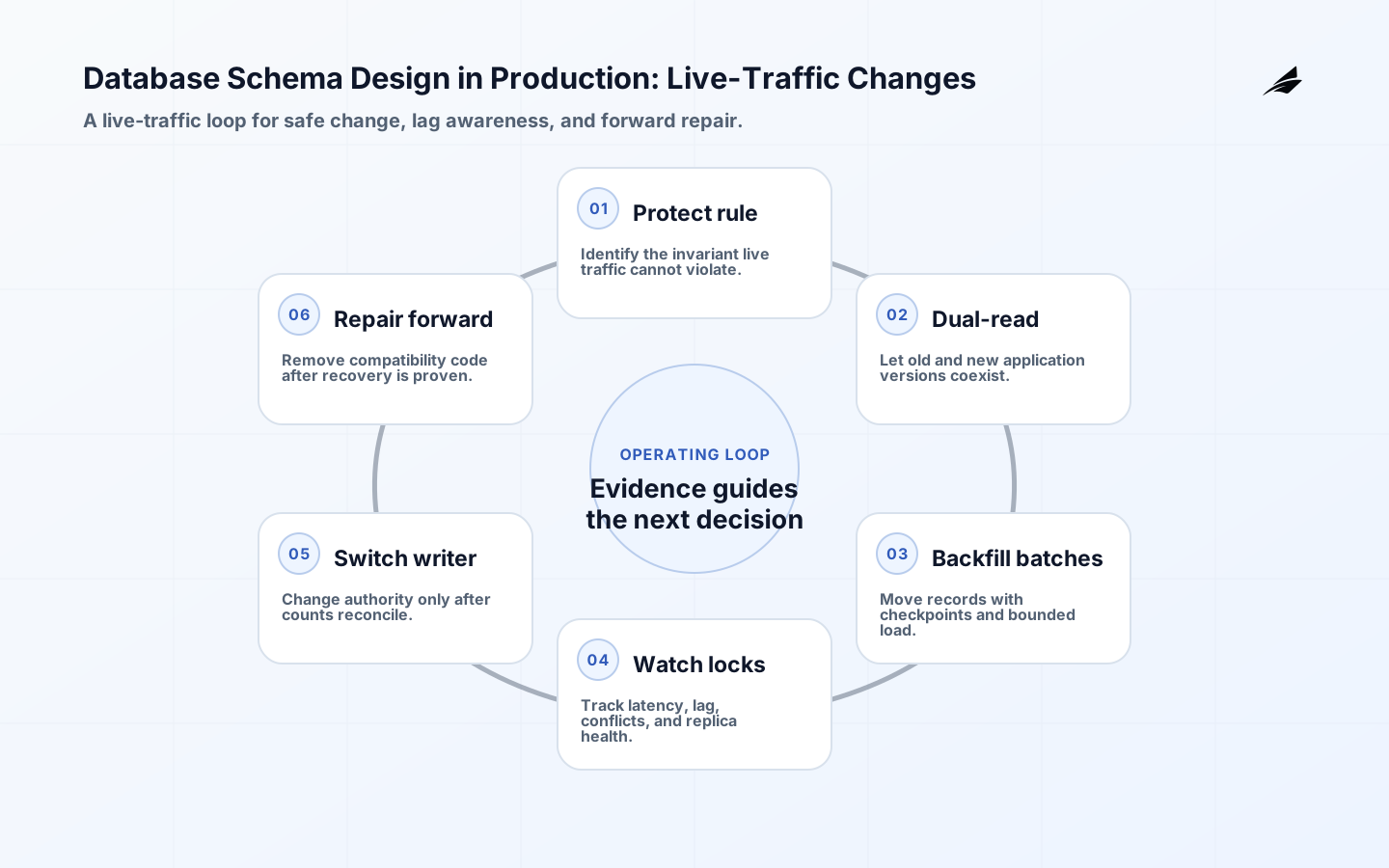
Treat a migration as a distributed deployment across application versions, jobs, analysts, and integrations. An expand-and-contract pattern is usually safer: add a nullable column or new table, deploy code that can read both representations, backfill in measured batches, validate results, switch writers and readers, then enforce the final constraint and retire the old route. Test with production-like volume and locking behavior; a correct statement can still cause unacceptable contention. For a risky transformation, define a stop condition, backup or restore route, and reconciliation query before execution. Never rely on a rollback that cannot undo data mutations or that conflicts with a newer deployment. The migration plan should name the owner who decides whether evidence is sufficient to progress.
| Migration phase | Purpose | Guardrail |
|---|---|---|
| Expand | Add compatible schema | Old application version continues working |
| Backfill | Populate new representation | Batch, monitor, and make rerunnable |
| Verify | Compare source and target | Use reconciliation queries and samples |
| Switch | Move reads and writes | Observe errors and latency |
| Contract | Remove obsolete structure | Confirm no remaining dependency |
Secure data access and performance together
Indexes should follow observed access patterns, not an instinct to index every column. Every index adds write, storage, and maintenance cost, so measure query plans and real latency before declaring a performance problem solved. Use parameterized queries and least-privilege accounts; OWASP stresses that prepared statements separate code from supplied data and that database credentials should have only the rights a workload needs. Views or constrained access layers can reduce exposure for reporting workloads. Monitor long queries, lock waits, connection saturation, replication lag where relevant, failed migrations, and backup restoration evidence. Caching strategy in production is the next design question when a correct database query needs faster or broader reuse without creating stale or unauthorized answers.
Give schema operations the same care as application releases
Database changes need an operating owner during and after release. Before a material migration, capture expected row counts, query latency, lock behavior, disk impact, and acceptable duration of each phase. Coordinate with analytics, reporting, and support teams that may run queries outside the primary application. During execution, monitor migration progress, lock waits, replication health, failures, and the discrepancy between old and new representations. After switching traffic, keep reconciliation jobs and dashboards until the confidence window closes. Practice restoring a backup or replaying a correction path on a realistic environment; backups that have never been restored are an assumption, not recovery evidence. These habits protect both the data and the team making the change.
Review a schema change before it touches production data
- State the invariant being protected and demonstrate whether concurrent application versions, background jobs, imports, and manual tools can all preserve it during the transition.
- Estimate table size, row growth, index build behavior, lock exposure, replication impact, and query-plan changes using realistic volume rather than an empty development database.
- Identify every reader and writer of the affected data, including analytics, exports, support tools, and external integrations that may not deploy with the main application.
- Define a rerunnable backfill with checkpoints, idempotent writes, progress measurement, and reconciliation queries that can detect values missed, duplicated, or transformed incorrectly.
- Practice the stop condition and recovery action, including which records must be corrected if a migration is halted after a portion of traffic or data has switched.
- Plan deletion of compatibility columns, triggers, indexes, and code paths only after telemetry shows their absence and retention obligations have been considered.
Data quality is an operating signal, not only a reporting concern. Track rejected writes, constraint violations, orphaned records, reconciliation differences, and manual corrections with enough context to find the responsible workflow. A rise in any of these measures may reveal a contract change, migration defect, or missing application validation before users report a confusing outcome. Feed that evidence back into schema and product design rather than normalizing correction work as routine.
The most valuable schema documentation is concise: the invariant, owner, migration history, and recovery path. Keep it near the code and operational runbook so it is available when a real correction must be made.
Production database design references
PostgreSQL's documentation on constraints and data definition provides precise reference material for schema capabilities. OWASP's SQL Injection Prevention Cheat Sheet and Database Security Cheat Sheet provide complementary access-control and query-safety guidance. These sources support a principle that applies across database products: put durable invariants near the data and make every change recoverable.
Database schema design takeaways
- Express important business invariants with durable constraints.
- Separate facts with distinct owners, histories, and lifecycles.
- Evolve through compatible, measured, reconcilable migration stages.
- Use indexes and access rights based on real workload evidence.
- Retain enough records and telemetry to explain and recover a change.
Database schema design FAQ
Should every rule be a database constraint? Put cross-writer integrity rules near the data when the database can express them; use application logic for richer workflow rules while preserving the core invariant. Can migrations run automatically? Yes, provided they are reviewed, observable, compatible with deployed versions, and safe at expected volume. When should data be denormalized? When a measured access need justifies it and a refresh or reconciliation rule keeps the derived value trustworthy. Are foreign keys always appropriate? They strongly protect relationships in many systems, but evaluate the operational and ownership boundaries rather than omitting them by habit.
Conclusion: make data rules durable and changeable
A production schema earns trust by protecting the facts that matter while allowing the application to evolve without blind leaps. Define invariants, stage change carefully, and keep recovery evidence close to every material migration.
Protect invariants during live traffic
In production, a schema change competes with customer traffic, background jobs, replicas and reporting workloads. A migration that completes quickly on a quiet fixture may hold a lock while a busy table is receiving writes. Start with an inventory of table size, write rate, replica topology, dependent views and the release’s compatibility window. Decide who can stop the change and which signal proves that it is safe to continue.
| Decision | Choose first when | Evidence to keep |
|---|---|---|
| Boundary | The outcome has one accountable owner. | Named owner, input and success condition. |
| Fallback | A dependency can be slow, unavailable or wrong. | Visible state, retry rule and escalation path. |
| Change | The system will learn or scale after launch. | Migration, review cadence and stop condition. |
Price locks, backfills, and lag
Split structural and behavioral changes. Add a column or index first, deploy code that can read both shapes, backfill in small batches with a measurable budget, then switch the writer and enforce the new rule after verification. For a uniqueness rule, look for duplicates before adding the constraint and define how they will be resolved. This sequence makes the risk legible and gives operations a recovery point at each stage.
Production correctness includes access control and data exposure. Parameterized queries address injection risk, but they do not decide tenant scope or whether a support role may export a record. Keep authorization predicates close to the data access boundary and test them with neighboring tenants, deleted records and changed roles. Log migration identity, row counts, duration and exceptions without placing secrets or sensitive values in logs.
Rehearse migration rollback
Recovery must be tested against the actual change. Restore a backup into isolation, run the application’s compatibility checks, compare key counts and measure the time to resume. A rollback may mean reverting code while keeping an additive column, not reversing every DDL operation. Write that distinction down before deployment so a stressful incident does not turn a reversible release into an improvised data rewrite.
| Signal | Healthy question | Action when it drifts |
|---|---|---|
| Outcome | Did the intended business result happen? | Inspect examples and pause unsafe scope. |
| Reliability | Can the path recover from delay or duplication? | Use retry, replay or manual review controls. |
| Ownership | Can a named person explain the current state? | Route the exception and update the runbook. |
Live schema changes intersect with background-job delivery when workers read both shapes, with schema design fundamentals when invariants are chosen, and with authentication flows when identity data is migrated. Trace only the dependency your rollout actually introduces.
A live migration is ready to continue when old and new readers agree, the backfill shows visible progress, lock and lag budgets hold, and rollback or forward repair is rehearsed. Treat those signals as release evidence, not post-incident archaeology.