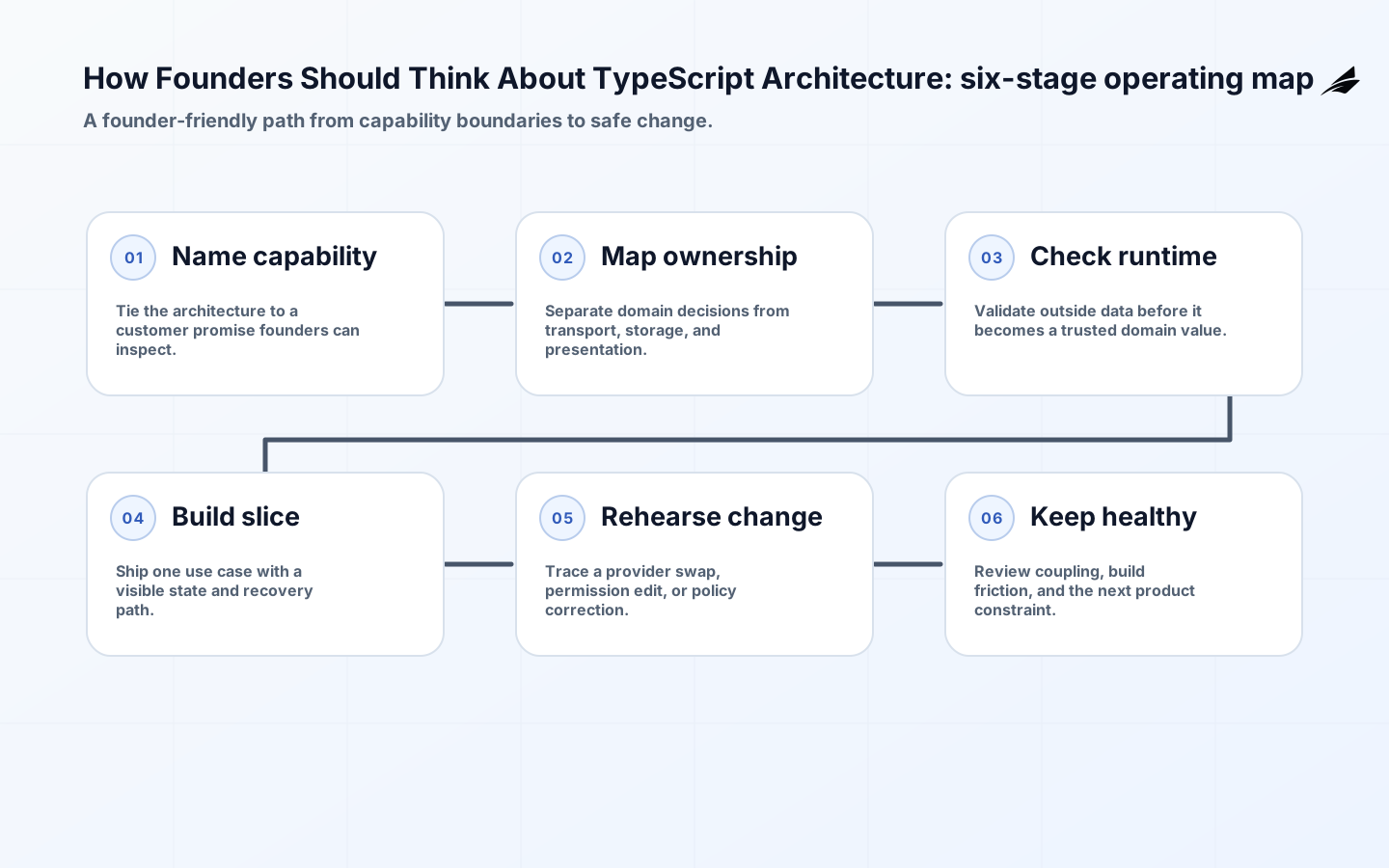
TypeScript architecture matters when a product has grown from a prototype into several customer-facing workflows, and every change now forces the founders to ask whether a type, API response, and database record still mean the same thing. This guide is for founders who need to use TypeScript architecture to make product boundaries and change costs visible without turning the codebase into a ceremony machine. The planning unit is a product capability expressed through stable domain names, explicit module boundaries, runtime validation, and a tested delivery path. For founder-led TypeScript architecture, that framing keeps the work tied to a decision people can inspect, rather than to a tool purchase or a collection of isolated tickets.
Start with the founder operating decision
Founders do not need to choose a fashionable folder structure. They need a TypeScript architecture that lets the team change a customer promise without guessing which module owns it. Start with the language in contracts, support conversations, and product decisions: subscription, approval, shipment, entitlement, invoice. Those terms are candidates for capability boundaries because they give engineers and non-engineers a shared way to decide whether a change belongs together.
| Question | Working rule | Evidence to collect |
|---|---|---|
| Outcome | Name the decision or task that must improve. | a product has grown from a prototype into several customer-facing workflows, and every change now forces the founders to ask whether a type, API response, and database record still mean the same thing |
| Authority | Identify who owns the fact and who may change it. | a product capability expressed through stable domain names, explicit module boundaries, runtime validation, and a tested delivery path |
| Risk | Describe the costly failure before selecting technology. | treating compiler success as proof that an integration, stored record, or customer input is valid at runtime |
| Measure | Choose a signal that can change the next investment decision. | time to change a business rule, type errors found before review, runtime validation failures, dependency direction violations, and onboarding time |
Map TypeScript boundaries and ownership
TypeScript helps describe intended shapes before code runs, but it does not validate data that crosses a network, comes from a database, or is supplied by a browser. Keep that distinction visible. Parse and validate at the edge, translate an external payload into a domain value, and let the core operate on the narrower representation. This avoids a common failure where an interface makes a third-party response look safe even though the provider can change it at any time.
For founder-led TypeScript architecture, map the path from request to outcome with the people who operate it. For founder-led TypeScript architecture, include entry points, systems of record, permissions, dependencies, handoffs, and the place where a person can correct an exception. For adjacent implementation concerns, read What Changes When Code Review Systems Move into Production, Test Strategy for Custom Software, and What Changes When Internal Tool Ux Moves into Production. For founder-led TypeScript architecture, these related guides help distinguish a local implementation choice from the wider delivery practices that keep a service understandable.
| Boundary | Decision to make | Operational check |
|---|---|---|
| Input | Define identity, required fields, and validation responsibility. | Can an invalid TypeScript architecture request be rejected with a useful reason? |
| Authority | State the source of truth and who can override it. | Can a reviewer explain which record or rule produced the TypeScript architecture result? |
| Change | Version behavior that clients, users, or operators rely on. | Can the team deploy a compatible change and observe its effect? |
| Recovery | Give failures an owner, reference, and safe next action. | Can support resolve a disputed case without an unsafe workaround? |
Design the first observable TypeScript slice
Use modules to control who can depend on what. The TypeScript modules documentation explains that module boundaries are created by imports and exports; apply that fact deliberately. A billing capability should not import a screen component to calculate a charge, and a screen should not query infrastructure directly merely because the import is convenient. Dependency direction is an architectural decision that can be reviewed in every change.
Types should clarify decisions, not reproduce every database column. Model a domain state when it prevents an invalid combination, such as an approved request with no approver or a paid invoice with no settlement reference. Discriminated unions are often more useful than a large optional object because they force callers to handle a real state transition. Keep persistence and transport representations separate when their constraints differ; the mapping is useful documentation of the boundary.
- Write one TypeScript architecture decision record with owner, boundary, and success condition.
- Collect ordinary, invalid, delayed, and contradictory examples before estimating broad scope.
- Assign an accountable operator for exceptions and a named escalation path.
- For founder-led TypeScript architecture, add correlation references that connect the user-visible outcome to supporting records.
- Test the recovery path as deliberately as the successful path.
- Review time to change a business rule, type errors found before review, runtime validation failures, dependency direction violations, and onboarding time after the first release before expanding the design.
Control TypeScript risk without blocking work
Choose a few conventions and make them boring. Decide how errors cross the application boundary, where runtime schemas live, how shared types are published, and which imports are forbidden. Avoid a generic “shared” directory that becomes a shortcut around ownership. A package or module earns reuse when it has a clear consumer set, versioning expectations, and tests that protect its public surface.
Use TypeScript guidance with local evidence
For founder-led TypeScript architecture, the design choices above should be checked against primary guidance and then tested against local constraints. Useful references include TypeScript handbook, TypeScript modules theory, Node.js TypeScript documentation, MDN JavaScript modules guide. For founder-led TypeScript architecture, these sources explain standards and supported behavior; they do not replace the organization’s own decision about owners, legal obligations, service targets, and user impact. In this TypeScript architecture context, turn the guidance into concrete configuration, review evidence, and runbooks that a team can use during a release or incident.
Measure founder-relevant architecture health
The build pipeline is part of the architecture. Compile settings must match the host that will load the emitted code; Node’s module rules and TypeScript’s resolution settings are operational facts, not polish. Run type checks, focused tests, and a production-like build in continuous integration. Then exercise one real deployment path so an import that satisfied the compiler does not fail because the runtime cannot resolve or interpret it.
Review architecture through change stories. Ask a developer to add a new policy, swap a provider, or correct a record from last month. Where must they touch? Which type makes a bad state impossible, and which boundary validates an outside claim? If the answer requires a tour of unrelated folders, make the next small refactor reduce that route. This is a practical investment in product speed, not an abstract code-style exercise.
Choose TypeScript boundaries founders can keep healthy
Founders usually do not need a grand TypeScript architecture on day one; they need boundaries that protect a small team from accidental coupling. Start by naming the product capabilities that change for different reasons—billing, identity, catalog, reporting, or workflow. Keep domain decisions in modules with clear inputs and outputs. A module boundary is doing useful work when a change can be reviewed without opening every directory in the repository.

Treat types as executable design decisions. A type that says “string” for an account identifier, currency, or permission is cheap at first but expensive when the system grows. Use named types or small value objects where confusion can cause a real defect. At an API edge, validate untrusted data before it enters the typed core; TypeScript’s compile-time guarantees do not inspect JSON received at runtime.
Choose a project layout that matches ownership. A feature-oriented structure often keeps routes, rules, tests, and adapters close enough for a small team to reason about together. A shared package should earn its place by reducing a genuine inconsistency; moving code into “common” because it is convenient creates a hidden dependency that every future change must negotiate. Review import direction as carefully as naming.
Build speed is a product constraint. Keep the default TypeScript configuration strict, but introduce stricter rules where they catch a known class of mistake and measure the feedback cost. Separate application compilation from declaration generation and test execution when that makes failures easier to diagnose. A ten-second local check that runs on every edit is often more valuable than a broad pipeline that developers learn to ignore.
As the company grows, architecture must answer operational questions: who owns a package, what is safe to expose, how is a breaking change announced, and how is a dependency upgraded? Record those answers in package metadata and review them during releases. The goal is not perfect taxonomy; it is a codebase where a new engineer can predict the impact of a change and recover from a bad assumption.
| Decision | Prefer | Reason |
|---|---|---|
| Domain model | Named types plus invariants | Prevents ambiguous primitives |
| API input | Runtime schema validation | Typed code receives checked data |
| Shared code | Small stable packages | Limits invisible coupling |
| Build layout | Fast local checks, staged CI | Preserves feedback while scaling |
Key takeaways
- TypeScript architecture should begin with a real operational decision, not an abstract technology preference.
- Use a product capability expressed through stable domain names, explicit module boundaries, runtime validation, and a tested delivery path as the unit of planning and review.
- Make authority, change behavior, and recovery visible before scaling a design.
- For founder-led TypeScript architecture, use authoritative guidance as an input, then validate the result with representative local cases.
- Let time to change a business rule, type errors found before review, runtime validation failures, dependency direction violations, and onboarding time determine whether the next increment is justified.
Frequently asked questions
What is the smallest useful scope for TypeScript architecture? For founder-led TypeScript architecture, start with one consequential path that has a clear product outcome, a bounded set of records, and a recovery route a founder can inspect. This first TypeScript release should prove ownership and behavior under normal and uncomfortable cases. It does not need to centralize every adjacent process.
When should a person intervene? A maintainer should review a TypeScript boundary when runtime data does not fit the intended type, a dependency direction is broken, or a type model conceals a product state. The review should clarify the contract, not patch an assertion over uncertainty.
How do we know the design is ready to expand? Broaden the TypeScript architecture after a capability can change without unrelated imports, untrusted boundaries are validated, and the build behaves in its actual runtime. More packages are not evidence of a better architecture.
Conclusion
TypeScript architecture becomes a durable advantage when the team designs the decision, authority, evidence, and recovery path together. When a product grows from a prototype into several customer-facing workflows, every change can force founders to ask whether a type, API response, and database record still mean the same thing. Keep the first change narrow enough to observe, and use real operating signals to guide the next investment. For founder-led TypeScript architecture, that is how a technical choice becomes a service people can trust.
For a related decision, compare this approach with What Changes When Code Review Systems Move into Production, Test Strategy for Custom Software: A Practical Guide, What Changes When Internal Tool Ux Moves into Production. For founder-led TypeScript architecture, each adjacent article treats a different boundary; use the links to test whether the same ownership, evidence, and recovery expectations hold in the surrounding system.
How Founders Should Think About TypeScript Architecture FAQ
What is the first decision for how founders should think about typescript architecture?
For how founders should think about typescript architecture, begin by naming the user or operational outcome, the accountable owner, and the evidence that will show whether the outcome is safe. For founder-led TypeScript architecture, that boundary determines the smallest useful first implementation and gives the team a shared test for scope.
How should a team handle failure in how founders should think about typescript architecture?
In how founders should think about typescript architecture, classify each failure by its next safe action: correct, retry, reconcile, escalate, or stop. For founder-led TypeScript architecture, preserve state and a correlation record so a person does not guess whether the first attempt took effect, especially when the boundary can create an external side effect.
When is the implementation ready to expand?
Expand how founders should think about typescript architecture after a representative path works with realistic data, known exceptions, observable ownership, and a rehearsed recovery. For founder-led TypeScript architecture, a larger rollout should add confidence, not conceal unresolved ambiguity in a wider queue.
Conclusion: operate how founders should think about typescript architecture with evidence
The durable version of how founders should think about typescript architecture is not the one with the most components. For founder-led TypeScript architecture, it is the one whose promise is explicit, whose boundaries are understandable, whose failure states preserve a safe next action, and whose evidence reaches the people responsible for the result. For founder-led TypeScript architecture, start with one complete path, measure what users and operators actually experience, and let observed risk decide where the next investment belongs.