For Technical debt, Technical debt is not a synonym for old code or an invoice that engineering must eventually pay. For technical debt, It is the accumulated cost of a decision that made sense under one set of constraints but now makes a valuable change slower, riskier, or harder to understand. For technical debt, Founders need a way to distinguish an intentional shortcut from a neglected liability, because both can look like a backlog item until a customer request, security patch, or hiring plan exposes the difference. For technical debt, This practical guide frames technical debt as a production decision: make the boundary visible, choose controls that fit the risk, and keep enough evidence to revise the approach when real use contradicts the plan. For technical debt, This article uses TechnicalDebt Accelerate State of DevOps Report NIST Secure Software Development Framework OWASP Dependency-Check to ground the decisions in topic-specific primary guidance. Sources and related decisions: schema design contract thinking delivery checklist.
Tie debt to a measurable business cost

For Technical debt, Start by tracing a business capability, not by counting planned follow-up comments. For technical debt, A debt item is worth attention when it impairs a journey the company depends on: pricing changes take weeks because rules are duplicated, support cannot explain an outcome because the event trail is incomplete, or a release relies on one person remembering an undocumented sequence. For technical debt, Martin Fowler separates intentional borrowing from the broader metaphor; that distinction is useful because an explicit trade can be reviewed while an invisible compromise quietly changes the cost of every future decision.
| Situation | Decision to make | Evidence to keep |
|---|---|---|
| Hidden rule | A pricing or eligibility decision exists in several places | Name one policy owner and test its callers |
| Fragile dependency | A patch cannot be applied without broad regression fear | Upgrade behind contract and integration tests |
| For a recurring pricing mismatch, name the cost, affected workflow, repair owner, and evidence of improvement. | Staff reconcile the same mismatch each week | Instrument the exception and repair its cause |
| Knowledge bottleneck | One person controls a release or production fix | Document and rehearse the handoff |
Rank constraints by leverage
For Technical debt, Classify each candidate by the capability it constrains, the failure it could cause, and the next likely change. For technical debt, Then compare it with product work using the same evidence: revenue at risk, customer harm, delivery delay, security exposure, and recoverability. For technical debt, Avoid a single debt score that hides the trade-offs. For technical debt, A brittle authentication library, an unowned deployment script, and a duplicated UI component demand different controls and should not compete through a cosmetic number.
- Which user or business outcome is technical debt expected to improve, and how will the team recognize success?
- State the user outcome the debt repair should improve and the measure that would prove it.
- Record the constrained boundary that makes this outcome slow, fragile, or expensive today.
- Name the authority that should own the rule once duplicated behavior is removed.
- Choose one bounded repayment slice with a compatibility check and a defined stop condition.
- Compare the repair with competing product work using delay, risk, and customer impact evidence.
Protect compatibility while changing internals
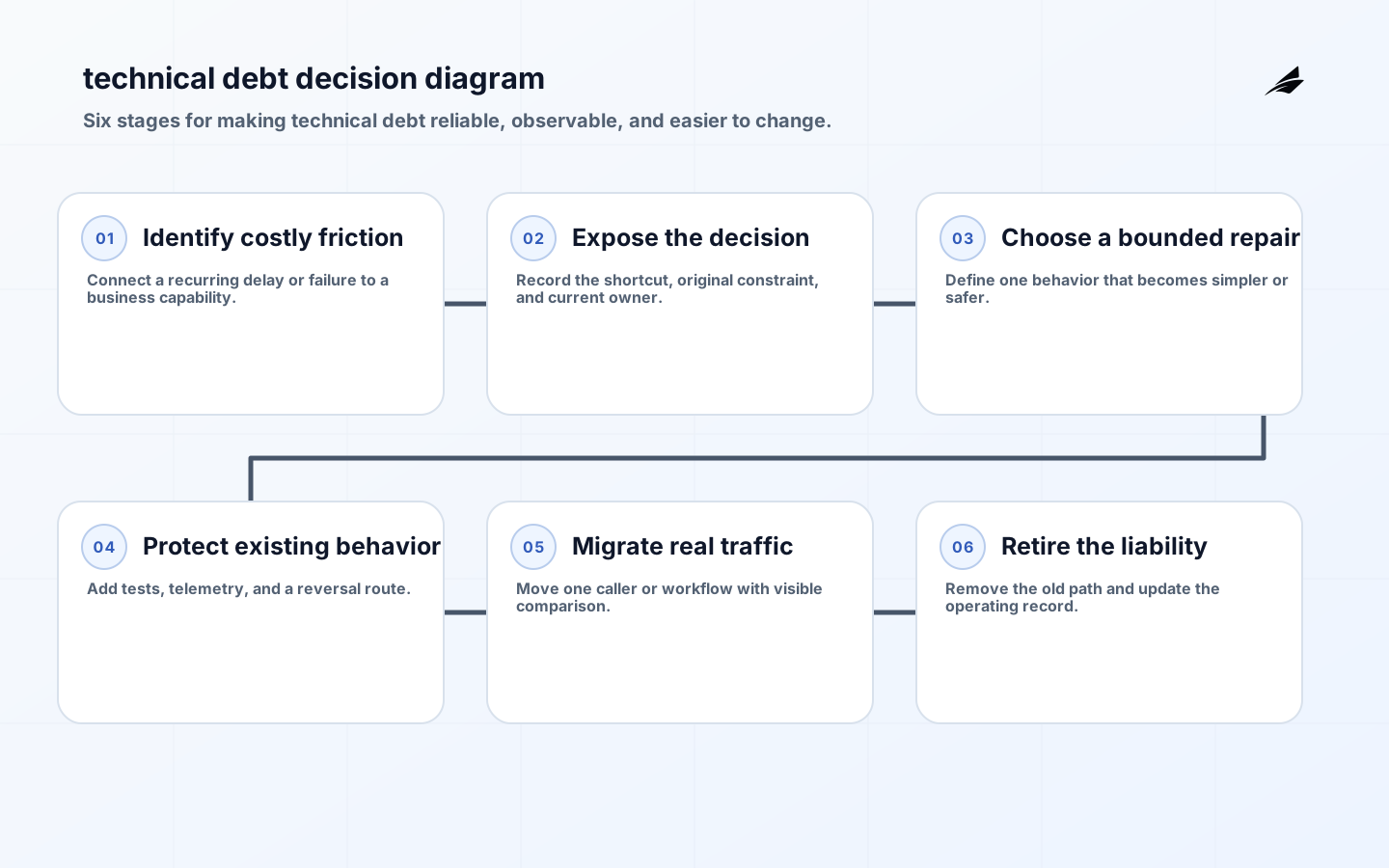
For Technical debt, Turn the chosen item into a small outcome with an observable before-and-after measure. For technical debt, For example, replace a manually copied entitlement rule with one owned policy module, add contract tests around it, migrate one caller, and prove that an approved change no longer needs a coordinated edit in three places. For technical debt, Keep the old path reversible until the new behavior has been exercised under normal load and an abnormal case. For technical debt, This is how debt reduction improves delivery rather than becoming a vague cleanup season.
| Failure pattern | Why it harms the workflow | Control to introduce |
|---|---|---|
| Rewrite without evidence | The new system repeats unknown rules | Modernize the constrained workflow first |
| Backlog theater | Items have labels but no accountable service | Link each item to a capability owner |
| Unsafe cleanup | Behavior changes without a comparison path | Use feature flags or parallel checks |
| Metric blindness | Work ships without proof of reduced friction | Track the pre-agreed operational signal |
Fund a bounded repayment slice
For Technical debt, A debt register is useful only when it joins ordinary planning. For technical debt, Review it beside incidents, missed estimates, accessibility defects, dependency alerts, and customer escalations. For technical debt, Tag an item to the service owner and architecture decision that created it; retire the record when the behavior, documentation, and alerting are all changed. For technical debt, The NIST Secure Software Development Framework is a helpful reminder that secure practices belong throughout development, not in a late audit.
Track drag after the change
For Technical debt, The common failure is announcing a large rewrite as the answer to technical debt before proving where the existing system blocks value. For technical debt, Rewrites reset learned edge cases, postpone user-visible improvement, and can recreate the same ownership gaps in a newer stack. For technical debt, A safer approach keeps the critical behavior covered, changes one boundary at a time, and gives operations a way to compare outcomes.
- Use a production-like record with a valid, invalid, delayed, and conflicting scenario.
- Run a representative valid case before adding edge cases to the debt repayment review.
- Exercise an invalid input and record whether the system rejects it without creating a second inconsistency.
- Delay a dependency and confirm that the repair exposes ownership, timeout behavior, and recovery.
- Introduce conflicting data and verify that the authoritative rule and correction path remain visible.
- Document the rollback or correction path before traffic is expanded.
Technical debt: operating evidence
For Technical debt, Watch lead time for a change in the affected capability, failed-change rate, time spent on manual reconciliation, and the Age of exceptions that need specialist intervention. For technical debt, Also watch concentration of knowledge: a service that only one engineer can safely modify is a business risk even when its latency dashboard looks healthy.
Technical debt: operating evidence
For Technical debt, A useful technical-debt review begins with evidence from the people closest to the friction. For technical debt, Ask support for the repeated workaround, finance for the delayed business change, and engineers for the dependency or boundary that makes the change unsafe. For technical debt, Put those observations next to traces, incident notes, and delivery history. For technical debt, The review should produce a decision record with the original shortcut, the present cost, the capability owner, and the narrow repair hypothesis. For technical debt, That record lets a founder challenge the priority without dismissing the operational evidence behind it.
For Technical debt, Acceptance should be behavior-based. For technical debt, If the aim is to remove a duplicated pricing rule, the team should demonstrate one authoritative calculation, a controlled migration of callers, an audit trail for the policy version, and a faster path for the next approved price change. For technical debt, If the aim is to replace a brittle job, demonstrate a failed dependency, the alert and owner who see it, and recovery without duplicate effects. For technical debt, Code cleanup that cannot state its expected operating improvement may be valuable, but it is not yet a prioritized debt investment.
For Technical debt, Fund recurring debt reduction as capacity attached to outcomes, then reserve larger work for constraints that cross service boundaries or materially change risk. For technical debt, This prevents the register from becoming a list of well-intentioned chores. For technical debt, It also gives leadership a truthful choice: accept a known cost for a period, reduce it through a bounded change, or redesign the capability because the underlying model no longer fits the business.
Key takeaways for founders
- Technical Debt should be owned as a business and operational decision, not an isolated framework task.
- Define authority, failure behavior, and acceptance evidence before expanding the implementation.
- Treat technical debt as a business and operational tradeoff with an accountable owner.
- Define authority, failure behavior, and acceptance evidence before expanding the implementation.
- Use a representative change to test whether the repayment reduces drag without hiding new risk.
Technical Debt FAQ
This technical debt case requires a distinct owner, evidence trail, and correction route.
- Ask whether this debt item changes a user workflow, a reliability risk, or only internal taste.
- Choose a rewrite only when bounded migration evidence shows that smaller repairs cannot restore safe change.
- Record the next review signal, owner, and rollback trigger before committing more capacity.
Conclusion: make technical debt easier to change and trust
Technical debt: operating evidence
For Technical debt, For How Founders Should Think About Technical Debt, keep the decision boundary visible in the runbook and connect each exception to an owner, evidence trail, and recovery action. For technical debt, Review the result with the people who use the workflow, then change scope only when the measured outcome supports it.
Audit the affected capability’s current delay, owner, and authoritative record before choosing a repayment slice.
If duplication causes mismatched pricing or access, centralize the rule and prove equivalent outputs with representative cases.
Where a boundary creates review rework, measure the touched components and preserve a contract test during refactoring.
For dependency drag, record the failed change pattern, the recovery action, and the signal that shows improvement.
A repayment plan should state what remains shared, what can migrate, and which compatibility condition pauses the rollout.
Give support and operations a visible correction route when the repaired path encounters an unfamiliar exception.
Tie capacity to a measurable reduction in lead time, incident frequency, reconciliation effort, or customer risk.
Review the debt item with product, support, and engineering so its cost is not reduced to code age.
Use a canary or bounded cohort when shared behavior changes, and compare results with the previous path.
Retire the old seam only after evidence shows traffic, callers, and recovery procedures have moved safely.
Update the debt register with the outcome, residual risk, owner, and next review date.
Escalate a repair when its blast radius crosses a service or tenant boundary that the team cannot observe.
Close the loop by checking whether the original user or operator friction actually declined after release.
Technical debt: operating evidence