Database schema design is the discipline of making business facts durable, constrained, queryable, and changeable without turning every release into a data-repair project. Engineering teams should resist both extremes: a schema that mirrors a UI so closely it cannot express history, and an unstructured collection of fields that pushes integrity work into every application caller. This practical guide frames database schema design as a production decision: make the boundary visible, choose controls that fit the risk, and keep enough evidence to revise the approach when real use contradicts the plan.
Set the database schema design boundary

Begin with the facts the business must be able to prove over time. Name identities, relationships, lifecycle states, and the event or policy that authorizes a change. Decide which facts are immutable, which are corrections, and which are derived for read performance. Database constraints are not a substitute for application rules, but the PostgreSQL documentation on constraints shows why they are valuable as a final line of defense for uniqueness, references, and permitted values.
| Situation | Decision to make | Evidence to keep |
|---|---|---|
| Natural business value | An email or code can change | Use a stable surrogate identifier and unique constraint |
| Many-to-many relation | Records can have several scoped memberships | Use an explicit join with authority and dates |
| Derived reporting value | A read needs a calculated summary | Materialize only with a defined refresh owner |
| New required field | Existing rows lack the value | Add nullable, backfill, verify, then enforce |
Make the critical database schema design decisions explicit
Model for the invariants and query paths that matter now, while leaving room to evolve. Normalization reduces conflicting copies of facts; selective denormalization can be justified when a measured read path needs it and the write or refresh rule is explicit. Treat identifiers as durable contracts, avoid encoding mutable business meaning into a primary key, and be explicit about tenant and ownership scope. Choose indexes from observed access patterns, not from a hunch that every column should be indexed.
- Which user or business outcome is database schema design expected to improve, and how will the team recognize success?
- Production schema work should verify ownership evidence.
- Production schema work should verify dependency direction.
- Production schema work should verify release cadence.
- Production schema work should verify affected-target tests.
- Production schema work should verify package visibility.
Deliver a small, testable database schema design slice
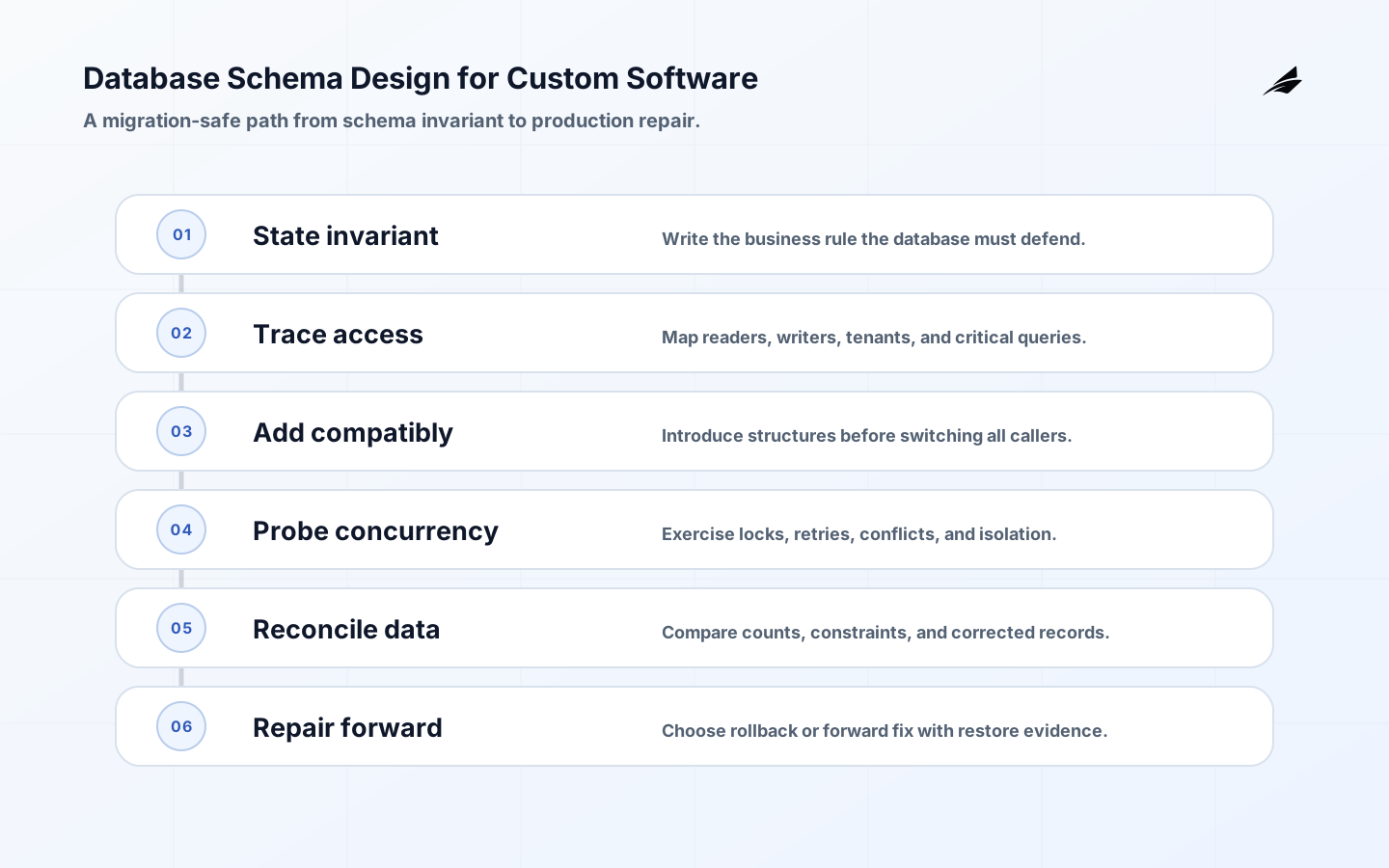
Make schema migration a release capability. Add new structures compatibly, backfill in observable batches, deploy readers that understand both shapes during transition, then remove the old path only after verification. Wrap multi-row business changes in transactions with a chosen isolation expectation, and test concurrent updates as well as a clean empty database. Review query plans and lock behavior using production-like data sizes before declaring an index or migration safe.
| Failure pattern | Why it harms the workflow | Control to introduce |
|---|---|---|
| Application-only integrity | Scripts create invalid combinations | Add database constraints for enduring truths |
| Premature index | Write cost grows without read benefit | Measure query plans and workload |
| Destructive migration | Old code and new schema collide | Use expand-and-contract releases |
| Hidden tenant scope | Queries cross organizational boundaries | Encode and test scope in keys and access paths |
Operate database schema design as a living capability
The operating record should connect a slow query or integrity exception to the schema decision behind it. Monitor migration duration, lock waits, failed constraints, replication or queue lag where applicable, query latency by pattern, and storage growth. The PostgreSQL index documentation is a useful grounding for index trade-offs: indexes can accelerate reads while adding write work and maintenance cost. For multi-step changes, PostgreSQL transaction documentation clarifies how atomic work should be framed, while PostgreSQL backup documentation grounds restore planning.
Review schema risk before it becomes repair work
The familiar failure is treating the database as a passive bucket and enforcing every invariant only in one application path. Imports, scripts, future services, and operator tools then create combinations the original UI never allowed. The opposite failure is forcing a changing workflow into rigid columns with no migration plan. Good design uses constraints for enduring truths and an explicit evolution path for changing policy.
- Production schema work should verify contract versioning.
- Production schema work should verify migration checkpoints.
- Production schema work should verify rollback evidence.
- Production schema work should verify review scope.
- Production schema work should verify build cache behavior.
- Document the rollback or correction path before traffic is expanded.
Measure whether database schema design reduces friction
Watch constraint violations, duplicate-record merges, migration rollback frequency, slow-query percentiles, lock wait time, backfill completion, and data-reconciliation findings. Review the highest-cost queries with the product path they support; a fast query that returns the wrong authority or hides a tenant boundary is not a success.
Prepare a production rollout for database schema design
Schema discovery should include the questions a future incident will ask: which account owned this fact at the time, which policy created it, what was corrected, and how can duplicate or conflicting records be resolved? Model the answers before selecting column names. An event history is not required for every table, but operations should not have to infer a consequential decision from the current value after the previous value and actor have been erased.
Acceptance for a schema change means more than applying it on an empty test database. Rehearse the migration against realistic volume, inspect query plans for the old and new access paths, introduce a conflicting concurrent update, and rehearse a rollback or forward repair. Verify backups and restore procedures when the change affects material records. A migration that completes quickly in development can still lock a production table or violate an assumption in a background job.
Document data ownership beside the schema and access code. When several services read or write a relation, name the system that creates it, which updates are allowed elsewhere, and how synchronization failures are reconciled. This turns the schema from a private implementation detail into a dependable boundary for product, analytics, operations, and future services.
Data design also benefits from a lightweight stewardship review. For material entities, confirm the definition, owner, retention need, quality checks, and correction process with the business team that relies on the data. This review catches semantic drift that SQL constraints cannot see, such as a status value used differently by two departments. It keeps reporting and integrations grounded in an agreed meaning while leaving the schema change process deliberate and testable.
Key takeaways for engineering teams
- Database Schema Design should be owned as a business and operational decision, not an isolated framework task.
- Define authority, failure behavior, and acceptance evidence before expanding the implementation.
- Production schema work should verify cycle detection.
- Production schema work should verify deprecation timing.
- Production schema work should verify toolchain pinning.
Database Schema Design FAQ
What should the first database schema design review decide? Production schema work should verify dependency direction. How much design is enough? Production schema work should verify release cadence.
- When should a team revisit database schema design? Production schema work should verify public API boundaries.
- Should every edge case block the first release? No. Production schema work should verify exception expiry.
- Who owns the decision? Production schema work should verify package stewardship.
Conclusion: make database schema design easier to change and trust
Further reading can broaden the production discussion, but the schema decision remains local to its facts, invariants, access paths, and migration evidence. Review modernization, quality assurance, and support practices only when they explain a concrete data risk.
Set invariants before columns
For custom software, the schema is an operational contract between product behavior, jobs, reports and integrations. Name the invariant before choosing the column: one invoice has one customer, a shipment cannot be delivered before it is dispatched, and a tenant cannot read another tenant’s records. Then decide which part belongs in a constraint, a transaction, an authorization policy or a scheduled reconciliation. This separation keeps one mechanism from carrying responsibilities it cannot prove.
| Decision | Choose first when | Evidence to keep |
|---|---|---|
| Boundary | The outcome has one accountable owner. | Named owner, input and success condition. |
| Fallback | A dependency can be slow, unavailable or wrong. | Visible state, retry rule and escalation path. |
| Change | The system will learn or scale after launch. | Migration, review cadence and stop condition. |
Budget migration and query overhead
Production data needs a lifecycle. Mark whether a record is active, superseded, cancelled or archived, and define who can make each transition. Avoid using deletion as a substitute for a business event when auditability matters. For sensitive corrections, keep the original event and record the correcting action, actor and reason. This makes support conversations and incident reviews concrete without forcing every read query to understand a complicated history model.
Indexing is a workload decision. Capture the endpoint or job that needs an access path, expected cardinality, sort order and write frequency. A composite index should reflect the leftmost filters used by the query, and a partial index can be appropriate when a small active subset dominates reads. Re-check plans after realistic growth and after a new report is introduced. An index catalogue with owners prevent a production database from becoming a museum of abandoned guesses.
Prove schema changes are reversible
Migrations should be staged around compatibility. Deploy readers that tolerate the old and new shapes, add or backfill data in bounded work, switch writers, verify counts and only then remove obsolete structures. Lock duration, replica lag, rollback behavior and backup restore time belong in the release plan. Treat a migration as a product change with observable checkpoints, not as a SQL file that is safe merely because it ran once on a development database.
| Signal | Healthy question | Action when it drifts |
|---|---|---|
| Outcome | Did the intended business result happen? | Inspect examples and pause unsafe scope. |
| Reliability | Can the path recover from delay or duplication? | Use retry, replay or manual review controls. |
| Ownership | Can a named person explain the current state? | Route the exception and update the runbook. |
For production schema work, connect the first principles in the founder schema guide to live-traffic migration practice and technical-debt risk. Together they cover ownership, rollout pressure, and the cost of leaving a data shortcut in place.
A production schema is credible when its invariants, migration checkpoints, query evidence, and repair path are all testable. Expand the model only after a representative workload shows that the new structure protects the workflow it serves.